
Iceland has no passenger rail, but public transport connects towns right around the coast. The regional bus network lets you complete the entire Ring Road, domestic flights link regional centres from central Reykjavík, four state-supported ferries serve offshore islands, and specialised highland coaches reach interior trails each summer.
The short version
According to Visit Iceland: public transport, there are no trains in Iceland, but you can get around by bus, ferry or plane. There is no hop-on, hop-off bus pass that covers the whole island.
The public bus network is extensive and makes it possible to travel the whole circle of the country. If you follow an Iceland Ring Road itinerary using public transport, planning is essential, particularly in winter between November and March.
From Keflavík Airport
International arrivals touch down at Keflavík International Airport. To reach the capital, two main bus services operate from the terminal. If you decide against public transport, you can review rules for driving in Iceland instead.
Flybus
Flybus coaches operate from Keflavík directly to central Reykjavík. Flybus departures are timed to every arriving flight, day and night, and a ticket bought from the airport remains valid on the next available coach if your flight is delayed.
Every Flybus coach ends at the BSÍ bus terminal (BSÍ, Bifreiðastöð Íslands, the main coach station), located at Vatnsmýrarvegur 10, roughly 1 km from the city centre. Fares list an adult ticket at 3,999 ISK to BSÍ and 5,299 ISK with hotel drop-off included. Youths aged 6 to 15 pay 1,999 ISK to BSÍ and 2,649 ISK with hotel drop-off. Children aged 1 to 5 travel free. You can read a complete breakdown of transfers on our guide to Keflavík Airport to Reykjavík.
Strætó route 55
Strætó runs route 55 between the capital area and Keflavík Airport every day of the week. Unlike the private airport coach, Isavia's airport guide notes that Strætó does not run in coordination with flight schedules.
Strætó lists the route 55 adult fare at 1,800 ISK to or from Fjörður in Hafnarfjörður, and 2,400 ISK to or from Garðabær and Reykjavík. Passengers aged 12 to 17 and people aged 67 and over pay 900 ISK to Hafnarfjörður and 1,200 ISK to Garðabær or Reykjavík. Children aged 11 and under travel free. You can pay your fare by debit or credit card, or in cash.
In Reykjavík
Strætó buses in the capital are yellow. The agency operates city lines as well as countryside connections. Its website provides timetables and a route planner, and ticketing is managed through its smartphone app, Klapp.
An adult single fare on Strætó buses in the capital area is 690 kr., the same when you pay contactless with a card or phone. If you purchase a Reykjavík City Card, it provides free unlimited travel on Strætó services within the capital area. However, the City Card does not cover route 55 to Keflavík Airport. For more details on city transit and museum admissions, see our guide to the Reykjavík City Card.
Strætó's country buses: the routes that matter
Iceland's regional buses are owned and operated by the Icelandic Road and Coastal Administration (Vegagerðin, IRCA), with Strætó providing information and passenger services. On countryside journeys, you pay on board the bus using a debit or credit card, in cash, or with a regional bus card. Timetables differ between summer and winter, so you must confirm active schedules when mapping your route.
Key regional lines include:
- Between Reykjavík and the north: Route 57 runs between Akureyri and Reykjavík.
- Along the south coast: Route 51 runs between Selfoss and Reykjavík. Route 52 runs between Höfn and Reykjavík, stopping at Hvolsvöllur, Skógar, and Vík (Vík í Mýrdal). Route 53 runs between Selfoss and Landeyjahöfn or Hvolsvöllur.
- In the west: Route 50 runs between Akranes or Borgarnes and Reykjavík. Route 58 links Stykkishólmur and Borgarnes. Route 82 connects Hellissandur and Stykkishólmur. Route 59 runs between Borgarnes and Hólmavík.
- From Akureyri: Route 56 runs to Egilsstaðir, route 78 to Siglufjörður, and route 79 to Húsavík.
- In the east: Route 93 runs between Seyðisfjörður and Egilsstaðir, and route 94 runs between Djúpivogur and Höfn.
- In the Westfjords: Strætó route 62 runs only during the summer season.
In addition to Strætó's trunk lines, local bus networks operate in the east and across the Westfjords.
Domestic flights
Reykjavík City Airport is Iceland's primary hub for domestic flights, maintaining only limited international services. The domestic airfield is situated directly next door to the BSÍ terminal in Reykjavík, completely separate from Keflavík International Airport. Local bus companies link most regional airports to surrounding towns.
Regional carrier Norlandair, based at Akureyri Airport, operates scheduled flights serving:
- Akureyri
- Bíldudalur
- Gjögur
- Grímsey
- Reykjavík
- Þórshöfn
- Vestmannaeyjar
- Vopnafjörður
- Nerlerit Inaat (Greenland)
Icelandair handles passenger check-in for Norlandair flights at Reykjavík and Akureyri airports. Check-in is 30 minutes before departure.
Ferries: the Westman Islands, the Westfjords, Grímsey and Hrísey
The Icelandic Road and Coastal Administration subsidises and oversees four primary ferries:
- Herjólfur, connecting the mainland with the Westman Islands (Vestmannaeyjar), carrying both passengers and vehicles.
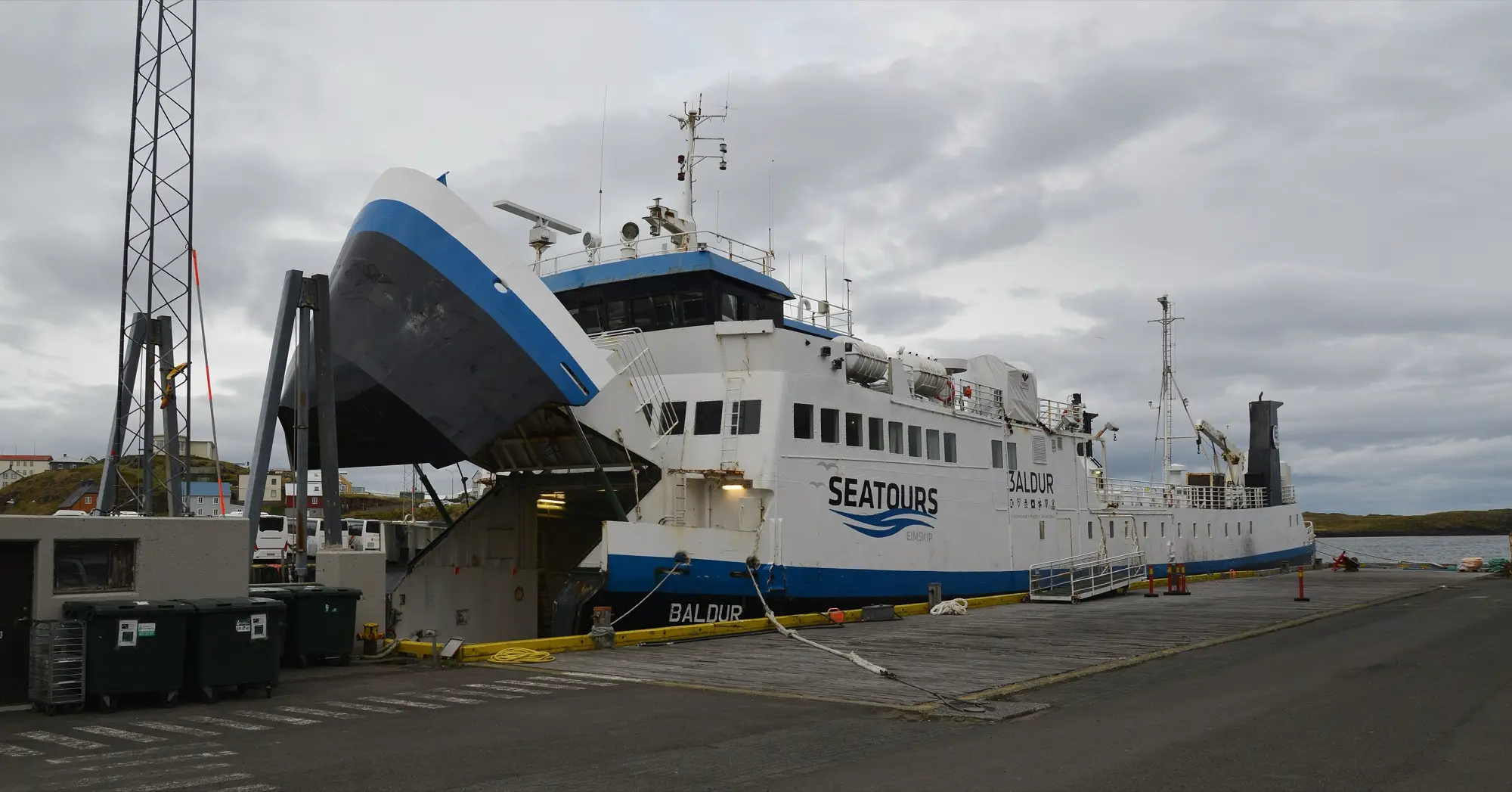
- Baldur, operated by Seatours (Eimskip), carrying passengers and cars between Stykkishólmur, Flatey and Brjánslækur across Breiðafjörður.
- Sæfari, sailing between Dalvík and the island of Grímsey.
- Sævar, sailing between Árskógssandur and Hrísey.
In winter, the vessel Björgvin carries passengers and freight between Mjóifjörður and Neskaupstaður.
The Herjólfur ferry to the Westman Islands
Herjólfur departs from the harbour at Landeyjahöfn on the south coast. You can reach Landeyjahöfn by standard passenger car with no four-wheel drive required, or by boarding a public bus from the Mjódd bus exchange in Reykjavík. Strætó coordinates route 53 trips directly with Herjólfur arrivals and departures at Landeyjahöfn. During bad weather or heavy sand buildup, the ferry diverts to Þorlákshöfn instead; whenever Landeyjahöfn closes, route 53 travels no further than Hvolsvöllur.
Passengers must check in no later than 30 minutes before departure. Tickets are scanned prior to boarding, and boarding access closes five minutes before departure. Herjólfur's schedule lists departures every day from Vestmannaeyjar at 07:00, 09:30, 12:00, 14:30, 17:00, 19:30 and 22:00. Daily sailings from Landeyjahöfn leave at 08:15, 10:45, 13:15, 15:45, 18:15, 20:45 and 23:15.
According to Visit Iceland, a one-way adult passenger fare is 2,700 ISK, with an additional 4,050 ISK each way for a car. Herjólfur's 2026 price list states that children under 12 travel free. Further details on visiting the archipelago can be found in our guide to the Westman Islands.
The Baldur ferry to the Westfjords
Seatours operates the ferry Baldur year-round between Stykkishólmur and Brjánslækur in the Westfjords, stopping en route at the island of Flatey.
Highland buses in summer: Þórsmörk and Landmannalaugar
During the summer months, dedicated highland buses and hikers' passes grant access to interior nature reserves.
Trex accepts bookings for travel from 18 June to 5 September 2027, pricing its daily highland bus services from Reykjavík to Þórsmörk and Landmannalaugar at ISK 15,900. Trex notes that travellers visit Landmannalaugar from June through late September, after which the access road closes.
Reykjavik Excursions publishes set timetables for its 2027 Highland Bus services:
- Route HB01 (Þórsmörk): Runs from 11 June to 15 September 2027. Departs BSÍ in Reykjavík at 07:00, reaching Básar in Þórsmörk at 11:15. The return service leaves Básar at 15:00 and arrives back at BSÍ at 19:30.
- Route HB02 (Landmannalaugar): Runs from 18 June to 12 September 2027. Departs BSÍ at 07:00, reaching Landmannalaugar at 11:30. The return coach departs Landmannalaugar at 15:45 and arrives at BSÍ at 20:20.
Tours and sharing a ride
Where scheduled public bus timetables do not suit your plan, private companies run excursions, scheduled tours and day trips out of Reykjavík.
Ride sharing is also common across Iceland. Drivers and prospective passengers coordinate trips via samferda.is, where users offer and request lifts at their own risk.