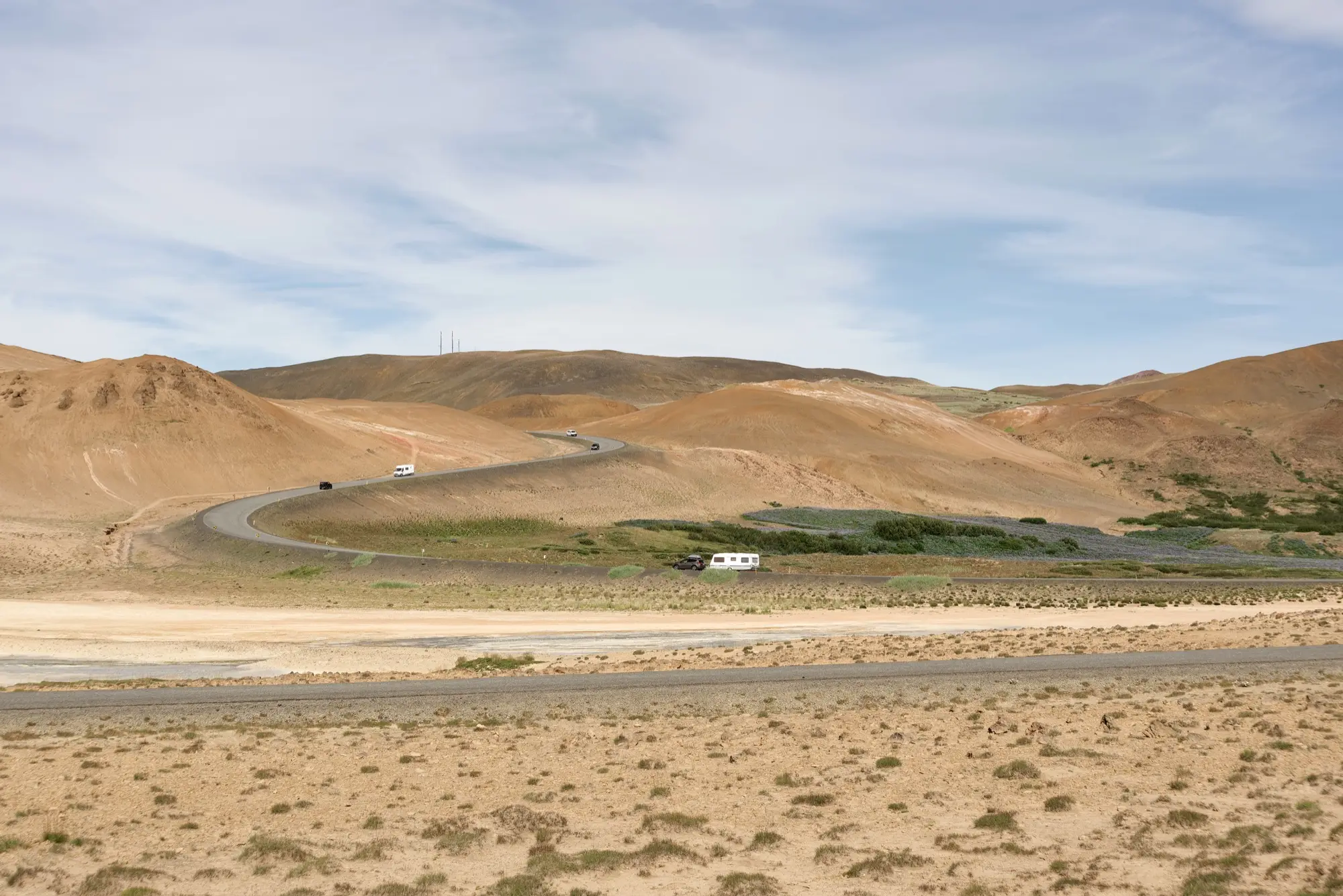

The standard speed limit in Iceland is 50 km/h in urban areas, 80 km/h on rural gravel roads, and 90 km/h on rural paved roads, unless signs state otherwise. Headlights and rear lights must remain on at all times, seat belts are mandatory for everyone, and off-road driving is completely banned. A blood alcohol level of 0.2‰ makes you unfit to drive, and you must never hold a mobile phone while driving.
The rules that catch visitors out
The speed limit is 50 km/h in urban areas, 80 km/h on rural gravel roads and 90 km/h on rural paved roads, unless road signs say otherwise. Headlights and taillights must be on at all times, all year round. Safetravel says a car's automatic light setting might not be enough, because in many cases it does not turn on the rear lights.
The driver and all passengers must wear a seat belt, wherever they sit in the vehicle. Children under 135 cm must use a car seat that fits their age, height and weight. Safetravel puts the blood alcohol limit at 0.2‰ and says this means you cannot drive even after one alcoholic drink. Using a phone or tablet while driving is illegal and can bring heavy fines. Travellers who prefer not to drive can look at Iceland without a car.
Off-road driving is strictly forbidden; F-roads (fjallvegir, mountain roads) and gravel roads are not off-road driving, but leaving them is. Safetravel says not to stop in the middle or at the side of the road for photos, even when spotting scenery or looking for the northern lights, but to find a safe spot off the road instead.
Speed limits and the speeding fine schedule
The police list the common limits as 30 to 50 km/h in built-up areas, 80 km/h on gravel roads and 90 km/h on paved roads outside built-up areas, and say drivers must always adapt their speed to conditions. Safetravel says the speed limit applies to the best conditions, and in winter conditions are seldom that good. Automatic speed cameras stand around the country where speeding and accidents are a risk, and the notice of a camera fine is sent to the vehicle's registered owner.
Traffic fines are set by Regulation no. 1240/2019 on fines for traffic offences, and its speeding table gives each fine in thousands of krónur and each loss of licence in months. This is the official fine schedule as published in November 2026.
Where the limit is 90 km/h:
- 96 to 100 km/h: 20 thousand krónur
- 101 to 110 km/h: 50 thousand krónur
- 111 to 120 km/h: 80 thousand krónur
- 121 to 130 km/h: 120 thousand krónur
- 131 to 140 km/h: 150 thousand krónur
- 141 to 150 km/h: 210 thousand krónur and 1 month without a licence
Where the limit is 80 km/h, such as on rural gravel roads:
- 86 to 90 km/h: 20 thousand krónur
- 91 to 95 km/h: 30 thousand krónur
- 96 to 100 km/h: 50 thousand krónur
- 101 to 110 km/h: 80 thousand krónur
- 111 to 120 km/h: 100 thousand krónur
Where the limit is 50 km/h:
- 56 to 60 km/h: 10 thousand krónur
- 61 to 65 km/h: 20 thousand krónur
- 66 to 70 km/h: 30 thousand krónur
- 71 to 75 km/h: 40 thousand krónur
- 101 to 110 km/h: 150 thousand krónur and 3 months without a licence
Speeding fines carry a 20% surcharge for a car of 3.5 tonnes or less towing a trailer, including a folding camper, tent trailer or caravan. The police say speeding fines rise with the speed, and in the most serious cases the police can take your licence on the spot. The police must give a 25% discount on a police fine paid in full, with costs, within 30 days.
Lights, seat belts, phones and alcohol: the fines
Beyond speeding, Regulation 1240/2019 penalises everyday motoring breaches:
- Driving a motor vehicle without its driving lights on is fined 20 thousand krónur.
- Not wearing a seat belt is fined 20 thousand krónur.
- Not using the required child safety equipment is fined 30 thousand krónur, as is failing to make sure a passenger under 15 uses a belt or other safety equipment.
- Using a mobile phone, smart device or other electronic device that can distract you while driving, without a hands-free kit, is fined 40 thousand krónur.
- The police fine calculator lists 10 thousand krónur for not carrying your driving licence.
Under the Traffic Act no. 77/2019, in force since 1 January 2020, a driver with 0.2‰ alcohol in the blood is deemed unable to drive safely, but penalties apply only above 0.5‰. The police give the penalty threshold for drink-driving as 0.5 per mille in the blood or 0.25 milligrams per litre of exhaled breath. For a first offence at 0.50 to 0.60‰ in the blood, the schedule sets a fine of 90 thousand krónur and 2 months without a licence. Refusing an alcohol test is a punishable offence with the same consequences as drink-driving.
Gravel roads, single-lane bridges and sheep
Visit Iceland says the Ring Road (Hringvegur, Route 1) is paved and open all year, though winter weather can close stretches temporarily. If you are planning an Iceland Ring Road itinerary or heading out across the island to explore things to do in Iceland, you will often meet other road surfaces. Visit Iceland says gravel roads can be driven with a normal car and do not need four-wheel drive, but many accidents happen where the pavement changes to gravel. Slow down before you leave a paved road for gravel, because the tyres can lose grip and you can lose control if you are going too fast.
There are many single-lane bridges, on and off the Ring Road. The speed limit across them is 50 km/h, and the car closer to the bridge has the right of way.
Expect livestock on or by the road, usually sheep but sometimes horses or cows, and drive very carefully when a lamb and a sheep are on opposite sides of the road. In a two-lane roundabout, the inner lane has the right of way when exiting, so the outer lane has to give way.
Off-road driving is banned
Off-road driving is strictly forbidden; F-roads and gravel roads are not off-road driving, but leaving them is. The Environment Agency of Iceland says off-road driving is strictly prohibited and is punishable by fines or imprisonment. The Environment Agency says to drive only on roads and marked trails, and to walk or turn back if it is not feasible to drive further.
Vatnajökull National Park says off-road driving is prohibited and violations bring high fines. The park says bad road conditions never justify off-road driving; if a road does not feel safe, turn back and look for a better road. The Road Administration says the greatest risk to the highlands in spring is premature traffic, especially vehicles driving off-road around snowdrifts. Which roads outside the national road network motor vehicles may use is set by a register made under the Nature Conservation Act, no. 60/2013.
F-roads and the highlands
Visit Iceland says F-roads are open only for a short time in summer, and that for the highlands you need a four-wheel-drive vehicle with good ground clearance. The Road Administration says a road is usually classed as an F-road (mountain road) if it is exceptionally uneven, rough and steep, or has one or more unbridged rivers to ford. For detailed route regulations, read about F-roads in Iceland. Safetravel says not every 4WD vehicle suits the F-roads; some are fine for a Dacia Duster or similar, others need a Toyota Land Cruiser or bigger, and some a modified superjeep.
Safetravel says the F-roads are usually closed from mid-September until June or July, and in that period only a modified vehicle (a superjeep) can get through. When mapping out the best time to visit Iceland, note that opening dates vary from year to year. The first thing to check before a highland trip is whether the F-roads in the area are open yet, on umferdin.is. The Road Administration's table gives each highland road's opening date for 2021 to 2025, the earliest and latest of those, and the average opening for 2021-2025:
- The Kjölur route (35) from Gullfoss to Hveravellir opened between 30 May and 14 June in 2021-2025, on average on 1 June.
- The F208 from Sigalda to Landmannalaugar opened between 23 May and 23 June in 2021-2025, on average on 2 June.
- Lakagígar (F206) opened between 12 June and 1 July in 2021-2025, on average on 20 June.
- Sprengisandur (F26) from Hrauneyjar to Nýidalur opened between 21 June and 13 July in 2021-2025, on average on 6 July.
- The Fjallabak south route (F210) from Keldur to Hvanngil opened between 23 June and 15 July in 2021-2025, on average on 7 July.
Safetravel says no insurance covers damage to a vehicle while it crosses a river; the risk is always yours, and the damage can cost thousands of euros or dollars. River depth and current change constantly and rivers often become impassable; if you are unsure about a crossing, do not make it. The Road Administration asks travellers to respect the opening windows and not to go into the highlands off-season without permission, because traffic before the roads have thawed causes lasting damage.
Winter driving and studded tyres
Safetravel warns that winter conditions can occur in spring and autumn as well as in winter. Safetravel says a hire car should have winter equipment such as winter tyres, and that four-wheel drive helps in some conditions but does not remove the risk of skidding on ice. When there is snow or ice on the road, a vehicle must have snow chains or, depending on conditions, other equipment that gives grip, such as winter-pattern tyres with or without studs. Similar to the winter tyre rules in Finland, seasonal restrictions govern studs.
Chains and studded tyres may not be used from 15 April to 31 October inclusive, unless driving conditions require them. Using studded tyres when they are not allowed is fined 20 thousand krónur per tyre.
Clear all snow and ice off the windows, mirrors, lights and roof before driving. Safetravel says strong winds, snow, rain and drifting snow can make driving difficult and sometimes dangerous even when the roads look clear. Visit Iceland says to pay special attention to strong winds when driving a high vehicle such as a camper or motorhome.
Safetravel says to allow extra time in winter and to expect limited daylight, which can make driving harder. For daylight figures computed on this site to help plan your routes, check daylight in Reykjavík or daylight in Akureyri. Keep plans flexible and be ready to change or cancel them if conditions become unsafe; if the weather gets too much, wait in a safe place for it to calm down.
Checking road status: umferdin.is, 1777 and Safetravel
The Road Administration's watch stations monitor road conditions 24 hours a day all year and update umferdin.is, which is in English and Polish as well as Icelandic. Safetravel says road conditions can change rapidly and sends drivers to umferdin.is for them.
The Road Administration's 1777 traffic service gives travellers the latest information on road conditions and the weather, by phone and by e-mail. The 1777 traffic service is open from 06:30 to 22:00 every day, all year round.
Safetravel says to check the weather and road conditions in the morning and a few times during the day. Visit Iceland says a daily check of the weather forecast on vedur.is should be part of your travel routine. Safetravel says Google Maps and other map apps may not show closed or impassable roads. Respect road closures; lokað means closed. In an emergency, call 112.
Tolls: Hornafjörður and the Vaðlaheiði tunnel
The tolls detailed here are as listed in November 2026.
The Road Administration announced on 31 August 2026 that tolls on the new Ring Road section in Hornafjörður would be collected from September onwards. A single trip through the Hornafjörður toll section costs 1,500 ISK for a vehicle under 3.5 tonnes. Collection is fully automatic, with no booths; cameras at each end of the tolled section read every number plate. Spölur, which collects the toll, says a hire car driver can pay the 1,500 ISK at spolur.is within 24 hours of the trip; otherwise the rental company is charged and may add a service fee.
The Vaðlaheiði tunnel (Vaðlaheiðargöng) is a 7.5 km toll tunnel on the Ring Road close to Akureyri. Vaðlaheiðargöng price information states that from 2 March 2026 a single trip through the Vaðlaheiði tunnel in a vehicle under 3.5 tonnes costs 2,216 kr, paid at veggjald.is or tunnel.is. A single trip can be paid within 24 hours before or after driving through the tunnel. The tunnel operator says that if a hire car driver does not pay, the rental company is notified and charges the driver's credit card for the toll plus its service fee.
Licences, insurance and paying for fuel
A licence issued in an EEA country or the Faroe Islands lets you drive the same vehicles in Iceland for as long as it is valid, but not beyond the holder's 70th birthday. A licence issued outside the EEA lets you drive the same vehicles in Iceland as in the issuing country for up to 12 months. A licence issued outside the EEA must be in Latin letters or come with a translation into Icelandic, Danish, Norwegian, Swedish or English.
Visit Iceland says motorists from outside the EU or EEA bringing their own car need a green card or other proof of third-party insurance. Visit Iceland says automated self-service fuel stations operate in all towns and along major highways, but distances between them vary, so make sure you can reach the next one. Visit Iceland says payment at most Icelandic fuel stations is possible only with a debit or credit card and a PIN, not with cash.
Finally, Safetravel warns that you may be jet-lagged or drowsy after an overnight flight, and says to be well rested before you drive across Iceland.