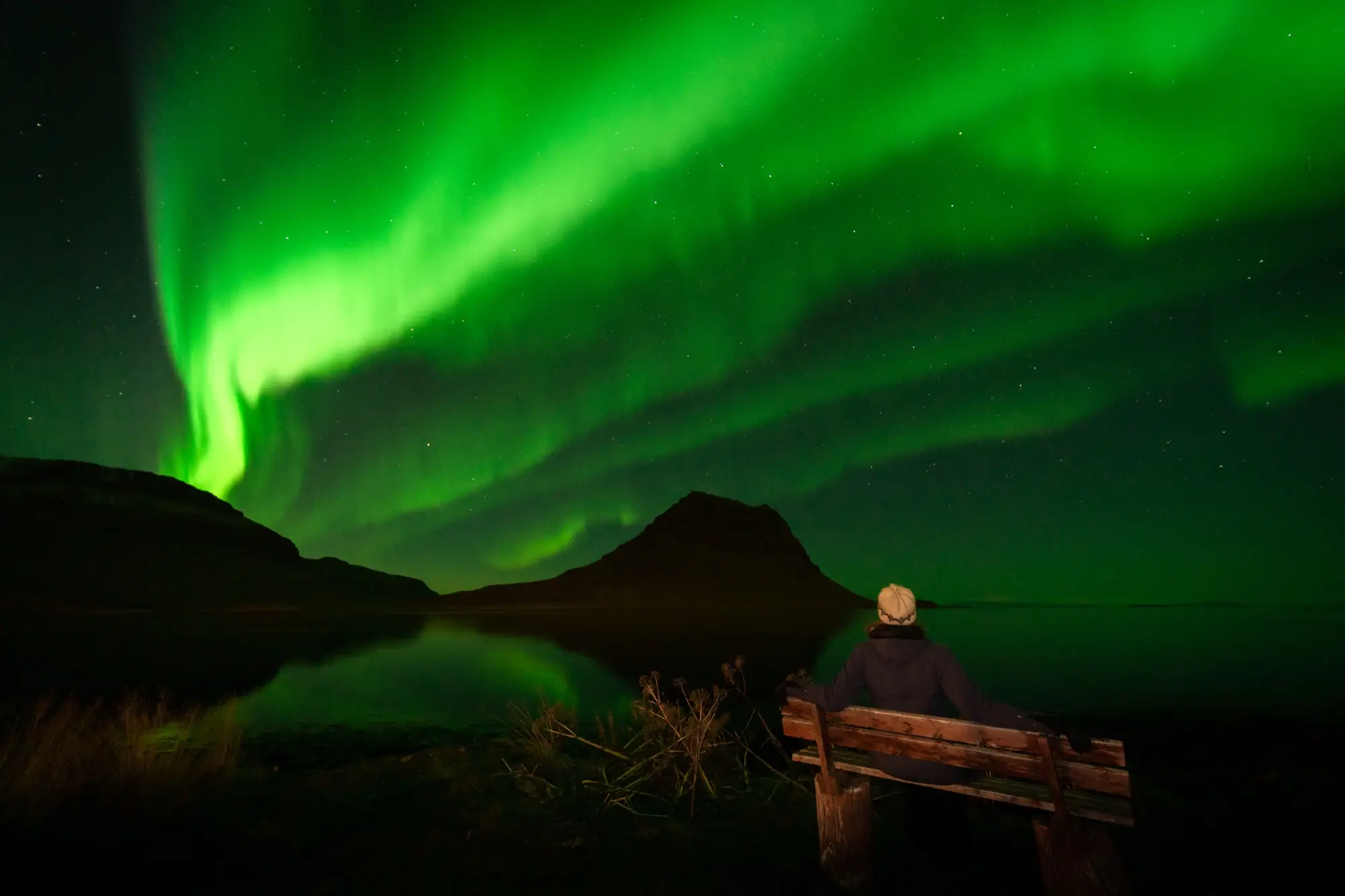

To see the northern lights in Iceland, you need clear skies and astronomical darkness, which returns to Vík between 15 August and 1 September, reaches Reykjavík and Akureyri by mid September, and ends by mid April. Look from dark spots around Reykjavík like Grótta, travel within an hour to Þingvellir, or head out along the south coast and around Akureyri, checking the Icelandic Met Office cloud forecast to find clear gaps.
Why Iceland is a good place to see the northern lights
According to Visit Iceland, the country's position close to the Arctic Circle places it directly within the auroral zone. If you are deciding between destinations, compare Norway vs Iceland: which to visit. Visit Reykjavík notes that Reykjavík is the northernmost capital in the world, sitting directly beneath the auroral oval. Unlike areas that experience polar night, the capital experiences sunrise every day of the year, lies south of the Arctic Circle, and needs around Kp 2 to show visible displays.
The Icelandic Met Office explains that even grade 2, which represents low activity on its scale, can be beautiful, while grade 3, or moderate activity, can be dazzling. Both Visit Iceland and the Met Office point out that the aurora requires dark skies along with clear or partly clear conditions. Visit Iceland emphasizes that sightings cannot be guaranteed, meaning the more nights you spend searching, the higher your chances will be.
When it is dark enough
Because the aurora requires a genuinely dark sky, the season is governed strictly by the sun. Computed on this site for the 2026-27 season, astronomical darkness returns to Reykjavík between 1 September and 15 September and ends between 1 April and 15 April. For detailed breakdowns of these solar windows, see daylight in Reykjavík and daylight in Akureyri.
According to the figures computed on this site for the 2026-27 season:
- Reykjavík is not dark enough for the aurora on 1 September.
- Reykjavík has 4h 50m of astronomical darkness on 15 September, 10h 32m on 1 November, 12h 54m on 15 December, 6h 42m on 15 March, 3h 44m on 1 April, and none on 15 April.
- Akureyri in the north has 4h 10m of astronomical darkness on 15 September, 13h 02m on 15 December, and 2h 42m on 1 April, with no darkness on 1 September or 15 April.
- Darkness returns earliest at Vík on the south coast, arriving between 15 August and 1 September in the 2026-27 season, with 1h 38m of astronomical darkness on 1 September.
- On the winter solstice on 21 December, the sun rises in Reykjavík at 11:22 and sets at 15:29, giving 4h 06m of daylight, and the sky is dark enough for the aurora for 12h 58m.
- On 21 December, Akureyri has 3h 04m of daylight and 13h 04m dark enough for the aurora.
- Reykjavík is never dark enough for the aurora on 1 May, 1 June, 1 July, or 1 August, even though the sun still sets below the horizon.
Iceland keeps the same clock throughout the year without daylight saving time, meaning local times do not shift in spring or autumn. Visit Iceland explains that there is no single best hour of the night; displays can appear whenever the sky is dark enough, making it necessary to monitor the forecast and cloud shifts through the evening.
How to read the Icelandic Met Office forecast
Visit Iceland advises checking weather conditions, cloud cover, and solar activity directly on the Icelandic Met Office website, noting that once the sky is dark and clear, the aurora forecast is the primary tool to consult.
On the Met Office aurora forecast, the map of Iceland outlines predicted cloud cover: green areas show cloud, while white areas mark clear skies. You can toggle the map between low and mid-level clouds, lower clouds, middle clouds, high clouds, or a composite view, using a slider or clicking specific days and times to step through the prediction. Visit Reykjavík advises checking this cloud map before setting out, pointing out that clear skies matter more than a high Kp number.
The Met Office displays its midnight auroral activity forecast on a scale from 0 to 9 in the upper-right box, which updates as you select different dates under the map. The sunset, darkness, sunrise, and moonrise times shown on that page apply to Reykjavík only. To view local sky data elsewhere, check the dedicated pages on this site for the Reykjavík northern lights forecast, the Þingvellir northern lights guide, the Vík northern lights guide, or the Akureyri northern lights forecast.
Visit South Iceland recommends checking cloud cover and aurora forecasts in the late afternoon and again after dinner. Safetravel warns that local weather can alter at short notice, requiring frequent reviews of both forecasts and road conditions. Each local page on this site gives tonight's verdict, offers a forecast for the following three nights based on four essential factors lining up, and provides an optional browser alert with a maximum of two notifications per night.
Where to go: Reykjavík, Þingvellir, the north and the south coast
Visit Iceland states there is no single best location in the country; on clear nights displays can be spotted throughout Iceland, though darker settings away from artificial street lighting provide clearer views. Sightings improve outside populated settlements, away from capital light pollution, though Visit Iceland notes that the aurora is often visible from inside Reykjavík during active periods.
Within the capital area, Visit Reykjavík highlights several spots:
- Grótta lighthouse, on a small peninsula in Seltjarnarnes, offers an unobstructed northern horizon where displays often begin, though the walking path is submerged at high tide, requiring a check of the tide schedule in advance.
- The Old Harbour features a clear view to the north due to the absence of buildings across the water.
- Öskjuhlíð hill, the site of Perlan, elevates observers above the city's main light haze.
- Heiðmörk nature reserve, situated on the south-eastern fringe of the capital, provides protected grounds with minimal artificial lighting.
Yellow city buses operate until around midnight, but reaching outer areas like Heiðmörk or surrounding lakes requires a car. Outside the capital, Visit Reykjavík notes that Þingvellir National Park, a UNESCO World Heritage Site, sits 45 minutes away, offering open plains and an unobstructed horizon. Kleifarvatn lake lies 40 minutes away among volcanic hills, offering a quiet setting whose surface can reflect displays, while Hvalfjörður fjord is situated 45 to 60 minutes away with low traffic and minimal artificial light. The Reykjavík place page on this site lists Þingvellir at 41 km, Vík at 165 km, and Akureyri at 249 km.
In the north, Visit North Iceland notes that while Akureyri produces some light pollution, dark skies can be reached in minutes. Krossanesborgir nature reserve is a 7-minute drive north of the town centre with views over the fjord, Kjarnaskógur woods are an 8-minute drive south and offer shelter from wind, and the Hlíðarfjall ski area above town provides wide views and low light pollution from its car park. Goðafoss waterfall sits a 37-minute drive east along the Ring Road.
In the south, Visit South Iceland highlights open landscapes with minimal light pollution along the Ring Road, suggesting drivers stay flexible and travel 20 to 60 minutes to reach clearer skies. Visit Iceland notes that several countryside hotels offer dedicated wake-up calls if displays begin overnight.
Northern lights tours, and what they promise
Visit Iceland states that excursion leaders are skilled at hunting displays and finding favourable local weather on any given evening. Visit Reykjavík divides organized excursions into standard bus tours, boat outings into Faxaflói bay, super jeep trips designed to reach rougher terrain, and specialized photography outings.
Most tour operators provide a free retry if displays do not show on the initial evening, making it sensible to book an excursion early in your itinerary. Reykjavik Excursions explains that its standard tour travels roughly an hour from the city based on cloud movement, with a final decision on running taken the evening before. If weather prevents the tour from running, Reykjavik Excursions cancels and offers a full refund or rebooking. If the tour operates but no lights appear, passengers may rejoin a future outing free of charge for up to two years using a rebook ticket, though no refunds are issued once a trip departs. The tour runs for at most 3.5 hours.
Special Tours, on Geirsgata in Reykjavík, runs a Northern Lights by Boat tour among its northern lights excursions. In northern areas, Visit North Iceland suggests taking an organized tour early in a visit to understand local conditions before self-driving later, pointing out that local guides track weather models, adjust routes around clouds, and offer free rebooking.
Indoor aurora shows for cloudy nights
When heavy cloud cover blocks the sky, indoor options offer alternative viewings. Aurora Reykjavík, located in the Grandi district, includes interactive exhibits, a live forecast display, and a dark room configured for testing camera settings. On its website, entrance is listed at 3.900 ISK for adults, 3.500 ISK for students with ID, and 1.900 ISK for children aged 6 to 16, as checked on that day.
Visit Reykjavík also notes Perlan's planetarium, which projects a 360-degree film to recreate the northern lights indoors. Perlan markets Áróra as the first 8K planetarium film focused on the aurora.
Driving and staying safe at night
Safetravel warns photographers never to walk into roads to take pictures, as approaching drivers struggle to spot pedestrians in the dark. Vehicles must only stop in designated car parks; stopping in the middle of a lane or pulling onto an unsafe roadside shoulder is strictly prohibited under any circumstances and risks accidents or police fines. Iceland's road network features narrow surfaces where stopping presents major hazards.
Before departing, drivers must consult weather reports on the Met Office site and monitor road conditions. Safetravel's winter driving page directs motorists to umferdin.is to check conditions, which alter rapidly. Running vehicle lights, both front and rear, is mandatory 24/7 across Iceland; automatic vehicle settings frequently fail to turn on rear lights, requiring manual activation. Hire cars should carry winter equipment such as winter tyres. While a four-wheel-drive vehicle assists in difficult conditions, it does not stop tyres from skidding on ice.
Visit Reykjavík asks observers waiting in vehicles to switch off headlights so everyone's night vision can adjust. Safetravel recommends dressing warmly in multiple layers, as clear evenings are cold. Visit Reykjavík notes that seasonal temperatures in the capital typically range between -5°C and 5°C, with winds making standing outside feel colder. Safetravel recommends bringing food, hot drinks, a fully charged phone, and a torch or headlamp, warning that moving around unfamiliar dark terrain carries risks of stepping into holes or slipping on icy ground. Visit Reykjavík suggests using a red headlamp to protect night vision. In an emergency, dial 112.
Patience and photographs
Seeing the northern lights requires waiting. Visit Reykjavík explains that displays might appear for five minutes, fade for an hour, and return with greater strength, recommending that visitors spend at least two hours outside. Formations can resemble a faint grey cloud for an hour before transforming into an active display for ten minutes.
For photography, Visit Iceland emphasizes bringing a sturdy tripod along with a cable release or using the camera's self-timer to prevent motion blur. Recommended starting settings from Visit Iceland include an ISO range of 800-3200, an aperture between f/2.8 and f/5.6, and a shutter speed between 15 and 30 seconds, noting that stars begin to show slight trailing movements on exposures longer than 15 seconds.