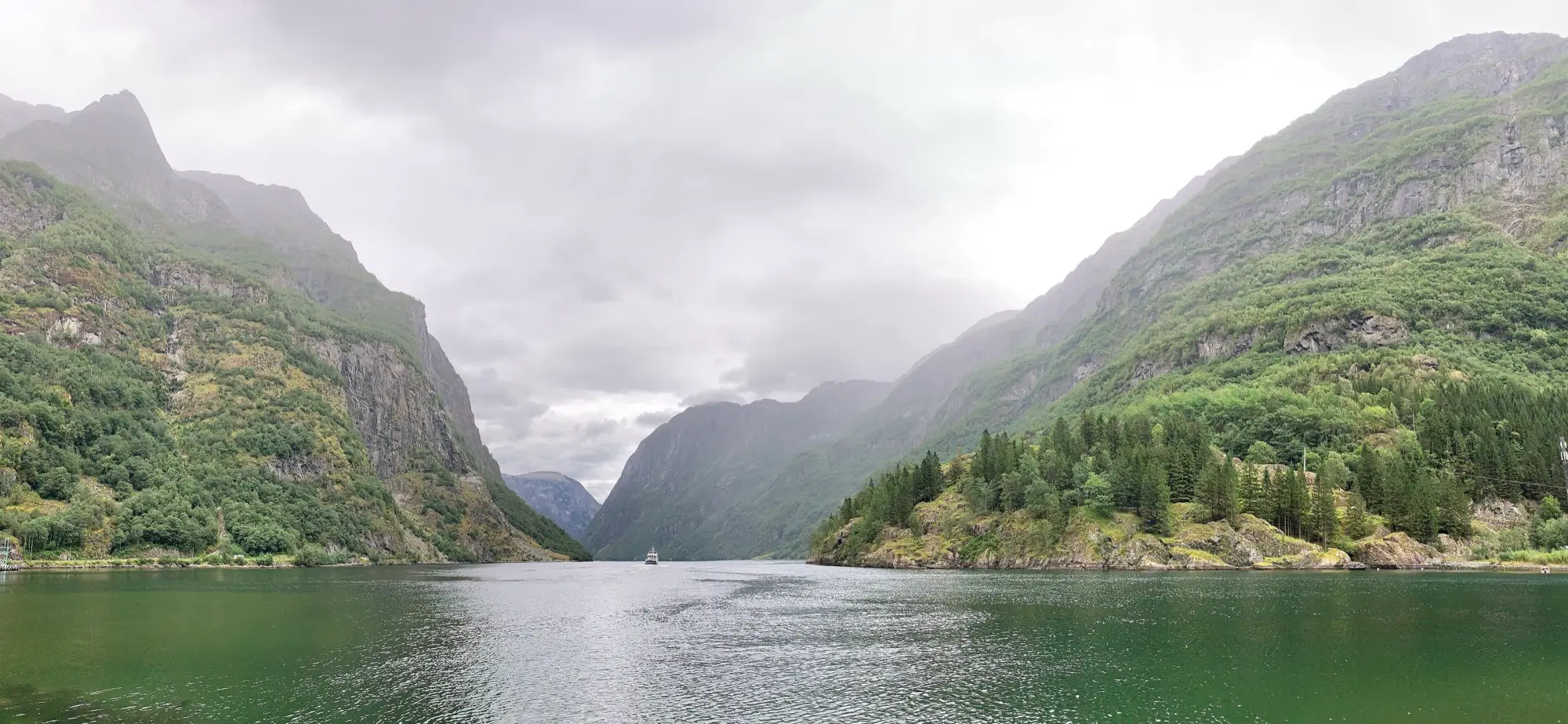

Norway and Iceland both sit within the Schengen area, meaning one uniform Schengen visa covers entry to both countries. Iceland is the more expensive destination, ranking highest among 36 European countries in Eurostat's 2025 price comparison, where Norway scored 129 against Iceland's 174. Norway features deep coastal fjords linked by mountain railways, while Iceland offers a paved circular highway running past open glaciers and waterfalls under the auroral oval.
Norway vs Iceland at a glance
To plan travel between the two countries, start with how their infrastructure, costs and landscape compare side by side.
| Feature | Norway | Iceland |
|---|---|---|
| Price level (Eurostat 2025, EU=100) | 129 | 174 |
| Currency and payment | Norwegian krone (NOK); cards accepted almost everywhere | see the Iceland pages |
| Visa requirements | Uniform Schengen visa covers stays up to 90 days | Uniform Schengen visa covers stays up to 90 days |
| Signature scenery | West Norwegian Fjords (Geirangerfjord and Nærøyfjord) | Glaciers covering 11% of the country, waterfalls |
| Getting around | Bergen Railway connects Oslo and Bergen | Ring Road circles the country; open all year |
| Northern lights | Arctic Norway lies under the northern lights oval | Within the auroral zone (Visit Iceland) |
The Geirangerfjord and the Nærøyfjord were inscribed together on UNESCO's World Heritage List in 2005 as the West Norwegian Fjords. In Iceland, glaciers cover 11% of the country. For overland transport, the Bergen Railway opened in 1909 and runs over the highlands between Oslo and Bergen, Norway's two largest cities. In Iceland, Visit Iceland says the Ring Road is paved and open all year, though bad winter weather can cause temporary, local closures.
For sky watching, Visit Northern Norway states that Arctic Norway lies under the northern lights oval and so has the most northern lights. Visit Iceland, the official travel guide, notes that Iceland's location close to the Arctic Circle places it within the auroral zone.
Which is more expensive?
In Eurostat's 2025 comparison of price levels for household consumption, Norway stood at 129, where the EU average is 100. Iceland, at 174, and Switzerland, at 171, were the most expensive countries in the comparison, well above Norway. The comparison rests on price surveys of more than 2,000 consumer goods and services in 36 European countries, Norway among them. These figures were published by Eurostat in June 2026, with the next update planned for December 2026. You can review the details of what Norway costs before choosing your budget.
Eurostat's food and beverage data also shows that all the EFTA (European Free Trade Association) countries, Norway included, had higher price levels for food than any EU country. Norway was the only country with higher prices for non-alcoholic drinks than any EU country, and with Iceland it was dearer for alcohol than any EU country.
In Norway, the currency is the Norwegian krone (NOK), and cash is rarely needed. Cards such as Visa, Mastercard, Diners Club and American Express are accepted almost everywhere and locals prefer them to cash.
One visa for both
A uniform Schengen visa from any Schengen state is valid across the whole area for up to 90 days, so if you already have one you do not need a separate visa for Iceland. To stay in the Schengen area, Iceland included, for up to 90 days in any 180-day period, non-EEA/EFTA citizens need a valid visa unless exempt or holding another EEA/EFTA residence permit. Travellers must give the purpose of the stay, have enough money for the stay and the return, and not be listed in the Schengen Information System to be refused entry. Check the Iceland visa rules for standard documentation criteria.
Fjords or glaciers and waterfalls
The Geirangerfjord and the Nærøyfjord were inscribed together on UNESCO's World Heritage List in 2005 as the West Norwegian Fjords. UNESCO describes the fjords' steep crystalline rock walls as rising up to 1,400 m from the sea and reaching 500 m below sea level. The Sognefjord is Norway's longest and deepest fjord and the world's second-longest; it is 205 km long and 1,303 metres deep off the Vadheimsfjord. UNESCO notes that tourism pressure is intense in both fjords and that most visitors arrive on cruise ships in a short season. You can plan visits to the best fjords in Norway.
Glaciers cover 11% of Iceland. Dettifoss is widely known as Europe's most powerful waterfall, and Morsárfoss is considered Iceland's tallest, with a drop of around 240 m (790 ft).
Getting around: trains or the Ring Road
Norway allows long-distance overland travel by rail. The Bergen Railway opened in 1909 and runs over the highlands between Oslo and Bergen, Norway's two largest cities. The journey from Oslo to Bergen takes about 6.5 to 7.5 hours, depending on whether you take a day or a night train. The line crosses Hardangervidda National Park and the Hardangervidda plateau, Europe's largest high mountain plateau. Finse station lies at 1222 metres and has no road; you reach it only by train or on foot. You can see schedules on the Oslo to Bergen train route.
Visit Iceland gives the Ring Road at least 7 travel days, best travelled year-round, with no 4x4 required. Visit Iceland says the Ring Road is paved and open all year, though bad winter weather can cause temporary, local closures. You can follow the Ring Road itinerary to map stops around the island. Visit Iceland says automated self-service fuel stations operate in all towns and along major highways, but distances between them vary, so make sure you can reach the next one. Safetravel says the F-roads (fjallvegir, mountain roads) are usually closed from mid-September until June or July, and in that period only a modified vehicle (a superjeep) can get through.
Northern lights in both
Visit Northern Norway says Arctic Norway lies under the northern lights oval and so has the most northern lights. The northern lights belt stretches along the coast of Arctic Norway from Lofoten to the North Cape. Visit Tromsø says the northern lights may be visible in the Tromsø region from late August to early April, whenever the sky is dark and clear enough. Around the equinoxes, late September/early October and late March, the aurora can be particularly strong, though equally strong displays happen all season. You can read about northern lights in Norway before selecting an Arctic base.
Visit Iceland, the official travel guide, says Iceland's location close to the Arctic Circle places it within the auroral zone. Visit Reykjavík describes Reykjavík as the world's northernmost capital, located directly beneath the auroral oval. The Icelandic Met Office says the aurora needs dark and partly clear skies. Check guides for northern lights in Iceland along with tonight's aurora across the Nordic places and seasonal daylight through the year to track viewing windows.
When each is busiest
In Norway, most visitors to Bergen come in summer, between May and September. The Geiranger-Trollstigen scenic route is always closed in winter and is normally open from mid-May to October or November, when winter comes. In contrast, the Norway in a Nutshell trip from Bergen runs daily all year, except on 24 and 25 December and 1 January.
In Iceland, the Icelandic Tourist Board counted 314 thousand departures of foreign passengers in August 2026, compared to 119 thousand departures of foreign passengers in January 2026. Almost 99% of visitors to Iceland come through Keflavík Airport, where departing passengers are counted by hand just before security; the Tourist Board says the figures need some caution. Visit Iceland says the weather changes quickly and the seasons blend into one another.
Choose Norway if, choose Iceland if
Choose Norway if you want to travel across high plateaus by train, avoid Iceland's higher price level of 174 on the Eurostat index, or see the West Norwegian Fjords. The Bergen Railway connects Norway's two largest cities across the highlands.
Choose Iceland if you want a self-drive circular journey along a single highway, access to glaciers that cover 11% of the country, or powerful waterfalls such as Dettifoss and Morsárfoss. Visit Iceland gives the Ring Road at least 7 travel days, best travelled year-round with no 4x4 required, provided you prepare for the higher price levels confirmed by Eurostat.