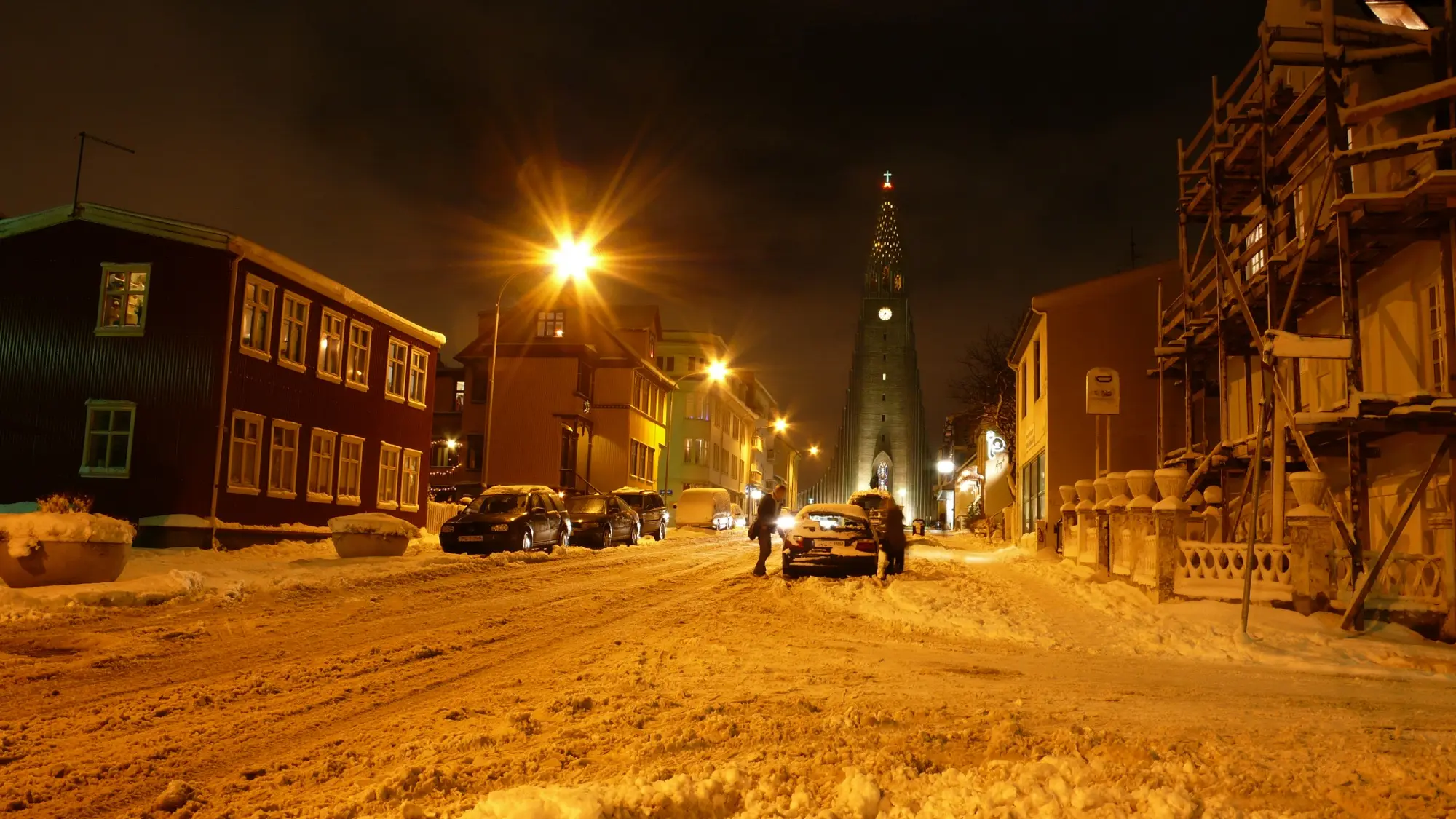

There is no single best month to visit Iceland; it depends on what you plan to do. Summer is the only time the highland roads open, while the dark half of the year provides the conditions to see the northern lights. Reykjavík's mean monthly temperature stays above freezing year-round, whereas Akureyri dips below freezing in the winter months.
The short answer: it depends on what you want to do
Your itinerary dictates the calendar. The Icelandic Road and Coastal Administration (Vegagerðin) states that mountain roads are only open a couple of months a year. Highland routes such as Sprengisandsleið do not fully open until early July, sometimes later, and are passable only with large four-wheel-drive vehicles and superjeeps. By contrast, the Kjölur route (Route 35) from Gullfoss to Hveravellir opened between 30 May and 14 June in the 2021-2025 record, opening on average on 1 June.
Temperatures vary between regions. The 1991-2020 mean temperature for January is about 0.7 °C in Reykjavík and about -0.5 °C in Akureyri. In summer, the 1991-2020 mean temperature for July is about 11.7 °C in Reykjavík and about 11.2 °C in Akureyri.
Crowd levels fluctuate sharply across the year. The Icelandic Tourist Board counted 314 thousand departures of foreign passengers in August 2026, compared to 119 thousand departures of foreign passengers in January 2026.
Iceland's weather month by month: Reykjavík and Akureyri
Visit Iceland notes that the weather changes quickly and the seasons blend into one another. Because rapid shifts occur regardless of the month, the official packing list advises bringing a wind- and waterproof outer jacket, waterproof trousers, and a hat and gloves even in summer.
The values below present the 1991-2020 climatological normal temperatures for Reykjavík and Akureyri. These figures are monthly means of day and night together, drawn from Veðurstofa Íslands. Each temperature sits at about the stated figure:
| Month | Reykjavík (°C) | Akureyri (°C) |
|---|---|---|
| January | 0.7 | -0.5 |
| February | 0.5 | -0.8 |
| March | 1.2 | 0.1 |
| April | 3.6 | 2.6 |
| May | 6.7 | 6.2 |
| June | 9.8 | 9.6 |
| July | 11.7 | 11.2 |
| August | 11.1 | 10.8 |
| September | 8.5 | 8.0 |
| October | 4.9 | 3.5 |
| November | 2.3 | 0.6 |
| December | 0.7 | -0.7 |
For day length patterns across these months, consult /daylight/reykjavik/ and /daylight/akureyri/.
How wet it is
Official precipitation records from the Icelandic Met Office (Veðurstofa Íslands) for selected stations cover the thirty-year period 1961-1990. In these records, r denotes average precipitation in millimetres.
In the 1961-1990 averages for Reykjavík:
- May is the driest month with 43.8 mm.
- October is the wettest month with 85.6 mm.
In the 1961-1990 averages for Akureyri:
- May is the driest month with 19.3 mm.
- October is the wettest month with 58.0 mm.
Winter brings harsh conditions, including fierce winds and snow or rain coming down sideways. Because wet fabrics lose insulation quickly in these winds, Visit Iceland advises against wearing cotton and jeans outdoors.
When the visitors come: departures month by month
Almost 99% of visitors to Iceland travel through Keflavík Airport (Keflavíkurflugvöllur). At the airport, departing passengers are counted by hand just before the security checkpoint. The Icelandic Tourist Board notes that these manual counts require some caution.
Across the twelve-month sequence from November 2025 to October 2026 (with December 2025 unpublished as a monthly report), the counts of foreign departures at Keflavík were:
- November 2025: 141 thousand departures of foreign passengers
- January 2026: 119 thousand departures of foreign passengers
- February 2026: 147 thousand departures of foreign passengers
- March 2026: 155 thousand departures of foreign passengers
- April 2026: 149 thousand departures of foreign passengers
- May 2026: 163 thousand departures of foreign passengers
- June 2026: 223 thousand departures of foreign passengers
- July 2026: 293 thousand departures of foreign passengers
- August 2026: 314 thousand departures of foreign passengers
- September 2026: 228 thousand departures of foreign visitors
- October 2026: 203 thousand departures of foreign passengers
August and July recorded the highest volumes in this period, January recorded the lowest, and the shoulder months of April, May, September, and October sat between.
Summer: the highlands and the F-roads
The interior of Iceland is defined by elevation: land more than 300 metres above sea level counts as highland (hálendið). This terrain is generally under snow well into the summer months, leaving a highland summer that lasts only a month and a half. Consequently, mountain roads remain open for only a couple of months each year. For broader planning on this period, see Iceland in summer.
Safetravel notes that F-roads (Fjallvegir, mountain tracks) are usually closed from mid-September until June or July. During the closed period, only modified vehicles known as superjeeps can travel there. Snow cover is the primary factor dictating when tracks open. In addition, any road passing through a nature conservation area may stay closed until the entire area is dry enough to withstand visitor traffic.
The Road Administration's 2021-2025 records show the following opening windows and averages:
- Kjölur route (35) (Gullfoss to Hveravellir): opened between 30 May and 14 June; average opening 1 June.
- F208 (Sigalda to Landmannalaugar): opened between 23 May and 23 June; average opening 2 June.
- Lakagígar (F206): opened between 12 June and 1 July; average opening 20 June.
- Sprengisandur (F26) (Hrauneyjar to Nýidalur): opened between 21 June and 13 July; average opening 6 July.
- Fjallabak south route (F210) (Keldur to Hvanngil): opened between 23 June and 15 July; average opening 7 July.
Vegagerðin requests that travellers respect these opening dates. Driving into the highlands off-season without permission causes lasting damage to soft, thawing soil. Sprengisandsleið does not fully open until early July, sometimes later, and remains passable only for large four-wheel-drive vehicles and superjeeps.
Before undertaking any highland driving, the first step is to verify whether specific F-roads have opened by checking umferdin.is. When planning routes involving river crossings, note that no insurance policy covers water damage sustained while fording a river. Off-road driving is strictly forbidden across Iceland; standard gravel roads and designated F-roads do not count as off-road driving.
Winter: snow, ice, short days and the northern lights
Winter conditions demand specific preparation. Rental vehicles must have winter equipment, including winter tyres. Having four-wheel drive does not eliminate the risk of skidding on packed ice. Vehicle headlights and taillights must remain switched on at all times, all year round. Readers visiting late in the year can read about Iceland in December.
Mean monthly temperatures (1991-2020 normals) during winter reflect the contrast between the coast and the north:
- December: about 0.7 °C in Reykjavík; about -0.7 °C in Akureyri.
- January: about 0.7 °C in Reykjavík; about -0.5 °C in Akureyri.
- February: about 0.5 °C in Reykjavík; about -0.8 °C in Akureyri.
To view the northern lights (norðurljós), conditions must be dark and the sky must be clear, ideally away from city lights and light pollution. Check /aurora/reykjavik/ or /aurora/akureyri/ for current viewing forecasts. For broader context on how northern Iceland compares to northern Scandinavia, see /nordics/best-places-to-see-the-northern-lights/.
Spring and autumn: the shoulder months
The transitional months bring shifting conditions. Safetravel warns that winter conditions can occur in spring and autumn as well as in winter. Mountain F-roads remain closed to standard traffic through spring and close again by mid-September, accessible only by superjeep outside the summer season.
Temperatures in the shoulder months follow the 1991-2020 normals:
- April: about 3.6 °C in Reykjavík; about 2.6 °C in Akureyri.
- May: about 6.7 °C in Reykjavík; about 6.2 °C in Akureyri.
- September: about 8.5 °C in Reykjavík; about 8.0 °C in Akureyri.
- October: about 4.9 °C in Reykjavík; about 3.5 °C in Akureyri.
Visitor traffic during these periods sits between the quiet winter and the summer peak. Keflavík departure counts for 2026 recorded 149 thousand foreign passengers in April, 163 thousand in May, 228 thousand foreign visitors in September, and 203 thousand foreign passengers in October. For travellers coordinating stops across northern Europe, comparative guidance is available in /norway/travel/best-time-to-visit-norway/ and /finland/travel/best-time-to-visit-finland/.