
Summer in Iceland, running from June to August, is mild rather than warm, with 1991–2020 monthly mean temperatures of about 10 to 12 °C in Reykjavík and Akureyri. Nights remain light throughout the season; on 21 June the sun sets in Reykjavík at 00:04 and rises at 02:55, while in Akureyri it sets at 00:59 and rises at 01:29. Highland roads open gradually between late May and early July, and July and August see the highest passenger departures at Keflavík Airport.
What summer in Iceland is like: temperatures and rain
Summer weather stays cool. The table below lists the 1991–2020 normal mean temperatures, representing combined day and night monthly means from the Icelandic Met Office.
| Month | Reykjavík | Akureyri |
|---|---|---|
| June | about 9.8 °C | about 9.6 °C |
| July | about 11.7 °C | about 11.2 °C |
| August | about 11.1 °C | about 10.8 °C |
Rainfall is moderate across the season. According to the Icelandic Met Office's thirty-year averages for 1961–1990, where r is average precipitation in millimetres, rainfall totals are:
- June: 50.0 mm in Reykjavík; 28.2 mm in Akureyri
- July: 51.8 mm in Reykjavík; 33.0 mm in Akureyri
- August: 61.8 mm in Reykjavík; 34.1 mm in Akureyri
Full monthly figures across the year are available in our guide to Iceland weather by month. Visit Iceland notes that weather changes quickly and seasons blend into one another. Its all-season packing list includes a wind- and waterproof outer jacket, waterproof trousers, and a hat and gloves even in summer. You can check our complete Iceland packing list for details on what to wear by season.
Light nights: how long the days are
Iceland keeps the same clock all year, with no summer time. All sunrise, sunset and day-length figures below are computed on this site using local time in 2026. You can inspect exact times across the calendar in our detailed tables for daylight in Reykjavík and daylight in Akureyri.
- 1 June: Reykjavík sunrise 03:20, sunset 23:30 (20h 10m daylight); Akureyri sunrise 02:30, sunset 23:50 (21h 20m daylight).
- 21 June (summer solstice): Reykjavík sunrise 02:55, sunset 00:04 (21h 10m daylight); Akureyri sunrise 01:29, sunset 00:59 (23h 30m daylight).
- 1 July: Reykjavík sunrise 03:07, sunset 23:56 (20h 50m daylight); Akureyri sunrise 02:02, sunset 00:30 (22h 28m daylight).
- 1 August: Reykjavík sunrise 04:37, sunset 22:31 (17h 54m daylight); Akureyri sunrise 04:05, sunset 22:32 (18h 28m daylight).
In these tables, the sun sets in both Reykjavík and Akureyri even on 21 June. True midnight sun in Iceland does not occur in these towns. Because the sky remains bright during these months, nights never get dark enough for aurora viewing. Travellers seeking the aurora should consult our guide to the northern lights in Iceland, as viewing requires the darker skies of other seasons.
The highlands: when the mountain roads open
Land sitting more than 300 metres above sea level counts as highland, and it is generally under snow well into the summer months. The highland summer lasts only a month and a half. According to Vegagerðin (the Icelandic Road and Coastal Administration), mountain roads are only open a couple of months a year. Safetravel reports that mountain tracks (F-vegir, or F-roads) are usually closed from mid-September until June or July, during which time only a modified vehicle (a superjeep) can access them. See our dedicated guide to F-roads in Iceland for specific rules, opening dates and rivers.
Opening dates depend on ground conditions and vary each year. Vegagerðin's records for 2021 to 2025 document the following ranges and averages:
- Kjölur route (35) (Gullfoss to Hveravellir): opened between 30 May and 14 June; average opening 1 June.
- F208 (Sigalda to Landmannalaugar): opened between 23 May and 23 June; average opening 2 June.
- Lakagígar (F206): opened between 12 June and 1 July; average opening 20 June.
- Fjallabak south route (F210) (Keldur to Hvanngil): opened between 23 June and 15 July; average opening 7 July.
- Sprengisandur (F26) (Hrauneyjar to Nýidalur): opened between 21 June and 13 July; average opening 6 July.
Sprengisandsleið does not fully open until early July, sometimes later, and is then passable only with large four-wheel-drive vehicles and superjeeps. The first thing to check before any highland trip is whether local F-roads have opened, which is reported on umferdin.is.
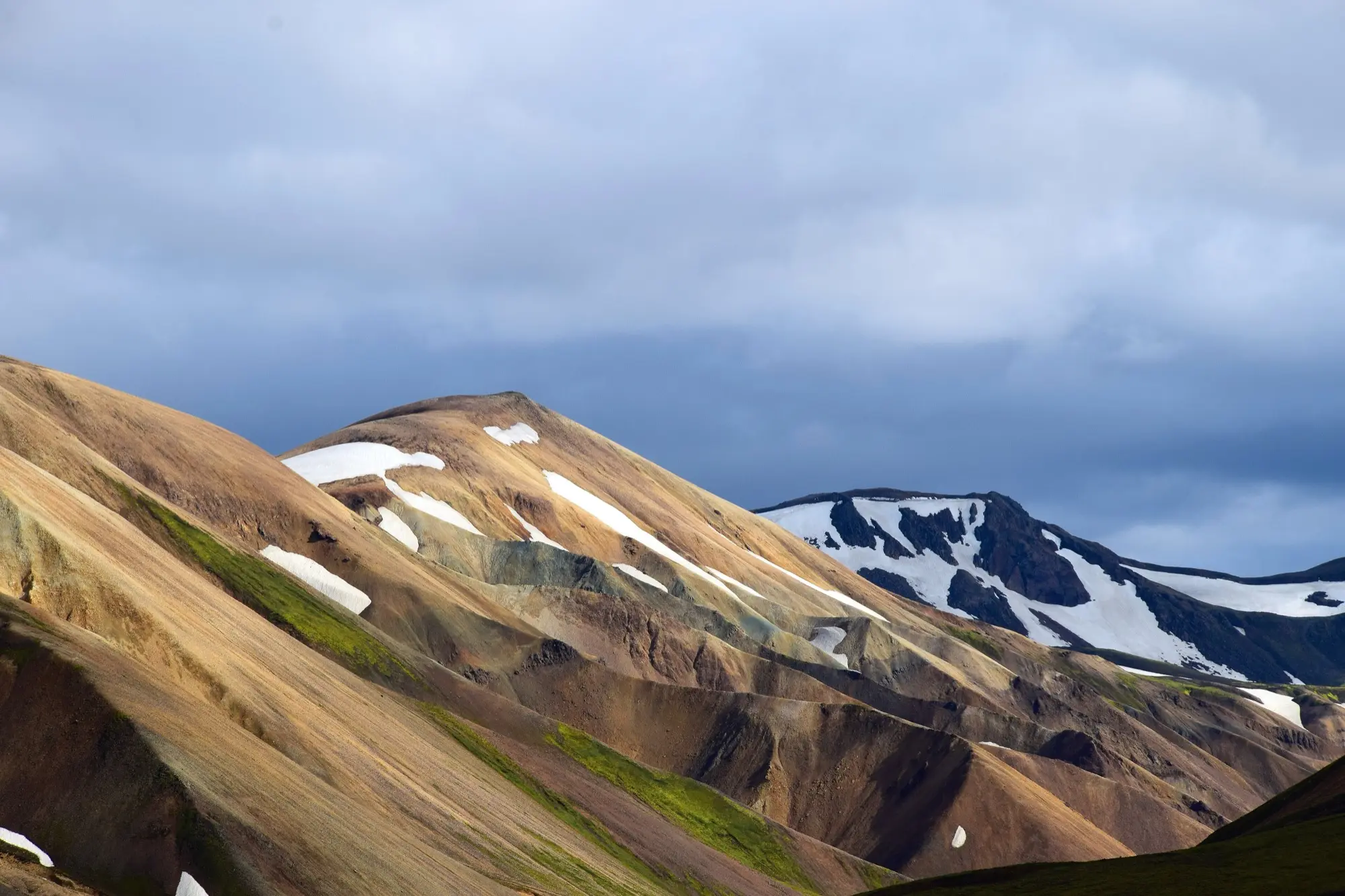
To reach Landmannalaugar, vehicles take road F208, followed by the final 2.5 km on F224. Two rivers must be crossed just before the destination; drivers can choose to park at car park P1 without crossing them and walk across via a footbridge. Highland bus services operate on fixed summer timetables. For 2027, Reykjavik Excursions schedules route HB01 to Þórsmörk from 11 June to 15 September, and route HB02 to Landmannalaugar from 18 June to 12 September.
Hiking the Laugavegur trail
Ferðafélag Íslands (FÍ, the Iceland Touring Association) maintains the huts along the Laugavegur trail. FÍ defines Laugavegur as a 55 km route starting at Landmannalaugar, amid colourful mountains and hot springs, and concluding in forested Þórsmörk. Access depends on snow and weather, with the trail opening on average from 25 June to 15 September. FÍ designates July and August as the most popular and reliable period, offering the best trail conditions alongside fully open huts.
Hut capacities along the trail are strictly limited:
- Landmannalaugar: 78 people
- Hrafntinnusker: 52 people
- Álftavatn: 72 people
- Hvanngil: 60 people
- Emstrur (Botnar): 60 people
- Þórsmörk (Skagfjörðsskáli in Langidalur): 73 people
Hikers must hold confirmed bookings for huts or campsites prior to setting out, as huts frequently sell out during peak weeks. Camping space is available adjacent to every hut, and FÍ accepts bookings for 2027. Safetravel instructs all hikers to share a travel plan with a contact who can react if required. The Safetravel mobile app can transmit your GPS location directly to the 112 emergency service.
Puffins and whales
Visit Iceland states that Atlantic puffins typically arrive on cliffs and offshore islands in late April or early May. The best viewing window spans May through mid-August. Puffins generally return to open sea by mid to late August, meaning August travellers should schedule wildlife excursions during the first half of the month. Learn more about nesting colonies in our overview of puffins in Iceland. Vestmannaeyjar (the Westman Islands) host Iceland's largest puffin colony, with birds nesting on the sea cliffs from May through August.
According to Visit Iceland, the optimal season for whale watching extends from April until September, as boat tours run less frequently during the winter months. Many whale-watching excursions depart into Skjálfandi Bay, where humpback whales represent the most common sighting.
Crowds: how busy the summer months are
Almost 99% of travellers entering Iceland pass through Keflavík Airport. Departing passengers are counted by hand immediately before security screening, and the Icelandic Tourist Board advises that these counts require some caution.
Passenger counts compiled by the Icelandic Tourist Board for foreign departures in 2026 show:
- May 2026: 163 thousand departures
- June 2026: 223 thousand departures
- July 2026: 293 thousand departures
- August 2026: 314 thousand departures
- September 2026: 228 thousand departures
July and August record the highest foreign departure counts of the summer period.
Summer holidays and events
Iceland observes its national holiday on 17 June each year, marking the anniversary of the founding of the Republic of Iceland on 17 June 1944.
Commerce Day occurs on the first Monday in August. This creates a three-day weekend known as verslunarmannahelgi, which is an exceptionally popular domestic travel weekend across the country. Visit Iceland notes that Culture Night (Menningarnótt), one of the largest events on the national calendar, takes place in Reykjavík each August.
Driving and staying safe in summer
Rural driving presents specific hazards. Visit Iceland notes that starting in May, sheep roam freely across the countryside and frequently wander onto roads. Drivers must follow road restrictions carefully; driving off established tracks is strictly illegal, though designated gravel roads and open F-roads do not count as off-road driving. Note that vehicle rental insurance never covers damage incurred while crossing a river.
At the coast, beach safety requires extreme caution. Safetravel warns that Reynisfjara beach is hazardous due to sneaker waves, which arrive with zero warning and can drag an adult into the ocean within seconds, as well as falling rocks from adjacent cliffs. Safetravel issues four specific safety rules for the site:
- Stay well back from the water's edge.
- Never turn your back on the sea.
- Keep children accompanied by an adult at all times.
- Beware of falling rocks when near the cliff face.
In any emergency, call 112. For remote highland journeys, Safetravel recommends carrying a rented personal locator beacon or a Garmin inReach device, and submitting a route plan that can be acted upon if you fail to check in.