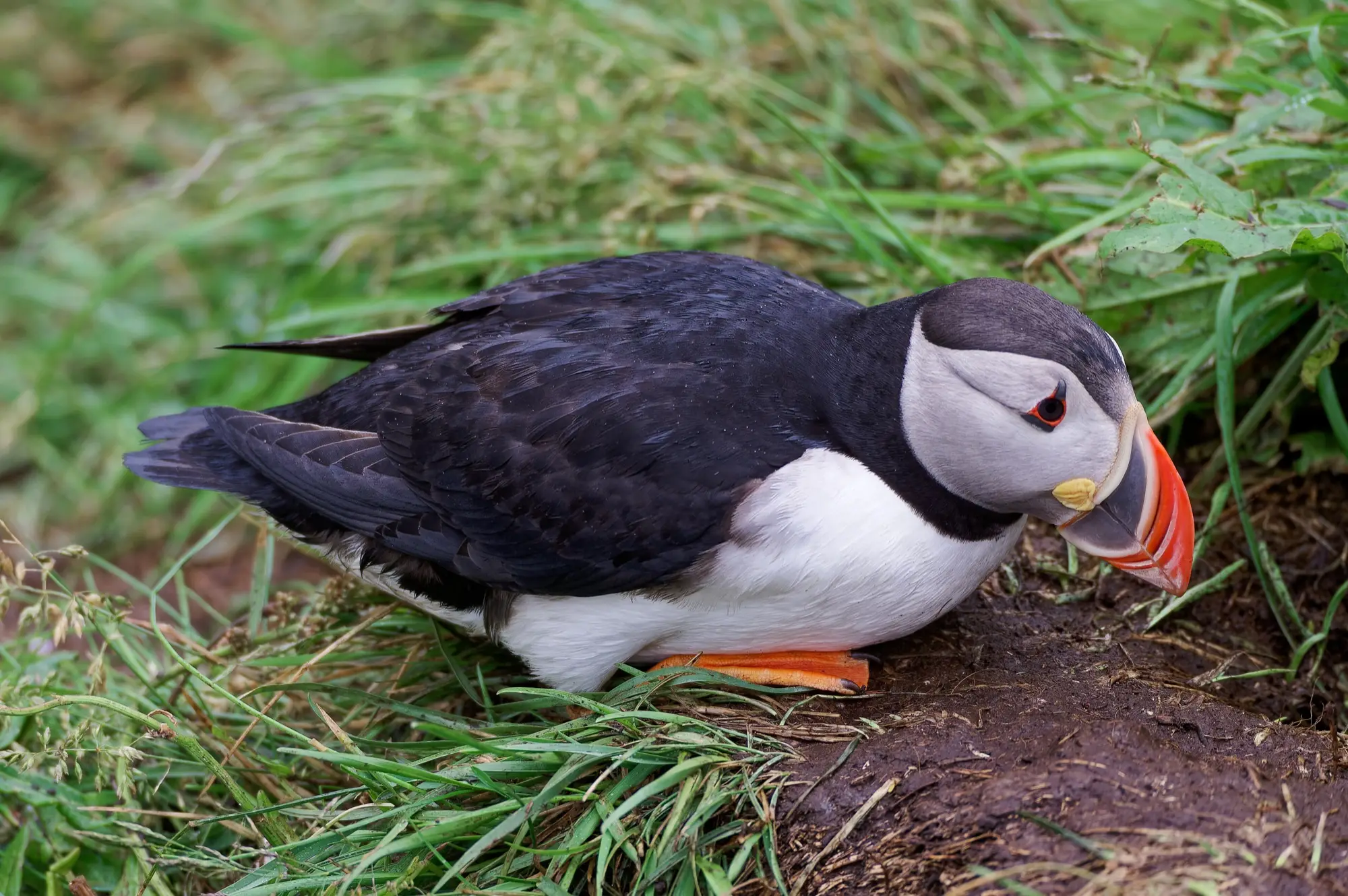

Visit Iceland gives May to mid-August as the time to see puffins, with the birds arriving in late April or early May and gone by early October; the best hours are before 9 am or after 6 pm; and the seven places it names are the Westman Islands, Dyrhólaey, Látrabjarg, Grímsey, Hafnarhólmi, Breiðafjörður and Papey.
When to see puffins in Iceland
Visit Iceland gives May through mid-August as the best time to see puffins, when the birds gather on their nesting cliffs. Puffins usually arrive on Iceland's cliffs and islands in late April or early May. The puffin is a migrating bird that spends about eight months a year out at sea.
Once the pufflings are strong enough the birds head back out to sea, usually by mid to late August, so in August the earlier weeks are better. By early October nearly all puffins have left the coast for the open Atlantic. Parent puffins spend long hours at sea hunting during the day, so a sighting is never fully guaranteed on a short visit. If you are organising travel during Iceland in summer, align your schedule with this nesting window.
The best time of day
Puffins are most active at their nesting sites in the early morning and late evening; Visit Iceland advises going before 9 am or after 6 pm.
Seven places to see puffins
Visit Iceland names seven spots as the most reliable and accessible nesting sites, and says a boat ride offers one of the best chances of a sighting. You do not need a boat tour; Dyrhólaey and Hafnarhólmi can be reached by car or on foot.
- The Westman Islands (Vestmannaeyjar) in south Iceland are home to Iceland's largest puffin colony, spread across several islands.
- Dyrhólaey on the south coast of Iceland has a small, accessible colony close to a car park.
- Látrabjarg in the Westfjords is Iceland's westernmost point and one of Europe's westernmost accessible sea cliffs, which you can include on a Westfjords road trip.
- Grímsey island in north Iceland, the only Icelandic territory on the Arctic Circle, has a dense summer colony.
- Hafnarhólmi at Borgarfjörður eystri in the Eastfjords is a land-connected island with boardwalks and viewing platforms.
- Breiðafjörður in west Iceland is a fjord dotted with small islands, reached by boat tours from Stykkishólmur.
- Papey in east Iceland is a small uninhabited island reached by daily boat tours from Djúpivogur.
Dyrhólaey in early summer
Dyrhólaey is a 120-metre-high tuya formed in at least two eruptions around 100,000 years ago. Dyrhólaey was protected in 1978 for its natural beauty and its birdlife; the reserve covers 147.2 hectares and a ranger lives there all year. Dyrhólaey is named after its lava arch, 20 metres high and 50 metres wide, and looks out over Mýrdalsjökull, Eyjafjallajökull and Reynisfjara.
The Environment Agency can restrict visits to Dyrhólaey from 1 May to 25 June to protect the birdlife. An ornithologist assesses the birdlife on the island each year to decide whether a closure is needed, and the length of any closure has been disputed locally.
Puffins near Reykjavík
Boat tours from Reykjavík's harbour visit nearby islands such as Akurey and Lundey, where puffins nest each summer. Puffins can be seen on coastal waters from spring to autumn.
How to watch puffins safely
To view puffins without damaging their habitat or breaking the law, keep these rules in mind:
- Puffin burrows are shallow and the ground above them can collapse without warning; stay at least 1 metre back from any cliff edge near a colony.
- Move slowly and quietly, never touch a puffin (contact can damage the water-repelling layer of its feathers), do not feed them, and from a boat keep a respectful distance and avoid loud engines near the cliffs.
- Disturbing a nest is strictly forbidden under Iceland's wildlife protection laws, and it is illegal to disturb burrows during the breeding season.
Why puffins are on Iceland's red list
About 60% of the world's Atlantic puffins breed in Iceland, and the puffin is Iceland's most common bird. However, the IUCN classes the Atlantic puffin as vulnerable, BirdLife International rates it endangered in Europe, and Iceland's own red list of birds classes it as critically endangered after a sharp decline tracked since 2000.
Warming seas are the main driver, pushing sandeel, the puffin's main food, farther from the cliffs where chicks are raised. In July 2025 Iceland's nature conservation agency urged restaurants to stop serving puffin meat; some restaurants still serve it. Every August the Westman Islands run the puffling patrol, in which residents rescue young puffins disoriented by the town lights and release them to the sea.
The puffin in a few facts
- In Icelandic the puffin is lundi, with the old nickname prófastur ("preacher") for its black and white feathers.
- The puffin nests in a curved burrow about 1.2 metres long with two chambers, and lays one egg a year.
- An Atlantic puffin is 26 to 29 cm long with a wingspan of 45 to 65 cm and weighs about 500 g.
- Puffins can dive to 60 metres and fly at up to 88 km/h, flapping up to 400 times a minute.
- Puffins mate for life and live 20 to 25 years on average.
- The beak turns bright orange in the breeding season and is shed for a smaller, duller grey beak in winter.