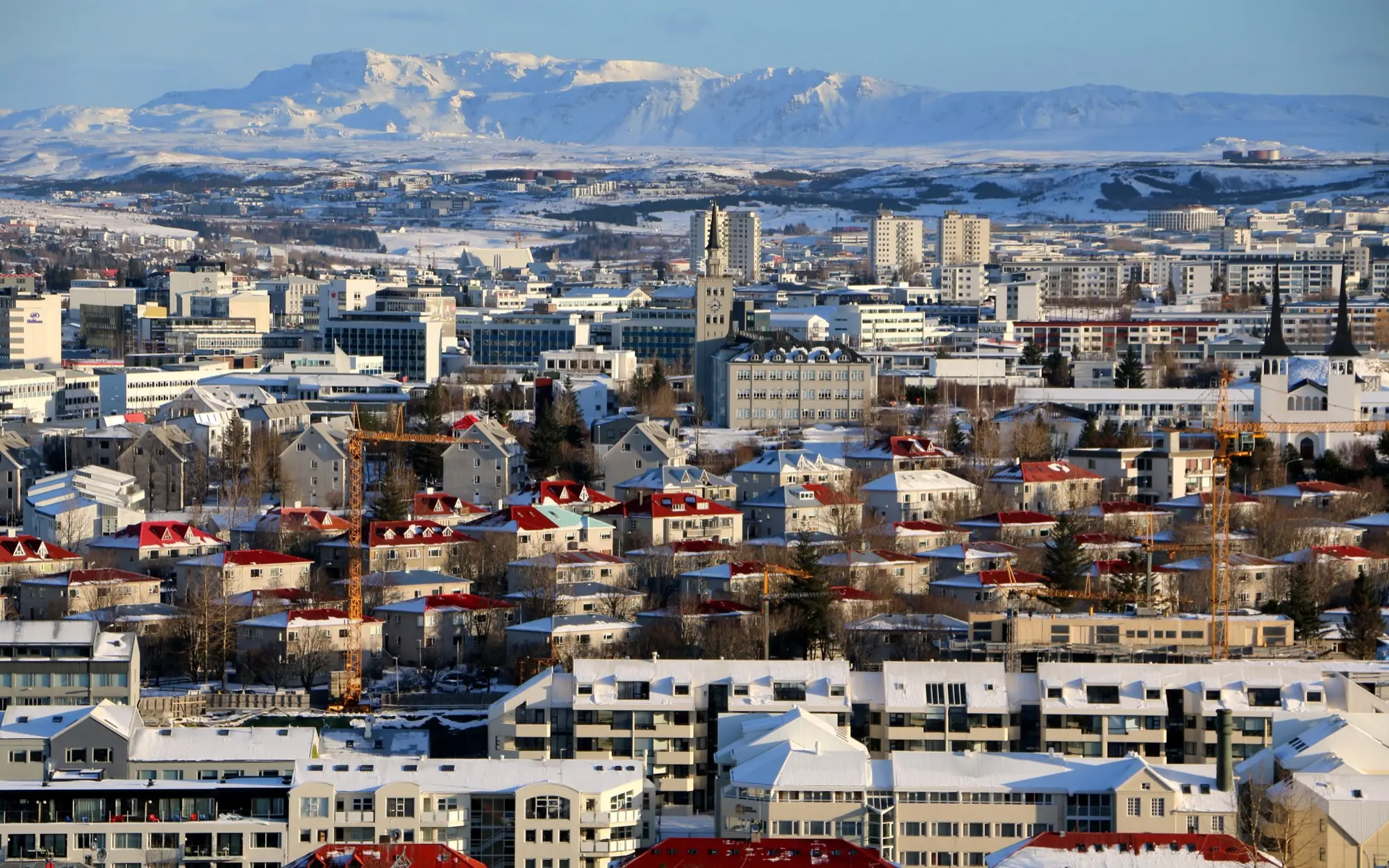

On the Icelandic Met Office's 1991-2020 normals Reykjavík's monthly mean stays above freezing all year, from about 0.5 °C in February to about 11.7 °C in July, while Akureyri in the north dips below freezing from December to February and peaks at about 11.2 °C in July. The weather changes quickly and the seasons blend into one another.
Iceland's weather in short: mild, wet and changeable
Under the 1991-2020 climate normals published by the Icelandic Met Office, Reykjavík records a mean temperature of about 0.5 °C in February, about 11.7 °C in July, and about 0.7 °C in December. In Akureyri, the largest town in North Iceland, the mean temperature is about -0.8 °C in February, about 11.2 °C in July, and about -0.7 °C in December.
Visit Iceland notes that the weather changes quickly and the seasons blend into one another. Because of this, Visit Iceland's all-season packing list includes a wind- and waterproof outer jacket, a hat and gloves even in summer, and waterproof trousers; you can compare these requirements with our detailed Iceland packing list. Safetravel warns that winter conditions can occur in spring and autumn as well as in winter. If you plan to travel across different seasons, check our guide on the best time to visit Iceland.
Average temperatures by month: Reykjavík and Akureyri
The figures below show the 1991-2020 monthly mean temperatures for Reykjavík and Akureyri. In the text and table, each normal represents about the stated figure because each normal is a month's measured mean minus its published deviation. These numbers are monthly means of day and night taken together, so afternoons are milder and nights are colder.
Daylight figures across this guide are sampled on the 1st of each month and on the four astronomical turning points of the year in 2026, using local time. Iceland keeps the same clock all year, with no summer time. For a regional comparison across the North Atlantic, see the Faroe Islands weather by month.
| Month | Reykjavík (°C) | Akureyri (°C) |
|---|---|---|
| January | 0.7 | -0.5 |
| February | 0.5 | -0.8 |
| March | 1.2 | 0.1 |
| April | 3.6 | 2.6 |
| May | 6.7 | 6.2 |
| June | 9.8 | 9.6 |
| July | 11.7 | 11.2 |
| August | 11.1 | 10.8 |
| September | 8.5 | 8.0 |
| October | 4.9 | 3.5 |
| November | 2.3 | 0.6 |
| December | 0.7 | -0.7 |
Rain and snow: how wet each month is
The Icelandic Met Office's thirty-year precipitation averages for selected stations cover 1961-1990, where r represents average precipitation measured in millimetres.
In the 1961-1990 averages, May is the driest month for both major settlements, recording 43.8 mm in Reykjavík and 19.3 mm in Akureyri. October is the wettest month for both, recording 85.6 mm in Reykjavík and 58.0 mm in Akureyri. South Iceland receives significantly more rain: at Kirkjubæjarklaustur, the 1961-1990 average records April as the driest month with 115.1 mm, October as the wettest with 184.8 mm, and an annual total of 1644.8 mm.
Visit Iceland states that snow is more common in North Iceland and at higher elevations, while Reykjavík and the southern lowlands typically see less. In winter, the weather can be very harsh, with fierce winds and snow or rain coming down sideways, so Visit Iceland advises against wearing cotton and jeans.
| Month | Reykjavík (1961-1990 average mm) | Akureyri (1961-1990 average mm) | Kirkjubæjarklaustur (1961-1990 average mm) |
|---|---|---|---|
| January | 75.6 | 55.2 | 145.0 |
| February | 71.8 | 42.5 | 130.4 |
| March | 81.8 | 43.3 | 130.6 |
| April | 58.3 | 29.2 | 115.1 |
| May | 43.8 | 19.3 | 117.6 |
| June | 50.0 | 28.2 | 131.0 |
| July | 51.8 | 33.0 | 120.8 |
| August | 61.8 | 34.1 | 158.7 |
| September | 66.5 | 39.1 | 140.7 |
| October | 85.6 | 58.0 | 184.8 |
| November | 72.5 | 54.2 | 136.5 |
| December | 78.7 | 52.8 | 133.1 |
January: short days, studded tyres and Þorri
The 1991-2020 mean temperature for January is about 0.7 °C in Reykjavík and about -0.5 °C in Akureyri. On the 1961-1990 average, January precipitation is 75.6 mm in Reykjavík and 55.2 mm in Akureyri.
Daylight figures computed on this site show that on 1 January, the sun rises in Reykjavík at 11:18 and sets at 15:43, providing 4h 24m of daylight, with 12h 48m where it is dark enough for the aurora. In Akureyri, sunrise is at 11:30 and sunset at 14:59, leaving 3h 28m of daylight and 12h 56m dark enough for the aurora. For daily schedules throughout the month, consult the site's daylight tables for Reykjavík daylight and Akureyri daylight. To plan night viewing, read about the northern lights in Iceland.
Under national vehicle regulations, studded tyres are permitted without condition from 1 November to 14 April. If you plan to rent a car, read our guide on driving in Iceland.
At New Year, grocery shops close at noon on 31 December, remain closed on 1 January, and reopen on the 2nd or 3rd. The City of Reykjavík notes that Þorri (the fourth winter month under the old Icelandic calendar) begins between 19 and 25 January and ends between 18 and 24 February. It is marked by traditional winter feasts called Þorrablót. Visit Iceland notes that the ski season runs from November through April, with the best snow typically found in the north.
February: the coldest month on the normals
February is the coldest month on the 1991-2020 normals, with a mean temperature of about 0.5 °C in Reykjavík and about -0.8 °C in Akureyri. The 1961-1990 average precipitation is 71.8 mm in Reykjavík and 42.5 mm in Akureyri.
Computed on this site, daylight on 1 February expands to 7h 10m in Reykjavík (sunrise at 10:05, sunset at 17:15) with 11h 08m dark enough for the aurora. In Akureyri, sunrise is at 10:02 and sunset at 16:47, providing 6h 44m of daylight and 11h 08m of aurora-dark conditions.
The month of Þorri and its Þorrablót celebrations continue until between 18 and 24 February. Safetravel warns that strong winds, snow, rain and drifting snow make driving difficult and sometimes dangerous, even when roads appear clear. Harsh conditions bring fierce winds and driving precipitation, which is why Visit Iceland advises against wearing jeans and cotton. The ski season continues across the country.
March: the equinox and late-winter snow
The 1991-2020 mean temperature rises to about 1.2 °C in Reykjavík and about 0.1 °C in Akureyri. The 1961-1990 average precipitation is 81.8 mm in Reykjavík and 43.3 mm in Akureyri.
On 1 March, Reykjavík gets 10h 16m of daylight (sunrise at 08:31, sunset at 18:46) with 8h 24m dark enough for the aurora. Akureyri receives 10h 06m of daylight (sunrise at 08:20, sunset at 18:26) with 8h 14m dark enough for aurora viewing. By the spring equinox on 20 March, Reykjavík daylight reaches 12h 18m (sunrise at 07:25, sunset at 19:43), leaving 5h 54m dark enough for the aurora.
Safetravel warns that winter conditions can occur in spring just as in winter. Visit Iceland notes that the community at Mývatn holds a family-friendly Winter Festival every March. At Hlíðarfjall, the ski resort above Akureyri, heavy snowfall means the season often lasts until late April.
April: studded tyres come off and the puffins return
In April, the 1991-2020 mean temperature reaches about 3.6 °C in Reykjavík and about 2.6 °C in Akureyri. The 1961-1990 average precipitation drops to 58.3 mm in Reykjavík and 29.2 mm in Akureyri.
On 1 April, daylight in Reykjavík is 13h 36m (sunrise at 06:42, sunset at 20:19) with 3h 40m dark enough for the aurora. In Akureyri, daylight is 13h 44m (sunrise at 06:23, sunset at 20:07) with 2h 38m dark enough for the aurora.
Under Icelandic equipment rules, chains and studded tyres may not be used from 15 April to 31 October inclusive, unless driving conditions require them. The First Day of Summer (Sumardagurinn fyrsti), marking the first day of the old calendar's six summer months, always falls on a Thursday between 19 and 25 April. Good Friday is a public holiday; Visit Iceland explains that Easter forms a five-day weekend where business hours vary considerably from Maundy Thursday to Easter Monday, and many businesses close entirely on Good Friday and Easter Sunday.
Wildlife activity picks up this month. Visit Iceland notes that puffins usually arrive on coastal cliffs and offshore islands in late April or early May. April to September is the best period to see whales, with tours operating less frequently outside these months. Skiing at Hlíðarfjall often extends until late April.
May: the driest month and long light evenings
May is the driest month of the year on the 1961-1990 averages, with 43.8 mm of rain in Reykjavík and 19.3 mm in Akureyri. The 1991-2020 mean temperature is about 6.7 °C in Reykjavík and about 6.2 °C in Akureyri.
On 1 May, sunrise in Reykjavík is at 04:56 and sunset is at 21:51, providing 16h 54m of daylight. In Akureyri, sunrise is at 04:28 and sunset is at 21:49, yielding 17h 20m of daylight. On this date, it is never dark enough for the aurora in either location.
Land situated more than 300 metres above sea level is classed as highland, and it remains under snow well into the summer months. On lower ground, Visit Iceland states that sheep roam freely across the countryside from May onward and frequently wander onto roads. Visit Iceland identifies May through mid-August as the best time to see puffins, while the prime whale-watching period continues.
June: the first highland roads open
June mean temperatures on the 1991-2020 normals are about 9.8 °C in Reykjavík and about 9.6 °C in Akureyri. The 1961-1990 average precipitation is 50.0 mm in Reykjavík and 28.2 mm in Akureyri.
On 1 June, Reykjavík sees 20h 10m of daylight (sunrise at 03:20, sunset at 23:30). Akureyri sees 21h 20m of daylight (sunrise at 02:30, sunset at 23:50). By the summer solstice on 21 June, Reykjavík has 21h 10m of daylight, rising at 02:55 and setting just after midnight at 00:04. In Akureyri, the solstice brings 23h 30m of daylight, rising at 01:29 and setting just after midnight at 00:59. Throughout June, it is never dark enough for the aurora. For more on the season, see our guide to the midnight sun in Iceland, or plan warm-weather journeys with our guide to Iceland in summer.
Iceland celebrates its national holiday on 17 June, commemorating the founding of the Republic of Iceland on 17 June 1944.
Mountain roads begin to open this month. Before heading inland, the first step is to check whether mountain routes (the F-roads) are open on the official road authority website, umferdin.is. Based on the Road Administration's 2021-2025 opening records:
- The Kjölur route (route 35, which is not an F-road) from Gullfoss to Hveravellir opened between 30 May and 14 June, with an average opening of 1 June.
- The F208 from Sigalda to Landmannalaugar opened between 23 May and 23 June, with an average opening of 2 June.
- Lakagígar (F206) opened between 12 June and 1 July, with an average opening of 20 June.
Scheduled transport begins in June. Under Reykjavik Excursions' 2027 timetable, the Highland Bus to Þórsmörk (route HB01) operates from 11 June to 15 September, while the bus to Landmannalaugar (route HB02) runs from 18 June to 12 September.
July: the warmest month and the last roads to open
July is the warmest month of the year on the 1991-2020 normals, averaging about 11.7 °C in Reykjavík and about 11.2 °C in Akureyri. Average precipitation from the 1961-1990 baseline is 51.8 mm in Reykjavík and 33.0 mm in Akureyri.
On 1 July, Reykjavík receives 20h 50m of daylight (sunrise at 03:07, sunset at 23:56). Akureyri receives 22h 28m of daylight (sunrise at 02:02, setting just after midnight at 00:30). It is never dark enough for the aurora.
The highland summer lasts only a month and a half, and late routes open in July:
- Sprengisandur (F26) from Hrauneyjar to Nýidalur opened between 21 June and 13 July in the 2021-2025 record, with an average opening of 6 July.
- The Fjallabak south route (F210) from Keldur to Hvanngil opened between 23 June and 15 July across 2021-2025, with an average opening of 7 July.
According to road authorities, Sprengisandsleið does not fully open until early July, sometimes later, and is passable only with large four-wheel-drive vehicles and superjeeps. Drivers must take care at water crossings: no insurance covers vehicle damage incurred while crossing a river. Off-road driving is strictly forbidden; driving on designated F-roads and gravel roads does not count as off-road driving.
August: late summer and Culture Night
The 1991-2020 mean temperature for August is about 11.1 °C in Reykjavík and about 10.8 °C in Akureyri. The 1961-1990 average precipitation is 61.8 mm in Reykjavík and 34.1 mm in Akureyri.
On 1 August, Reykjavík records 17h 54m of daylight (sunrise at 04:37, sunset at 22:31). Akureyri has 18h 28m of daylight (sunrise at 04:05, sunset at 22:32). It remains never dark enough for the aurora on 1 August.
The first Monday of the month is Commerce Day (Frídagur verslunarmanna), producing a three-day holiday weekend (verslunarmannahelgi) that forms a popular travel period. Visit Iceland notes that Culture Night (Menningarnótt), one of the biggest events on the national calendar, takes place in Reykjavík each August.
Wildlife departures begin late in the month. Visit Iceland advises that puffins usually return to the open sea by mid to late August, meaning visitors hoping to see them should aim for the earlier weeks of the month. The peak whale-watching season remains active.
September: the highland roads close
September temperatures cool to a 1991-2020 mean of about 8.5 °C in Reykjavík and about 8.0 °C in Akureyri. Precipitation on the 1961-1990 average is 66.5 mm in Reykjavík and 39.1 mm in Akureyri.
On 1 September, Reykjavík sees 14h 30m of daylight (sunrise at 06:12, sunset at 20:43), and Akureyri sees 14h 40m (sunrise at 05:52, sunset at 20:33); neither location is dark enough for the aurora on the 1st. By the autumn equinox on 22 September, daylight in Reykjavík shortens to 12h 16m (sunrise at 07:13, sunset at 19:28), providing 6h 00m dark enough for the aurora.
Highland access shuts down during September. Safetravel states that F-roads are usually closed from mid-September until June or July; during that period, only modified vehicles (superjeeps) can reach the interior. Scheduled Highland Buses terminate for the season: the Þórsmörk bus runs until 15 September and the Landmannalaugar bus until 12 September.
Visit Iceland notes that snow is possible in September, particularly in the Highlands and at higher elevations, though coastal settlements usually receive rain. Across rural Iceland, communities carry out Réttir, the centuries-old annual sheep round-ups, and many welcome visitors. The peak whale-watching season concludes at the end of September.
October: the wettest month
October is the wettest month of the year. Based on 1961-1990 averages, precipitation peaks at 85.6 mm in Reykjavík, 58.0 mm in Akureyri, and 184.8 mm at Kirkjubæjarklaustur. The 1991-2020 mean temperature drops to about 4.9 °C in Reykjavík and about 3.5 °C in Akureyri.
On 1 October, Reykjavík daylight drops to 11h 18m (sunrise at 07:39, sunset at 18:56), leaving 7h 14m dark enough for the aurora. In Akureyri, daylight is 11h 14m (sunrise at 07:25, sunset at 18:39), with 6h 56m dark enough for the aurora.
Safetravel warns that winter conditions can occur in autumn. Visit Iceland notes that snow is more common in North Iceland and at elevated sites, whereas Reykjavík and southern lowlands typically see less. Most F-roads are already closed by October. By early October, nearly all puffins have departed the coastline for the open ocean.
Under national regulations, studded tyres and chains may not be used up to and including 31 October unless driving conditions require them.
November: studded tyres go on and winter begins
In November, the 1991-2020 mean temperature is about 2.3 °C in Reykjavík and about 0.6 °C in Akureyri. The 1961-1990 average precipitation is 72.5 mm in Reykjavík and 54.2 mm in Akureyri.
On 1 November, sunrise in Reykjavík is at 09:14 and sunset at 17:10, giving 7h 56m of daylight and 10h 32m dark enough for the aurora. In Akureyri, sunrise is at 09:08 and sunset at 16:45, providing 7h 36m of daylight and 10h 30m of dark conditions. Those planning a colder trip can review our guide to Iceland in winter.
Vehicle rules change on 1 November: the regulation leaves studded tyres free to use through 14 April without requiring specific road conditions. Safetravel recommends that hire cars carry winter equipment, such as winter tyres. Safetravel also notes that four-wheel drive helps in certain conditions but does not remove the risk of skidding on ice.
Winter activities get underway. Visit Iceland notes that the ski season runs from November through April, with the most reliable snow found in the north. November also marks the start of the natural ice cave season; because glaciers move constantly, caves change appearance between winters. On the south coast, boat tours on Jökulsárlón wind down as winter approaches, though icebergs can be viewed from the shore all year.
December: the shortest days and Christmas
December mean temperatures on the 1991-2020 normals are about 0.7 °C in Reykjavík and about -0.7 °C in Akureyri. The 1961-1990 average precipitation is 78.7 mm in Reykjavík and 52.8 mm in Akureyri. For full details on road travel and holiday schedules, read our guide to Iceland in December.
On 1 December, Reykjavík receives 4h 58m of daylight (sunrise at 10:48, sunset at 15:47) with 12h 32m dark enough for the aurora. In Akureyri, daylight is 4h 12m (sunrise at 10:57, sunset at 15:08) with 12h 38m dark enough for the aurora. By the winter solstice on 21 December, daylight reaches its minimum: Reykjavík has 4h 06m of daylight (sunrise at 11:22, sunset at 15:29) and 12h 58m dark enough for the aurora. In Akureyri, daylight drops to 3h 04m (sunrise at 11:39, sunset at 14:42), with 13h 04m dark enough for the aurora.
Safetravel warns that strong winds, snow, rain and drifting snow can make driving difficult and hazardous even when roads seem clear.
Icelandic Christmas customs begin in mid-December. Visit Iceland explains that the 13 Yule Lads (jólasveinarnir) are folklore figures described as pranksters rather than saints. Children put a shoe in their window from 11 to 24 December hoping for small gifts. According to the City of Reykjavík, Christmas is celebrated on 24 December and is rung in at 6pm on Christmas Eve, following the Mass of St. Thorlac (Þorláksmessa) on 23 December. Visit Iceland notes that grocery shops usually stay open until noon on 24 December, close on the 25th, and reopen on either the 26th or 27th.