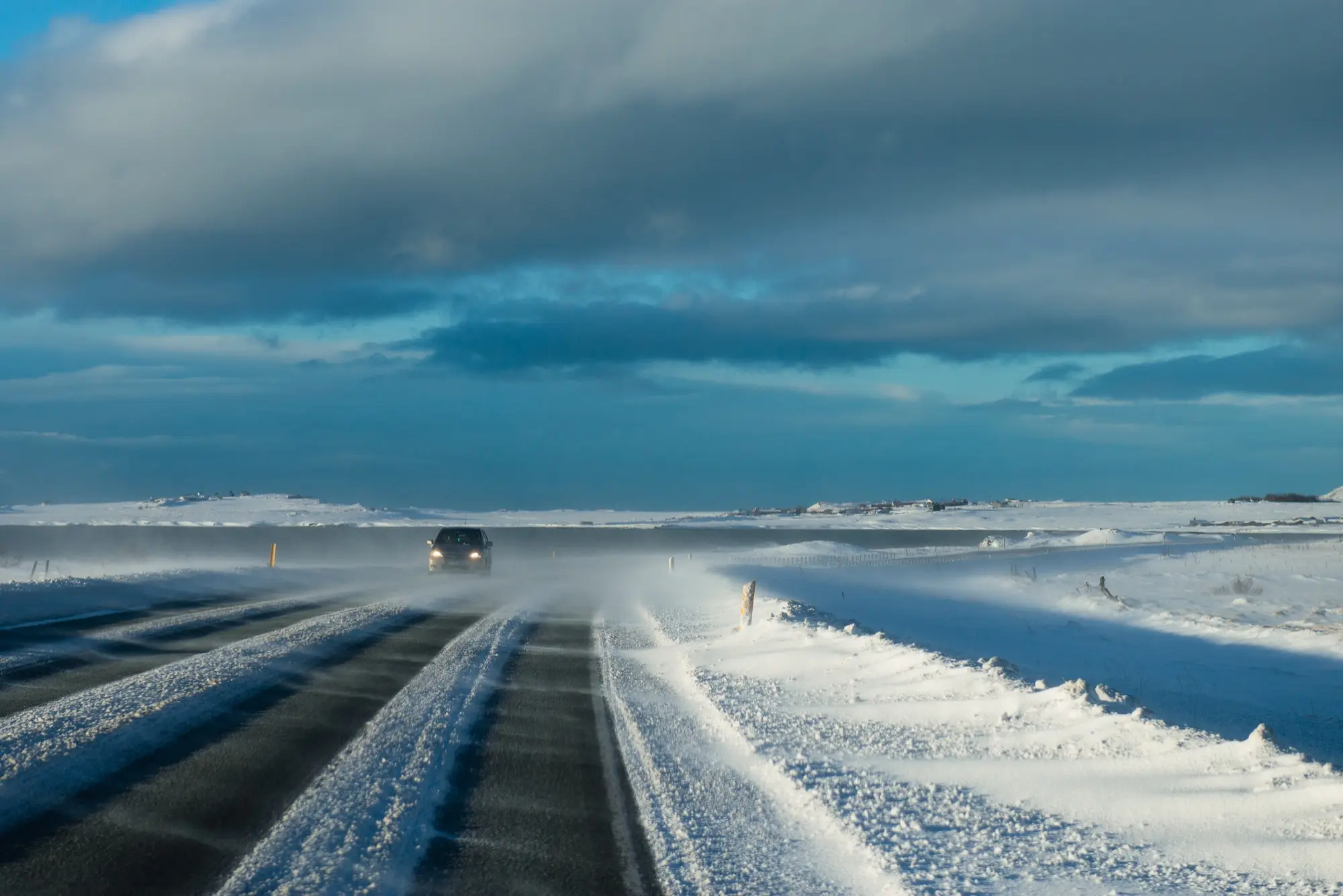

In the 1991-2020 normals Reykjavík's mean temperature stays just above freezing through the winter months while Akureyri's dips below it from December to February. Days are short, with 4h 06m of daylight in Reykjavík on 21 December, and while the Ring Road is open all year, winter storms close stretches temporarily and the highland tracks are shut. Major destinations including the Golden Circle, the Blue Lagoon and public pools remain open, while natural ice caves are accessible on guided tours only.
Opening hours and tour seasons are as each operator lists them on its own site and can change, so always verify specific dates before setting out.
What winter in Iceland is like: temperatures and weather
Winter conditions in Iceland vary considerably between the south and north coasts. The figures below are monthly means of day and night together, drawn from the Icelandic Met Office's 1991-2020 normals.
| Month | Reykjavík | Akureyri |
|---|---|---|
| November | about 2.3 °C | about 0.6 °C |
| December | about 0.7 °C | about -0.7 °C |
| January | about 0.7 °C | about -0.5 °C |
| February | about 0.5 °C | about -0.8 °C |
| March | about 1.2 °C | about 0.1 °C |
Visit Iceland says the weather changes quickly and the seasons blend into one another. In winter the weather can be very harsh, bringing fierce winds alongside snow or rain coming down sideways, which is why Visit Iceland advises against wearing cotton and jeans. Safetravel warns that winter conditions can occur in spring and autumn as well as in winter. Safetravel also notes that strong winds, snow, rain and drifting snow make driving difficult and sometimes dangerous even when the roads look clear. For advice on layers, consult our Iceland packing list. For a broader seasonal overview, compare these months in our guide to the best time to visit Iceland, or see how they contrast with Iceland in summer.
How short the days are
Daylight changes rapidly over the winter months. Iceland keeps the same clock all year, with no summer time. All sunrise, sunset, day length and darkness figures below are computed on this site, sampled on the 1st of each month and on the winter solstice, in 2026, in local time. You can check daily tables directly for Reykjavík daylight and Akureyri daylight. If you are travelling specifically mid-season, see our detailed guide to Iceland in December.
In Reykjavík:
- 1 November: sunrise at 09:14, sunset at 17:10 (7h 56m of daylight; dark enough for the aurora for 10h 32m)
- 1 December: sunrise at 10:48, sunset at 15:47 (4h 58m of daylight; dark enough for the aurora for 12h 32m)
- 21 December: sunrise at 11:22, sunset at 15:29 (4h 06m of daylight; dark enough for the aurora for 12h 58m)
- 1 January: sunrise at 11:18, sunset at 15:43 (4h 24m of daylight; dark enough for the aurora for 12h 48m)
- 1 February: sunrise at 10:05, sunset at 17:15 (7h 10m of daylight; dark enough for the aurora for 11h 08m)
- 1 March: sunrise at 08:31, sunset at 18:46 (10h 16m of daylight; dark enough for the aurora for 8h 24m)
In Akureyri:
- 1 November: sunrise at 09:08, sunset at 16:45 (7h 36m of daylight; dark enough for the aurora for 10h 30m)
- 1 December: sunrise at 10:57, sunset at 15:08 (4h 12m of daylight; dark enough for the aurora for 12h 38m)
- 21 December: sunrise at 11:39, sunset at 14:42 (3h 04m of daylight; dark enough for the aurora for 13h 04m)
- 1 January: sunrise at 11:30, sunset at 14:59 (3h 28m of daylight; dark enough for the aurora for 12h 56m)
- 1 February: sunrise at 10:02, sunset at 16:47 (6h 44m of daylight; dark enough for the aurora for 11h 08m)
- 1 March: sunrise at 08:20, sunset at 18:26 (10h 06m of daylight; dark enough for the aurora for 8h 14m)
These extensive dark hours provide ample sky darkness for spotting the northern lights. Read our guide to the northern lights in Iceland, or consult the nightly verdict for Reykjavík aurora viewings or Akureyri aurora viewings. Safetravel says to allow extra time in winter and to expect limited daylight, which can make driving harder.
Roads in winter: what stays open and what closes
Visit Iceland says the Ring Road (Route 1, the main national circular route) is paved and open all year, though winter weather can close stretches of it temporarily. The Road Administration (Vegagerðin) services roughly 5,000 km of the 12,000 km of Icelandic highway in winter, and oversees and pays for all snow and ice removal on the routes it manages. Winter service is split into prioritised divisions, and how each road is serviced depends on traffic volume and an assessment of conditions. The Road Administration does not treat ice on every road in the network. On regular service days, snow and ice removal in each region should be finished before the regular morning traffic starts.
The Road Administration says icy roads cannot be fully prevented, and that ice can form at very short notice, forming on bridges, lowlands and shaded stretches more than elsewhere. Its traffic centre monitors road conditions 24 hours a day, 365 days a year, coordinates winter service and monitors road closures caused by weather or natural disasters. The Road Administration also runs SMS alerts regarding avalanche or collapse danger for select roads: Route 61 at Súðavíkurhlíð, 64 Flateyrarvegur, 76 Siglufjarðarvegur, 82 Ólafsfjarðarmúli, Route 1 through Fagridalur and 62 through Raknadalshlíð. Anyone can sign up for these alerts by e-mail or through the 1777 telephone line. On those roads, when a state of avalanche danger is declared the road is closed, and it reopens when the danger is over.
Safetravel notes that F-roads (fjallvegir, mountain tracks) are usually closed from mid-September until June or July, and during that period only a modified vehicle (a superjeep) can travel there. Vatnajökull National Park says that in winter the roads in its highland areas are closed, though the areas stay open for winter tourism.
Safetravel warns that road conditions can change rapidly and directs drivers to umferdin.is to check status. On umferdin.is you can select a road and see how its winter service is carried out. The Road Administration gives weather and road information on umferdin.is and by phone through the 1777 information service, which is open from 06:30 to 22:00 every day, all year round. Safetravel cautions that Google Maps and other map apps may not show closed or impassable roads. Always respect road closures; lokað means closed. For more details on rules, consult our guide to driving in Iceland.
Winter tyres, studs and getting the car ready
Safetravel says a hire car should have winter equipment such as winter tyres, noting that four-wheel drive helps in some conditions but does not remove the risk of skidding on ice. When there is snow or ice on the road, a vehicle must have snow chains or, depending on conditions, other equipment that gives grip, such as winter-pattern tyres with or without studs.
By regulation, chains and studded tyres may not be used from 15 April to 31 October inclusive, unless driving conditions require them. This rule leaves studded tyres free to use from 1 November to 14 April. Using studded tyres when they are not allowed is fined 20 thousand krónur per tyre. For winter visits Vatnajökull National Park recommends crampons and suitable tyres, such as winter, all-season or studded tyres, as roads and footpaths may be slippery.
Vehicle lighting and preparation are strictly enforced:
- Front and rear lights must be on at all times in Iceland.
- Safetravel says a car's automatic light setting often does not turn on the rear lights, so walk round the car and check that every light is lit.
- Clear all snow and ice off the windows, mirrors, lights and roof before setting off.
What is open in winter
Many key tourist sites operate throughout the winter season:
- The Golden Circle: Visit Iceland gives the route as approximately 250 km from and back to Reykjavík, with all year as the time to travel and no 4x4 required. Many visitors complete this via day trips from Reykjavík. Within the route, Þingvellir National Park is open 24/7 and charges no entrance fee. Gullfoss is open all year, though in winter trails to the lower viewing platforms are sometimes closed by ice and snow.
- Vatnajökull National Park: The park states that in winter its areas, visitor centres, campsites and destinations on Route 1 are accessible, road and weather conditions permitting, while the mountains and hills are under snow. Park rangers look after Jökulsárlón, Fellsfjara and Fjallsárlón every day of the year, and are also responsible for the ice caves in Breiðamerkurjökull. Visit Iceland says boat tours on Jökulsárlón wind down as winter approaches, but watching the icebergs from the shore is possible all year.
- Lagoons and pools: The Blue Lagoon says it is open every day of the year. Its winter opening hours run from 08:00 to 22:00 from 21 August to 31 December and 08:00 to 20:00 from 1 January to 31 May, with guests asked to leave the water 30 minutes before closing. Visit Iceland highlights that Icelanders use swimming pools and hot tubs in rain, snow or shine; public pools exist in towns across the country, many featuring hot tubs and steam rooms, with Laugardalslaug and Vesturbæjarlaug serving as local favourites in Reykjavík. For more capital amenities, see our guide to Reykjavík in winter. Other winter lagoon suggestions from Visit Iceland include Sky Lagoon near Reykjavík, Forest Lagoon in Akureyri and Earth Lagoon Mývatn. The mandatory rule in Icelandic pools is to shower thoroughly with soap, without your swimsuit, before entering the water.
- Tours: Elding runs classic whale watching from Reykjavík all year, operating from the Old Harbour at Ægisgarður. Visit Iceland adds that many riding stables offer guided horse riding tours all year, with routes adjusting according to the weather.
Ice caves: guided tours only
Visit Iceland says November typically marks the start of the natural ice cave season, noting that because glaciers move, caves can look different from one winter to the next. Visit Iceland stresses that you must always enter an ice cave with a qualified glacier guide, who assesses the ice and provides the necessary safety equipment. For more on planning these trips, read our guide to ice caves and glacier hikes in Iceland.
Local Guide of Vatnajökull states that the ice cave season typically runs from October to March, depending on weather and glacier conditions, and can sometimes extend into April. The operator notes that visiting ice caves on Vatnajökull without a guide is not allowed and is extremely dangerous because the caves are unstable and conditions change rapidly. The caves are only entered when safe; guides check glacier and weather conditions daily, and tours are rescheduled or refunded if conditions become unsafe.
Schedules vary across operators:
- Glacier Adventure lists its Crystal Ice Cave Adventure on Vatnajökull for November to April.
- Glacier Adventure lists its longer Blue Ice Cave Adventure for October to April.
- Glacier Guides lists a natural ice cave tour in Mýrdalsjökull from Vík as running all year.
Ice cave tours and glacier walks on Breiðamerkurjökull, Falljökull/Virkisjökull and Skeiðarárjökull in Vatnajökull National Park are run by companies under contract with the park, valid from 1 October 2025 to 30 September 2027.
What does not run: the highlands and the highland buses
Interior routes are shut down for normal traffic during winter. Vatnajökull National Park says that in winter the roads in its highland areas are closed, even though the areas themselves stay open for winter tourism. Safetravel explains that F-roads are usually closed from mid-September until June or July, and in that period only a modified vehicle (a superjeep) can access them. The Road Administration notes that mountain roads are only open a couple of months a year.
Highland bus transfers do not operate over the winter months. For example, Reykjavik Excursions' 2027 Highland Bus to Landmannalaugar (route HB02) runs only from 18 June to 12 September, and the 2027 Highland Bus to Þórsmörk (route HB01) runs from 11 June to 15 September.
Christmas and New Year
Visit Iceland explains that the 13 Yule Lads (jólasveinarnir) are sometimes called the Icelandic Santas, though they are pranksters rather than saints. Children place a shoe in the window from 11 to 24 December hoping for a small present from them. Most Icelanders celebrate Christmas on Christmas Eve, 24 December, opening their presents after dinner. If you want to visit seasonal stalls, check the dates and opening hours for the Reykjavík Christmas markets.
Holiday opening hours affect basic services:
- Grocery shops: Visit Iceland states that grocery shops are generally open until noon on 24 December, closed on the 25th, and open again on the 26th or 27th. For the New Year, grocery shops close at noon on 31 December, remain closed on 1 January, and reopen on the 2nd or 3rd.
- Restaurants: Visit Iceland says Reykjavík restaurants are generally open in winter but hours vary around Christmas, so book ahead, especially for 24, 25, 26 and 31 December and 1 and 2 January, when some shut or shorten their hours.
- Attractions: The Blue Lagoon operates special hours of 08:00 to 16:00 on Christmas Eve and 08:00 to 18:00 on New Year's Eve.
- Celebrations: On New Year's Eve, Visit Iceland suggests heading up to Hallgrímskirkja, Perlan or another high point in the capital area around midnight to watch the fireworks.
Staying safe: 112, a travel plan and weather warnings
In an emergency anywhere in Iceland, call 112.
Safetravel says the first step for any traveller is to leave a travel plan with someone who can react. This plan provides ICE-SAR (the Icelandic Association for Search and Rescue) with the details needed to start a search or rescue if an incident occurs. The plan must name an emergency contact who is not travelling on the trip. Vatnajökull National Park also instructs visitors to check Met Office forecasts on vedur.is, inspect road conditions with the Road Administration, record a travel plan at safetravel.is, and call 112 in an emergency.
Safetravel emphasises that conditions depend entirely on the weather. You should check the forecast at least once a day on en.vedur.is and watch Safetravel's website and app for travel alerts. Keep your plans flexible and be ready to adapt or cancel them if conditions turn unsafe; if the weather becomes too severe, wait in a safe place until it calms down.
The Icelandic Met Office issues weather warnings using three colour tiers based on how dangerous the weather is:
- Forecasters set the warning colour by judging the expected impact and the likelihood of the forecast.
- Assessed impacts include disrupted transport, damage to property and buildings, and the risk of accidents.
- Yellow warning: The lowest level. It is used either when the impact will be limited though the weather is likely, or when severe weather further ahead is less likely. A yellow warning can also signal a small or moderate chance of very severe weather 3 to 5 days ahead, moving up to orange as the forecast becomes more certain.
- Orange warning: Represents an intermediate threat with higher societal impact and certainty.
- Red warning: The highest level, indicating weather that will have a major impact on society.