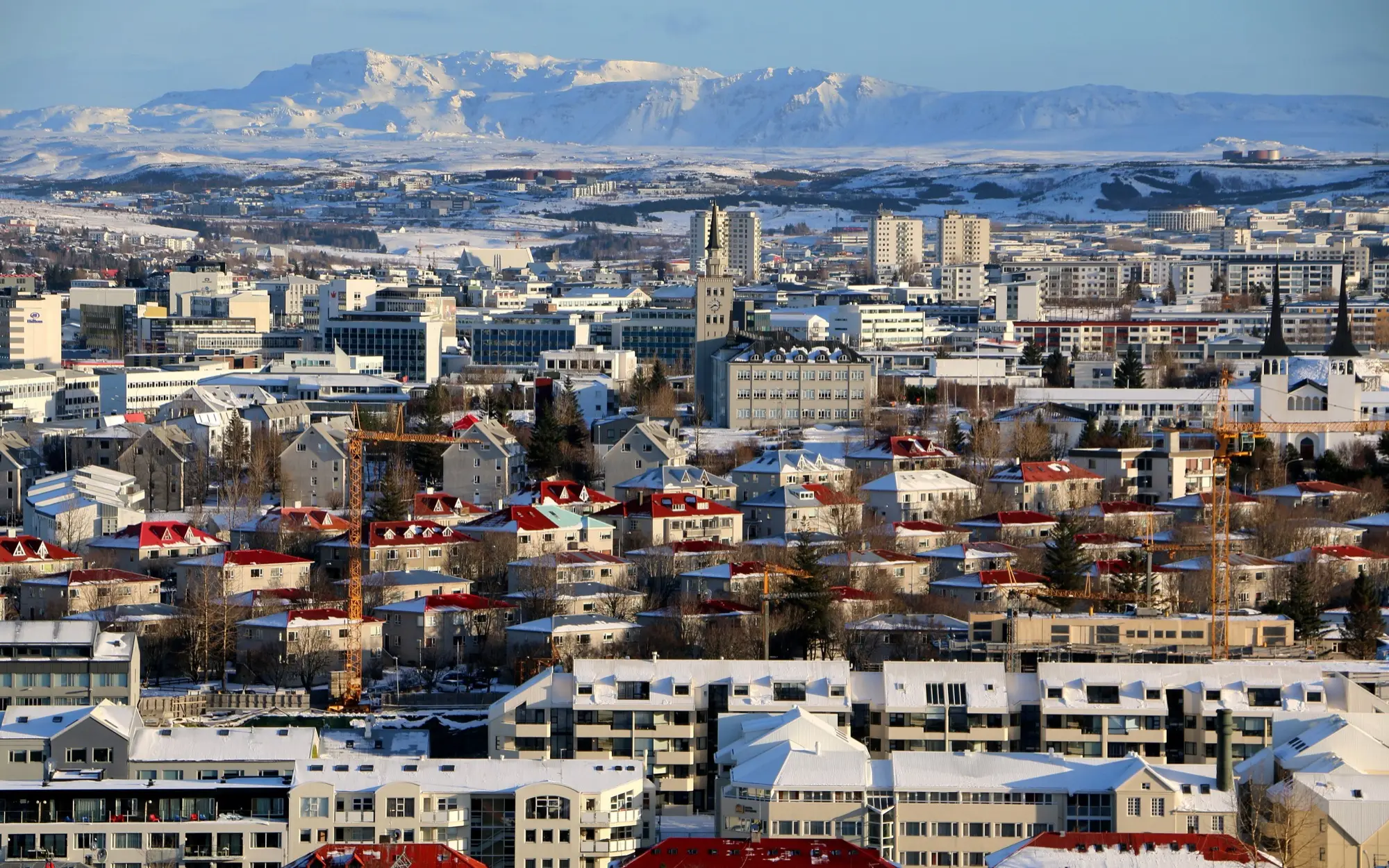

Reykjavík's winter is dark and windy rather than very cold, with 1991–2020 mean temperatures staying just above freezing at about 0.5 to 2.3 °C from November to March. On 21 December the sun is up only from 11:22 to 15:29, but the city's geothermal pools, museums, and lagoons open all winter, so you can plan the short days around them.
This guide covers the capital itself. If you want to head out across the country for the classic sights or ice caves, see Iceland in winter or browse day trips from Reykjavík.
What winter in Reykjavík is like
Reykjavík does not experience extreme Arctic cold during the winter months, but it does face persistent wind, rain, and rapid shifts in conditions. Safetravel notes that strong winds, snow, rain, and drifting snow can make driving difficult and sometimes dangerous even when the roads look clear.
The figures below show the monthly means of day and night combined, drawn from the Icelandic Met Office's 1991–2020 normals.
| Month | Reykjavík mean temperature |
|---|---|
| November | about 2.3 °C |
| December | about 0.7 °C |
| January | about 0.7 °C |
| February | about 0.5 °C |
| March | about 1.2 °C |
How short the days are
Daylight changes rapidly over the winter season. Iceland keeps the same clock all year, with no summer time. All solar times, day lengths, and aurora-dark periods below are computed on this site and sampled on the 1st of each month and the winter solstice in local time; you can find full daily figures via the Reykjavík daylight calculator.
- 1 November: sunrise at 09:14, sunset at 17:10; 7h 56m of daylight; dark enough for the aurora for 10h 32m.
- 1 December: sunrise at 10:48, sunset at 15:47; 4h 58m of daylight; dark enough for the aurora for 12h 32m.
- 21 December (winter solstice): sunrise at 11:22, sunset at 15:29; 4h 06m of daylight; dark enough for the aurora for 12h 58m.
- 1 January: sunrise at 11:18, sunset at 15:43; 4h 24m of daylight; dark enough for the aurora for 12h 48m.
- 1 February: sunrise at 10:05, sunset at 17:15; 7h 10m of daylight; dark enough for the aurora for 11h 08m.
- 1 March: sunrise at 08:31, sunset at 18:46; 10h 16m of daylight; dark enough for the aurora for 8h 24m.
Long stretches of darkness mean more hours to watch for the northern lights. To learn about conditions across the country, check when and where to see the aurora, and see tonight's aurora verdict for Reykjavík.
The pools: the city's winter habit
Visiting public swimming pools and soaking in heitir pottar (communal hot tubs) is a daily local routine regardless of rain, snow, or shine. Icelandic swimming pool culture is inscribed on UNESCO's list of the intangible cultural heritage of humanity, and you can explore Reykjavík's eight city swimming pools across the capital. Prices and opening hours are set by each facility and can change.
Strict hygiene and privacy rules apply at every municipal bathhouse:
- Every swimmer must shower thoroughly without swimwear before entering the pool.
- Cameras, phones, and other smart devices are banned in changing rooms and pool areas.
Since 5 May 2026, a single swim at a Reykjavík city pool costs 1,500 kr. for adults and 400 kr. for children aged 10–17. Children aged 0–9 accompanied by a guardian go free. If you need equipment, swimwear rental costs 1,270 kr. and towel rental costs 860 kr., or you can pay 2,770 kr. for a combined ticket covering a swim, towel, and swimsuit.
Three central pools are particularly practical in winter:
- Laugardalslaug: The city calls this the largest swimming pool in Iceland. It features a 50-metre outdoor pool, an indoor pool, children's pools, a steam room, a cold tub, and water slides.
- Sundhöll Reykjavíkur: Opened in 1937 in a building by the architect Guðjón Samúelsson, with an extension opened on 3 December 2017. It has a 25-metre indoor pool, hot tubs, a cold tub, a sauna, a steam room, and a rooftop terrace with sun loungers.
- Vesturbæjarlaug: Located on Hofsvallagata. It opens Monday to Friday from 6:30 a.m. to 10 p.m. and Saturday and Sunday from 9 a.m. to 10 p.m.
For a different outdoor dip, Nauthólsvík geothermal beach offers sea swimming, bathing facilities, and hot tubs all year round, including a 38°C hot tub right by the service building. The sand beach and lukewarm sea lagoon are added only in summer. During winter, from 19 August to 14 May, the facility is closed on Mondays and Sundays, opening Tuesday to Friday from 11:00 to 19:00 and Saturday from 11:00 to 16:00 (in summer, from 15 May to 18 August, it opens daily from 10:00 to 19:00).
Lagoons near the city
If you want a dedicated spa experience, geothermal lagoons operate throughout the winter months.
- Sky Lagoon: Situated on the coast at Vesturvör 44 in Kópavogur, this oceanside geothermal lagoon features an infinity edge looking over the sea. It is open all year and includes a seven-step ritual with a sauna, body scrub, cold mist, and steam room.
- The Blue Lagoon: Located on the Reykjanes peninsula, the Blue Lagoon is open every day of the year. Winter opening hours run from 08:00 to 22:00 between 21 August and 31 December, and from 08:00 to 20:00 between 1 January and 31 May. Swimmers must leave the water 30 minutes before closing time.
Visit Iceland's winter suggestions also include Forest Lagoon in Akureyri and Earth Lagoon Mývatn.
Indoors when the light goes: museums and Harpa
When daylight fades in the afternoon, cultural venues, galleries, and historic sites remain open across the centre.
- Hallgrímskirkja: Entry to the church itself is free, while access to the tower requires a ticket. From 1 September, winter opening hours run from 10:00 to 17:00, with last entry to the tower at 16:45. Tower admission costs 1,500 kr. for adults and 200 kr. for children aged 7–16; tickets are sold only in the church shop, cannot be booked in advance, and remain valid for a single entry on the day of purchase. Services, ceremonies, and concerts restrict access to both the church and tower.
- Perlan: Located on the Öskjuhlíð hill, its exhibitions open from 9:00 to 21:00. Inside is a walk-through ice cave 100 metres long built with an estimated 350 tons of snow, alongside an indoor geyser that shoots water 25 metres up into the atrium.
- National Museum of Iceland: Displays the permanent exhibition on national heritage and opens daily from 10:00 to 17:00. Admission costs ISK 3,300 for adults and ISK 1,600 for students and seniors; children under 18 and people with disabilities go free.
- Reykjavík Art Museum: Operates across three separate venues under one general ticket costing ISK 2,550 for adults and ISK 1,550 for students (free for visitors under 18). Hafnarhús (Tryggvagata 17) and Kjarvalsstaðir (Flókagata 24) open from 10:00 to 17:00, with Hafnarhús remaining open until 22:00 on Thursdays. The third venue, Ásmundarsafn (Sigtún), opens from 13:00 to 17:00.
- National Gallery of Iceland: Open every day from 10am to 5pm.
- Harpa Concert Hall: The glass building by the harbour is open Monday and Tuesday from 10:00 to 18:00, Wednesday to Saturday from 10:00 to 20:00, and Sunday from 10:00 to 18:00.
- Kolaportið: Iceland's indoor flea market has operated in the old customs house by the harbour at Tryggvagata 19 since 1989. It opens every Saturday and Sunday all year, and entry is free.
Outdoors in daylight
Make the most of the midday light on the water or along the coast.
- Whale watching: Elding operates its classic boat tour all year round from Ægisgarður 5c at the Old Harbour. Tickets cost 14,500 ISK for adults and 7,250 ISK for children aged 7–15, while children aged 0–6 go free. Elding lists these prices as valid from 1 April 2025 to 31 March 2027.
- Viðey Island: The ferry to Viðey runs winter weekend sailings leaving Skarfabakki at 13:15, 14:15, and 15:15, with returns leaving the island at 14:30, 15:30, and 16:30.
- Grótta: Located at the westernmost tip of the greater Reykjavík area, you can walk the causeway out to the lighthouse only at low tide. Nearby, the Kvika foot bath provides a spot to soak your feet in warm geothermal water.
Christmas and New Year in the city
Winter festivities transform the city centre from mid-November onwards. Icelandic folklore features 13 jólasveinar (Yule Lads), who visit children on the 13 consecutive nights before Christmas, placing small gifts inside shoes left on window sills. You can find detailed festive customs in the guide to Christmas in Iceland.
In town, the illuminated Yule Cat (Jólakötturinn) stands on Lækjartorg; the city switched its lights on at 5 pm on Saturday 14 November. Nearby on Austurvöllur square stands the Oslo Christmas tree, felled in the Heiðmörk woods, whose lights are switched on on 29 November, the first Sunday of Advent. Beside it sits the Austurvöllur Christmas market. Its operating hours are:
- Monday to Thursday: 16:00 to 20:00
- Friday to Sunday: 13:00 to 20:00
- Þorláksmessa (St Thorlak's Day, 23 December): 14:00 to 23:00
For additional locations, see the Reykjavík Christmas markets guide.
Holiday closures require advance planning:
- Christmas Eve and Christmas Day: Most Icelanders celebrate on Christmas Eve (24 December) and open gifts after dinner. Grocery shops generally stay open until noon on 24 December, close entirely on 25 December, and reopen on either the 26th or 27th.
- New Year: Grocery shops close at noon on 31 December, remain closed on 1 January, and reopen on 2 or 3 January. For midnight fireworks on New Year's Eve, Visit Iceland recommends walking up to Hallgrímskirkja, Perlan, or another elevated spot in the capital area.
- Restaurants: Dining rooms generally trade throughout the winter, but opening hours vary substantially over the holidays. You must book ahead for 24, 25, 26, and 31 December, as well as 1 and 2 January, when several venues close or run limited sittings.
- Special lagoon hours: The Blue Lagoon runs shorter hours on holidays, opening from 08:00 to 16:00 on Christmas Eve and from 08:00 to 18:00 on New Year's Eve.
Getting around and the City Card
Public transit in the capital area is run by Strætó buses. A single adult fare costs 690 kr., the same when you pay contactless with a card or phone. The Klappið mobile app sells fares, calculates routes, and tracks bus locations in real time.
If you plan to visit multiple attractions, the Reykjavík City Card covers unlimited municipal bus travel, entry to 17 museums and attractions, a ferry ride, and admission to eight city pools (including Laugardalslaug, Sundhöll Reykjavíkur, and Vesturbæjarlaug). The card costs:
- 24 hours: 6,100 ISK
- 48 hours: 8,500 ISK
- 72 hours: 10,500 ISK
Every pass grants the same access regardless of the time tier chosen.
Weather warnings and safety
Winter weather alerts are issued by the Icelandic Met Office using a three-tier colour system: yellow, orange, and red. The colour is set by forecasters judging the expected impact and how likely the forecast is.
- Yellow warning: The lowest level, used either when the impact will be limited though the weather is likely, or when severe weather further ahead is less likely. A yellow warning can also mean a small or moderate chance of very severe weather 3 to 5 days ahead, and it moves up to orange as the forecast becomes more certain.
- Red warning: The highest level, meaning weather with major impact on society.
Check road and weather reports before heading outside, and call 112 in an emergency.