
The Golden Circle loop is about 250 km, Vík on the south coast about 190 km, Hvalfjörður about 50 km and Hveragerði 45 km. Strætó's regional buses reach Hveragerði, Akranes, Landeyjahöfn for the Westman Islands ferry and the south coast. Landmannalaugar and Þórsmörk have summer highland buses, while the Golden Circle, Hvalfjörður, Borgarfjörður and Snæfellsnes are simplest by car or on a tour. For details on the sights themselves, read the guide to things to do in Iceland.
Day trips from Reykjavík in one answer
Visit Iceland gives the Golden Circle as approximately 250 km from and back to Reykjavík, drivable all year without a 4x4. To the south, Visit Iceland puts Vík about 190 km from Reykjavík, while Visit South Iceland puts Hveragerði 45 km away, where the best-known walk is the hike to Reykjadalur valley to bathe in a hot river.
To the north and west, Visit West Iceland puts Hvalfjörður, the Whale Fjord, 50 km from Reykjavík. Further inland, Krauma, the geothermal baths beside Deildartunguhver on road 50, is 97 km from the capital. Out on the western coast, Visit Iceland gives the Snæfellsnes drive as a 260 km loop starting and ending in Borgarnes, which is possible in 1 day though 2 to 3 days are recommended; a standard car is fine on the main paved roads all year. For those heading towards the Reykjanes peninsula, Keflavík International Airport is approximately 50 km from central Reykjavík.
Getting out of Reykjavík without a car
Iceland's regional buses are owned and operated by the Icelandic Road and Coastal Administration (Vegagerðin, IRCA), with Strætó providing passenger services and travel information. On countryside trips, you pay on board by debit or credit card, in cash, or with a regional bus card.
For interior highland routes, Reykjavik Excursions runs its Highland Bus using a specially upgraded bus built for the rough terrain and deep river crossings of the mountain roads.
Winter travel requires planning around limited light. According to daylight records for daylight in Reykjavík, on 1 December the city has 4 hours 58 minutes of daylight, with sunrise at 10:48 and sunset at 15:47. By 21 December, the sun rises at 11:22 and sets at 15:29, leaving 4 hours 6 minutes. A winter day trip needs an early start so you are out of the car during daylight.
1. The Golden Circle: Þingvellir, Geysir and Gullfoss in about 250 km
Visit Iceland gives the Golden Circle as approximately 250 km from and back to Reykjavík, drivable all year without a 4x4. A car or an organised tour is the simple way to travel the route. Those planning an evening stop can check the local aurora forecast for Þingvellir northern lights.
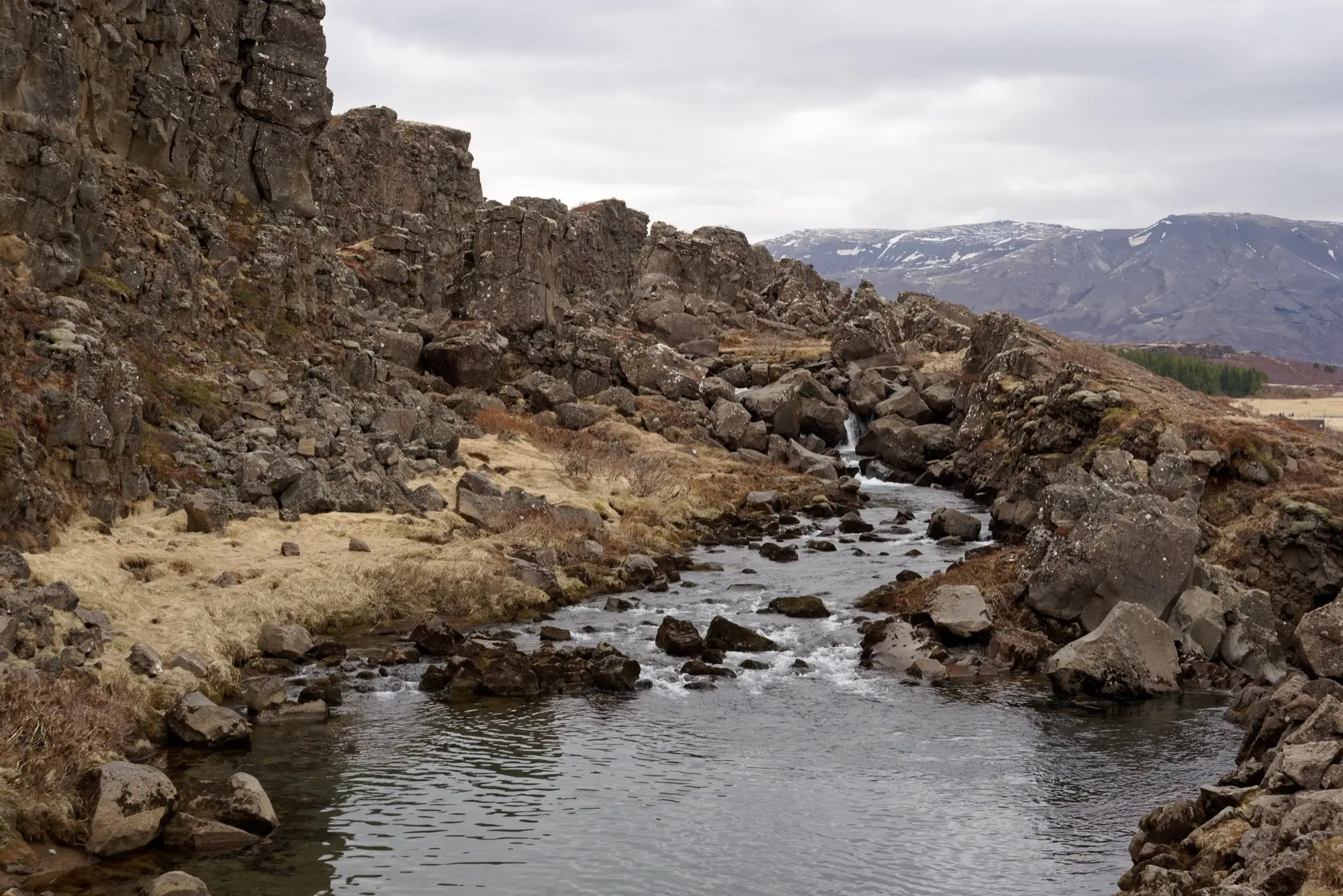
Þingvellir National Park is open 24/7 and charges no entrance fee. Further east at the geothermal area, the Great Geysir barely spouts, but Strokkur erupts every 8 to 10 minutes, throwing water up to 30 metres into the air. All visitors must keep to the marked walkways throughout the hot spring area, and throwing stones, coins or anything else into the springs is prohibited.
Gullfoss waterfall is open all year. In winter, the paths leading to the lower viewing platforms are sometimes closed by ice and snow.
2. The south coast to Vík: about 190 km from Reykjavík
Visit Iceland puts Vík about 190 km from Reykjavík. If travelling without a private car, Strætó lists regional route 52 running along the south coast between Reykjavík and Höfn. Its scheduled stops include Hvolsvöllur, Skógar and Vík (Vík í Mýrdal). Because timetables vary, check Strætó's timetable before relying on a same-day return. If staying overnight or returning late, check the conditions for Vík northern lights.
Visit South Iceland states that Seljalandsfoss waterfall stands about 30 km west of Skógar and is 60 metres high, with a walking track behind the cascade at the bottom of the cliff. In winter, the paths around Seljalandsfoss can become slippery, and large pieces of ice fall from the rock face. Continuing east, the Environment Agency of Iceland gives Skógafoss as approximately 60 metres high and 25 metres wide.
At the black sand beach of Reynisfjara near Vík, Safetravel requires visitors to stay well back from the water's edge, never turn their back on the sea, keep children with an adult, and beware of falling rock near the cliff. Warning lights installed at the beach entrance signal the current hazard level. When the light shows orange, visitors must stay at least 25 metres from the sea. On a red light, the beach is closed, though you can remain at the designated viewing area.
3. The Blue Lagoon and Reykjanes: bathing water at 37 to 40°C
The Blue Lagoon's history begins with the Svartsengi geothermal power plant, constructed in the mid-1970s. Water for the lagoon emerges from underground at 240°C and cools to a bathing temperature between 37 and 40°C. Flybus, the airport coach service run by Icelandia from the BSÍ bus terminal, operates between Reykjavík and Keflavík Airport all year and offers direct connections to the Blue Lagoon.
Visit Iceland reports that volcanic eruptions have taken place along the Sundhnúkur crater row near Grindavík since December 2023, most recently in July 2025, and that Grindavík reopened to visitors in October 2024. In an update dated September 2025, Safetravel stated that there was no active eruption in the Grindavík area and Grindavík was open, but warned that crevasses can be expected and visitors must stay on marked paths. Safetravel rules state that it is strictly forbidden to hike on the lava even after an eruption has ceased, because the material underneath may still be fresh. Always check Safetravel on the day of travel.
4. Hveragerði, 45 km away, and the Reykjadalur hot river
Visit South Iceland places the town of Hveragerði 45 km from Reykjavík. Its best-known walk is the trail into Reykjadalur valley, where visitors can bathe in a naturally heated river. The route passes active hot springs and geothermal terrain on the way to the water; for part of the river's length, the temperature is suitable for bathing.
Strætó operates regional route 51 between Reykjavík (Mjódd) and Selfoss, which stops directly in Hveragerði. The Reykjadalur trail can be closed at certain times; Visit South Iceland advises walkers to check Safetravel to confirm whether the valley is open before setting off, and to keep strictly to the paths.
5. The Westman Islands: Herjólfur from Landeyjahöfn, 2,700 ISK each way
The Westman Islands (Vestmannaeyjar), situated off the south coast, form an archipelago of 15 volcanic islands where only Heimaey is inhabited. In 1973, the Eldfell volcano erupted at the edge of the town, forcing the entire population to evacuate within a few hours. Today, visitors can walk on the cooled lava.
The Herjólfur ferry sails from Landeyjahöfn on the south coast, carrying both vehicles and foot passengers. In periods of storms or heavy sand buildup, the vessel may sail from Þorlákshöfn instead. Herjólfur's own price list is headed 2026, on which children under 12 travel free. Visit Iceland lists the one-way adult passenger fare as 2,700 ISK, with children under 12 free and a charge of 4,050 ISK extra for a car each way.
Public transport connects directly to the harbour: Strætó's route 53 trips are timed around Herjólfur's arrivals and departures at Landeyjahöfn. If the harbour closes due to conditions, route 53 terminates at Hvolsvöllur.
6. Landmannalaugar: the highland bus from 18 June to 12 September 2027
Landmannalaugar is bordered by colourful mountains and serves as the starting point for the Laugavegur trail, probably Iceland's best-known hike. Road access is via the F208 mountain road, with the final 2.5 km on the F224.
Two rivers must be crossed immediately before reaching Landmannalaugar. Drivers can choose to park at the P1 car park without crossing the rivers and walk into the site via a footbridge. Safetravel warns that F-roads are usually closed from mid-September until June or July, so verify whether they are open before departing. Safetravel also states that not every 4WD vehicle is suitable for F-roads, and no insurance policy covers damage caused to a vehicle while crossing a river.
For public transport, Reykjavik Excursions' 2027 Highland Bus timetable runs route HB02 to Landmannalaugar from 18 June to 12 September. It departs the BSÍ terminal in Reykjavík at 07:00 and arrives at 11:30. The return bus leaves Landmannalaugar at 15:45 and reaches BSÍ at 20:20. In addition, operator Trex takes bookings for 18 June to 5 September 2027, listing its daily highland bus from Reykjavík to Landmannalaugar at 15.900 ISK. Trex notes that visitors travel to Landmannalaugar from June through late September, after which the access road is closed.
7. Þórsmörk: the highland bus from 11 June to 15 September 2027
Trex describes Þórsmörk (Þórsmörk) as an expanse of birch woods lying beneath the Eyjafjallajökull and Mýrdalsjökull glaciers, with the valleys of Þórsmörk, Langidalur and Básar popular for hiking and camping. Skógafoss marks the usual starting point for the hike over Fimmvörðuháls pass to Þórsmörk, a route measuring approximately 24 km.
Safetravel warns that not every 4WD is suitable for mountain tracks, and vehicle damage incurred during river crossings is excluded from all insurance coverage.
Highland bus services eliminate the river-crossing risk for independent hikers. Reykjavik Excursions' 2027 Highland Bus timetable runs route HB01 to Þórsmörk from 11 June to 15 September. The coach leaves the BSÍ terminal at 07:00 and reaches Básar at 11:15; the return leg departs Básar at 15:00 and arrives back at BSÍ at 19:30. Trex operates highland buses to Þórsmörk from 18 June to 5 September 2027, charging a fare of 15.900 ISK from Reykjavík.
8. Hvalfjörður and Akranes: Glymur's 198-metre drop, 50 km from Reykjavík
Visit West Iceland places Hvalfjörður 50 km from Reykjavík. The opening of the Hvalfjörður tunnel in 1998 cut 42 km off the Ring Road, leaving the coastal route around the fjord as a quiet detour.
Near the head of the fjord, Visit Iceland gives Glymur waterfall as 198 metres high. It is accessed via a 7 km circular route starting at Botnsdalur, involving 400 metres of ascent, two steep hills and one or two stream crossings. Visit Iceland recommends preparing for a three-hour hike and avoiding the trail during snow, ice or thaw. Visit West Iceland adds that the path crosses the river on a log, becomes dangerous during winter, and requires proper equipment and mountain experience.
To reach the coast at Akranes without a car, Strætó operates regional route 50 between Reykjavík and Akranes or Borgarnes. Akranes features two lighthouses beside the harbour; the larger structure remains active, is open to the public, and houses a photography exhibition alongside views from the top. The town also contains Langisandur, a sandy strip that is one of three Blue Flag beaches in Iceland. Inland from the coast, Akrafjall mountain can be climbed from the Akranes water works car park up to Háihnúkur at 555 metres, or extended along a longer path to Geirmundartindur at 643 metres.
9. Borgarfjörður: Deildartunguhver and Krauma, 97 km from Reykjavík
Krauma geothermal baths sits on road 50 beside Deildartunguhver, 97 km from Reykjavík. Reaching this area is simplest by car or on an organised tour. Deildartunguhver maintains the highest flow rate of any hot spring in Europe, discharging 180 litres of 100°C water every second, a portion of which is piped to heat residential homes across West Iceland. Krauma uses this source to supply six outdoor baths: five warm and one cold.
Visit Iceland groups Deildartunguhver together with the historic settlement of Reykholt and the Hraunfossar waterfalls, which flow directly out of a lava field, as related sights located close to one another within Borgarfjörður.
10. Snæfellsnes: a 260 km loop from Borgarnes
Visit Iceland records the Snæfellsnes circuit as a 260 km driving loop beginning and ending in Borgarnes. It can be completed as Snæfellsnes in one day, although 2 to 3 days are officially recommended. A standard vehicle is suitable on the main paved roads throughout the year. Often described as "Iceland in miniature", this 90 km peninsula contains examples of almost every Icelandic landscape within a single region.
Along the southern coast, the small fishing hamlets of Arnarstapi and Hellnar are connected by an easy 2.5 km coastal walking path. On the northern shore, Grundarfjörður sits directly beneath the peak of Kirkjufell.
Strætó operates regional route 50 between Reykjavík and Borgarnes. On the peninsula itself, Strætó runs regional route 58 between Borgarnes and Stykkishólmur, alongside route 82 connecting Stykkishólmur and Hellissandur. Travellers must consult Strætó's timetable before attempting to connect these regional lines for a same-day return from Reykjavík.
Whale watching from Reykjavík's Old Harbour
Elding runs classic whale watching tours out of Reykjavík all year, departing directly from the Old Harbour at Ægisgarður. The wildlife species most frequently observed in Faxaflói Bay are humpback whales, minke whales, dolphins and porpoises.
According to Elding's schedule and price list, valid from 1 April 2025 to 31 March 2027, tickets for classic whale watching cost 14,500 ISK for adults and 7,250 ISK for children aged 7 to 15. Children up to 6 years old travel free. If you are staying around the capital after a boat trip, you can check the evening conditions for Reykjavík northern lights.
Staying safe on a day trip: 112, travel plans and river crossings
For any emergency in Iceland, call 112. Safetravel requests that all travellers submit a travel plan to someone capable of taking action if you fail to check in. The Safetravel mobile app allows you to transmit your exact GPS coordinates to emergency responders at 112.
Strict regional safety rules govern specific hazards:
- Highland tracks: Safetravel notes that not every 4WD vehicle meets the demands of mountain F-roads. Vehicle damage sustained during river crossings is completely excluded from rental insurance policies.
- Coastal surf: At Reynisfjara beach, you must remain well back from the water, never turn your back on incoming waves, keep children close to an adult, and maintain awareness of falling rocks near the cliffs.
- Geothermal and volcanic zones: Safetravel warns that hiking on fresh lava fields is strictly prohibited even after active eruptions conclude, as molten rock underneath can remain fresh and unstable. Check Safetravel for status updates before setting out on any road trip.