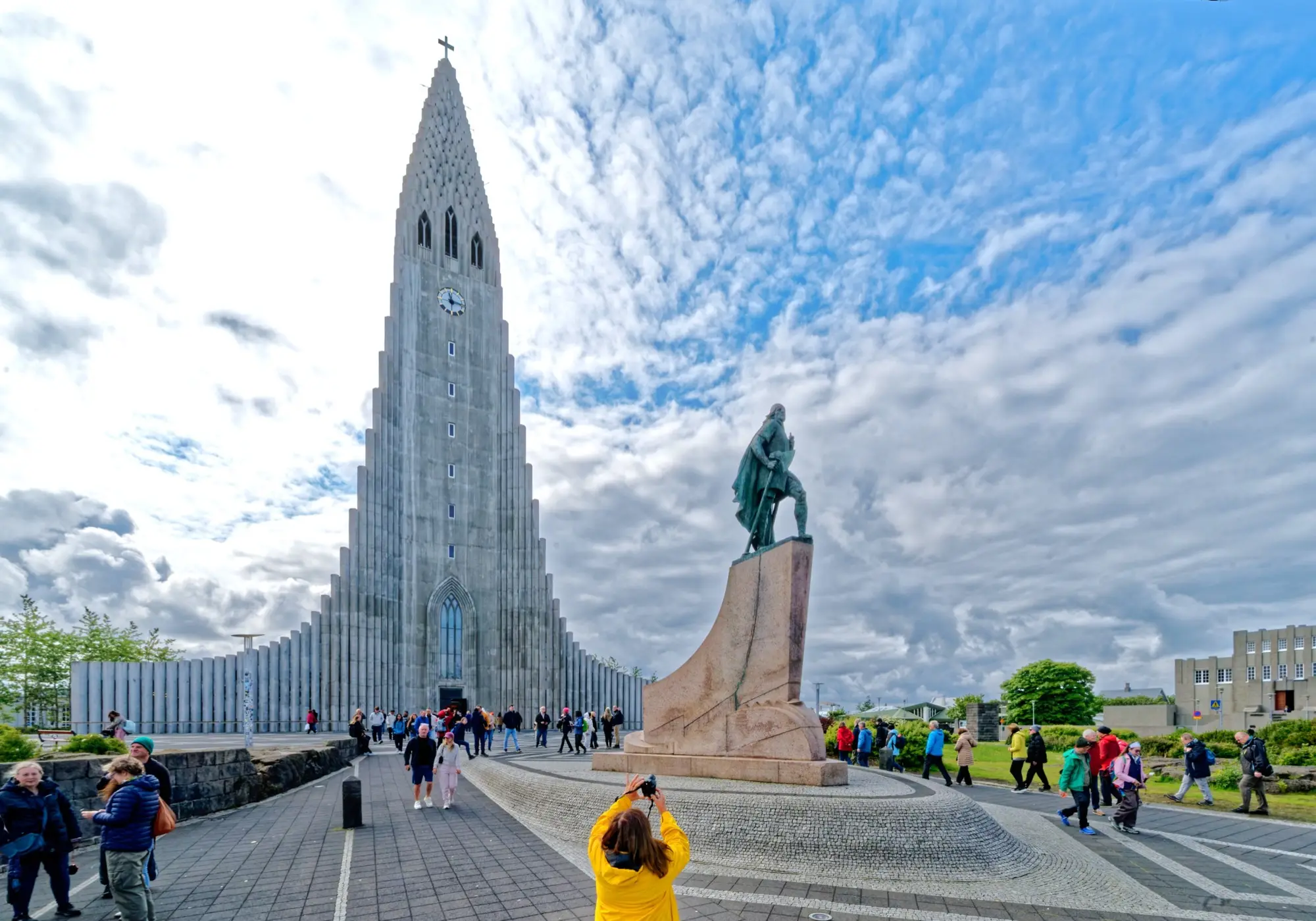

The top things to do in Reykjavík are Hallgrímskirkja, Harpa, the Sun Voyager, the Old Harbour and whale watching, Perlan, the National Museum, the geothermal pools such as Laugardalslaug and Sundhöllin, Grótta, Laugavegur, and the Settlement Exhibition. A single swim at a city pool costs 1,500 kr. for an adult, a Strætó bus fare is 690 kr., and the Reykjavík City Card covers museums, eight pools, the city buses and the Viðey ferry.
To check daylight levels before you head out, see sunrise, sunset and daylight hours in Reykjavík. For night viewing conditions, consult the Reykjavík northern lights guide. If you are planning excursions further afield across Iceland, take a look at our regional guide to things to do in Iceland.
Getting around Reykjavík by bus
An adult single fare on Strætó buses in the capital area is 690 kr., and you pay the same rate when paying contactless with a bank card or phone. Young people aged 12-17 and seniors aged 67 and older pay 345 kr., while children aged 11 and younger ride free.
Klapp is the account-based ticketing system for Strætó's city buses. The Klappið app sells Strætó tickets, plans journeys and tracks the buses in real time. Buses 13 and 18 stop closest to Perlan, and there is free parking outside the building. The City Card covers Strætó buses in the capital area but does not cover bus 55 to Keflavík Airport.
1. Hallgrímskirkja: the 73-metre tower above the city
The church says Hallgrímskirkja is the largest church in Iceland and the tallest building in Reykjavík, with a tower that stands 73 metres high. The state architect Guðjón Samúelsson began designing the church in 1937 as his final work, shaping it to recall columnar basalt, mountains and glaciers. Construction began in 1945, and the church was consecrated on 26 October 1986.
Entry to the church itself is free, so you pay only if you visit the tower. According to Hallgrímskirkja's price list, the tower ticket costs 1,500 kr. for adults as the price from 1 June 2026, and 200 kr. for children aged 7-16. Tickets are sold in the church shop, cannot be booked in advance, and remain valid once on the day of purchase. Winter opening from 1 September is 10:00 to 17:00, with last entry to the tower at 16:45; services, ceremonies and concerts restrict access to both the church and tower.
2. Harpa: the glass concert hall on the harbour
Harpa, the concert hall and conference centre on the harbour, opened in 2011 and is home to the Iceland Symphony Orchestra. Visit Reykjavík notes that the glass facade, designed by artist Ólafur Elíasson with Henning Larsen Architects, is one of the largest artworks in the world. World of Icelandic Music, an interactive exhibition inside Harpa, opens every day from 10:00 to 20:00. The Harpa building itself is open Monday and Tuesday 10:00-18:00, Wednesday to Saturday 10:00-20:00, and Sunday 10:00-18:00.
3. Sun Voyager: Jón Gunnar Árnason's dreamboat on Sæbraut
Sólfar (Sun Voyager), created by Jón Gunnar Árnason (1931-1989), sits on granite slabs on the coastal path along Sæbraut. The stainless steel sculpture represents a dreamboat and serves as an ode to the sun. It was commissioned in 1986 to mark the 200th anniversary of the city of Reykjavík and was unveiled on the city's birthday, 18 August 1990.
4. The Old Harbour: where Reykjavík grew up
Reykjavík developed around the Old Harbour, which became one of the primary centres of Iceland's trawling industry during the early 20th century. Over time, whale watching and tourism have taken the place of commercial fishing boats, and old dockside warehouses have been converted into shops and restaurants. The modern harbour sits on landfill ground; the original shoreline ran roughly where Hafnarstræti stands today.
5. Whale watching from the Old Harbour: Elding sails all year
Elding operates whale-watching boats from Ægisgarður 5c on the Old Harbour throughout the entire year, from 1 January to 31 December. Elding notes that the wildlife most frequently sighted on these tours includes humpback whales, minke whales, dolphins and porpoises. For the classic tour, Elding lists tickets at 14,500 ISK for adults and 7,250 ISK for children aged 7-15, with children aged 0-6 travelling free; these prices are valid from 1 April 2025 to 31 March 2027.
6. Perlan: a 100-metre ice cave on Öskjuhlíð
Perlan stands on Öskjuhlíð, which Visit Reykjavík calls the tallest hill in Reykjavík. The building is constructed from six large water tanks positioned under a glass dome; Visit Iceland states that these six tanks store 24 million litres of Reykjavík's hot water. Exhibitions inside run from 9:00 to 21:00 and feature an indoor geyser that erupts 25 metres into the atrium, alongside an indoor walk-through ice cave that is 100 metres long and built from an estimated 350 tons of snow. Admission includes access to the 360° observation deck around the dome, which cannot be purchased separately; children aged four and younger enter free. Buses 13 and 18 stop nearest to Perlan, and free parking is provided outside.
7. The National Museum of Iceland: free for under-18s
The National Museum of Iceland was established on 24 February 1863 and moved into its current building on Suðurgata in 1950. The permanent exhibition, Making of a Nation, is located at Suðurgata 41, where Visit Iceland states that it traces more than 1,000 years of Icelandic history through historical artefacts and archaeological finds. Admission as listed in November 2026 is ISK 3,300 for adults and ISK 1,600 for students and seniors; children under 18 and people with disabilities enter free. The museum opens daily from 10:00 to 17:00.
8. Reykjavík Art Museum: one ticket, three buildings, 24 hours
Reykjavík Art Museum is split across three distinct venues in central Reykjavík and stages around fifteen exhibitions a year. Its collection contains over 17,000 items, focusing predominantly on Icelandic artists of the 20th and 21st centuries. A single general ticket remains valid for 24 hours across all three sites, costing ISK 2,550 for adults and ISK 1,550 for students as listed in November 2026, with visitors under 18 admitted free. Hafnarhús (Tryggvagata 17), which presents contemporary art and a permanent Erró collection, opens 10:00-17:00 (until 22:00 on Thursdays); Kjarvalsstaðir (Flókagata 24) opens 10:00-17:00; and Ásmundarsafn (Sigtún) opens 13:00-17:00.
9. Laugardalslaug: the city's 50-metre outdoor pool
Reykjavík's public pools are found across eight separate sites, and Icelandic pool culture is recognised on UNESCO's list of the intangible cultural heritage of humanity. The city calls Laugardalslaug the largest swimming pool in Iceland; it features a 50-metre outdoor pool, an indoor pool, children's pools, water slides, a cold tub and a steam room. In 1907-1908 the town council built a stone pool basin in Laugardalur, which was probably the town's first purpose-built sports facility.
Rules and prices are strictly managed across municipal facilities. Since 5 May 2026, a single swim at a city pool costs 1,500 kr. for adults and 400 kr. for children aged 10-17, while children aged 0-9 enter free with a guardian. Swimmers can rent swimwear for 1,270 kr. and a towel for 860 kr., or pay 2,770 kr. for a combined swim with towel and suit rental. All visitors must shower thoroughly without swimwear before entering the water. Children under 10 must be accompanied by a swimmer aged 15 or older. Cameras, phones and all other smart devices are banned in changing rooms and pool areas. For details on visiting pools and attractions during the colder months, see our guide to Reykjavík in winter.
10. Sundhöllin: the 1937 pool in the centre
Sundhöll Reykjavíkur, situated at Barónsstígur 45a, opened in 1937 inside a structure designed by architect Guðjón Samúelsson. A modern extension opened on 3 December 2017. The complex features a 25-metre indoor pool, several hot tubs, a cold tub, a sauna, a steam room and a rooftop terrace with sun loungers.
11. Vesturbæjarlaug: the west-side neighbourhood pool
Vesturbæjarlaug, located on Hofsvallagata, opened in 1961, and the city calls it one of Reykjavík's most popular neighbourhood pools. Facilities include a 25-metre outdoor pool, five hot tubs, a steam room, and two saunas plus an infrared sauna added in 2025. Vesturbæjarlaug opens Monday to Friday from 6:30 a.m. to 10 p.m., and Saturday and Sunday from 9 a.m. to 10 p.m.
12. Sky Lagoon: the seven-step ritual in Kópavogur
Sky Lagoon is an oceanside geothermal lagoon with an infinity edge, situated at Vesturvör 44 in Kópavogur. It is open all year and offers a seven-step ritual that includes a sauna, a body scrub, a cold mist and a steam room.
13. Grótta: the lighthouse at the tip of Seltjarnarnes
Grótta lighthouse sits at the westernmost tip of the greater Reykjavík area. Built in 1897 and rebuilt in 1947, the lighthouse remains in active use. You can walk across the causeway to the lighthouse only at low tide. Grótta is a designated nature reserve where birdwatchers observe arctic terns, eiders and gulls; because of the bird breeding season, the island is completely closed to visitors from 1 May to 15 July. Nearby, visitors can use the Kvika foot bath to soak their feet in warm geothermal water.
14. Laugavegur and Skólavörðustígur: the shopping streets
Visit Reykjavík calls Laugavegur the city's main shopping street, featuring boutiques, bookshops, cafés and local brands, which transitions into bars, nightclubs and restaurants in the evening. Street parking on Laugavegur falls into paid zone 1, which operates on weekdays from 9:00 am to 9:00 pm and at weekends from 10:00 am to 9:00 pm. Skólavörðustígur runs uphill from the western end of Laugavegur directly towards Hallgrímskirkja; it is widely known for art galleries, design shops, cafés and its painted rainbow street.
15. The Settlement Exhibition: a Viking-age longhouse under Aðalstræti
The Settlement Exhibition at Aðalstræti 16 is constructed directly around an excavated 10th-century Viking longhouse, which was discovered in 2001 and preserved in place. A preserved wall fragment found just north of the longhouse dates from before 871, representing one of Iceland's oldest archaeological remains. The underground exhibition connects through to Aðalstræti 10, the oldest building in the Kvosin district, tracing Reykjavík's evolution from a single farm into a city.
16. Árbær Open Air Museum: more than 20 old buildings
Located at Kistuhylur 4 outside the city centre, Árbær Open Air Museum contains more than 20 historical buildings; Visit Reykjavík calls it Iceland's only open air museum. Costumed museum guides, grazing farm animals and traditional crafts demonstrate how Reykjavík developed from scattered rural farms into the nation's capital. Árbær forms one of the five sites of the Reykjavík City Museum, alongside the Settlement Exhibition, the Maritime Museum, the Museum of Photography and Viðey.
17. Viðey: the ferry island with the Imagine Peace Tower
Viðey island holds Viðey House, an 18th-century structure that Visit Reykjavík calls one of the oldest stone buildings in Iceland. The island also features Yoko Ono's Imagine Peace Tower, which is illuminated every year in memory of John Lennon on his birthday, 9 October. Elding lists return ferry fares as 2,500 ISK for adults (18+), 1,250 ISK for children aged 7-17, and 2,250 ISK for students, seniors and disabled passengers, with children aged 0-6 riding free; these prices are valid until 31 March 2027.
From 15 May to 31 August the ferry operates daily departures from Skarfabakki pier, adding departures from the Old Harbour from 1 June. From 1 September to 14 May sailings run only on Saturdays and Sundays from Skarfabakki pier. Winter weekend boats depart Skarfabakki at 13:15, 14:15 and 15:15, and return from Viðey at 14:30, 15:30 and 16:30.
18. Kolaportið: the weekend flea market by the harbour
Kolaportið calls itself Iceland's largest flea market, hosting more than 50 vendors inside the old customs house at Tryggvagata 19, where it has operated since 1989. It opens every Saturday and Sunday throughout the year, with free admission. For more no-cost activities across the capital, see our guide to free things to do in Reykjavík. Stalls sell antiques, souvenirs, second-hand items, hand-knitted woollen clothing, fresh bread and fermented shark. For ideas on sampling traditional specialities, read our guide to Icelandic food.
19. Hlemmur Mathöll: food hall lunch, open every day
Hlemmur Mathöll is an indoor food hall modelled on European market concepts, housing eight distinct food vendors and restaurants under a single roof. It operates daily from 11:00 to 22:00.
20. Laugardalur: the park, the zoo and the botanical garden
Visit Reykjavík calls Laugardalur the most popular outdoor area in Reykjavík. The valley naturally holds geothermal heat, and historically local residents did their laundry in the hot springs here. Today the park area contains the city's main campsite, Laugardalslaug, an ice rink, the Botanical Garden, and the Family Park and Zoo. The Botanical Garden was founded in 1961, is managed by the city, and cultivates roughly 5,000 plant species.
Admission to the Family Park and Zoo as listed in November 2026 is ISK 2,800 for adults, ISK 1,600 for children aged 6-17, and free for children aged 0-5. The zoo displays native wild mammals including foxes, reindeer and seals, alongside Icelandic domestic farm animals. The staffed rides are open in summer and at weekends into the autumn; the outdoor play area is open during the park's hours every day, all year round.
21. Nauthólsvík: the geothermal beach
The beach was built by importing golden sand and building seawalls to protect a man-made lagoon, which is heated with warm excess water. The lagoon averages 15-19°C in summer, and the beach has changing rooms, showers, a steam bath and hot tubs. Hot tubs, bathing facilities and sea swimming are there all year round; the sand beach and the lukewarm sea lagoon are added only in summer. The hot tub by the service building is 38°C.
Admission as listed in November 2026 is ISK 1,500 for adults and ISK 400 for children aged 10-17, with children aged 0-9 admitted free. During the summer season (15 May to 18 August), the beach opens daily from 10:00 to 19:00. During the winter period (19 August to 14 May), the facility is closed on Mondays and Sundays, opening Tuesday to Friday 11:00-19:00 and Saturday 11:00-16:00.
22. Tjörnin and City Hall: the pond and the 3D map of Iceland
Tjörnin is a large freshwater lake situated right in the city centre. Urban development in Reykjavík originated around the northern bank of the pond in the 18th century. Reykjavík City Hall stands directly on this northern bank at Tjarnargata 11, housing a large 3D-printed topographical map of Iceland on its ground floor. City Hall is open to visitors on weekdays from 8 a.m. to 6 p.m., Saturdays from 10 a.m. to 6 p.m., and Sundays from 12 noon to 6 p.m.
23. Höfði: the house of the 1986 summit
Höfði, located at Borgartún 1, was built for the French consul Jean-Paul Brillouin and was taken into use in 1909. Today the building serves as the official reception hall for the city mayor. In October 1986, Höfði hosted the historic summit meeting between Ronald Reagan and Mikhail Gorbachev, which Visit Reykjavík states is believed to mark the beginning of the end of the Cold War.
24. The National Gallery of Iceland: Icelandic art since 1884
The National Gallery of Iceland was founded in 1884, moving later into a structure originally erected as an industrial icehouse in the early 20th century. The museum preserves a permanent collection of more than 16,000 works of art. The gallery is open to the public every day from 10am to 5pm.
25. Reykjavík Maritime Museum: aboard the coastguard ship Óðinn
Housed in a former fish-freezing plant by the Old Harbour at Grandagarður 8, the Reykjavík Maritime Museum explores the history of national seafaring. Its core permanent exhibition, Fish & Folk, outlines 150 years of Icelandic fisheries, starting from the era of small wooden rowing boats through to modern industrial trawlers. Visitors can also take a guided tour on board the Óðinn, a preserved 900-ton coastguard vessel moored beside the museum.
The Reykjavík City Card: 24, 48 or 72 hours
The Reykjavík City Card costs 6,100 ISK for 24 hours, 8,500 ISK for 48 hours and 10,500 ISK for 72 hours, as listed in November 2026. Every tier provides identical access and privileges for its duration. The card grants entry to 17 museums and attractions, admission to 8 public swimming pools, unlimited travel on capital-area Strætó buses, a return ferry ride to Viðey, and various venue discounts. Children under 18 receive free entry to museums when accompanied by an adult carrying a card.
Included museums comprise the National Museum of Iceland, the National Gallery of Iceland, all three sites of the Reykjavík Art Museum (Hafnarhús, Kjarvalsstaðir and Ásmundarsafn), the Settlement Exhibition, Árbær Open Air Museum, the Maritime Museum, the Museum of Photography, Viðey, and the Family Park and Zoo. The eight covered public pools include Laugardalslaug, Sundhöll Reykjavíkur and Vesturbæjarlaug. Discount offers include 10% off Elding whale watching, 30% off Whales of Iceland, 50% off Aurora Reykjavík and a discount at Perlan.
You purchase the pass online and exchange the digital voucher for a physical card at one of eight designated collection points in the city. You then write your exact starting date and time on the reverse of the card; its valid hours begin counting down from that moment rather than the purchase time. The card covers Strætó public bus routes within the capital area, but it does not cover bus 55 running to Keflavík Airport.
Frequently asked questions
What are the best free things to do in Reykjavík?
Free highlights include Hallgrímskirkja church interior (the 73-metre tower costs 1,500 kr. for adults), the Sun Voyager sculpture along Sæbraut, walking to Grótta lighthouse at low tide (closed 1 May to 15 July for nesting birds) and soaking at Kvika foot bath, Kolaportið weekend flea market, Tjörnin pond and City Hall's 3D topographical map of Iceland, and Laugardalur park and Botanical Garden.
How much do Reykjavík's public swimming pools cost, and what are the rules?
Since 5 May 2026, single entry to Reykjavík's eight municipal geothermal pools (including Laugardalslaug, Sundhöll Reykjavíkur, and Vesturbæjarlaug) costs 1,500 kr. for adults, 400 kr. for ages 10 to 17, and free for ages 0 to 9 with a guardian. All swimmers must shower thoroughly without swimwear before entering the pools, and cameras and phones are banned in changing rooms and pool areas.
How does public transport work in Reykjavík?
Strætó city buses cost 690 kr. for an adult single ride in the capital area (including contactless payment), 345 kr. for ages 12 to 17 and seniors 67+, and free for children 11 and under, with tickets and live tracking in the Klappið app. The Reykjavík City Card covers capital-area Strætó buses, 17 museums, 8 pools, and the Viðey ferry, but does not cover bus 55 to Keflavík Airport.
What do Reykjavík's main paid sights cost?
Standard adult rates include 3,300 ISK for the National Museum of Iceland (under 18 free), 2,550 ISK for Reykjavík Art Museum (valid 24 hours across all three buildings, under 18 free), 1,500 kr. for Hallgrímskirkja tower, 2,800 ISK for the Family Park and Zoo, 1,500 ISK for Nauthólsvík geothermal beach, 2,500 ISK for the Viðey return ferry, and 14,500 ISK for Elding classic whale watching (sailing year-round).
When does the Viðey island ferry run?
From 15 May to 31 August, the ferry sails daily from Skarfabakki pier (adding Old Harbour departures from 1 June). From 1 September to 14 May, boats run only on Saturdays and Sundays from Skarfabakki pier at 13:15, 14:15, and 15:15. Return fares are 2,500 ISK for adults and included on the Reykjavík City Card.