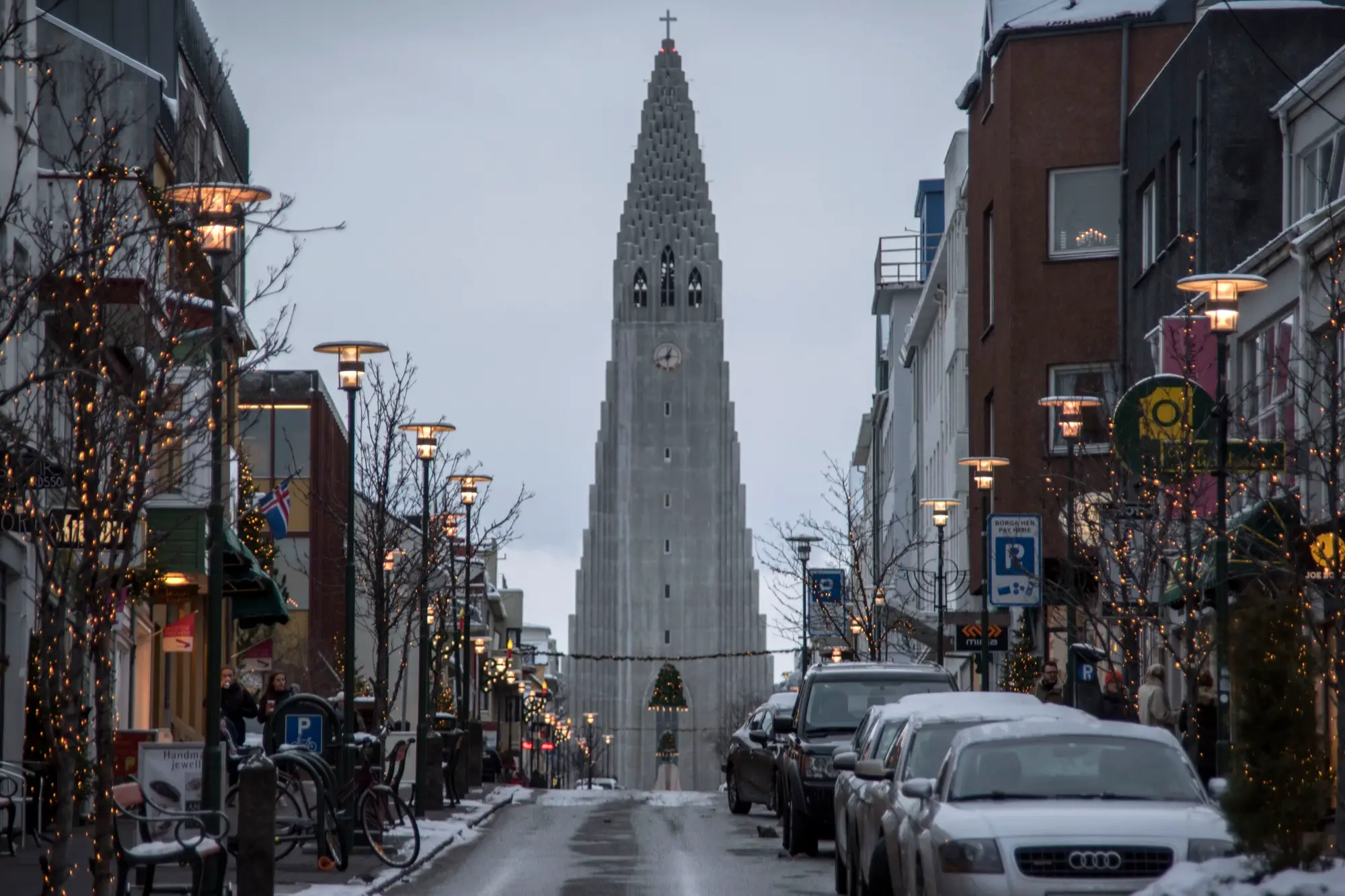

On the Icelandic Met Office's 1991-2020 normals December averages about 0.7 °C in Reykjavík and about -0.7 °C in Akureyri. Computed on this site, Reykjavík has 4h 58m of daylight on 1 December and 4h 06m on 21 December. The Ring Road stays open though weather can close stretches, and much of the country closes from noon on 24 December to 26 December and again on 1 January.
December weather: cold, wet and windy rather than deep frozen
The 1991-2020 mean temperature for December is about 0.7 °C in Reykjavík and about -0.7 °C in Akureyri, as reported by the Icelandic Met Office. These numbers are monthly means of day and night together. For comparisons across the calendar, see the December section of the weather table.
Rain and snow depend heavily on where you travel. In the Icelandic Met Office's older thirty-year averages, which cover 1961-1990 and record average precipitation in millimetres, Reykjavík receives 78.7 mm of precipitation in December, while Akureyri receives 52.8 mm. In those same older thirty-year averages, Kirkjubæjarklaustur in South Iceland, on the way to the Vatnajökull ice caves, receives 133.1 mm of December precipitation.
Visit Iceland says the weather changes quickly and the seasons blend into one another. In winter the weather can be very harsh, with fierce winds and snow or rain coming down sideways, so Visit Iceland advises against cotton and jeans. Safetravel notes that strong winds, snow, rain and drifting snow can make driving difficult and sometimes dangerous even when the roads look clear.
The Road Administration points out that common causes of icy roads are snowfall, freezing rain, freezing fog, or rain on a road that is already icy, even when the air temperature is above freezing. Hoarfrost can also form under clear skies and turn into ice crystals on the road surface. These conditions can arise in a moment and cannot be foreseen.
How short the days are in December
Computed on this site, daylight drops to its annual minimum around the winter solstice. Iceland keeps the same clock all year, with no summer time. The daylight figures below are sampled on the 1st of each month and on the four turning points of the year, in 2026, in local time.
| Date | Location | Sunrise | Sunset | Daylight | Dark hours for aurora |
|---|---|---|---|---|---|
| 1 December | Reykjavík | 10:48 | 15:47 | 4h 58m | 12h 32m |
| 21 December | Reykjavík | 11:22 | 15:29 | 4h 06m | 12h 58m |
| 1 December | Akureyri | 10:57 | 15:08 | 4h 12m | 12h 38m |
| 21 December | Akureyri | 11:39 | 14:42 | 3h 04m | 13h 04m |
After the solstice, daylight begins to return. Computed on this site, on 1 January the sun rises in Reykjavík at 11:18 and sets at 15:43, providing 4h 24m of daylight and 12h 48m of aurora darkness. In Akureyri on 1 January, the sun rises at 11:30 and sets at 14:59, giving 3h 28m of daylight and 12h 56m of aurora darkness. You can check specific daily times on our pages for daylight in Reykjavík and daylight in Akureyri.
Driving on short December days
Visit Iceland says the Ring Road (Route 1) is paved and open all year, though winter weather can close stretches of it temporarily. A broader summary of winter transport is available in our guide to Iceland in winter.
Safetravel says to allow extra time in winter and to expect limited daylight, which can make driving harder. The Road Administration services roughly 5,000 km of the 12,000 km of Icelandic highway network in winter, and oversees and pays for all snow and ice removal on the routes it manages. On regular service days, snow and ice removal in each region should be finished before the regular morning traffic starts. However, the Road Administration says icy roads cannot be fully prevented, and that ice can form at very short notice, especially on bridges, lowlands and shaded stretches.
Vehicle requirements and preparations include the following:
- Front and rear lights must be on at all times in Iceland.
- Safetravel says a car's automatic light setting often does not turn on the rear lights, so walk round the car and check that every light is on.
- Clear all snow and ice off the windows, mirrors, lights and roof before driving.
- Safetravel says a hire car should have winter equipment such as winter tyres, and notes that four-wheel drive helps in some conditions but does not remove the risk of skidding on ice.
- Under national vehicle regulations, chains and studded tyres may not be used from 15 April to 31 October inclusive, unless driving conditions require them. This regulation leaves studded tyres free to use from 1 November to 14 April.
Check road conditions and forecasts before setting out. Safetravel says road conditions can change rapidly and directs drivers to umferdin.is for live updates. The 1777 traffic service run by the Road Administration is open from 06:30 to 22:00 every day, all year round. Because conditions depend entirely on the weather, Safetravel advises checking the forecast at least once a day on en.vedur.is, while monitoring Safetravel's website and app for alerts.
The Icelandic Met Office issues weather warnings in three colour codes:
- Yellow, orange and red indicate how dangerous the weather is, determined by forecasters judging the expected impact and forecast certainty.
- A yellow warning can also mean a small or moderate chance of very severe weather 3 to 5 days ahead, moving up to orange as the forecast becomes more certain.
Keep plans flexible and be ready to change or cancel them if conditions become unsafe. If the weather gets too severe, wait in a safe place for it to calm down. Safetravel notes that the mountain tracks known as F-vegir (F-roads) are usually closed from mid-September until June or July, and during that period only a modified vehicle (a superjeep) can travel on them. In an emergency, call 112.
Ice caves in December: guided tours only
Natural glacier caves can only be visited on organised excursions. Visit Iceland says November typically marks the start of the natural ice cave season, and notes that because glaciers move, the caves can look different from one winter to the next. Visit Iceland stresses that travellers must always enter an ice cave with a qualified glacier guide, who assesses the ice structure and provides required safety gear.
Operators operate on distinct schedules rather than a single joint season:
- Local Guide of Vatnajökull states that its ice cave season typically runs from October to March, depending on weather and glacier conditions, and can sometimes extend into April.
- Local Guide of Vatnajökull notes that visiting ice caves on Vatnajökull without a guide is not allowed and is extremely dangerous, because the caves are unstable and conditions change rapidly. The caves are only entered when it is safe; guides check conditions daily, and tours are rescheduled or refunded if conditions are unsafe.
- Glacier Adventure lists its Crystal Ice Cave Adventure on Vatnajökull from November to April.
- Glacier Adventure lists its longer Blue Ice Cave Adventure from October to April.
The run-up to Christmas: markets and the Yule Lads
Holiday celebrations begin well before 24 December. You can read about the folklore behind each figure in our guide to Christmas in Iceland, while complete schedules are collected under Reykjavík Christmas markets.
Central markets and cultural events hold specific operational dates:
- The Christmas market on Austurvöllur in central Reykjavík lists its opening hours from 14 November to 23 December.
- In Hafnarfjörður, the town says the Christmas village is open every weekend until Christmas, with stallholders partly changing from weekend to weekend, and is also open on Þorláksmessa (St Thorlac's Day, 23 December).
- The Reykjavík Forestry Association lists the 2026 Advent weekends of the Heiðmörk market as 28-29 November, 5-6 December, 12-13 December and 19-20 December.
- Reykjavík City Museum runs its Christmas programme at Árbær Open Air Museum on Sunday 13 December and 20 December, from 13:00 to 16:00.
- Swimming pools across Reykjavík open from 06:30 to 18:00 on Þorláksmessa, 23 December, under the city's 2026 holiday timetable.
Visit Iceland explains that the thirteen jólasveinar (Yule Lads) arrive one by one: the first, Sheep-cote Clod, arrives 13 nights before Christmas on 12 December, and the last, Candle Beggar, arrives on 24 December. The National Museum of Iceland's Christmas programme has the Yule Lads greet visitors at 11:00 every day from 12 to 24 December, with each figure appearing on the specific day he leaves a small gift in children's shoes.
What closes on 24, 25 and 26 December
The City of Reykjavík notes that Christmas is celebrated on 24 December and is rung in at 18:00 on Christmas Eve. Visit Reykjavík says that as church bells ring across the city at 18:00, Reykjavík seems to pause. Christmas Eve (24 December), Christmas Day (25 December) and Boxing Day (26 December) are significant holidays when many businesses close or keep reduced hours, though restaurants, hotels, swimming pools and tour companies often maintain holiday schedules.
Retail and restaurant patterns over the three days include:
- Grocery shops: Visit Iceland says grocery stores are generally open until noon on 24 December, remain closed on 25 December, and open again on 26 or 27 December.
- Dining: Visit Iceland states that most restaurants are closed on the evening of 24 December and the following day, though in Reykjavík a number of high-end places stay open. Visit Iceland advises booking restaurants well in advance, particularly for 24, 25, 26 and 31 December and 1 and 2 January.
City amenities and transport follow altered schedules:
- Reykjavík pools: Under the city's 2026 holiday table, pools open from 08:00 to 13:00 on aðfangadagur jóla (Christmas Eve). Every city pool is closed on jóladagur (Christmas Day, 25 December), and pools open from 11:00 to 17:00 on annar í jólum (Boxing Day, 26 December).
- Strætó public transport: For Christmas 2025, Strætó ran capital-area buses on Christmas Eve to a Saturday timetable, ending service with the last trips around 15:00. On 25 and 26 December, buses ran to a Sunday timetable. Strætó publishes the new season's timetable nearer the date.
- The Blue Lagoon: The lagoon is open every day of the year, listing special holiday hours of 08:00 to 16:00 on Christmas Eve. Operating hours can change, so check directly before visiting.
Visit Reykjavík states that from 27 December, most of the city returns to its regular rhythm.
New Year's Eve and 1 January: closures, bonfires and fireworks
Closures repeat around the change of the year. At New Year, grocery shops close at noon on 31 December, remain closed on 1 January, and reopen on 2 or 3 January. Advance reservations remain essential for dining on 31 December and 1 and 2 January. Timetables can shift, so confirm current hours before heading out.
Public facilities and transport operate under specific schedules:
- Reykjavík swimming pools open from 08:00 to 13:00 on gamlársdagur (New Year's Eve, 31 December) and from 13:00 to 17:00 on New Year's Day 2027.
- For New Year's Eve 2025, Strætó ran buses on a Saturday timetable with final trips around 15:00, followed by a Sunday timetable on New Year's Day, 1 January. Strætó issues the upcoming timetable closer to the holiday.
- The Blue Lagoon lists special hours of 08:00 to 18:00 on New Year's Eve. Its broader winter opening hours run from 08:00 to 22:00 from 21 August to 31 December, and 08:00 to 20:00 from 1 January to 31 May, with guests asked to leave the water 30 minutes before closing.
By 22:00 on New Year's Eve, Visit Reykjavík notes that streets empty as residents watch Áramótaskaupið, the annual television comedy review of the year. Earlier in the evening, neighbourhood gatherings take place around bonfires:
- For New Year's Eve 2025, Reykjavík city listed ten bonfires (áramótabrennur), each lit at 20:30. The city checks the forecast before noon on New Year's Eve and cancels the lighting if winds exceed 10 m/s; walking to the fires is recommended.
- Fireworks and rocket flares are prohibited at the bonfires, but sparklers and hand flares are permitted.
Iceland's fireworks regulation (no. 414/2017) sets strict legal limits on private fireworks:
- Retail sale of category 2 and category 3 fireworks to the public is permitted only from 28 December to 6 January, both days included. Category 1 fireworks may be sold all year.
- General public use of category 2 and 3 fireworks is restricted to the same window of 28 December to 6 January.
- Setting off fireworks is illegal between 22:00 and 10:00 the following morning throughout this window, except on New Year's night.
- The minimum purchase age set by Ísland.is is 16 for category 2 fireworks and 18 for category 3.
Around midnight on New Year's Eve, Visit Iceland suggests heading up to Hallgrímskirkja, Perlan or another elevated viewpoint in the capital area to watch the fireworks across the city.
What December weather means for the northern lights
Seeing the northern lights requires two core conditions: clear skies and astronomical darkness, as outlined in our guide to the northern lights in Iceland. On this site's daylight tables, the dark-hours column records the time when the sun sits more than 18° below the horizon. The aurora is always present when the magnetic field is active, but darkness is required to see it.
Because December sits adjacent to the winter solstice, it provides the longest continuous windows of astronomical darkness of the year:
- Computed on this site for the 2026-27 season, Reykjavík is astronomically dark from 19:02 to 07:34 on 1 December (12h 32m), and from 18:58 to 07:52 on 15 December (12h 54m).
- Akureyri is astronomically dark from 18:44 to 07:22 on 1 December (12h 38m), and from 18:38 to 07:40 on 15 December (13h 02m).
Cloud coverage remains the primary barrier to sightings during December. When total cloud cover exceeds roughly 70%, the sky cannot be seen through, whereas cloud cover under 30% does not interfere with viewing. Precipitation remains common alongside cloud cover; in the older thirty-year averages from the Icelandic Met Office, Reykjavík records 78.7 mm of precipitation for December.
Magnetic activity needs to be kept in perspective. At 64°N, the auroral oval usually sits directly overhead, so a quiet Kp index is not a reason to cancel an outing. Moonlight also does not stop the aurora, though a full moon high in the sky washes out faint green arcs; a strong display remains visible under moonlight, while a marginal display will be obscured.
For current nightly conditions, you can check tonight's Reykjavík aurora verdict, which provides the local sky outlook for the evening along with the next three nights.