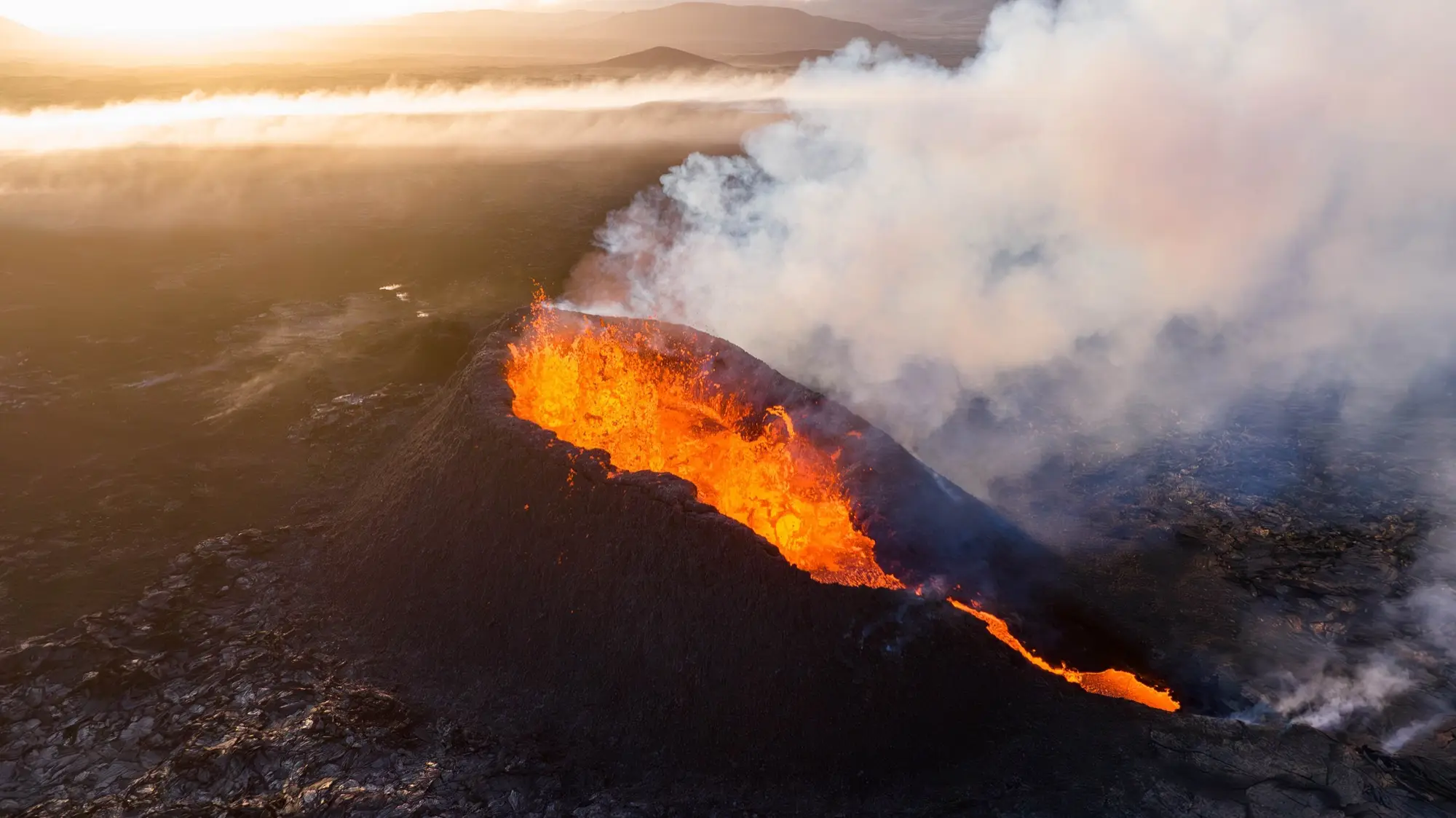

Iceland has a volcanic event every five years on average by Civil Protection's count. The recent events have taken place on the Reykjanes Peninsula, the latest by Visit Iceland's list occurring in July 2025. You can hike to the older Fagradalsfjall sites along marked paths, but you must never walk on lava, you must keep out of low ground because of gas, and you must check Safetravel and the Icelandic Met Office before setting out.
How often Iceland erupts, and where
According to Almannavarnir (Department of Civil Protection and Emergency Management), Iceland experiences a volcanic event every five years on average. The authorities and the general public are highly prepared for these occurrences.
Volcanic activity returned to the southwest along the Reykjanes Peninsula in 2021. Eruptions began near Fagradalsfjall in 2021, followed by further events in 2022 and 2023. Visit Iceland notes that since December 2023, a series of eruptions has taken place along the Sundhnúkur crater row near Grindavík, with the most recent event occurring in July 2025. The town of Grindavík reopened to visitors in October 2024.
What the authorities said most recently
The Icelandic Met Office (Veðurstofa Íslands) reports that since the eruption in July 2025, magma has been accumulating beneath Svartsengi and the ground there has been rising. In an official update published on 10 November 2026, the Met Office stated that land was still rising at Svartsengi, which indicates continued magma accumulation. According to that update, a magma intrusion that could lead to an eruption remained the most likely scenario. Recent earthquake activity at Svartsengi had been very low, counting as normal background activity.
The Icelandic Met Office emphasizes that it cannot state when the next event will happen. Warning periods may again prove short, matching the patterns observed before earlier intrusions and eruptions along the Sundhnúkur crater row.
The dangers
Civil Protection states that eruptions can begin without warning, although they are usually preceded by earthquakes and unrest that scientists detect. They are dangerous through lava flow, lightning, poisonous gases and ash fall. It is vital to stay informed and follow every instruction from the authorities to understand is Iceland safe during an event.
Safetravel warns visitors never to walk across the lava, even after an active eruption has ceased. The crust may be thin with hot lava underneath. Stay on marked paths.
Volcanic gas is a lethal poison. Civil Protection warns that in most instances, this gas has no smell and remains extremely hard to detect. Do not enter valleys, hollows, or low-lying ground where dense gases collect. Safetravel confirms there is still a possibility of gas pollution lingering in the eruption areas, and directs travellers to monitor readings on the national air-quality platform loftgaedi.is.
Hiking to the old Fagradalsfjall sites
Official trails run across the Reykjanes landscape toward viewpoints overlooking the older craters and lava fields around Fagradalsfjall. These routes feature varying lengths and difficulties. Check trail status before you set out, remain on marked tracks, and never step onto the lava.
Safetravel, quoting Visit Reykjanes, lists three main paths for visitors undertaking hiking in Iceland around these sites:
- Path A: Leads towards the 2021 and 2022 eruption sites, measuring about 6 to 8 km one way.
- Path C: Climbs Langihryggur, running about 4 km one way to reach a viewpoint that looks over all three Fagradalsfjall eruption sites.
- Path E: Travels via Meradalir to the July 2023 eruption site by Litli-Hrútur. This route covers about 18 to 20 km there and back. The initial section follows a gravel path, while the final 2 km crosses moss-covered lava rocks. Safetravel states that Path E can take 5 to 6 hours to complete.
The trails departing from the main parking area feature demanding terrain, including loose gravel, uneven ground, and steep inclines. In addition, Safetravel notes that ground subsidence and sinkholes have been detected near the Bridge between Continents, making it essential to stay on marked paths.
Grindavík
Grindavík is a fishing town profoundly affected by the eruptions. Visit Iceland notes that the town reopened to visitors in October 2024, and that you can see the protective lava barriers; check safety information before visiting.
On 22 October 2026 Civil Protection published the first results of a revised risk assessment for Grindavík, which found the safety of people there comparable to other Icelandic communities living with long-term natural hazards, provided safety measures, monitoring and preparedness stay in place.
Before you go
Civil Protection instructs all travellers to rely on safetravel.is for travel logistics concerning volcanic areas, and to check the Icelandic Met Office website for information regarding seismic activity. Conditions on the peninsula depend completely on the weather. You should check the forecast at least once every day on en.vedur.is, and keep an eye on active alerts published through Safetravel's website and application.
Safetravel states that the first step for any trip is to log a travel plan with someone who can respond if you fail to return. An accurate travel plan provides the Icelandic Association for Search and Rescue (Slysavarnafélagið Landsbjörg, known as ICE-SAR) with the precise details needed to initiate a search if an emergency occurs. This plan must specify an emergency contact person who is not travelling with you on the trip.
If you need emergency assistance anywhere in the country, telephone 112. You can also download the 112 Iceland application, which allows you to contact emergency services without placing a voice call. As soon as a message reaches the emergency operator, the app transmits your exact coordinates. Safetravel is operated by ICE-SAR, a nationwide volunteer network made up of more than 4,500 trained volunteers who remain on call day and night throughout the entire year.