Compulsory education in Norway covers ten years, starting in the calendar year a child turns six; in Oslo, the 2026/2027 school year started on Monday 17 August 2026. Under the Education Act (opplæringslova), public schools are free of charge, and children who move to Norway have a right to schooling if they are likely to stay for more than three months in a row. Assessment relies on individual feedback without grades until year 8, leading to a choice between general and vocational paths in upper secondary education.
The system at a glance
Grunnskole is the ten-year compulsory school for children and young people aged 6 to 16. Under the Education Act, children have the right to public primary and lower secondary education from the year they turn six until they have finished year 10. Children also have a duty to receive this education from the year they turn six until the end of year 10, at a public school, an approved private school, or through private education at home.
Grunnskole is split into barneskole (primary school) and ungdomsskole (lower secondary school). Oslo, for example, has separate catchment areas for each and assigns a new school place when a pupil moves up to ungdomsskole in year 8. Statistics Norway counts three kinds of school: barneskolar (primary schools), kombinerte skolar (combined schools) and ungdomsskolar (lower secondary schools). In its 2025 count, Statistics Norway recorded 621,961 pupils in primary and lower secondary schools, 32,508 of them in private schools. The same 2025 count had 2,663 primary and lower secondary schools, 279 of them private.
Before school - barnehage
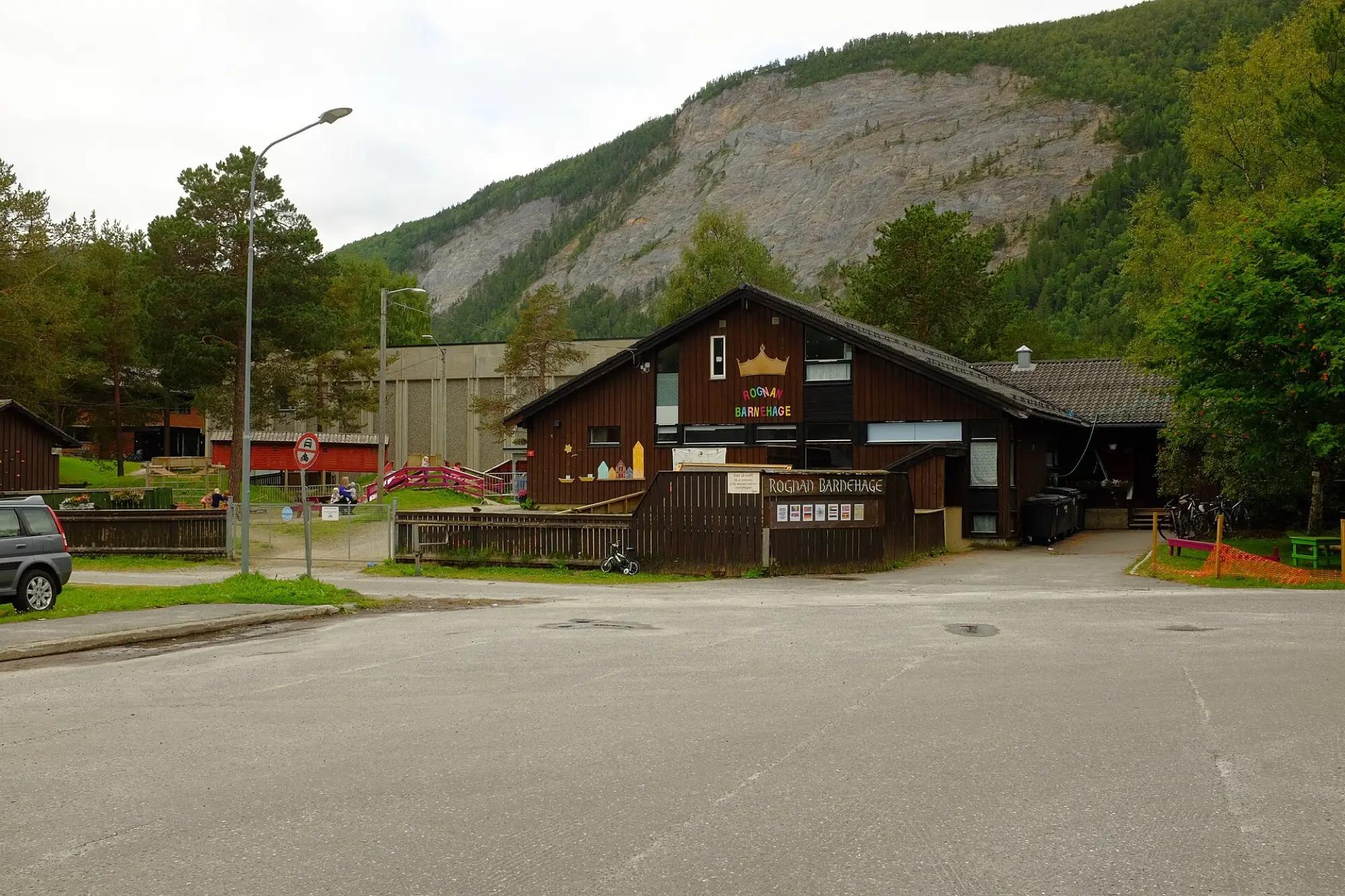
A child who turns one by the end of August has, on application, the right to a kindergarten (barnehage) place from August that year. A child who turns one in September, October or November has, on application, the right to a place by the end of the month it turns one. The right to a place is in the municipality where the child lives. You can read more about options when moving to Norway with children.
Parents' fees for a kindergarten place may not exceed a national maximum that the Storting sets in its annual budget; food can be charged on top. In Oslo a full-time kindergarten place costs NOK 1,200 a month, and July is free of charge in both municipal and private kindergartens. Food costs NOK 320 a month in Oslo's municipal kindergartens; private kindergartens set their own food price. In Oslo, a household with a total annual income under NOK 220,000 before tax has the right to a lower price, and second children get a 30 percent sibling discount. More details on enrolment are available in our guide to kindergarten in Norway.
Starting school - age six, August and the nearest school
School starts in the calendar year a child turns six. The municipality must let a child start school in the year it turns seven if the parents apply or agree and an expert assessment finds doubt that the child is ready. A child may start in the year it turns five if the parents apply or agree and an expert assessment shows it is sound.
Pupils have the right to attend a school in their local area, and in assigning places the municipality must give particular weight to which school is closest to home. On application, a pupil can be admitted to a different school from the one they have the right to attend.
For school start in autumn 2027, Oslo writes in November 2026 to the parents of children born in 2021 who are registered in the city, through their digital mailbox. Oslo schools assign year 1 places by 19 March at the latest; after that main intake, schools take in newly arrived pupils on a rolling basis.
What public school costs - and what is free
Primary and lower secondary education must be free; the municipality may not ask pupils or parents to pay for teaching materials, transport during the school day, camp school (leirskole) or other school trips. As part of primary and lower secondary school, the municipality must offer camp school or another school trip with at least three nights in a row. The municipality must also offer free homework help to pupils in primary and lower secondary school.
Pupils in year 1 have the right to free school transport if they live more than two kilometres from school; pupils in years 2 to 10 if they live more than four kilometres away. Pupils also have the right to free transport if part of the route is particularly dangerous or difficult. For household planning, see our overview of the cost of living in Norway.
Grades, national tests and the year 10 exams
Pupils in years 1 to 7 are assessed individually without grades. From year 8, pupils get grades in their subjects; grades are only required in the half-year assessment and the final assessment. From year 8 the half-year assessment also includes a written grade, given midway through the teaching period. Pupils are assessed in a subject at the end of the period in which it is taught, and the marks represent the competence they have reached against the subject curriculum.
According to regulations on assessment, grades are whole numbers from 1 to 6:
- 6: Outstanding competence in the subject
- 1: Very low competence
- In upper secondary a subject is passed with a 2 or better.
A final mark for order and conduct is set at the end of year 10, and a certificate (vitnemål) documents completed primary and lower secondary education. In grunnskole every pupil is drawn for one centrally set written exam and one locally set oral or oral-practical exam. Year 10 pupils can be drawn for an oral-practical exam in natural science, mathematics or working life studies (arbeidslivsfag); the school tells the pupil the subject 48 hours before the exam starts.
The national tests (nasjonale prøver) are held in the autumn, shortly after pupils start years 5, 8 and 9, and their purpose is to tell schools about pupils' basic skills in reading, numeracy and English. Years 5 and 8 take national tests in reading, numeracy and English; year 9 takes reading and numeracy, the same tests as year 8. In 2026 the national tests for years 5, 8 and 9 ran from 31 August to 25 September. All pupils normally take part, but pupils with a right to special education or special Norwegian tuition can be exempted.
After-school care - SFO, and AKS in Oslo
Every municipality must offer after-school care (skolefritidsordning, SFO) before and after school for pupils in years 1 to 4, and for pupils with special needs in years 1 to 7; it may charge parents for it. Under a national scheme, no family pays more than 6 percent of household income for SFO; Oslo says the scheme's upper income limit is NOK 653,583.
Pupils in years 1 to 3 have the right to 12 hours of free SFO a week. From 1 August 2026 the Ministry made this an individual right in the Act for pupils in years 1 to 3; the municipality cannot average the twelve hours over more than a week, and may charge for food.
In Oslo, SFO is called Aktivitetsskolen (AKS), a service before and after school and in some school holidays. In 2026/2027 every pupil in years 1 to 3 in Oslo is offered a free part-time AKS place. Oslo's AKS prices for 1 August 2026 to 31 July 2027 depend on income; a full-time place in years 1 to 3 costs from NOK 292 to NOK 1,242 a month, food money included, and July is free because AKS is closed. From 2026/2027 Oslo's free part-time place in year 4 applies only to households with income up to NOK 1,500,000, except in six city districts where all year 4 pupils get it. AKS is open in school holidays and days off, except the whole of July, public holidays, Christmas Eve and New Year's Eve.
The school year - Oslo 2026/2027 as an example
Teaching must cover at least 38 school weeks within a span of 45 consecutive weeks in the school year. Each municipality and county sets its own calendar of school days and holidays (skolerute). Oslo plans its calendar so pupils get at least 190 school days, with the same calendar for primary, lower and upper secondary schools.
In Oslo the autumn break is always in week 40 and the winter break always in week 8, and school starts on a Monday after the summer holiday. Oslo's 2026/2027 calendar runs as follows:
- School year starts: Monday 17 August 2026
- Autumn break: Monday 28 September to Friday 2 October 2026
- Christmas holiday: Monday 21 December 2026 to Friday 1 January 2027
- Winter break: Monday 22 February to Friday 26 February 2027
- Easter holiday: Monday 22 March to Tuesday 30 March 2027
- Last school day before the summer holiday: Friday 18 June 2027
Oslo's 2027/2028 school year starts on Monday 16 August 2027.
Arriving mid-way - rights and Norwegian language support
A child's right to school applies if the child is likely to stay in Norway for more than three months in a row, and must be met as soon as possible and at the latest within three months of arrival. Children who arrive are placed in the year group that fits their age; the municipality can make an exception when a specific assessment shows a lower year group is better.
Pupils whose mother tongue is not Norwegian or Sámi have the right to special language tuition until their Norwegian is good enough to follow ordinary teaching; it includes extra Norwegian and, if needed, mother-tongue or bilingual subject teaching. The municipality must regularly assess whether a pupil with special language tuition now speaks Norwegian well enough to follow ordinary teaching. Parents seeking language training can read our guide to learn Norwegian. Pupils who have lived in Norway a short time can be taught wholly or partly in separate groups, classes or schools (introductory teaching), but only if the pupil or the parents consent. For families who prefer tuition in English, options are described in our guide to international schools in Norway.
In Oslo what a newly arrived pupil is offered depends on age and school background:
- Years 1 and 2: Pupils are taught in an ordinary class at the local school.
- Years 3 to 10: The Language Centre (Språksenteret) at Sofienberg assesses newly arrived pupils.
- Years 5 to 10: Pupils may be taught in an ordinary class, in a reception group (mottaksgruppe, for pupils who can read and write and have some schooling from abroad), or in a literacy group (alfabetiseringsgruppe, for pupils with little or no schooling who have not learned to read and write).
Students in upper secondary school have the same right to special language tuition as pupils in grunnskole.
Videregående - general and vocational routes
Everyone who has completed grunnskole or equivalent education has the right to upper secondary education (videregående), if they are likely to stay in Norway for more than three months. The right also covers people who completed upper secondary education in another country but whose education is not recognised in Norway as qualifying for higher education or a trade. Lawful residence in Norway is a condition for the right to upper secondary education. Someone living lawfully in Norway while waiting for a decision on a residence permit has the right to upper secondary education until the end of the school year that starts in the year they turn 18.
The right lasts until you have gained a university-entrance or vocational qualification, but no longer than the school year that starts in the year you turn 24. People who have finished grunnskole but have no upper secondary qualification have a right to upper secondary education for adults from the school year that starts in the year they turn 19.
Students must apply for an upper secondary place themselves, on vigo.no, and in Oslo a student who does not turn up on the first school day loses the place. A student with the right to upper secondary education must be admitted to one of the three programmes they applied for in the first year (Vg1), and then to Vg2 and Vg3 if they meet the admission conditions. The upper secondary certificate (vitnemål) documents a completed three-year course that gives access to university studies, or vocational competence.
Upper secondary has two main routes:
General programmes
General (study preparation) programmes are three years in school. The general programmes are:
- General studies (studiespesialisering)
- Sports (idrett)
- Art, design and architecture
- Media and communication
- Music, dance and drama
Vocational programmes
Since the 2020-21 school year, upper secondary vocational education has had 10 programmes leading to more than 180 different trade or journeyman's certificates. Most vocational programmes follow the 2+2 model: two years at an upper secondary school, then two years of apprenticeship and productive work in a company or public body, ending with a trade or journeyman's test. The apprenticeship is formalised in a contract between the apprentice and the company, which the county authority must approve. Applicants who qualify for an apprenticeship have the right to one; if the county cannot offer an apprenticeship, they have the right to another Vg3 course building on their Vg2 programme. Those who have passed a vocational qualification have the right to supplementary study (påbygging) to gain general university admission.
Rules in upper secondary - cost, travel, absence and residence
Upper secondary education is free, but the county may ask students and apprentices to pay for individual equipment the course normally requires. Upper secondary students have the right to free transport or a full travel allowance if they live more than six kilometres from school.
All upper secondary schools have the same absence rule: a student with more than 10 percent self-reported health-related or undocumented absence in a subject gets no half-year grade or final grade in it, unless they bring documentation from a health professional.
Changes announced for 2027 and later
The Directorate for Education and Training (Udir) is developing new learning-support tests in reading, mathematics and English that will replace the current national tests in the middle and lower secondary years. As of November 2026 Udir says the work is at an early stage, solutions will be developed and tried out with schools from 2027, and the national tests will continue until the new solution is ready.
Udir is also working on a new school day for years 1 and 2, with stronger teaching of reading, writing and arithmetic and more play and physical activity; which subjects and hours there will be has not been decided. As announced, from autumn 2027 schools that wish to can change the school day for years 1 and 2, and new regulations are to apply to all schools from autumn 2028/2029.
Higher education, briefly
Norwegian universities and university colleges offer around 350 study programmes taught in English, most of them at master's level. Degree students from outside the EU/EEA and Switzerland must normally pay tuition fees, which vary between institutions and programmes. Students from the EU/EEA are normally exempt from tuition fees at public institutions. For full application rules and requirements, read our guide to studying in Norway.