Besides ordinary Sundays, Norway has 12 public holidays: the 10 days named in the Public Holidays Act plus 1 and 17 May under a separate 1947 act. In 2026, 8 of these fall on a weekday, while 6 fall on a weekday in 2027. Neither Christmas Eve nor New Year's Eve is an official public holiday.
Norway's public holidays in 2026 and 2027
Under the Public Holidays Act (helligdagsfredloven), the statutory public holidays are ordinary Sundays, New Year's Day (1 January), Maundy Thursday, Good Friday, Easter Day, Easter Monday, Ascension Day, Whit Sunday, Whit Monday, Christmas Day (25 December), and the second day of Christmas (26 December). Under a 1947 act, 1 May and 17 May are also public holidays (høgtidsdager), treated the same as Sundays except for the rules on church ceremonies and the holiday peace.
Easter Day (første påskedag) and Whit Sunday (første pinsedag) are always Sundays, and their dates in the table are the day before Easter Monday and the day before Whit Monday. In 2026, 8 public holidays fall on a weekday (Monday to Friday): 1 January, 2, 3, and 6 April, 1 and 14 May, 25 May, and 25 December. This is because 17 May is a Sunday and 26 December is a Saturday. In 2027, 6 public holidays fall on a weekday: 1 January, 25, 26, and 29 March, 6 May, and 17 May. This happens because 1 May and both Christmas days fall on a weekend, and Whit Monday coincides with 17 May.
| Holiday | 2026 | 2027 |
|---|---|---|
| New Year's Day (nyttårsdag) | Thursday 1 January | Friday 1 January |
| Maundy Thursday (skjærtorsdag) | Thursday 2 April | Thursday 25 March |
| Good Friday (langfredag) | Friday 3 April | Friday 26 March |
| Easter Day (første påskedag) | Sunday 5 April | Sunday 28 March |
| Easter Monday (andre påskedag) | Monday 6 April | Monday 29 March |
| May Day (første mai) | Friday 1 May | Saturday 1 May |
| Ascension Day (Kristi himmelfartsdag) | Thursday 14 May | Thursday 6 May |
| Constitution Day (grunnlovsdagen) | Sunday 17 May | Monday 17 May |
| Whit Sunday (første pinsedag) | Sunday 24 May | Sunday 16 May |
| Whit Monday (andre pinsedag) | Monday 25 May | Monday 17 May |
| Christmas Day (første juledag) | Friday 25 December | Saturday 25 December |
| Boxing Day, second day of Christmas (andre juledag) | Saturday 26 December | Sunday 26 December |
Easter Eve is Saturday 4 April in 2026 and Saturday 27 March in 2027. Whitsun Eve is Saturday 23 May in 2026 and Saturday 15 May in 2027.
How the moving holidays are set, and the 2027 overlap
The Public Holidays Act calculates moving holidays from Easter Day, which falls on the first Sunday after the first full moon on or after 21 March. Maundy Thursday and Good Friday are the last Thursday and Friday before Easter Day, while Easter Monday is the Monday immediately after. Ascension Day is the sixth Thursday after Easter Day, Whit Sunday is the seventh Sunday after it, and Whit Monday is the Monday following Whit Sunday.
In 2026, May Day is Friday 1 May, Ascension Day is Thursday 14 May, Constitution Day, 17 May, falls on a Sunday, and Whit Monday is Monday 25 May. In 2027, May Day falls on Saturday 1 May and Ascension Day on Thursday 6 May. Because of where Easter falls that year, Constitution Day and Whit Monday fall on the same day: Monday 17 May 2027.
The days before the holidays
Christmas Eve, New Year's Eve, Easter Eve, and Whitsun Eve are not included in the Public Holidays Act's list of public holidays, which starts with ordinary Sundays and New Year's Day. Under the Working Environment Act (arbeidsmiljøloven), work stops from 18:00 on the day before a Sunday or public holiday until 22:00 on the day before the next working day. On Christmas Eve, Easter Eve, and Whitsun Eve, work stops from 15:00. Work during these hours counts as Sunday and holiday work. New Year's Eve, as the day before New Year's Day, falls under the 18:00 rule and Christmas Eve under the 15:00 rule.
In the state sector, employees get time off from 12:00 on Christmas Eve and New Year's Eve as far as the service allows, under the state's main collective agreements (hovedtariffavtalene). In the central government administration, office hours start at 10:00 between Christmas and New Year where the service allows. For many, New Year's Eve is a half day off, and some shops and public offices close earlier than usual.
In the Nordic countries the Christmas dinner is eaten on Christmas Eve and presents are opened that evening; read more about seasonal customs in our guide to Christmas in Norway. On public holidays, and on the afternoons of Easter Eve, Whitsun Eve and Christmas Eve, the act protects the holiday peace (helligdagsfred), which no one may disturb with undue noise.
What is closed on a public holiday
On public holidays, fixed shops that sell to consumers must stay closed, and on Christmas Eve, Easter Eve and Whitsun Eve they must close at 16:00. The Public Holidays Act's shop-closing rules apply on 1 and 17 May as well.
The closing rule does not apply to:
- Shops selling mainly kiosk goods or groceries with a sales area of no more than 100 square metres
- Petrol stations with a sales area of no more than 150 square metres
- Shops on campsites in the camping season
- Restaurants and cafes
- Shops selling mainly flowers, plants and garden goods
- Shops selling mainly local handicrafts and souvenirs
- Airport shops in check-in buildings licensed for duty-free sales
- Shops in areas that the county governor (statsforvalteren) has designated typical tourist places
The county governor decides on the municipality's application, for all or part of the year, and only areas where sales then go mainly to tourists qualify.
On public holidays, public entertainments, shows and sports competitions may not be held between 06:00 and 13:00, though events run by religious and belief communities, art, science or educational exhibitions and events on 1 and 17 May are exempt.
Norges Bank's settlement system (NBO), which settles payments between banks, is closed on Saturdays, Sundays and the national public holidays, and it is also closed on Christmas Eve, 24 December.
Shopping before Christmas
Shops may open on the last three Sundays before Christmas Eve between 14:00 and 20:00. Christmas Eve 2026 is a Thursday, so the three Sundays are 6, 13 and 20 December 2026.
Alcohol sales on holidays and the days before
By law the state wine and spirits shops (Vinmonopolet) may sell from 08:30 to 18:00, and on the day before a Sunday or public holiday from 10:00 to 16:00, except on the day before Ascension Day. Vinmonopolet may not sell on Sundays, public holidays, 1 and 17 May, or on Christmas Eve.
Beer and other drinks of up to 4.7% alcohol may be sold in shops from 08:00 to 18:00 as the default. The municipality can change the hours, but sales are banned after 20:00 on weekdays and after 18:00 on the day before a Sunday or public holiday, except the day before Ascension Day. Beer may not be sold on Sundays, public holidays, or 1 and 17 May.
1 May and 17 May
Under a 1947 act, 1 May and 17 May are public holidays (høgtidsdager) treated the same as Sundays, except for the rules on church ceremonies and the holiday peace. May Day (første mai) became a public holiday and statutory day off again in 1947, after the wartime law of 1942 was repealed in 1945. On May Day the labour movement and trade unions usually hold marches and speeches.
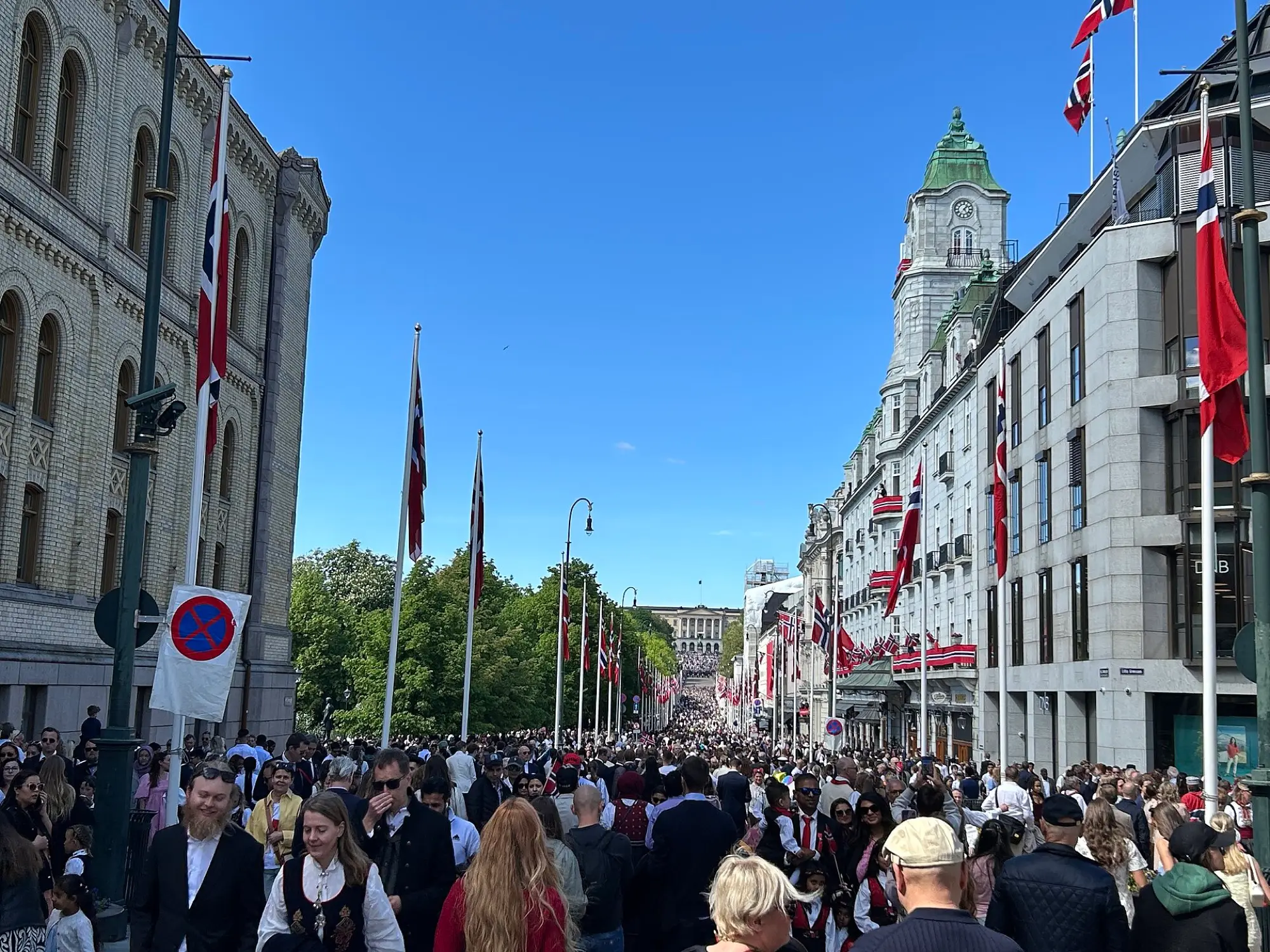
Norway's constitution was adopted at Eidsvoll on 16 May 1814 and dated and signed the next day, 17 May, which is why 17 May is the national day, also called Constitution Day. 17 May is a public holiday and an official flag day, and Norway marks its national day more than many countries do, among other things with children's parades, which were first held in 1870. The holiday-morning ban on public events does not apply on 1 and 17 May. You can see how the day is marked in our guide to Norway in May.
The days before 1 and 17 May count as ordinary working days, unless they fall on a Saturday, a Sunday or another holiday or on the day before Ascension Day; work that may not run on Sundays must stop by 22:00 on those days, though this does not apply to shops.
Pay and working on a public holiday
Under the Working Environment Act, Sunday work is not allowed unless the nature of the work makes it necessary, and Sunday work includes work on public holidays. Before Sunday or holiday work starts, the employer must discuss with the employees' elected representatives whether it is necessary. An employee must have every other Sunday off; a written agreement can allow work on up to three Sundays in a row, but over 26 weeks the employee must on average have every other Sunday off.
Supplements for evening, night, Sunday and holiday work are agreed between employer and employee and must be stated in the employment contract; they are often also in internal agreements or the collective agreement. The guide to a work permit in Norway covers the general employment and pay framework.
You are entitled to full pay for 1 and 17 May if you would normally have been at work and have been employed by the employer for at least 30 days before the date, or were hired later for work lasting at least 30 days. If you work on 1 or 17 May you are owed both your ordinary pay and a supplement, the same as you get for Sundays; if no agreement or pay scale sets it, the supplement is at least 50% of your normal pay. There is no pay for the two days if they fall on days the business is normally closed and you would not have been at work anyway.
Public holidays and annual leave
Everyone is entitled to at least 25 working days (virkedager) of annual leave; working days are weekdays and Saturdays, and Sundays and public holidays do not count as working days. If you are on leave on 1 or 17 May you are paid for those days, and you can ask to extend your leave if either falls on a leave day.
School holidays in Oslo in 2026 and 2027
Oslo's school calendar (skoleruta) shows the holidays and days off of the public primary and upper secondary schools in Oslo, and it is the same for both. In Oslo the autumn break is always in week 40 and the winter break always in week 8.
In the school year 2026/2027 Oslo's schools start on Monday 17 August 2026, the autumn break runs from Monday 28 September to Friday 2 October 2026, and the Christmas holidays from Monday 21 December 2026 to Friday 1 January 2027. The winter break runs from Monday 22 February to Friday 26 February 2027, and the Easter holidays from Monday 22 March to Tuesday 30 March 2027. Oslo's schools are off on Thursday 6 May 2027 (Ascension Day), Friday 7 May 2027 (all schools off) and Monday 17 May 2027 (Constitution Day and Whit Monday); the last day before the summer holidays is Friday 18 June 2027.
In the school year 2027/2028 Oslo's schools start on Monday 16 August 2027, the autumn break runs from Monday 4 October to Friday 8 October 2027, and the Christmas holidays from Monday 20 December 2027 to Monday 3 January 2028.
Oslo's after-school programme (AKS) is open in the school holidays and days off except the whole of July, public holidays, Christmas Eve and New Year's Eve.
Getting a doctor on a public holiday
Every municipality in Norway has an out-of-hours medical service (legevakt) around the clock; call 116117 to reach the one where you are, which is free, when your GP's office is closed and help cannot wait. If it is acute and life is at stake, call 113.