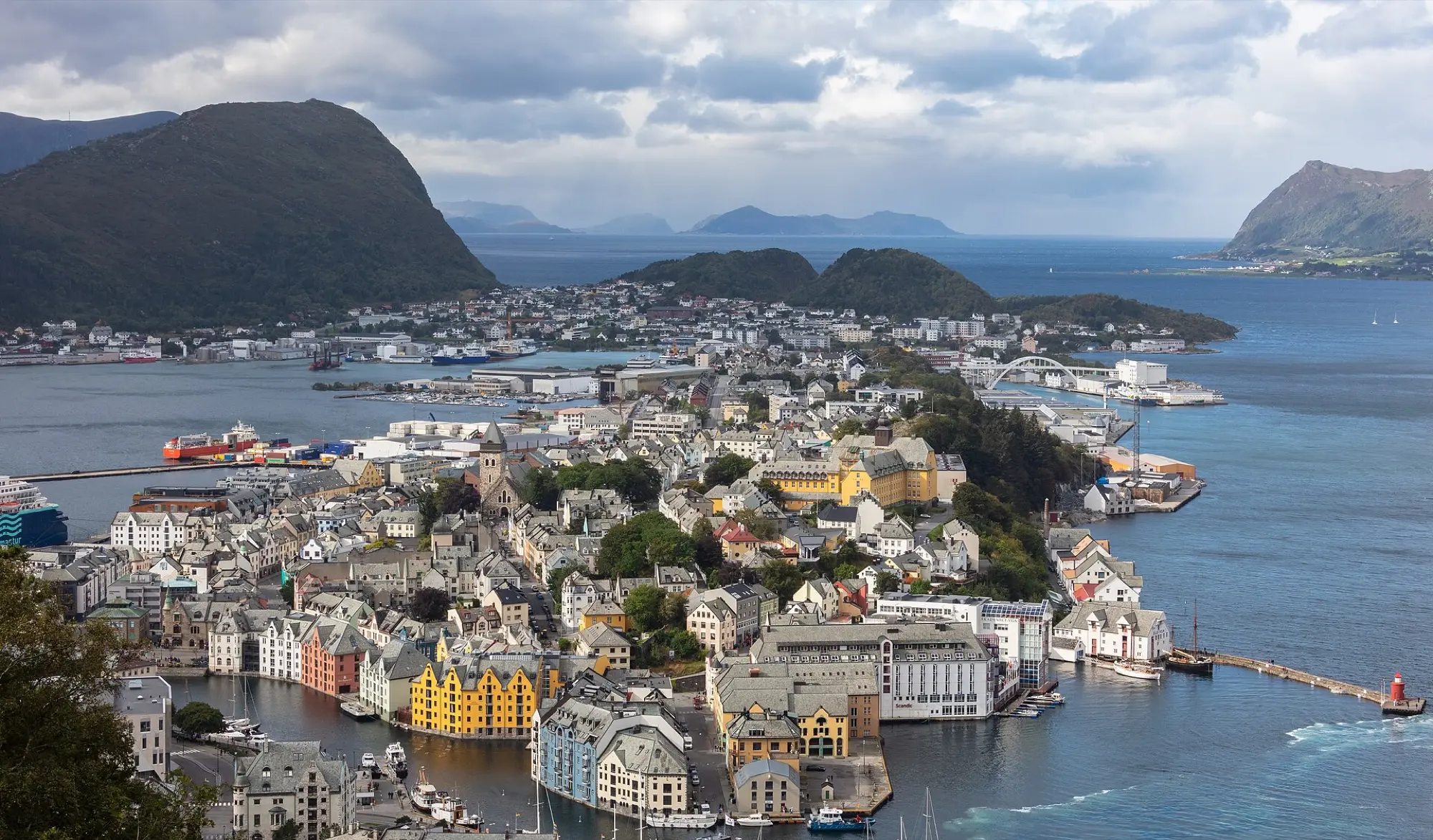

Ålesund offers ten main things to do: the Art Nouveau town centre, Jugendstilsenteret and KUBE, Mount Aksla, Atlanterhavsparken aquarium, the Fisheries Museum, Sunnmøre Museum, Giske, Alnes on Godøy, Runde bird island, and the Geirangerfjord boat. This guide sets out opening days, adult admission prices, and how to get to each one from the town centre.
1. The art nouveau town centre: rebuilt in three years after the 1904 fire
The town centre is built of brick and stone following the fire of January 1904. Ålesund is the largest urban area in Møre og Romsdal county, with 56,300 inhabitants in 2025, spread over the islands of Hessa, Aspøya, Nørve and Uksenøya. The fire started in the night between 22 and 23 January 1904 in the premises of Aalesund Preserving Co. in Nedre Strandgate, and a full south-westerly storm spread it fast. The fire burned for 15 hours, 850 houses burned down and more than 10,000 people were left homeless. One person died in the fire itself, an elderly woman who went back into her house to fetch something she had forgotten. Within a few days the German emperor Wilhelm II sent three ships of food, clothes and building materials to the burned town.
After the fire the Storting (the Norwegian parliament) made masonry compulsory, so that only brick and stone houses could be built inside the town limits. Rebuilding started in the autumn of 1904, and by 1907 most of the burned town had been rebuilt. A conservator at the Art Nouveau Centre says the whole town centre was built up within three years, which is why so many buildings date from the same period. Fjord Norway says Ålesund was rebuilt in a playful Art Nouveau style, with towers, spires and colourful facades. On a walk through the centre, the house at Apotekergata 9 carries the year 1905 on its facade, with towers and arches over its windows and doors. Havila says no other town in Norway has so many Art Nouveau houses next to one another.
The Ålesund Guide Association runs a guided walk through the centre every day from the tourist information at Skateflukaia, starting at 12:00 with a Norwegian- and English-speaking guide. The guided walk costs NOK 450 per adult; children under 12 go free and need no ticket. The walk is mostly flat and easy and ends at Jugendstilsenteret, the Art Nouveau Centre.
2. Jugendstilsenteret and KUBE: art nouveau rooms in the old pharmacy
Jugendstilsenteret is in the old Swan Pharmacy from 1907 and is both a museum and the national centre for Art Nouveau, with the pharmacy's original interiors and Art Nouveau objects. KUBE, the art museum of Møre og Romsdal county, is next door in the former Norges Bank branch building from 1906. Jugendstilsenteret and KUBE are open Tuesday to Sunday, 11am to 4pm. Adults pay NOK 120 and students NOK 100. Children enter free, and children under 15 must be with an adult. Jugendstilsenteret is at Apotekergata 16 in central Ålesund. There is a bus stop right across the street from the museum.
3. Aksla: 418 steps from the town park to Fjellstua
Aksla is Ålesund's town mountain, 189 metres above sea level, with views over the centre, the islands and the sea and towards the Sunnmøre Alps. To reach the top you can walk the 418 steps from Byparken (the town park), take a taxi, or drive up via Borgundfjordveien and Fjelltunveien. A bronze statue of Gange-Rolv, Rollo, stands in the town park at the foot of Aksla. Seats are dotted along the steps, and there is a café with large windows at the top. At Fjellstua, the restaurant at the top, you can have coffee, a svele (a local sweet pancake) or a meal with the view. From the top, paths lead to the Dammene ponds and the Rundskue viewpoint, and an alternative way down goes through Vannspringdalen.
A via ferrata climbs the granite south wall of Aksla from the town park and ends just below Fjellstua; you come back down by the 418 steps. The climb takes about an hour and rises 250 metres; it is graded A+, an easy route, and needs no climbing experience. The via ferrata costs NOK 395 without a guide and NOK 570 with one; equipment can be rented. Every day in summer two guides are on site to rent out equipment and look after safety; outside the regular hours you contact the operator. Anyone with a fear of heights cannot take part, and you need hiking boots or trainers.
4. Atlanterhavsparken: the aquarium on Tueneset, NOK 275 for an adult
Atlanterhavsparken is a saltwater aquarium and science centre on the Tueneset headland, three kilometres from the town centre, with seals, penguins and otters in outdoor pools. Its main tank is 36 metres long and holds four million litres of unfiltered seawater pumped from the sea outside. Every day around 1pm a diver feeds the fish in the main tank, and visitors can talk to the diver underwater. A new jellyfish aquarium opens in the autumn of 2026. Fjord Norway says Atlanterhavsparken is open all year round and many of its attractions are indoors.
Atlanterhavsparken's own ticket prices are NOK 275 for an adult and NOK 135 for children aged 3 to 15; children under 3 go free. There is no student discount, and one ticket covers the aquarium, the science centre and the aquaculture display. Take bus No.1 from the centre or Moa towards Hessa to the Tuenesvegen stop; the aquarium is a 10 to 15-minute walk from there. It is about 3.6 km on foot from the centre along Kirkegata and Steinvåvegen, or about a seven-minute drive, with ample parking.
5. The Fisheries Museum: a warehouse that survived the fire, open at weekends
The Fisheries Museum tells the history of fishing and processing on land, from fishing just off the house to today's high-tech vessels. Hurtigruten notes that the Holmbua warehouse by the harbour, which houses the museum, survived the fire. The museum is in Holmbua on the north-east of Aspøya and opened in 1998. It is open all year on Saturdays and Sundays, 11am to 4pm, and on other days by appointment. Adults pay NOK 80 and students NOK 60; children enter free. A joint ticket with Jugendstilsenteret and KUBE costs NOK 120. The museum is at Molovegen 10, and its exhibitions are not fully accessible.
6. Sunnmøre Museum: 56 old houses and a boat collection
Sunnmøre Museum is an open-air museum with 56 old houses. Its boat collection is one of the largest in Norway and includes replicas of Viking ships. From October to April it is open Tuesday to Sunday, 11am to 4pm; from May to September every day, 10am to 5pm. It is closed on 1 January, 1 May, 17 May, 23 to 26 December and 31 December. Adults pay NOK 120 and students NOK 100; children up to 18 enter free.
The Medieval Museum, built over part of the excavated medieval trading place of Borgund, is on the same grounds, and in summer the Sunnmøre Museum ticket includes it. The Medieval Museum opens every day from 21 June to 16 August, 11am to 5pm, and otherwise by appointment. Statens vegvesen's route planner gives the drive from Jugendstilsenteret to the museum along the E136 as about five kilometres, and about five minutes.
7. Giske: undersea tunnels to a marble church
The road to the islands north of town runs under the sea. The Ellingsøy tunnel from Ålesund to Ellingsøya opened in 1987, is 3,520 metres long and 140 metres deep. The Valderøy tunnel from Ellingsøya to Valderøya in Giske municipality also opened in 1987; it is 4,222 metres long and reaches 137 metres below the sea. On the flat island of Giske stands Giske Church, a long church in white marble from about 1170, and the island has walks along the shore and white beaches. Fjord Norway says it is much debated whether Rollo of Normandy came from Giske. The Makkevika bird reserve on Giske is one of Europe's most important stations for ringing waders. You can drive through the undersea tunnels or take the regular bus, but you cannot cycle through the tunnels.
8. Alnes on Godøy: the lighthouse at the end of the road
Godøya is reached from Giske by the Godøy tunnel, opened in 1989, 3,849 metres long and 153 metres below the sea at its deepest. Alnes, on the far side of Godøya, was one of the biggest fishing villages in Sunnmøre and is a designated national cultural landscape, with a sandy beach and old houses. The first lighthouse at Alnes was built in 1876; today's listed lighthouse dates from 1937 and is 22 metres tall, next to a visitor centre with a café. Only the lighthouse tower has an entrance fee, NOK 100 for adults and NOK 50 for children aged 7 to 15; the stairs inside are steep. A regular bus runs from Ålesund to Alnes via Valderøy and Giske. Statens vegvesen's route planner gives the drive from Jugendstilsenteret to Alnes as about twenty-one kilometres, and about twenty-two minutes, with no ferry.
9. Runde: puffins from early April to August
Runde is a bird island south-west of Ålesund in Herøy municipality, with about 150 permanent residents and more than a hundred thousand birds in the nesting season from April to August. Sea eagles can be seen all year, but to see puffins you have to come between early April and August, so checking the best season to visit Norway helps if you want to time your trip for the bird colonies. Around 80 species nest on the island every year. There are marked routes for visitors, and in the bird protection areas walking off the routes is banned. Rundebranden, the bird cliff, is the third largest bird mountain in Norway, with its top at around 300 metres and trails from the south and the north.
The Dutch trading ship Akerendam sank off Runde in 1725 with a cargo of coins; divers found the treasure in 1972, and some coins are on show at Runde Environmental Centre. A guided tour of the Runde Environmental Centre exhibition costs NOK 150 for adults and NOK 75 for children, students and seniors; the centre has a café. The puffin safari, an evening guided hike of 4.5 km to the bird cliffs with fish soup first, costs NOK 995 for adults and NOK 645 for children and runs in spring and summer. Statens vegvesen's route planner gives the drive from Jugendstilsenteret to Runde Environmental Centre as about eighty kilometres, and 105 minutes, including one ferry; read about Norwegian car ferries for how ticketing and payment operate.
10. The Geirangerfjord by boat: 3 hours each way from the town centre
Geiranger Fjordservice's catamaran sails from Ålesund to Geiranger in about 3 hours one way, past the Seven Sisters and the Suitor waterfalls. A round-trip day tour from Ålesund takes 9 hours and leaves time in Geiranger village; you can also go one way and stay. The boat leaves from Skutvika, Nedre Strandgate 53, in the centre; be there 15 minutes before departure. The operator's 2026 summer timetable runs from 1 April. For other ways to reach the area, see our guide to seeing Norway's fjords without a car, which covers both the Geirangerfjord and the Hjørundfjord.
Getting to Ålesund by air and by coastal ship
Ålesund Airport, Vigra, is on the island of Vigra in Giske municipality, north of the town. Vy Buss runs an airport bus to and from the city centre and Moa for most major flight departures and arrivals; the ride to the centre takes about 25 minutes. Statens vegvesen's route planner gives the drive from the airport to the centre along Rv658 as about seventeen kilometres, and about fifteen minutes. Fjord Norway says Vigra has direct flights and that Hurtigruten and Havila Voyages arrive in Ålesund daily. If you are comparing coastal ships that stop here, our guide to Norwegian coastal voyages compares the operators.
Hurtigruten's Coastal Express stops in Ålesund all year; in winter the northbound ship spends the full day in port, and in spring, summer and autumn it also sails into the Geirangerfjord and the Hjørundfjord. Northbound, Hurtigruten's Coastal Express stays in port between 2 hours 15 minutes and 10 hours 15 minutes. Havila's northbound ship arrives at Skansekaia at 09:45 and leaves at 20:00. From 1 April to 31 August, Havila's northbound ship sails to Geiranger between those times, leaving at 10:00 and returning at 19:00. Southbound, Havila calls in the middle of the night, arriving at 00:30 and leaving at 01:20.
A cruise ship day in Ålesund
The port authority says Ålesund is still among Norway's largest cruise ports and is the country's largest fishing port. Hurtigruten says that from its quay it is a 20-minute walk along the waterfront to the centre, or around five minutes on a blue city bus. The Sørsidekaiene quays and Skansekaia in the centre are usually open to the public. When a cruise ship is moored, the quay areas are closed for security reasons under the international ISPS rules. The lift bridge over Brosundet is also closed while a ship lies at the Sørsidekaiene quays.