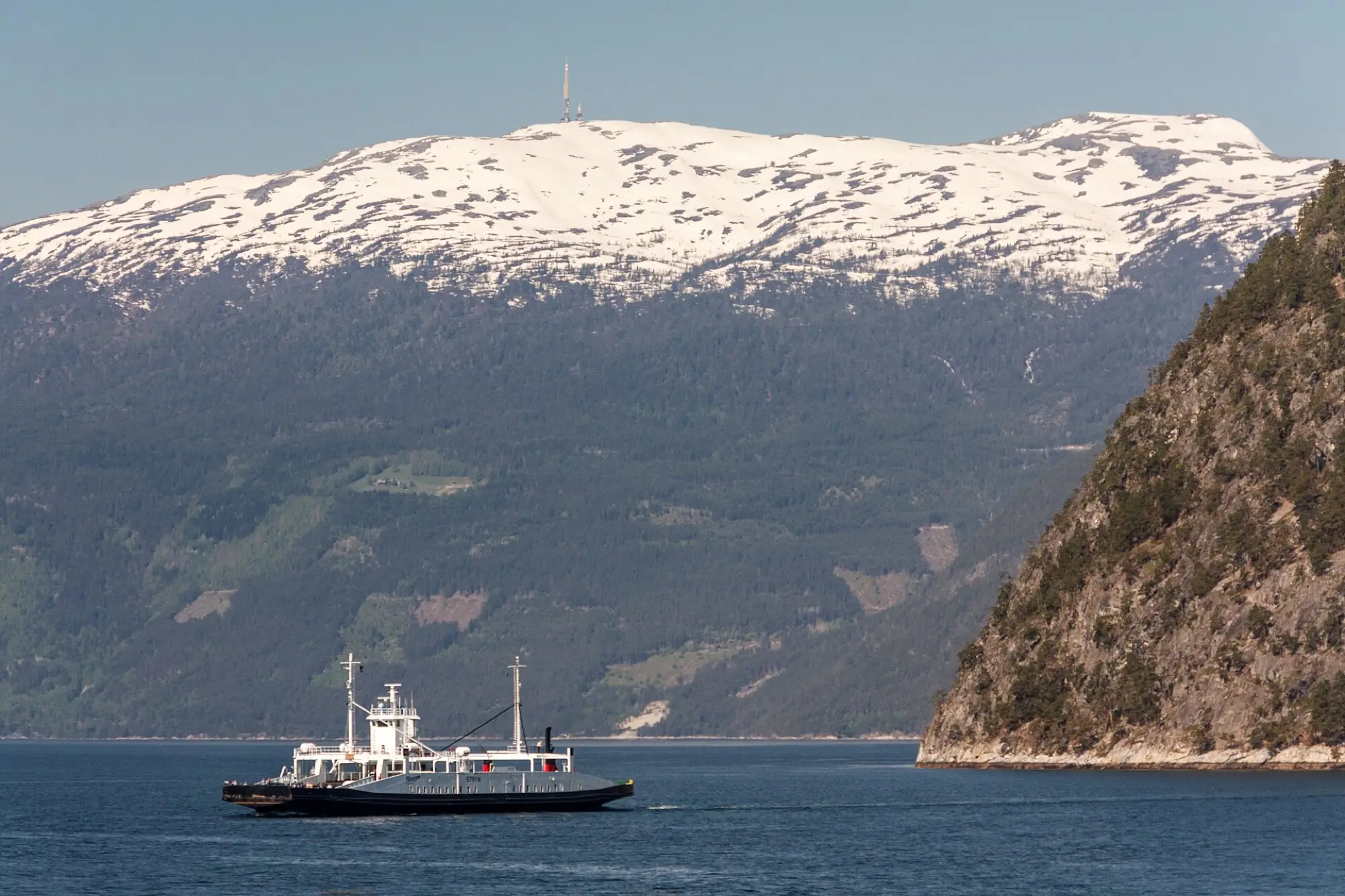

On almost every car ferry in Norway you do not book in advance. You drive straight to the quay, join the queue in your lane, and drive on board when directed. A camera reads your registration plate automatically, and the crossing is settled by an AutoPASS tag, through a digital FerryPay account, by card with the crew, or via an invoice posted to the registered owner.
The short answer - how a car ferry crossing works
Norway has about 130 ferry connections. Statens vegvesen (the Norwegian Public Roads Administration) is directly responsible for 16 of them, while the counties and municipalities oversee the rest. Even on the Bodø to Moskenes route, where reserving a place is an option, operator Torghatten notes that most travellers simply turn up at the quay and purchase their ticket as they drive on, as on other ferry connections.
When arriving without a pre-booked ticket, you wait inside your vehicle in the queue. If a departure fills up before your turn, you stay in your vehicle; the queue attendants try to keep your place for, hopefully, the next departure. Ferries sail strictly to fixed departure times agreed with the Norwegian authorities, meaning vessels will not wait for late drivers.
As you drive aboard, overhead cameras scan your number plate. If you hold no toll tag, prepayment agreement, or FerryPay agreement, the plate is read automatically and linked to the vehicle's registered owner, who is sent a full-price invoice by post along with an invoice fee. Most connections across the country participate in the national AutoPASS for ferje (AutoPASS for ferry) scheme. The notable exceptions are the Moss to Horten link across the Oslofjord and certain connections in Trøndelag.
Ways to pay, from cheapest to dearest
The payment method you select determines the price you pay for every crossing:
- AutoPASS prepayment agreement: Paying through an active prepayment agreement linked to an approved tag gives a 50% discount for private customers and 40% for business customers. This discount applies only when paying with an AutoPASS-approved tag; paying manually on board by bank card or cash earns no discount.
- AutoPASS tag alone: An AutoPASS-approved toll tag used on its own, without a prepayment agreement, automatically provides a 10% discount on participating tag-based ferries. The tag agreement itself is free, while the tag requires a one-time fee of NOK 200. Holding a tag agreement also provides up to 20% off at toll points in Norway. Tags are issued by suppliers including Flyt, Fremtind Service, SkyttelPASS, ØresundPay, and Tolltickets, all offering identical discounts.
- FerryPay: FerryPay is an automated, invoice-free payment solution designed for motorists driving without a tag or prepayment agreement. It covers all routes within the AutoPASS for ferry scheme. The system reads your registration number as you drive on and charges one full-price ticket per crossing directly to your registered card, avoiding any postal invoice fees.
- Card on board: If you have no agreement in place, you can ask the crew on board to take payment using a credit card. Paying manually avoids the invoice fee. Manual payment on board is credit card only; cash is not accepted for the crossing.
- Postal invoice: If you use none of the fee-free options, an invoice with a fee is sent by post to the vehicle's owner.
Driving a hire car or a car registered abroad
When planning routes with our guide to driving in Norway, vehicle registration details require attention before reaching the slipway. For vehicles registered abroad, EPASS24 handles invoicing and debt collection on behalf of AutoPASS for ferries. A toll tag for a light vehicle up to 3,500 kg cannot be had at the Norwegian border; you must order one well before your trip begins.
Alternatively, cars registered abroad can simply be registered online with Epass24 and driven without a tag. While this setup grants no discounts, road tolls are charged by the vehicle's environmental data. Electric or hydrogen cars registered abroad pay ordinary full prices unless their fuel class has been registered with Epass24 or your tag issuer.
If you drive a hire car, you can put a time limit on your FerryPay account so you only pay while you are using the vehicle. A FerryPay start date can be backdated up to two days, but an agreement not set up by the day before departure may not reach the ticketing system in time. Foreign customers without an agreement risk missing the departure they want, because paying manually takes longer. Because invoices go to whoever is registered as the vehicle's owner on the crossing date, check the rental company's terms.
How fares are set - rate zones and vehicle length
On the national road ferries the Ministry of Transport sets the fares, with Statens vegvesen managing the AutoPASS fare regulations on its behalf. County authorities set the fares on county ferries, and most of them use the same AutoPASS fare regulations. Fare levels and fare rules are normally adjusted at the new year. If you are budgeting for a wider journey, see is Norway expensive? for context on broader travel costs.
Crossings are grouped into standard rate zones, with fares stepping up according to vehicle length:
- Vehicle length bands: On the Lavik to Oppedal crossing, for example, a vehicle up to 6 m pays 81 kr, a vehicle measuring 6.01 to 8 m pays 180 kr, and a motorcycle costs 33 kr.
- Overall length: Total length counts. If you carry bikes hanging 55 cm off the back of an eight-metre motorhome, the total length exceeds 8 m, putting the vehicle in a higher tariff group.
- Cars towing trailers: For a car under 6 m and under 3,500 kg with a trailer, the car fare is doubled if total length is under 10 m and tripled if it is over 10 m.
- Included occupants: The driver is always included in the car ticket. On all of Fjord1's connections, passengers travel free.
- Zero-emission rates: On Fjord1 crossings, electric cars pay 70% of the fare for conventional vehicles, with no discount on any toll part of the ticket.
- Free and seasonal routes: Summer rates apply to certain ferry routes in summer 2026. Several ferry routes have become free to travel on; on the Molde to Sekken crossing, Fjord1's fare table shows 0 kr for every vehicle length.
What the main crossings cost
Fares across Norway follow fixed rate zones rather than individual operating companies. The following table lists standard full prices for light vehicles across primary routes.
| Crossing | Road | Operator | Crossing time | Car up to 6 m (full price) |
|---|---|---|---|---|
| Anda to Lote | E39 | Fjord1 | about 11 minutes | 63 kr |
| Lavik to Oppedal | E39 | Fjord1 | about 20 minutes | 81 kr |
| Eidsdal to Linge | road not published | Fjord1 | about 13 minutes | 81 kr |
| Bognes to Skarberget | E6 | Fjord1 | about 25 minutes | 104 kr |
| Hareid to Sulesund | road not published | Fjord1 | about 23 minutes | 110 kr |
| Halhjem to Sandvikvåg | E39 | Torghatten Nord | about 45 minutes | 176 kr |
| Arsvågen to Mortavika | E39 | Fjord1 | about 24 minutes | 178 kr including the toll supplement |
| Bognes to Lødingen | Rv. 85 | Torghatten Nord | not published | 187 kr |
| Moss to Horten | Rv. 19 | Torghatten | not published | 304 kr |
| Bodø to Moskenes | Rv. 80 | Torghatten Nord | not published | 605 kr |
The fares above are full prices as listed in November 2026 and change at the new year.
Specific crossing details:
- Anda to Lote is in rate zone 3 (63 kr).
- Lavik to Oppedal is in rate zone 6 (81 kr).
- Eidsdal to Linge is also in rate zone 6 and costs the same 81 kr, showing that the fare follows the zone, not the operator.
- Bognes to Skarberget is in rate zone 10 (104 kr).
- Hareid to Sulesund is in rate zone 11 (110 kr).
- Halhjem to Sandvikvåg crosses the Bjørnafjorden, charging 176 kr for vehicles up to 6 m and 59 kr for motorcycles.
- Arsvågen to Mortavika combines a baseline ferry fare of 104 kr with a 74 kr toll supplement, totalling 178 kr.
- Moss to Horten includes 12% VAT in its 304 kr full price.
- Bodø to Moskenes costs 605 kr for vehicles up to 6 m, and 1302 kr for vehicles between 6.01 and 8 m.
The discounts with an AutoPASS ferry agreement, worked through
For 2026, opening an AutoPASS for ferry prepayment agreement for a motorcycle or a vehicle up to 8 m requires an advance deposit of NOK 2,200.
AutoPASS illustrates the deduction mechanism with this example: against NOK 2,200 prepaid, taking a crossing whose full price is NOK 70 costs a private customer NOK 35. This leaves a remaining balance of NOK 2,165. When the balance falls to about 25% of the prepayment, you get a new invoice. You must pay this before the balance reaches zero to keep the discount.
If you end the agreement, a positive balance is refunded after 21 days, with extra time for transfers to foreign bank accounts. If the ferry account is empty, a crossing on a tag ferry still gets 10% off and is charged to your main tag agreement. For an electric car, the prepayment discount comes on top of the electric car discount.
Moss to Horten has its own rules. A tag alone gives 10% off, while a separate agreement for the route gives 30% off. Neither FerryPay nor Epass24 can be used to pay there.
The national road crossings on the E39 and beyond
Statens vegvesen is responsible for 16 ferry connections that link the national road network, served by 44 main ferries. These links include:
- Rv. 19 Horten to Moss
- E39 Arsvågen to Mortavika
- E39 Halhjem to Sandvikvåg
- E39 Lavik to Oppedal
- Rv. 5 Mannheller to Fodnes
- E39 Lote to Anda
- E39 Molde to Vestnes
- Rv. 80 Bodø to Værøy, Røst and Moskenes
- Rv. 85 Bognes to Lødingen
- E6 Bognes to Skarberget
Statens vegvesen's route planner takes Bergen to Stavanger along the E39 with two ferries: Halhjem to Sandvikvåg and Arsvågen to Mortavika. The route planner gives that route as 208,401 metres, which is just over two hundred kilometres.
Under the new contract, Lavik to Oppedal is run with four vessels from the first day. MF Skagastøl, the first of four new battery hybrid ferries for Lavik to Oppedal, has been handed over, and the next three are to be delivered through the winter and spring. Each of the new Lavik to Oppedal ferries takes 120 car units and 399 passengers.
Mannheller to Fodnes is run by Norled and is paid with an AutoPASS tag. Boreal runs Molde to Vestnes under contract with Statens vegvesen, and the crossing is included in the AutoPASS for ferry prepayment agreement. Moss to Horten is Norway's largest ferry route, with nearly 2 million vehicles and 4 million passengers a year.
Bodø to Moskenes, the crossing you can book
On Bodø to Moskenes a vehicle up to 6 m pays 605 kr at full price, and one of 6.01 to 8 m pays 1302 kr. Booking Bodø to Moskenes in advance is not mandatory, and only part of each ferry's capacity can be reserved.
A reserved spot costs extra on top of the ordinary ticket:
- 130 NOK for a vehicle up to 6 m
- 170 NOK for vehicles measuring 6.01 to 8 m
- 65 NOK for a motorcycle
A car up to 6 m with a reserved spot therefore pays 605 kr plus 130 NOK, 735 kr in all.
A reserved spot must be booked before 20:00 the day before departure. With a booking you must be at the dock at least 45 minutes before departure, in the innermost lanes marked reservert (reserved). Travelling without a vehicle and without a reserved spot, the crossing is free.
Because the route is over 20 nautical miles, every passenger must be registered. Without a booking you scan the QR code at the quay. The route is very busy in peak season; travellers to Røst and Værøy get priority, and Torghatten recommends the direct sailings for Bodø to Moskenes. On Bodø to Moskenes you can pay with AutoPASS, FerryPay or Epass24, or by card if you have no toll tag. For onward travel across the archipelago, consult our Lofoten guide, or check Tromsø to Lofoten for alternative ways to enter the islands.
Geiranger to Hellesylt - suspended until further notice
The Geiranger to Hellesylt car ferry is suspended until further notice, and the operator says it will give more information about the 2027 season.
When it sails, the Geiranger to Hellesylt ferry runs from April to October and takes about 65 minutes. When it sailed, booking was strongly recommended in the high season, May to September; drop-in was possible but a place was not guaranteed. Its latest check-in was 30 minutes before departure for vehicles, and changes or refunds had to be made at least 48 hours before departure. These booking rules are what applied when it sailed, not a promise for 2027.
Fjord1 stopped the service from Friday 4 September, until further notice, after Oslo District Court lifted the injunction that had kept it running since July; Fjord1 is appealing. On 8 May 2026 the Norwegian Maritime Authority gave Fjord1 a temporary exemption from the zero-emission requirement for its ferries MF Veøy and MF Bolsøy; the ministry later reversed it after a complaint from a competitor. Norway's zero-emission requirement in the World Heritage fjords applies from 1 January 2026 to passenger ships under 10,000 gross tonnage. If you are deciding which fjords to visit while this ferry is out of service, see Norwegian fjords without a car.
On board - the rules every ferry asks you to follow
Once directed onto the car deck, motorists must follow standard safety rules:
- Engines off: The engine must be switched off during the crossing, for safety and because of the fire risk.
- Vehicle lights: Switch off all exterior lights, which can dazzle the navigator on the bridge.
- Car alarms: Switch off the car alarm, which can damage the hearing of crew and passengers.
- Travelling with pets: Animals can travel on all of Fjord1's ferry routes but must stay in the car or in a cage, which you can borrow on board, and are not allowed in the lounge.
- On-board purchases: At a manned kiosk on board you can pay cash while it is staffed; unmanned kiosks take bank card, credit card or Vipps.
Electric and hydrogen ferries
At the end of 2024 over 60 percent of the national road ferries Statens vegvesen is responsible for were green, comprising 27 electric and 1 hydrogen-electric ferry, according to data on Grønn ferjedrift. Close to 30 percent, 13 ferries, run on liquefied natural gas, which Statens vegvesen no longer classes as a green fuel.
Statens vegvesen started in 2014 with the world's first electric ferry, MF Ampere, on Lavik to Oppedal. Torghatten describes Moss to Horten as electric transport across the Oslofjord, with Bastø Electric among its ships.
MF Hydra, which came out of a development contract for a hydrogen-electric ferry on Hjelmeland to Nesvik to Skipavik, is the world's first ship to sail on liquid hydrogen. In 2021 Statens vegvesen put out its largest hydrogen contract so far, for Bodø to Værøy, Røst and Moskenes, where two new ferries mainly running on hydrogen are to be built.