
When driving in Norway, your dipped headlights or daytime running lights must be on at all times, and the blood alcohol limit is 0.02 percent. Road tolls are collected electronically off your number plate without toll booths to stop at, and general speed limits are 50 km/h in built-up areas and 80 km/h outside them unless signposted otherwise. There is no set date when you must fit winter tyres, but your vehicle must always have adequate grip for the conditions, with at least 3 mm tread depth during the defined winter period.
The short answer
Statens vegvesen, the Norwegian Public Roads Administration, says you must drive with your lights on whatever the weather, light and visibility, and the 0.02 percent blood alcohol limit is strictly enforced. The general speed limits, where no other limit is signposted, are 50 km/h in cities and built-up areas and 80 km/h in rural areas and outside built-up zones. All vehicles must pay road tolls in Norway, foreign-registered ones included. From 1 November to the first Sunday after Easter Monday, tyres must have a tread depth of at least 3 mm.
Speed limits and the speeding fine table
The general speed limits, where no other limit is signposted, are 50 km/h in cities and built-up areas and 80 km/h in rural areas and outside built-up zones. With a car pulling a caravan, and in a motorhome over 3.5 tonnes, the motorway speed limit is 80 km/h; a motorhome under 3.5 tonnes follows the motorway limit. Speed cameras are placed along the roads, and fines are high if you are caught; you must also adjust your speed to conditions such as poor visibility or slippery roads.
The fixed fines below come from the regulation on simplified fines in road traffic cases, last amended with effect from 15 February 2026.
| How far over the limit | Fine where limit is 60 km/h or lower | Fine where limit is 70 km/h or higher |
|---|---|---|
| Up to 5 km/h over | NOK 1,250 | NOK 1,250 |
| Up to 10 km/h over | NOK 3,350 | NOK 3,350 |
| Up to 15 km/h over | NOK 5,950 | NOK 5,350 |
| Up to 20 km/h over | NOK 8,650 | NOK 7,450 |
| Up to 25 km/h over | NOK 13,450 | NOK 10,100 |
| Up to 30 km/h over | not in the table | NOK 13,450 |
| Up to 35 km/h over | not in the table | NOK 16,050 |
On a motorway with a limit of 90 km/h or more, driving 36 to 40 km/h over the limit costs NOK 16,700.
Lights, alcohol, phones and the other fines
When driving a motor vehicle, main beam, dipped headlights or approved daytime running lights must always be on, whatever the weather, light and visibility. Driving without the required lights on, or with a fault in the dipped, main or running lights, costs NOK 4,100.
Under the Road Traffic Act, a driver with more than 0.2 per mille alcohol in the blood, or more than 0.1 milligrams per litre in the breath, always counts as under the influence. Visit Tromsø warns that penalties for driving under the influence are severe and notes the limit applies to all vehicles.
It is forbidden to talk on a hand-held mobile phone or touch its screen while driving; with Bluetooth or other hands-free equipment you may make a call, hang up and find contacts. Section 23 b of the Road Traffic Act is the ban on using electronic equipment in a motor vehicle. Breaking the rules made under section 23 b costs NOK 10,750.
Unless signs say otherwise, drivers must give way to vehicles coming from the right. Failing to give way, including to traffic from the right or to pedestrians on a crossing, costs NOK 10,750. Driving through a red light, or too close to the vehicle in front, costs NOK 10,750. Children under 135 cm must have their own restraint suited to their weight and height, and children between 135 and 150 cm must use approved child safety equipment if the car has it; everyone else wears a seat belt. Failing to secure a passenger under 15 costs the driver NOK 3,600. Stopping is not allowed in tunnels, on the crest of a hill or anywhere with poor visibility.
| Offence | Fine |
|---|---|
| Driving without required lights or with light fault | NOK 4,100 |
| Using hand-held electronic equipment | NOK 10,750 |
| Failing to give way | NOK 10,750 |
| Driving through a red light | NOK 10,750 |
| Driving too close to vehicle in front | NOK 10,750 |
| Failing to secure passenger under 15 | NOK 3,600 |
Tolls and AutoPASS for a foreign car
All vehicles must pay road tolls in Norway, foreign-registered ones included. Without a tag, a toll station takes a photo of the vehicle's registration number. You then receive an invoice by post for the regular toll rate, with no penalty charge, from the company that owns the toll station. A foreign vehicle pays the highest rate where its Euro emission class or fuel type is not registered. Toll rates can vary with the vehicle's weight and emissions, and with the time of day. Because tolls and ferries add to what a trip costs, see our guide to whether Norway is expensive.
The simplest option for a visitor is to register the vehicle with Epass24 and drive without a tag; there are no discounts, but in cities with environmental toll rates you are charged the correct rate for your vehicle. A driver of a foreign car may be charged the cost of looking up the owner in their own country's vehicle register; as of 1 May 2025 that is EUR 14.00 for Austria, EUR 5.10 for Germany, PLN 47.40 for Poland and EUR 8.67 for Spain. Registering with Epass24 or signing an AutoPASS agreement avoids it.
The other option is a user agreement with a toll service provider, which posts you a tag to mount inside the windscreen. A tag for a vehicle up to 3,500 kg cannot be picked up at the Norwegian border, so it has to be ordered well in advance. With a tag and agreement you get a 20% discount on each toll passage.
Renting a car
A rental car may be one you are not used to, so get to know the car and its functions before driving on winter roads, and ask the rental company if anything is unclear. Visit Lofoten notes that rental cars have winter tyres, often studded, which is useful when preparing for Lofoten in winter.
Visit Tromsø notes that a rental company may require your driving licence to have been valid for at least one year. Driving in the Tromsø region can be challenging, especially in winter, with icy roads, fast-changing weather, long distances and narrow roads. If you are inexperienced with winter driving during a stay in Tromsø in winter, public transport or tours with transport included are sensible options. Ask the rental company how tolls and ferries are handled.
Winter tyres and tread depth
The driver is responsible for the vehicle having enough grip on the road all year round. There is no date on which a car must switch to winter tyres; the rule is grip for the conditions, plus the 3 mm tread depth in the winter period. Outside those periods the vehicle must still have winter tyres, studded or not, or chains, if that is what it takes to grip the road. You cannot use summer tyres on winter roads, because they do not grip on ice and snow. Non-studded winter tyres may be used all year round. In summer the minimum tread depth is 1.6 mm.
| Region | Winter tread depth (minimum 3 mm) | Permitted studded tyre period |
|---|---|---|
| Most of Norway | 1 November to first Sunday after Easter Monday | 1 November to first Sunday after Easter Monday |
| Nordland, Troms and Finnmark | 16 October to 30 April | 16 October to 30 April |
Studded tyres and the city fee in Oslo, Bergen and Trondheim
A car on studded tyres must have them on all wheels. Outside the permitted dates, studded tyres are allowed only if the weather and road make it necessary.
Oslo charges a studded tyre fee within the city limits from 1 November 2026 to 4 April 2027. You pay only for the days the car with studded tyres is driven, not for days it stays parked. Driving in Oslo on studded tyres without paying costs NOK 750. No sticker goes on the car; payment is registered electronically to the registration number, and a day can be bought in the Bil i Oslo ("Car in Oslo") app or at sticker machines on the main roads into Oslo. A valid studded tyre permit from Stavanger, Bergen, Kristiansand or Trondheim is valid in Oslo too.
Bergen's studded tyre fee applies in the whole municipality, even if you only drive through, and this season runs from 1 November to 4 April. A day fee is valid for 24 hours from purchase. Bergen runs the same studded tyre scheme as Oslo and Trondheim, and a valid permit from those cities is valid in Bergen; if conditions require studs outside the season, there is no fee. At NOK 35 a day, the NOK 1400 season fee for a car is the same as 40 days of driving.
| Period | Car up to 3,500 kg | Heavier vehicle |
|---|---|---|
| Day | NOK 35 | NOK 70 |
| Month | NOK 450 | NOK 900 |
| Season | NOK 1400 | NOK 2800 |
Snow chains
Chains may not be used from the first Monday after Easter Monday to 31 October, or in Nordland, Troms and Finnmark from 1 May to 15 October, unless the road conditions make it necessary. Vehicles over 3,500 kg, such as large motorhomes, must carry chains that fit their wheels when snow or ice can be expected, and in any case from 1 November to the first Sunday after Easter Monday. In Nordland, Troms and Finnmark that period for heavy vehicles is 16 October to 30 April.
Convoy driving on mountain passes
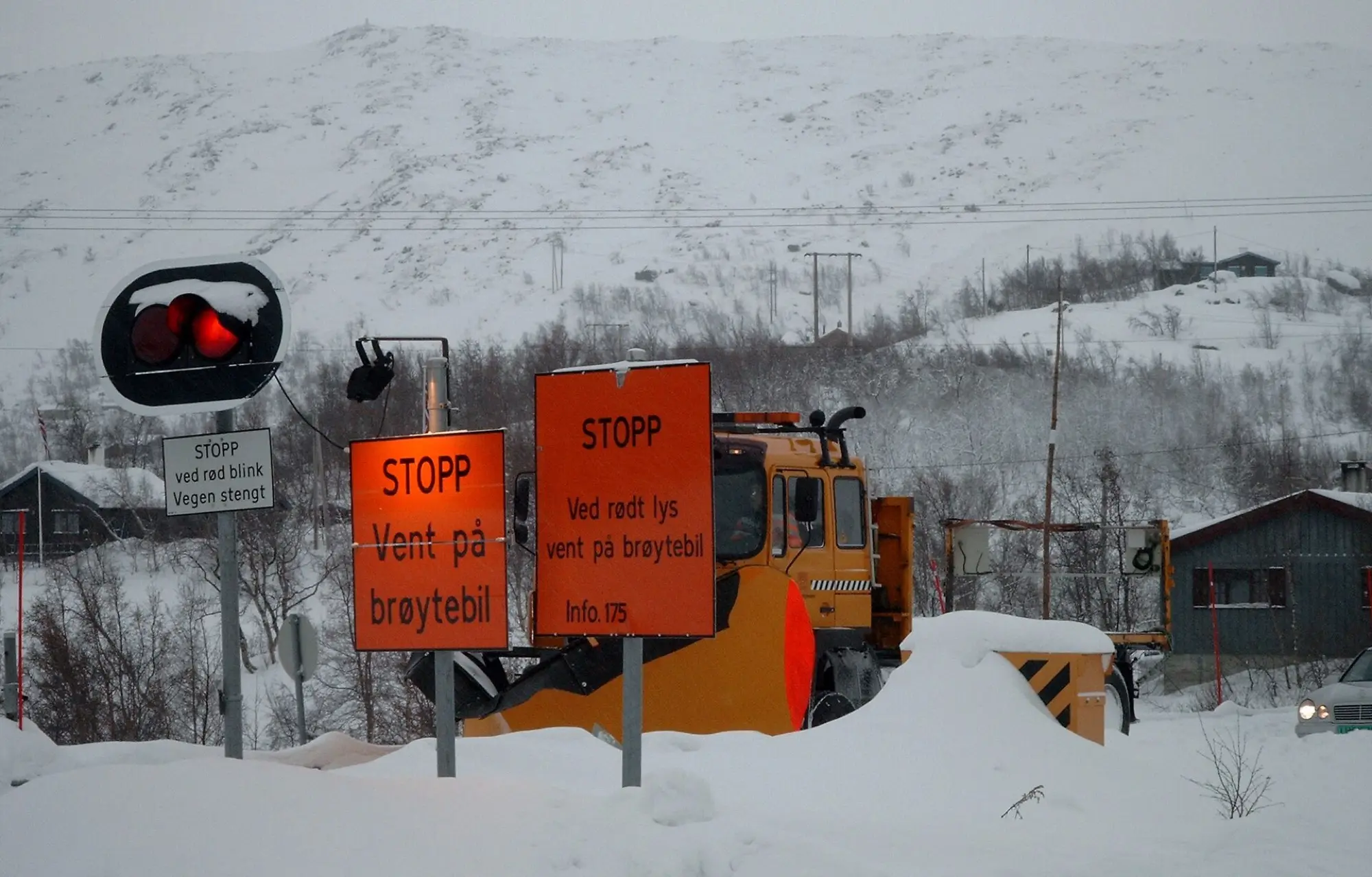
In convoy driving (kolonnekjøring), cars drive together behind a lead vehicle, usually because of bad weather on a mountain pass or roadworks; follow the traffic directors, and do not overtake or turn around. Keep at least 15 metres behind a car and at least 50 metres behind a heavy vehicle. Our Tromsø to Lofoten guide covers a winter drive in the north.
Use your hazard warning lights, and fog lamps if you have them, keep the vehicle in front in sight and drive at an even speed. On busy days there may be a long wait to join a convoy, so check traffic information and think about other routes. There are no petrol or charging stations on convoy routes, so start with a full tank or a fully charged battery. If you have to stop, or the convoy stops, do not move away from your car. The snow-clearing crew may turn away drivers without warm enough clothing, or whose vehicles have technical faults or inadequate tyres.
Closed roads, the Lærdal tunnel and the 175 line
For road traffic information in English, call 175 from a Norwegian phone, or +47 22 175 175 from abroad. Live road information is at vegvesen.no/trafikk and in the Vegvesen trafikk app, which can send notifications for your area. Statens vegvesen has a status page for the main mountain passes and roads exposed to rough weather. Always check road and traffic information and the weather forecast before you set off.
Some roads close in winter, and ferry departure times are worth checking before a drive. Winter-closed roads have normal seasons, for example the Gaularfjellet road (Fv13) normally open May to December, the Sognefjell road (Fv55) and Geirangervegen (Fv63) normally open May to October, and Trollstigen (Fv63) open from the end of May to the end of October; opening dates depend on the weather. These seasonal openings are important when assessing the best time to visit Norway or planning a wider Norway itinerary.
From Monday 16 November 2026 the Lærdal tunnel on the E16 is closed every night from 18:00 to 06:00, except the night to Sunday; if you arrive too late, the next chance to drive through is 06:00 the next morning. If you are exploring the fjords from Oslo, keep these night closures in mind. The period of 12-hour night closures will last around one and a half years, then the night closures get shorter; Statens vegvesen points drivers to Rv 7 over Hardangervidda as an alternative between east and west. The tunnel is to be kept open when the Hardangervidda road is closed by bad weather in winter. Visit Bergen does not recommend driving Oslo to Bergen in winter; roads close often, some stretches can only be driven in convoy behind an escort vehicle, and it suggests taking the Oslo to Bergen train instead.
Ferries
Several companies run the car ferries in Norway, among them Norled and Fjord1, and AutoPASS is used to pay for ferries too. Our guide to the best fjords in Norway shows where the fjord roads go. An AutoPASS tag and user agreement can be used to pay on most ferries in Norway, with some exceptions.
With a valid AutoPASS tag you get 10% off ferry journeys, and with an AutoPASS for ferry prepayment agreement 40 to 50% off. Without an agreement you can ask the crew on board to pay by card, which avoids an invoice fee. FerryPay charges a registered card one full-price ticket per crossing, with no invoice and no discount. If you use none of those, an invoice with a NOK 35 fee is sent by post to the vehicle's owner. For foreign vehicles, Epass24 handles the invoicing of unpaid ferry journeys on behalf of AutoPASS for ferries. Ask your rental company how ferry payments are handled.
Driving licences for visitors
You may drive in Norway on a valid driving licence from another EU or EEA country. A licence from most countries outside the EU and EEA can normally be used for three months from arrival; it must be valid and you must meet the Norwegian age requirements. You also need an international driving licence if, for example, your licence has no photo, is written in a non-Latin alphabet such as Arabic, Cyrillic or Japanese, or its categories differ from the international ones. Licences from the UK and Switzerland give the same rights as an EEA licence. A Japanese licence can be used for three months, and for a passenger car for one year.
What to carry and who to call
You must have a warning triangle in the car, and on long drives a warning triangle and reflective vest should be easy to reach. Always wear a reflective vest when you step out of the car along the road. For winter, Statens vegvesen suggests a shovel, extra clothes and food, a torch, a tow rope, a warm blanket, lock oil, gloves and jump leads. Fill up or charge before a mountain pass, and clear snow and ice off the car, the roof included.
Emergency numbers are 112 for the police (02800 for other serious incidents), 113 for an ambulance and 110 for the fire service. Call the Traffic Control Centre on +47 22 175 175 to report objects in the road, flooding, breakdowns or road damage.