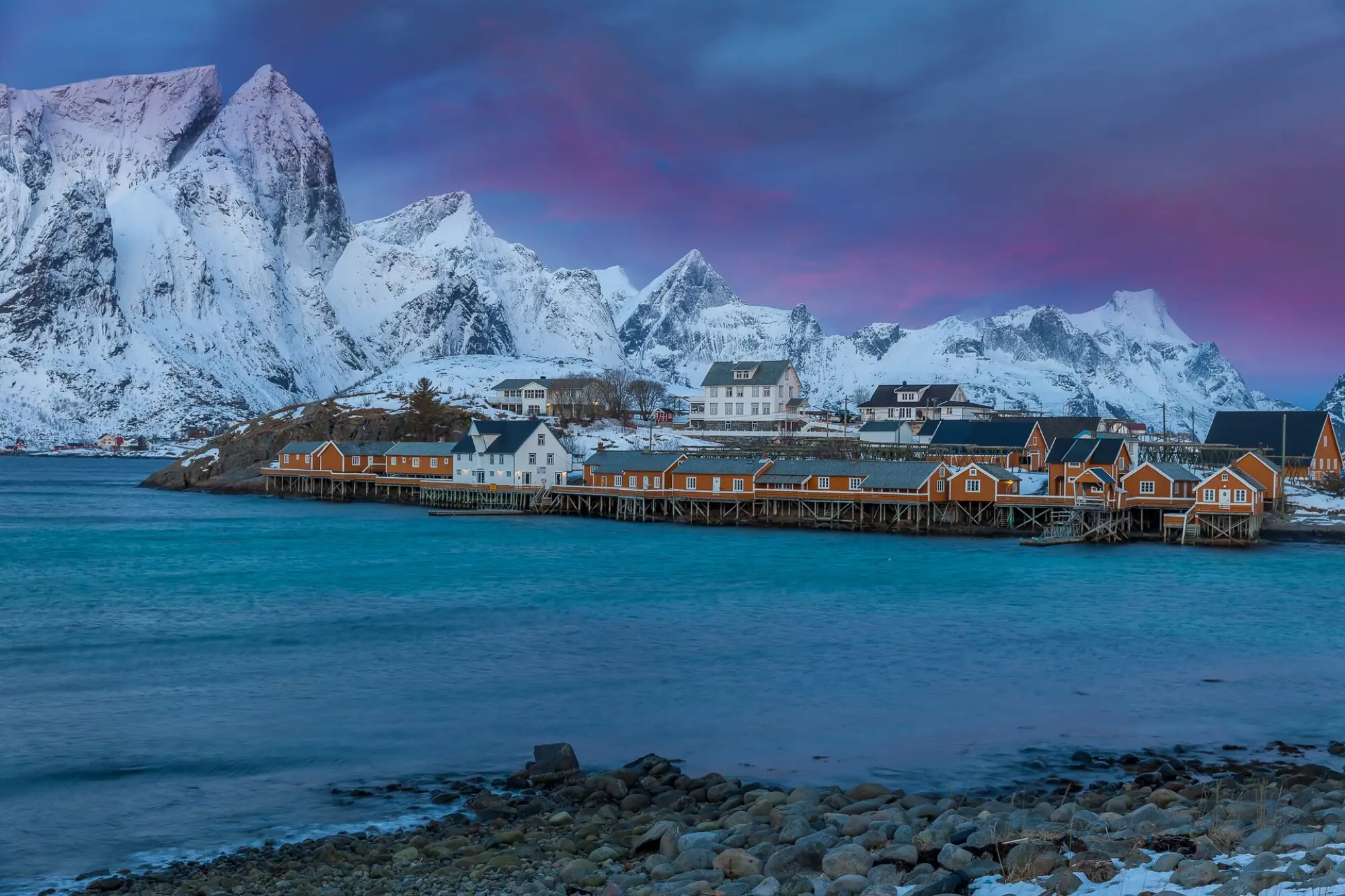

Winter in Lofoten runs from about November to March. The sun stays below the horizon from around 7 December to 5 January, but midday is blue rather than black. The coast is mild but wet and windy, the E10 is the one road with pilot cars through the Nappstraum tunnel, and the skrei fishery runs from January to April.
When winter is, and which month to pick
Visit Lofoten says winter in Lofoten usually lasts from November to March, although snow and weather vary from year to year. Reliable snow is most likely between January and March. Visit Lofoten says there is no single best time in winter; it depends on whether you come for the light, the snow, the fishing or the quiet.
Winter is quieter than summer across the islands. December brings the Arctic night and a deep blue light, often called the blue hour. In March the days are growing longer, the cod fishery is still on, and the world championship in cod fishing is held. If you are comparing seasons, you can read our Lofoten 5-day itinerary for the summer route and the ten stops along the E10.
The polar night and what the light is like
Locals call the polar night the Arctic night, or mørketiden. Visit Lofoten says it lasts from around 7 December to 5 January, when the sun does not rise above the horizon.
The polar night is not pitch black, as many people believe. For a few hours around midday the sky glows deep blue, sometimes rose and gold, the "blue hour" photographers come for. Snow on the ground and the sea around the islands reflect what little light there is.
After 21 December the days lengthen quickly, and by mid-January the light is returning fast. Daylight is short in December and January, so plan the driving and the time outdoors around the middle of the day. When the sun first comes back over the horizon, locals celebrate its return in different ways.
How cold, wet and windy it gets
Thanks to the Gulf Stream, daytime temperatures usually sit between about -5°C and 5°C, dipping to around -5°C to -10°C in clear, cold spells. The trade-off is weather that changes fast; when mild Atlantic air meets cold Arctic air there is wind, and sun, snow, sleet and rain can all come in one day.
Normal figures from yr show the pattern across the winter months:
| Month | Normal mean temperature | Normal precipitation |
|---|---|---|
| November | 3.3 °C | 272 mm |
| December | 1.5 °C | 286 mm |
| January | 0.3 °C | 238 mm |
| February | -0.4 °C | 236 mm |
| March | 0.3 °C | 212 mm |
The normal mean temperatures are from the Svolvær airport station, and the normal precipitation figures are from the Kongsmarka station, 3.5 km from Svolvær. Wind is part of it: in the 13 months from October 2025 to October 2026, the strongest gust measured at Svolvær airport was 39.2 m/s, on 27 December 2025.
Pack for wet, wind and ice rather than extreme cold, with a wool base layer, a fleece or wool mid-layer, an insulated jacket, a windproof, waterproof shell, a warm hat, gloves and insulated waterproof boots. The thing visitors most often forget is a set of pull-on spikes for their boots, because ice is everywhere, village pavements included. A head torch is worth having in the dark months, and shops in Lofoten sell what you forgot.
Northern lights in the dark months
Computed on this site for the 2026-27 season, astronomical darkness returns to Lofoten between 1 September and 15 September and ends between 15 March and 1 April.
The computed hours of astronomical darkness through the winter are:
| Date | Dark from | Dark until | Hours |
|---|---|---|---|
| 15 November | 17:56 | 05:40 | 11h 44m |
| 1 December | 17:28 | 06:18 | 12h 50m |
| 15 December | 17:18 | 06:38 | 13h 20m |
| 1 January | 17:30 | 06:42 | 13h 12m |
| 1 February | 18:40 | 05:50 | 11h 10m |
| 1 March | 20:18 | 04:10 | 7h 52m |
| 15 March | 21:26 | 02:56 | 5h 30m |
On 1 April it is not dark enough for the aurora. Visit Lofoten says Lofoten sits at about 68°N, directly under the auroral oval, so the lights are often visible even when solar activity is modest. Two things have to line up, activity in the sky and clear weather; nothing is guaranteed on any night, so give yourself several nights.
Get away from village lights, for example to a beach or out on the water; the aurora reflects off snow, lakes and the sea. Visit Lofoten says a guided tour improves your odds because the guides chase the clear patches of sky. Our Lofoten aurora page gives tonight's verdict and offers an alert when Lofoten lights up. If you are comparing bases in Northern Norway, read our guide to Tromsø in winter.
Driving the E10 in winter
The E10 is the islands' single main road, and in one day it can be dry, black-iced, snow-packed or slushy, sometimes all four. Rental cars have winter tyres, often studded; studs are allowed in Nordland from 16 October to 30 April.
Visit Lofoten says a few exposed points, such as the Gimsøy bridge, close in strong winds. When the E10 is icy or a bridge closes in high wind there is no quick detour, so leave early, drive well within the speed limits and keep your distance. Never stop on the road for a photo; use the marked lay-bys.
Main roads in Northern Norway are cleared of snow regularly, but some smaller roads may not be ploughed; do not drive on unploughed roads. The drive from Evenes airport to Svolvær takes around two and a half hours depending on conditions; allow longer in winter. Visit Lofoten suggests the airport express bus from Evenes to Svolvær for the first leg, because narrow winter roads are hard even for locals after a long flight.
The Nappstraum tunnel, pilot car and night closure
Statens vegvesen is upgrading the Nappstraum tunnel on the E10. Since 30 October 2025 traffic has been led through by a pilot car, and this lasts until the works end in December 2027.
The pilot car runs on this schedule:
- 06:00 to 09:00: Twice an hour from both sides.
- 09:00 to 15:00: One passage an hour.
- 15:00 to 17:00: Twice an hour from both sides.
- 17:00 to 23:00: One passage an hour.
- 23:00 to 06:00: Closed at night, with only one passage.
From 16 November 2026 the night passage moved from 02:00 to 00:30 from the Flesa side and about 00:40 from the Napp side, to fit the winter timetable of the Bodø-Moskenes ferry. Statens vegvesen asks drivers to follow closures in its traffic app and says it will also send SMS alerts if the tunnel has to close beyond the planned closures.
Slides, avalanches and going into the mountains
Statens vegvesen plans to secure the E10 from Nappstraumen to Å against slides, wind and waves, with slide protection at Blekktinden, Bøfjellet, Spengerleira and Voland; draft zoning plans went out for consultation on 26 June 2026.
The Norwegian avalanche warning service, Varsom, publishes a bulletin for the Lofoten og Vesterålen region every day before 4 p.m. from 1 December to 31 May. Visit Lofoten says visitors without winter mountain and avalanche experience should always go with a qualified local guide.
Reinebringen, the hike above Reine, is only accessible in the summer and autumn season. The Kvalvika and Ryten hike is a spring-to-autumn route; in winter it needs snowshoes or skis.
Getting there in winter
By air the usual winter route is to Harstad/Narvik Evenes (EVE) or Bodø (BOO), via Oslo or from elsewhere in Europe. Harstad/Narvik airport (EVE) is 170 km from Svolvær. From Bodø, Widerøe flies to Svolvær (SVJ), about ten minutes from the town centre, and to Leknes (LKN) in the west.
On the Bodø-Moskenes ferry, Torghatten's winter timetable for 2026-2027 has applied since 7 September. The direct ferry from Bodø to Moskenes takes about 3.5 hours, and you can take a vehicle or travel on foot. Booking is not compulsory; Torghatten lets 50% of the capacity to and from Bodø and Moskenes be reserved, and reserved spots must be paid when booked on its website before 20:00 the day before departure.
- Reserving adds NOK 65 for an adult foot passenger and NOK 130 for a vehicle up to 6 metres.
- The full fare for a petrol, diesel or hybrid car up to 6 metres is NOK 605.
- Travelling without a vehicle and without a reserved spot, the crossing is free; you only need to be at the port before departure.
- With a pre-booked ticket you must be at the dock at least 45 minutes before departure.
Bus 300, the Lofoten Express (Lofotekspressen), runs from Narvik or Evenes all the way to Å. In winter, always allow buffer time; flights and ferries can be delayed or cancelled by weather.
The skrei season and the cod fishery
From January to April the skrei (Arctic cod) migrate from the Barents Sea to spawn in the Vestfjord, and boats fish for them as they have since before the Viking Age. The Norwegian Seafood Council's Godfisk site says skrei is cod that grows up in the Barents Sea and is in the waters around Lofoten and Vesterålen for only part of the year, usually from about January to April.
Norway has a strong tradition of serving skrei with its liver and roe, which are available only in the skrei season. Along the shore the cod hangs to dry on wooden racks, the hjell, to make stockfish; it is a working season, not a display. Visit Lofoten says the fishery still draws fishermen from the whole coast, especially in March and early April, when huge amounts of fish hang on the racks to dry. The fish comes down from the racks in June.
Since 1990 between 2000 and 4000 fishermen have taken part each year. The world championship in cod fishing, VM i skreifiske, has been held in Svolvær every year since 1991, usually in the third week of March, with around 600 anglers; book well ahead to take part. Restaurants build the season around the fresh skrei, serving the cod itself and also its tongues, liver and roe. Local children and teenagers often cut out cod tongues at the fish landing stations to earn pocket money; cod tongues are a delicacy in Lofoten.
Museums open in winter
Winter hours differ by museum, with dates set out below:
Skrei (Kabelvåg)
Skrei tells the story of the migrating cod. Its new building, the Otolith, opened on 30 June 2026, and Skrei also includes the Lofoten Aquarium, where the otters and seals are fed, the Lofoten Museum and the Espolin Gallery. The museum is located at Storvågan in Kabelvåg, close to the E10 with parking on site; as of 2026 the bus stops about 1000 metres, a 15-minute walk, away.
- Hours: Open daily 11:00 to 16:00 from September to April (closed on 24, 25 and 31 December).
- Admission: A combination ticket for all of Skrei (the Otolith exhibition, the aquarium, the gallery and the manor house museum) costs NOK 375 for adults, NOK 350 for seniors, students and groups, NOK 185 for children and NOK 750 for a family of 2 adults and 3 children.
Lofotr Viking Museum (Borg)
At Borg stood one of the most powerful Viking chieftain's farms in the Nordic region, and the museum has the world's longest reconstructed longhouse. Lofotr is on the E10, 14 km north of Leknes. The museum is renewing its exhibition from 2011, and a new main exhibition opens in December.
- Hours: Open on Wednesdays and Saturdays from 11:00 to 17:00 from 1 November to 31 December 2026 (closed on Saturday 26 December). Check the museum's page for January onwards.
- Admission: NOK 210 for adults and NOK 160 for children aged 6 to 15 from 16 September to 31 December 2026.
- Opening event: The new exhibition opens with a free event at the museum on 15 and 16 December.
Museums in Å
- Norwegian Fishing Village Museum: Open daily 09:00 to 15:00 from 1 October to 6 December 2026; closed from 7 December to 2 January 2027. Admission from 1 October to 6 December 2026 is NOK 125 for adults, NOK 115 for seniors, NOK 95 for students and children aged 6 to 17, and free under 6.
- Lofoten Stockfish Museum: Open all year, with longer hours in the summer months.
Restaurants, rorbu and what closes
Many shops, restaurants and museums are open in winter, but not all; some galleries and smaller museums close or keep limited hours off-season, so check ahead. The main towns, Svolvær, Kabelvåg, Henningsvær and Leknes, keep restaurants and shops running through the winter. Check in advance and consider booking a table.
The classic winter stay is a rorbu, a fisherman's cabin on the water's edge, many restored and still standing where the fishery put them; there are also sea houses, guesthouses and hotels in the main villages. The best cabins, and any dates around the cod-fishing championship in March, book up early.
Public facilities on the roads also change with the season. The toilets at the Eggum rest area on the scenic route are open from early May to early October. The toilets at Hauklandstranda are open all year round.
Christmas in Lofoten
In Henningsvær the pre-Christmas adventure runs from the beginning of November until Christmas, with the whole village opening its shops. It brings concerts, activities, street lights and shops open all weekend, with local food and crafts, and Santa in the village square at weekends.