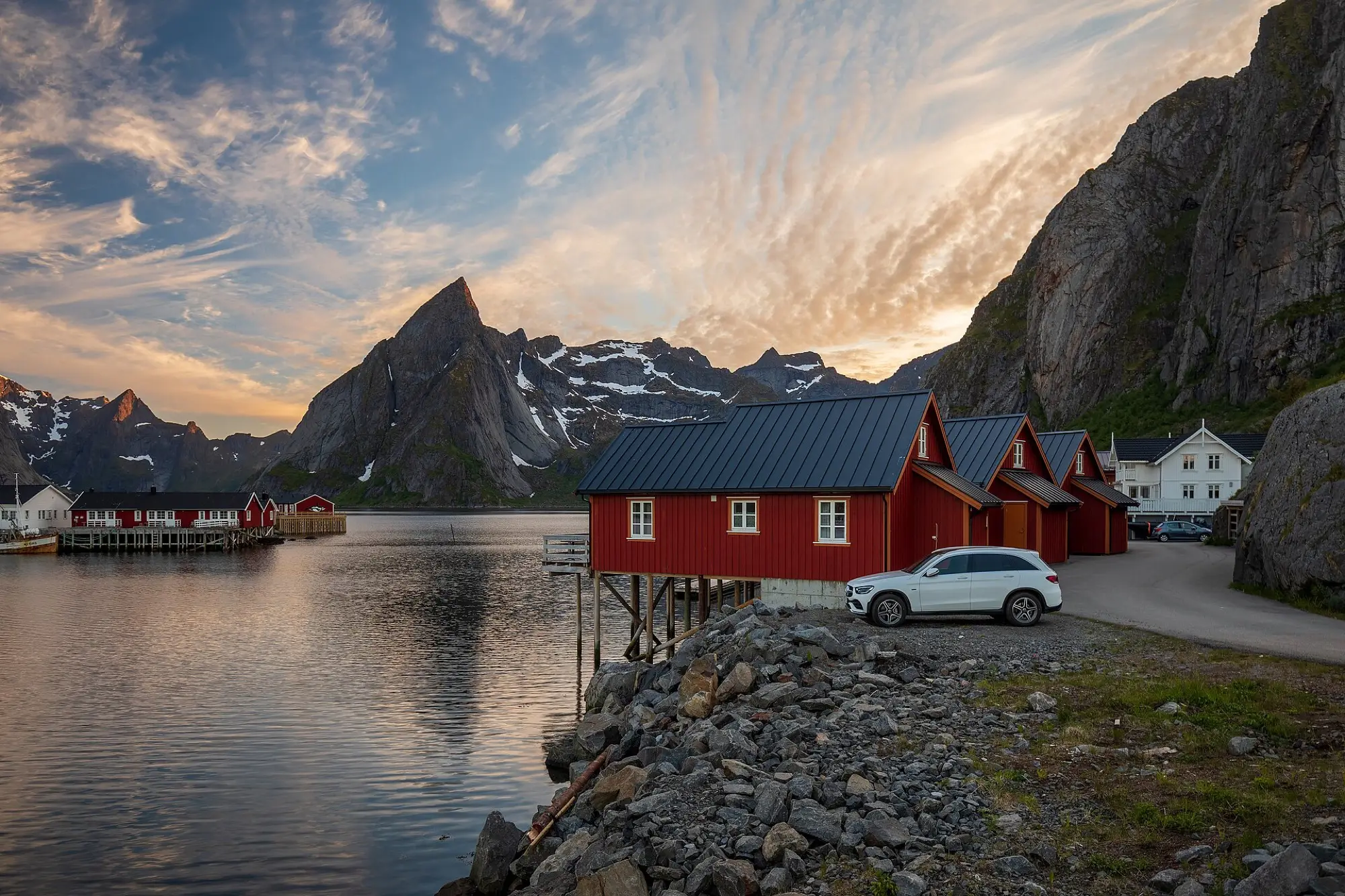

Choosing where to stay in Lofoten comes down to whether you hire a car, how you arrive, and how you handle the single main road connecting the islands. Svolvær suits travellers relying on public transport or arriving by air, while Henningsvær offers village atmosphere, Leknes provides a practical central base, and the western villages around Ramberg and Reine place you close to the high peaks and the Bodø ferry. West of Leknes, your movements across the archipelago depend on timed passages through the Nappstraum tunnel.
The five bases at a glance
Lofoten's settlements lie along the E10, stretching from the larger service hubs in the east to small fishing villages across the western islands. Svolvær is Lofoten's largest town, set between the mountains and the sea, where around 5,000 people live. Henningsvær is 25 km from Svolvær, a fishing village of several small islands joined by bridges, with just over 500 residents. In the middle of the archipelago lies Leknes, the administrative centre of Vestvågøy, providing extensive commercial services. Further west, Flakstad municipality covers Flakstadøy and the northern part of Moskenesøy, where most of its 1280 inhabitants live in five fishing villages: Ramberg, Fredvang, Napp, Sund, and Nusfjord. Near the southern end of the road, Reine is a fishing village on a chain of islands linked by bridges and serves as the municipal centre of Moskenes with approximately 300 residents. Å sits at the very end of the Lofoten archipelago, at the southernmost tip of Moskenesøya.
Statens vegvesen's route planner gives drive times across these connections on the E10. Driving from Svolvær to Leknes takes 61 minutes with no ferry, covering a route of just under sixty-eight kilometres. Svolvær to Henningsvær on the E10 and Henningsværveien takes 21 minutes over just over twenty-three kilometres. From Leknes, driving west to Ramberg takes 26 minutes across just over thirty-one kilometres, while Leknes to Reine takes 50 minutes over about fifty-six and a half kilometres. Continuing to the road's end, Leknes to Å takes 59 minutes across just under sixty-five kilometres. Driving the full distance from Svolvær to Å takes 119 minutes, which is about two hours with no stops over just over a hundred and thirty-two kilometres.
| Base | What it is like | Drive | Local bus | Best for |
|---|---|---|---|---|
| Svolvær | Largest town, between mountains and sea, lively coastal hub | 61 minutes to Leknes | Route 18-743, Route 300 | Travel without a car, flight arrivals, winter services |
| Henningsvær | Fishing village on small islands joined by bridges, protected cultural environment | 21 minutes from Svolvær | Route 18-743 | Village atmosphere, galleries, climbing and skiing community |
| Leknes | Administrative centre with shopping centres and farmland | 61 minutes from Svolvær | Route 18-766, Route 18-767, Route 300 | Single base for road trips, central position |
| Ramberg and Flakstad | Community centre and small villages near beaches | 26 minutes from Leknes | no figure | Beach access, western exploration with a car |
| Reine and Å | Reine is on a chain of islands and Å is at the end of the E10 | 50 to 59 minutes from Leknes | Route 18-772, Route 300 | Ferry arrivals from Bodø, mountain scenery |
What a rorbu is, and the other places to stay
According to Store norske leksikon, a rorbu (plural rorbuer) is a house in a fishing village used to lodge visiting fishermen during the big seasonal fisheries. The need for these cabins has fallen sharply, partly because fewer people take part in the fisheries and partly because modern fishermen live on board large vessels, which has made renting rorbuer to tourists standard practice. Visit Lofoten notes that for more than a thousand years, the rorbu has served as a second home for fishermen in Lofoten. Historically built by the sea, often perched on wooden poles above the water, the cabins gave fishermen shelter between trips to sea and space to store their gear. The layout traditionally featured two rooms: one for equipment storage and one fitted with beds. Their distinctive dark red paint originates from the era when paint made from cod liver oil was the cheapest coating available.
Today, accommodation labelled as a rorbu varies considerably. Some properties are authentic, restored cabins still occupying the waterside ground where the fishery put them, whereas other lodgings are purpose-built for tourists in the old style. Cabins range from rustic and simple rooms to modernised options with contemporary fittings, and from standalone small units to entire houses by the sea. Along with rorbuer, accommodation across the archipelago includes sjøhus (sea houses), conventional hotels, campsites, and rental apartments. Cabins and apartments set up for rent include fully equipped kitchens and private bathrooms, which suit families and groups of friends organising their own meals. When choosing a place to stay, consider the size of your group, the activities you plan to do, and whether you prefer to do your own cooking.
1. Svolvær: the largest town, for a stay without a car
Svolvær works best for visitors who want extensive services, direct airport or bus transfers, and the option to explore without hiring a vehicle. As the largest town in the islands with around 5,000 residents, it functions as one of Lofoten's main entry points and transit hub. The town centre contains a wide selection of hotels, restaurants, bars, shops, and activity operators that run through the entire year. On the island of Svinøya, connected within the town, a large cluster of old rorbu buildings, rental apartments, and sea houses stands among fish-drying racks. Behind the town, its own Sherpa stairs lead hikers directly up towards the viewpoints at Svolværgeita and Djevelporten. To prepare for broader regional travel, consult our Lofoten 5-day itinerary.
Widerøe operates flights connecting Bodø to Svolvær Airport (SVJ), located roughly ten minutes from the town centre. For mainland arrivals, a year-round airport shuttle bus runs directly between Harstad/Narvik Airport Evenes (EVE) and Svolvær; driving that same route from Evenes takes around two and a half hours, with longer times required during winter conditions. Regional bus 300 connects Narvik to Svolvær in four hours, travelling across Lofast, the permanent mainland road link. On the water, the NEX 2 express passenger boat operates between Bodø, Skrova, and Svolvær. Coastal voyages operated by Havila and Hurtigruten offer northbound port-to-port travel, taking approximately 1.4 hours to sail from Stamsund to Svolvær. From Svolvær, public bus services run along the E10 towards Leknes and Å, supported by local taxis and car hire desks. Local bus route 18-743 connects Svolvær to nearby Kabelvåg and Henningsvær.
Visit Lofoten says the main towns, Svolvær, Kabelvåg, Henningsvær and Leknes, keep restaurants and shops running through the winter. In Kabelvåg, where King Øystein built Lofoten's first fishermen's cabins, the Skrei museum at Storvågan stays open daily from 11:00 to 16:00 between September and April, closing only on 24, 25, and 31 December.
2. Henningsvær: the fishing village on islands, for atmosphere
Henningsvær suits travellers looking for coastal village character, local art venues, and an active outdoor community. The village is home to just over 500 permanent residents and is kept as one of Norway's 13 protected cultural environments to preserve one of the country's most important fishing villages. Rather than modern shopping malls, Henningsvær contains many small specialist shops, harbour-facing cafés, and galleries displaying pieces by local and world-known artists. The settlement acts as a base for climbing and skiing communities drawn to the surrounding peaks. In February and March, the Lofoten fishery is under way, and you can watch the boats come back to land the catch at the pier.
Reaching Henningsvær requires turning off the E10 onto Henningsværveien, a route taking 21 minutes from Svolvær over just over twenty-three kilometres. The road from the E10 is narrow, carries heavy traffic in summer, and can feel challenging for some; taking local bus route 18-743 from Svolvær or Kabelvåg is recommended by Visit Lofoten. Because the streets are narrow, drivers are asked to use one of the big car parks and explore the village on foot. Visitors are asked to keep the noise down in the evening and at night, because some people need to get up early.
Winter operating schedules shift through the season. From the beginning of November until Christmas, Henningsvær's pre-Christmas event brings concerts, activities, lights in the streets, and shops open all weekend. Some cafés and restaurants in Henningsvær may be closed in late December and January, so check opening hours before you go. For night sky viewing, one of the heights just past the football field is a good spot for photographing the northern lights, high enough and far enough from the village lights.
3. Leknes and Vestvågøy: the middle, for a road trip with one base
Leknes serves as a practical, central base for drivers planning to tour both eastern and western Lofoten from one location. Situated in the low-lying agricultural area of Vestvågøy, described by Arctic Norway as Lofoten's green centre where the Viking chieftains lived, the town operates as the administrative hub for the district. The town centre contains practical amenities including shopping centres, bakeries, pharmacies, vehicle repair workshops, and hotels. The surrounding landscape provides open space for hiking, paragliding, and surfing. To evaluate overall holiday expenditure and practical budgeting, read about whether Norway is expensive.
Statens vegvesen's route planner gives a driving duration of 61 minutes along the E10 between Svolvær and Leknes, a distance of just under sixty-eight kilometres without ferry crossings. Public transport links include Widerøe flights connecting Bodø to Leknes Airport (LKN) several times per day, as well as stops by the Lofoten express bus on its route along the E10. Local bus route 18-766 connects Leknes south to Ballstad, an active fishing community of more than 1000 years with waterside rorbu accommodation facing the Vestfjord. Local bus route 18-767 links Leknes with Mortsund, Ure, and Stamsund. Both northbound and southbound Hurtigruten ships stop at Stamsund, which has fishermen's cabins, restaurants, an art gallery, theatres, and a ski resort, as detailed in our guide to the Hurtigruten coastal express.
From Leknes, driving north to Haukland beach takes 10 minutes. The Lofotr Viking Museum at Borg sits 14 km north of Leknes along the E10. From 1 November to 31 December 2026, the museum opens on Wednesdays and Saturdays from 11:00 to 17:00, remaining closed on Saturday 26 December. Commercial businesses and dining establishments in Leknes stay open throughout the winter.
4. Ramberg and Flakstad: beaches and small villages, with a car
Ramberg and the wider Flakstad municipality cater to independent travellers with rental vehicles who prefer quiet coastal hamlets and beaches such as Ramberg beach, easy to reach from the road. Flakstad covers Flakstadøy and northern Moskenesøy, housing 1280 residents across Ramberg, Fredvang, Napp, Sund, and Nusfjord. Ramberg functions as the local service village, containing a department store, a petrol station, a library, and a boat and car workshop. Close to the village stands Flakstad church, an onion-domed timber church constructed around 1780. The wider district provides craft artisans, art galleries, museums, sea trips on local fishing boats, and places to stay. To understand road rules, tolls, and winter vehicle preparation, read our guide to driving in Norway.
Reaching Ramberg from Leknes takes 26 minutes of driving along the E10 across just over thirty-one kilometres. However, all road traffic between Leknes and Flakstad must pass through the Nappstraum tunnel. Major renovation work managed by Statens vegvesen requires a pilot car to escort all traffic through the tunnel until December 2027. Outside scheduled day convoys, night closures completely shut the tunnel from 23:00 to 06:00, permitting only a single passage through the night, which blocks uncoordinated late-night travel between Leknes and Ramberg.
Ramberg beach is on the north side of Flakstadøy, easy to reach from the road. The nearest shops to the Kvalvika hike are in Ramberg, 7 km from the start of the hike, with trails nearby also climbing Ryten. To reach Nusfjord, drivers leave the E10 midway between Napp and Ramberg and follow an adjoining county road for 6 kilometres.
5. Reine, Hamnøy, Moskenes and Å: the far west, for the ferry and the mountains
Moskenes municipality suits travellers seeking dramatic mountain topography, traditional rorbu settlements, and direct ferry access to Bodø. Reine serves as the local administrative centre with roughly 300 residents, situated across a chain of islands linked by bridges against the sheer peaks of Reinefjorden. Neighbouring Hamnøy is known for its red rorbuer, connected alongside Sakrisøy to Reine by small bridges. Driving between Reine and Moskenes harbour takes 4 minutes, while Sørvågen lies between Reine and Å near the open sea with mountain hiking trails around it. At the end of the road sits Å, the outermost fishing village that can be reached on the E10. For options on getting to Lofoten from Oslo, consult our route guide.
Transport through Moskenes relies on the E10, regional bus lines, and ferry connections across the Vestfjord. Driving between Leknes and Reine takes 50 minutes over about fifty-six and a half kilometres, while driving from Reine to Å takes 12 minutes. Local bus route 18-772 runs between Å i Lofoten, Reine, and Hamnøy, while regional bus 300 runs all the way from Å through Leknes and Svolvær to Evenes and Narvik. At Moskenes, Torghatten operates the passenger and car ferry to Bodø, which takes roughly 3.5 hours. Torghatten's winter timetable for 2026-2027 has applied since 7 September. Foot passengers travel free of charge without a booking simply by arriving before departure. For a standard petrol, diesel, or hybrid vehicle up to 6 metres, the crossing fare is NOK 605. Torghatten lets 50% of the capacity to and from Bodø and Moskenes be reserved before 20:00 the day before, adding NOK 130 for vehicles up to 6 metres. Learn more about booking systems in our overview of car ferries in Norway.
Reine's centre has small narrow streets, so drivers should use the public car parks. In winter, walking visitors should wear reflective gear, as drivers cannot see pedestrians in the dark. Visit Lofoten strongly advises against going up Reinebringen in winter for safety reasons. In Å, visitors can stay in modernised fishermen's cabins. The village contains one restaurant. Cultural sites include the Lofoten Stockfish Museum, open all year with longer hours in summer, and the Norwegian Fishing Village Museum, open daily from 09:00 to 15:00 through 6 December 2026, then closed from 7 December 2026 to 2 January 2027.
One base or two
Choosing between staying in a single accommodation or splitting your nights across two bases depends on the total length of your stay and your transport mode. The E10 connects the islands continuously over 163 km from Fiskebøl down to Å. Driving through from Svolvær to Å takes 119 minutes without stops, covering just over a hundred and thirty-two kilometres. Statens vegvesen's route planner gives 61 minutes of driving from Svolvær to Leknes, and 50 minutes from Leknes to Reine.
Dividing your booking between an eastern base like Svolvær or Henningsvær and a western base like Reine or Ramberg avoids travelling back and forth along the single main road. An eastern base provides access to airport shuttles, boat routes, and services. A western base places you directly beside the Moskenes ferry terminal and southern trailheads. If you travel on public transport, the Lofoten express bus stops at Svolvær and Leknes, while Svolvær functions as the natural hub for public buses heading along the E10 towards Leknes and Å.
Getting around without a car
Travelling through Lofoten on public transit takes some planning, so check timetables carefully. The main regional backbone is bus route 300, the Lofotekspressen, which runs from Å through Leknes and Svolvær before continuing on to Evenes and Narvik. Local feeder routes cover outlying settlements: route 18-743 connects Svolvær, Kabelvåg, and Henningsvær; route 18-766 runs between Leknes and Ballstad; route 18-767 serves Leknes, Mortsund, Ure, and Stamsund; and route 18-772 links Å i Lofoten, Reine, and Hamnøy.
Visit Lofoten says the most effective tool for buses, ferries and express boats is the Reis app, which shows routes with connections and current timetables, with the Reis Nordland travel planner as the alternative. Timetables alter slightly between winter and summer schedules, so check the dates a timetable applies from and to. Buying a bus ticket on board by card or cash adds a fee of NOK 20 for adults and NOK 10 for students, making tickets bought in the Reis app cheaper. The Travel Pass Nordland, bought in the Reis app, provides seven days of unlimited travel on buses and express boats. For visitors heading to Henningsvær, using bus route 18-743 is recommended over driving, because the road from the E10 is narrow, challenging for some and busy in summer.
Driving between the bases, and the Nappstraum tunnel
Driving within Lofoten needs no car ferry between Moskenes in the south and Fiskebøl in the north, as bridges and tunnels link the primary islands. The E10 is the islands' one main road. Specific exposed points, including the Gimsøy bridge, close in strong winds. Drivers should never stop on the road for a photo but use marked lay-bys. Rental cars come equipped with winter tyres, often studded; studded tyres are permitted in Nordland from 16 October to 30 April.
Every journey between Leknes and the bases to the west must pass through the Nappstraum tunnel on the E10. Statens vegvesen is upgrading the Nappstraum tunnel, and since 30 October 2025 traffic has been led through by a pilot car, lasting until the works end in December 2027. The escort schedule operates as follows:
- Between 06:00 and 09:00, the pilot car runs twice an hour from both sides.
- Between 09:00 and 15:00, there is one passage an hour.
- Between 15:00 and 17:00, the pilot car runs twice an hour from both sides.
- Between 17:00 and 23:00, there is one passage an hour.
At night, the tunnel is closed from 23:00 to 06:00, with only one passage. From 16 November 2026, the night passage moved from 02:00 to 00:30 from the Flesa side and about 00:40 from the Napp side, to fit the winter timetable of the Bodø-Moskenes ferry. Statens vegvesen asks drivers to follow closures in its traffic app and says it will also send SMS alerts if the tunnel has to close beyond the planned closures.
Staying in winter, and what stays open
Visit Lofoten says winter in Lofoten usually lasts from November to March, although snow and weather vary from year to year. The main towns, Svolvær, Kabelvåg, Henningsvær, and Leknes, keep restaurants and shops running through the winter. December and January are quiet across the villages, though Henningsvær is busy with its pre-Christmas market. February and March bring higher activity as the Lofoten fishery is in full swing and visitors come to ski, surf, and watch the northern lights. Demand rises around the world championship in cod fishing in March, meaning accommodation books up early. To review seasonal conditions and road details, read our dedicated guide to Lofoten in winter.
Opening hours for visitor sites vary across the colder months:
- Skrei Museum (Kabelvåg): Open daily 11:00 to 16:00 from September to April; closed 24, 25, and 31 December.
- Lofotr Viking Museum (Borg): Open Wednesdays and Saturdays 11:00 to 17:00 between 1 November and 31 December 2026; closed Saturday 26 December.
- Norwegian Fishing Village Museum (Å): Open daily 09:00 to 15:00 through 6 December 2026; closed from 7 December 2026 to 2 January 2027.
- Lofoten Stockfish Museum (Å): Open all year, running longer hours during summer.
- Henningsvær dining: Some cafés and restaurants in Henningsvær may be closed in late December and January, so check opening hours before you go and consider booking a table.
Northern lights from your base
Due to very little light pollution across the archipelago, aurora viewings can occur directly from Lofoten's villages when skies are clear. Sighting the display requires two things to line up: activity in the sky and clear weather. Because nothing is guaranteed on any night, giving yourself several nights improves your odds. The site's Lofoten northern lights page gives tonight's verdict and offers an alert when Lofoten lights up. If your trip also includes northern destinations like Tromsø, see our overview of where to stay in Tromsø.
Stepping away from village lights produces stronger viewing contrast, particularly on a beach or out on the water, where overhead light reflects off snow, lakes, and the sea. In Henningsvær, one of the heights just past the football field is a good spot for photographing the northern lights, high enough and far enough from the village lights.
Campervans and camping
Visit Lofoten asks campers and motorhomes to use campsites and motorhome pitches whenever possible. You may park and stay overnight at roadside stopping places or on non-agricultural land, provided your vehicle sits at least 150 metres from any building. Avoid camping on private property or farmland, and never drive off-road.
For fire safety, park at least four metres from other vehicles. On narrow roads, a sign with a large M marks a meeting place for cars to pass; you must not park in passing places to camp or take photos. Where there is no road, asphalt or gravel, you may not drive or park, and you may not sleep in a vehicle there, though you can pitch a tent.
Frequently asked questions
What exactly is a rorbu?
Store norske leksikon defines a rorbu as a house in a fishing village used to lodge visiting fishermen during the big seasonal fisheries. Today, many have been restored or purpose-built for tourists in the old style.
Can I reach Lofoten without a car?
Yes. Widerøe flies from Bodø to Svolvær and Leknes. By sea, the direct ferry from Bodø to Moskenes takes about 3.5 hours, and the NEX 2 express boat links Bodø with Skrova and Svolvær. Route 300 also provides a public bus service along the E10 from Narvik through Svolvær, Leknes, and Å.
How much does the ferry from Bodø to Moskenes cost?
Travelling without a vehicle and without a reserved spot, the Bodø-Moskenes crossing is free; you only need to be at the port before departure. For a petrol, diesel or hybrid car up to 6 metres, the standard crossing fare is NOK 605, with optional advance reservations available for an added NOK 130.
How long does it take to drive from Svolvær to Å?
Statens vegvesen's route planner gives 119 minutes of driving along the E10, about two hours with no stops, covering a route of just over a hundred and thirty-two kilometres.
What are the night closure hours for the Nappstraum tunnel?
The Nappstraum tunnel is closed at night from 23:00 to 06:00, with only one passage.