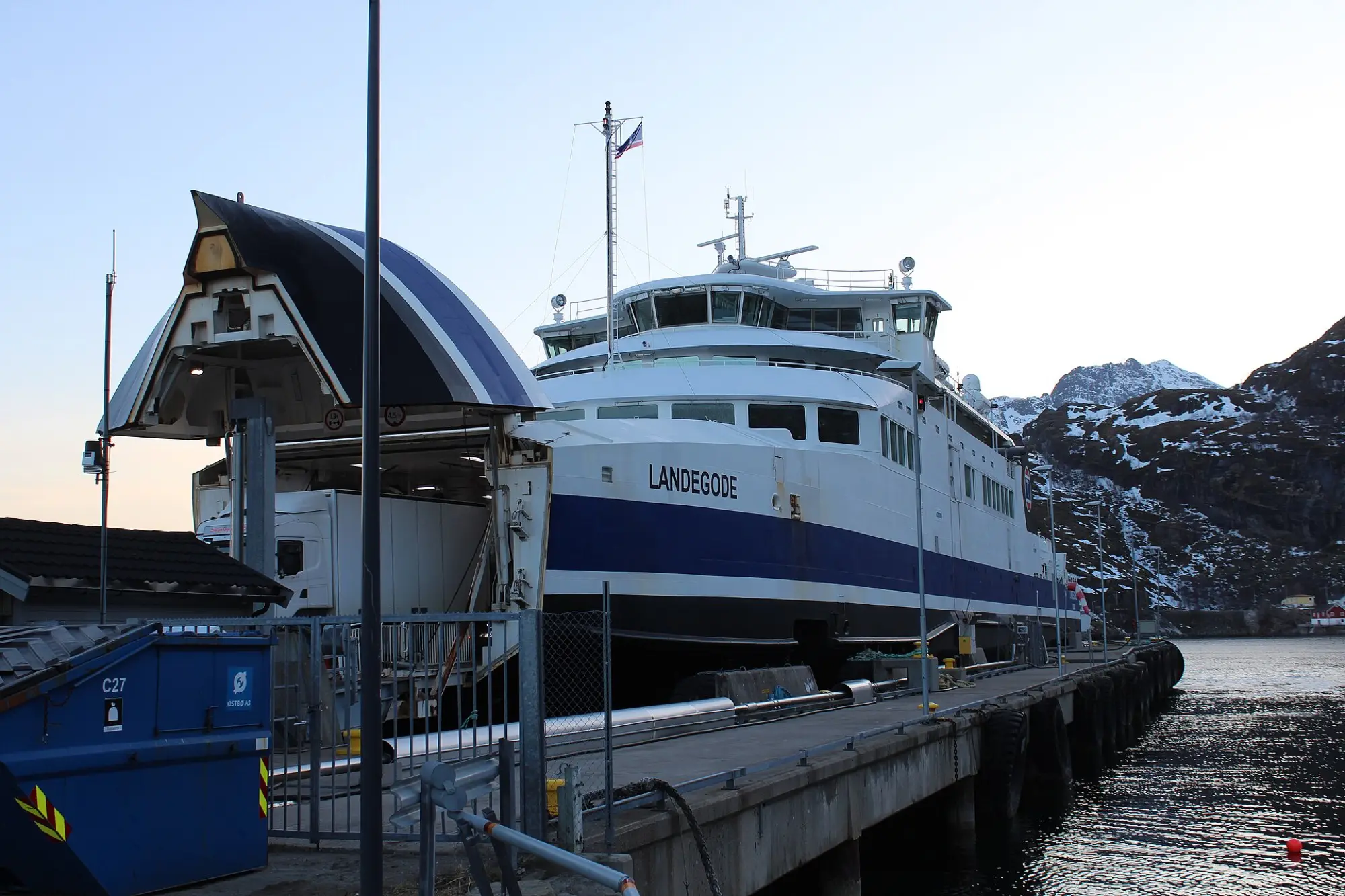

It is not possible to reach Lofoten by train; the nearest railway stations are Bodø and Narvik, so every route ends with a boat, a short flight, a bus or a drive. You can choose between five routes from Oslo: fly to Bodø and take the ferry to Moskenes, the express boat to Svolvær or the coastal ship; fly into Lofoten itself (Svolvær or Leknes via Bodø) or to Harstad/Narvik Evenes and take the bus or drive; take the train via Trondheim to Bodø and connect to a boat or bus; take the train via Stockholm to Narvik and catch bus 300; or drive all the way. For most people with a few days, flying via Bodø is the quick answer.
The short answer
There are 5 routes from Oslo to Lofoten, 2 that start with a flight, 2 that start with a train and 1 by car. For most people with a few days, flying via Bodø is the quick answer: Norwegian and SAS fly direct from Oslo Gardermoen to Bodø, where you can board the ferry, take the express boat or continue with Widerøe to Svolvær and Leknes. Norwegian also flies direct daily to Harstad/Narvik Evenes all year. In winter, allow buffer time, because weather can delay or cancel flights and ferries.
The five routes side by side
The table below outlines the five main options for travelling from Oslo to Lofoten using published transit times.
| Route | Legs | Time on the move | How often | Booking note |
|---|---|---|---|---|
| Fly to Bodø + ferry | Flight Oslo-Bodø, then Bodø-Moskenes ferry | Flight 1 hour and 30 min, ferry about 3.5 hours | Norwegian and SAS fly Oslo-Bodø; ferry: not published | Reserve a car spot on the ferry website; foot passengers free without booking |
| Fly to Svolvær or Leknes via Bodø | Flight Oslo-Bodø, then flight Bodø-Svolvær or Leknes | 1 hour and 30 min, then 25 min | Widerøe several flights a day from Bodø | Book as one ticket via SAS or Widerøe |
| Fly to Evenes + bus or drive | Flight Oslo-Evenes, then road drive or bus 300 | 1 hour and 45 min, then about two and a half hours by road or four hours on bus 300 from Narvik | Several direct flights a day from Oslo Gardermoen; bus 300 twice a day | Check the Reis app for bus times; rent a car at Evenes or Bodø |
| Train via Trondheim to Bodø + ferry | Dovre line train, Nordland line train, then ferry or boat | 16.5 to 17 hours on the two trains, then the boat | SJ NORD runs daily trains between Oslo and Trondheim; night train on the Nordland line not before mid-January 2027 | Book trains on Entur; book early for lower fares |
| Train via Stockholm to Narvik + bus | High-speed train Oslo-Stockholm, overnight train to Narvik, then bus 300 | About five hours to Stockholm, overnight train arriving in Narvik next day, then four hours on bus | Train to Stockholm up to five times a day; Stockholm-Narvik daily; bus 300 twice a day | Book rail on sj.se; bus tickets on the Reis app or by card on board |
| Drive | Drive via E6 and Bognes-Lødingen ferry | 1,191 minutes of driving on the E6 with the Bognes-Lødingen ferry | Ferry frequency not published; alternative through Sweden has no ferry | Tolls NOK 602 for a small car; 21 toll points |
Fly to Bodø, then the ferry, the express boat or the coastal ship
If you start in the capital, Oslo airport to city center: train, bus or taxi covers your initial transfer to Gardermoen, where the Flytoget airport express train leaves Oslo Airport every 10 minutes and takes 19 minutes to the city centre. Avinor, which runs Norway's airports, gives the flight time from Oslo to Bodø as 1 hour and 30 min. SAS also flies direct from Oslo Gardermoen to Bodø, and from Bodø you can continue with Widerøe to Svolvær and Leknes.
Bodø airport is just 1.2 km from the city centre, and many visitors walk into town. From the harbour, you have three maritime options into the islands:
- The car ferry to Moskenes: The direct ferry from Bodø to Moskenes is the quickest ferry to Lofoten and takes about 3.5 hours, and you can take a vehicle or travel on foot according to Visit Lofoten's ferry advice. The sailing via Røst and Værøy takes about 7 hours. On the Bodø-Moskenes ferry, run by Torghatten, the winter timetable for 2026-2027 has applied since 7 September.
- The express passenger catamaran: The NEX 2 express boat (Nordlandsekspressen) links Bodø and Svolvær for foot passengers, stopping at the island of Skrova on the way. Other stops on the express boat route include Helnessund, Nordskot, Bogøy and Skutvik. Arctic Norway says the Bodø-Svolvær catamaran is popular and can fill up, so reserve a seat ahead with the prebook function in the Reis app. Travel Pass Nordland gives unlimited travel on buses and express boats in Nordland for seven days at a fixed price.
- The coastal ships: Northbound, Havila's coastal ships arrive in Bodø at 13:05 and leave at 15:20. Northbound, Havila's ships then call at Stamsund in Lofoten from 19:15 to 19:40, arrive in Svolvær at 21:20 and leave at 22:15. In Bodø the coastal ship quay is in the city centre, opposite the railway station. On Hurtigruten a cabin is not needed for journeys under 23 hours, though it is advisable overnight. On Havila you can choose between a deckchair and a cabin when travelling overnight.
Booking the Bodø-Moskenes ferry
Booking the Bodø-Moskenes ferry is not compulsory; Torghatten lets 50% of the capacity to and from Bodø and Moskenes be reserved, and reserved spots are paid when booked on its website. A reservation is charged on top of the ticket, NOK 65 for an adult on foot and NOK 130 for a vehicle up to 6 metres. The full fare for a petrol, diesel or hybrid car up to 6 metres is NOK 605.
If you travel without a vehicle and do not reserve a spot, the crossing is free; you only need to be at the port before departure. With a reservation you must be in the lane marked reserved/prepaid 45 minutes before departure. The crossing is long enough that every passenger must be registered; passengers without a pre-booked ticket scan a QR code at the quay and enter their details.
The route is very busy in peak season, travellers to Røst and Værøy are prioritised, and Torghatten recommends the direct sailings between Bodø and Moskenes to avoid being left at the dock. Without a reservation you wait in your vehicle in the queue and an attendant sells you the ticket; you can pay with AutoPass, FerryPay or a card. If there is no space on the ferry, you stay in your vehicle and the queue attendants keep your place for the next departure.
Fly into Lofoten, or to Evenes and continue by road
You can also land closer to your accommodation by booking local commercial flights:
- Svolvær and Leknes airports: Avinor gives the flight time from Bodø to Svolvær as 25 min, and the flight time from Bodø to Leknes as 25 min. Widerøe has several flights a day from Bodø to Svolvær (SVJ) and Leknes (LKN). Svolvær airport is about ten minutes from the town centre; Leknes is further west. You can buy one connecting ticket for the whole journey from SAS or Widerøe. In the summer season Widerøe flies direct to Lofoten from Oslo Gardermoen and Bergen. Avinor's route data shows no direct Oslo-Leknes departure before 14 March 2027. Visit Lofoten says the sooner you book the flights, the better your chance of a reasonable fare.
- Harstad/Narvik Airport Evenes (EVE): Avinor gives the flight time from Oslo to Harstad/Narvik Evenes as 1 hour and 45 min, and there are several direct flights a day from Oslo Gardermoen. Evenes is 170 km from Svolvær. The drive from Evenes to Svolvær takes around two and a half hours depending on conditions, longer in winter; you can rent a car at Evenes or in Bodø. Visit Lofoten says even locals find narrow winter roads hard after a long flight, and suggests the airport bus from Evenes to Svolvær. Boreal Travel runs a year-round airport shuttle bus between Evenes airport and Svolvær. Bus 300 also runs from Evenes airport to Svolvær and on west through Lofoten to Å. Visit Lofoten lists bus 300 departures from Evenes airport at 10:50 and 17:05 every day, and says to check the Reis app that your flight fits.
The train via Trondheim to Bodø
Travelling entirely by rail through Norway requires two connecting lines. The Dovre line (Dovrebanen) from Oslo to Trondheim takes about 6.5 to 7 hours. Between Oslo and Trondheim SJ NORD runs daily trains and one night train, where you can sleep in a seat or a private sleeping compartment. You change trains in Trondheim, because the Dovre line and the Nordland line are separate lines, but both trains use the same station.
The Nordland line (Nordlandsbanen) from Trondheim to Bodø is 729 km long and takes around ten hours. It crosses the Arctic Circle on the Saltfjellet mountain plateau and ends at Bodø. On the two trains alone, Oslo to Bodø is about 16.5 to 17 hours, before the boat or bus to Lofoten.
SJ says the Nordland line night train between Trondheim and Bodø is not expected to resume before mid-January 2027. The reason is a delayed locomotive, which still needs approval from the Norwegian Railway Authority, and SJ needs about two months after delivery before it can run night services. SJ will put night train tickets on sale as soon as the final start date is confirmed.
You do not have to ride the whole Nordland line; you can book part of it, for example to Fauske, or break the trip with a night in Mosjøen or Mo i Rana. As on the rest of Norway's railways, the cheapest Nordland line tickets sell first, so book early. SJ sells its tickets through Entur, the national travel planner. Bodø station, the end of the Nordland line, is just over 400 metres from the city centre, and the coastal ship quay is opposite the railway station. There is also a daily bus from Bodø to Lofoten, which connects at Lødingen with the bus from Narvik, as noted on Visit Lofoten's bus overview.
The train via Sweden to Narvik, then bus 300
The second rail route travels through Sweden to Narvik. SJ's high-speed train runs from Oslo S to Stockholm Central Station in about five hours. SJ has five departures each way on weekdays, three on Saturdays and four on Sundays. From Stockholm, SJ's train between Stockholm and Narvik runs daily, leaving Stockholm Central and arriving in Narvik the next day. It stops at Arlanda Airport, Uppsala, Umeå, Boden, Kiruna, Abisko, Björkliden and Riksgränsen, among others. The train journey from Stockholm to Narvik is 1456 km, and Narvik is Norway's northernmost train station. The Stockholm-Narvik train is booked on SJ's Swedish website, sj.se; prices depend on the seat or compartment and how early you book.
Narvik's bus terminal is at the Thon Malmporten shopping centre, a short distance from the train station. Bus 300 runs twice a day from Narvik to Svolvær and on to Å at the end of the islands. Bus 300 from Narvik to Svolvær takes four hours, through Lofast, Lofoten's road link to the mainland. On the way the road crosses the Raftsund bridge, with a view down almost the whole of Raftsundet. Tickets for the Nordland buses can be bought in the Reis app or on board by card. Because of roadworks in Svolvær, bus 300's Svolvær stop has moved from the centre to the Lofotgata stop next to Coop Extra.
Driving from Oslo
If you prefer to drive, Statens vegvesen's route planner takes the route from Oslo to Svolvær up the E6, with one ferry from Bognes to Lødingen. This route is just under one thousand four hundred and twenty kilometres. The route planner gives 1,191 minutes of driving from Oslo to Svolvær, just under twenty hours, before stops and the ferry wait, and counts 21 toll points on that route, costing NOK 602 in tolls for a small car.
Visit Lofoten says Bognes-Lødingen is the most common ferry for drivers coming up from the south of Norway. The crossing takes about 1 hour. At Bognes, keep left for the Lødingen ferry on the E10; straight on takes you to the E6 ferry towards Narvik.
The route planner's alternative through Sweden, on the E16, E4 and E10, has no ferry and is just over one thousand nine hundred and forty kilometres. That route through Sweden is 1,412 minutes of driving, just over twenty-three and a half hours. Visit Lofoten says the E10 from Sweden is the alternative if you do not want to take a ferry to Lofoten. Lofast, the E10 road link that joins Lofoten to the mainland in the east, has been open since 2007.
If you drive to Bodø for the Moskenes ferry instead, Oslo to Bodø is 1,197 km and about 16 hours, on the E6 to Fauske and then road 80. The E6, Norway's main north-south road, is of a good standard throughout and can generally be driven all year. In winter the E6 is most often closed by bad weather on Saltfjellet, between Mo i Rana and Rognan, which is on the way to Lofoten. The passes generally reopen after a few hours; the Norwegian Public Roads Administration's website and the radio carry updates. All vehicles, foreign ones too, pay road tolls in Norway; AutoPass.no explains the payment options.
Winter on the way north
Winter conditions require specific precautions. For season-specific road context, read Lofoten in winter: daylight, roads and what's open. In winter, allow buffer time, because weather can delay or cancel flights and ferries. Rental cars have winter tyres, often studded; studs are allowed in Nordland from 16 October to 30 April. Statens vegvesen, the Norwegian Public Roads Administration, says to check road and traffic information and the weather forecast before you set off. Winter tyres should have a tread depth of at least 3 mm. Fill up with fuel or charge, especially before a mountain pass, and carry a shovel, warm clothes and food on long drives. In bad weather on mountain passes, cars may have to drive in a convoy behind a lead vehicle; do not overtake or turn around.
Statens vegvesen is upgrading the Nappstraum tunnel on the E10 in Lofoten; since 30 October 2025 traffic has been led through by a pilot car, and this lasts until the works end in December 2027. From 16 November 2026 the night passage through the tunnel moved from 02:00 to 00:30 from the Flesa side and about 00:40 from the Napp side, to fit the winter timetable of the Bodø-Moskenes ferry.
Once you are in Lofoten
Once on the archipelago, consult our Lofoten guide to plan your stops along the way. Most of the islands are joined by bridges and tunnels, and it is 163 km on the E10 from Fiskebøl to Å. Driving within Lofoten needs no car ferry between Moskenes in the south and Fiskebøl in the north. From the ferry at Moskenes to Svolvær, Statens vegvesen's route planner gives 114 minutes of driving on the E10, just under one hundred and thirty kilometres. One road and one bus line, routes 741, 742 and 300, run through the islands from Svolvær to Å, with 3 to 7 connections a day. There are several car rental agencies in Lofoten itself.