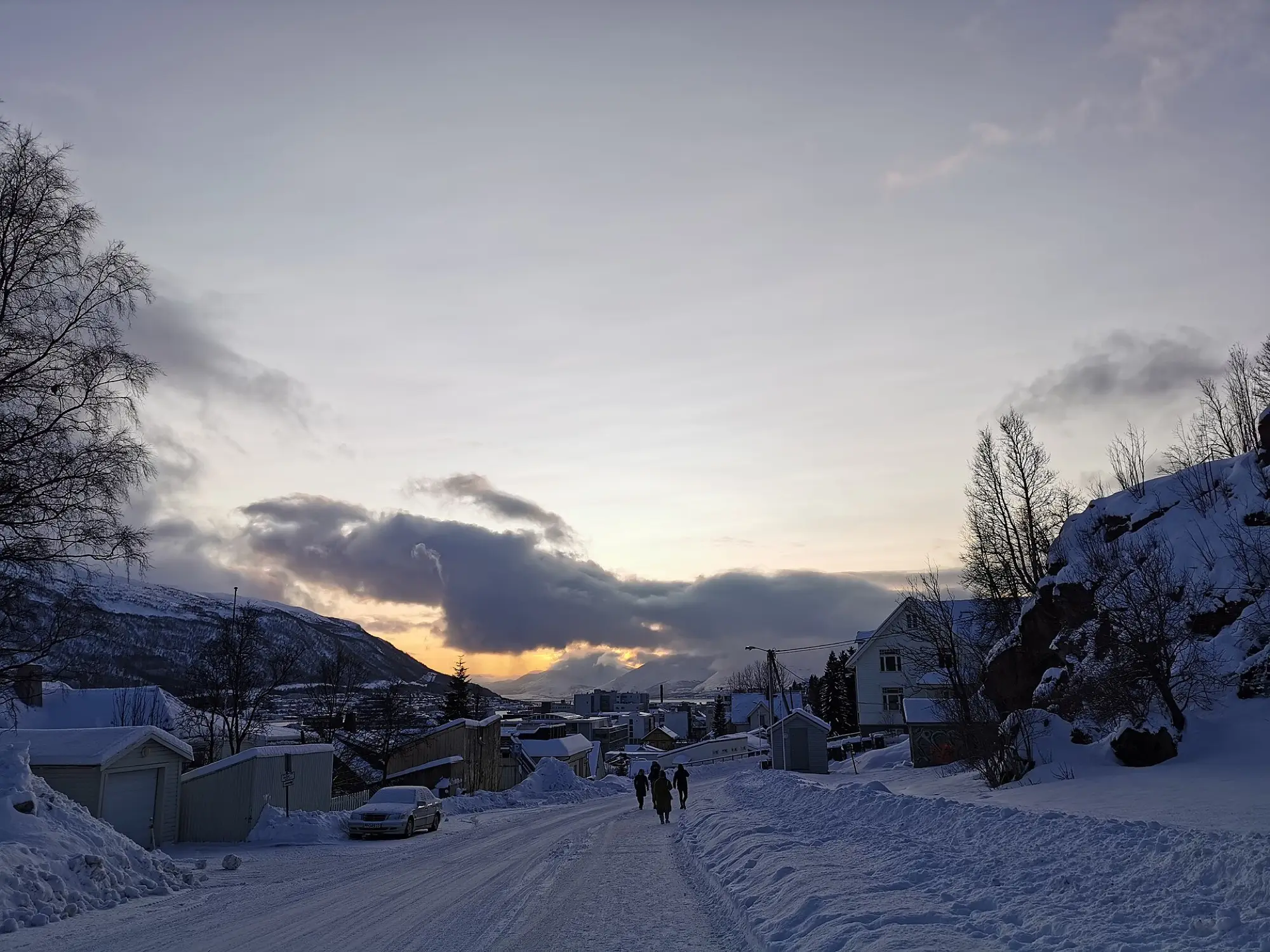

Tromsø lies at 69.6°N, but on yr's normals its coldest month is February at -3.3 °C and its warmest July at 12.3 °C. October is the wettest month (127 mm) and May the driest (57 mm). The polar night runs from 27 November to 13 January and the midnight sun from 18 May to 24 July.
Tromsø weather by month: the table
Tromsø lies at 69.6°N, on the island of Tromsøya, about 350 km north of the Arctic Circle. The temperature and precipitation figures come from yr's statistics for the Tromsø (Vervarslinga) measuring station, 1 km from Tromsø on yr's own measure. Yr is a collaboration between the Norwegian broadcaster NRK and the Norwegian Meteorological Institute. As Store norske leksikon explains, normals are averages over a fixed 30-year period, and the normals in use today are those for 1991-2020. The daylight and dark hours are computed on this site for 2026 in Tromsø local time, sampled on the 1st of each month. In the table, "dark enough for the aurora" means the time the sun is more than 18° below the horizon; you can find sunrise, sunset, day length and dark hours for every day on the Tromsø daylight page.
| Month | Normal mean temperature | Normal precipitation | Daylight on the 1st | Dark enough for the aurora on the 1st |
|---|---|---|---|---|
| January | -3.0 °C | 108 mm | polar night | 13h 22m |
| February | -3.3 °C | 97 mm | 5h 14m | 11h 08m |
| March | -1.9 °C | 97 mm | 9h 40m | 7h 34m |
| April | 1.2 °C | 71 mm | 14h 04m | never |
| May | 5.5 °C | 57 mm | 18h 52m | never |
| June | 9.4 °C | 58 mm | midnight sun (24h 00m) | never |
| July | 12.3 °C | 73 mm | midnight sun (24h 00m) | never |
| August | 11.3 °C | 88 mm | 20h 44m | never |
| September | 7.8 °C | 111 mm | 15h 20m | never |
| October | 3.1 °C | 127 mm | 11h 04m | 5h 48m |
| November | 0.2 °C | 94 mm | 6h 28m | 10h 22m |
| December | -1.7 °C | 110 mm | polar night | 12h 58m |
A monthly normal mean temperature averages day and night together. On yr's normals for the station, October is the wettest month (127 mm) and May the driest (57 mm); February is the coldest (-3.3 °C) and July the warmest (12.3 °C). Four months have a normal mean below 0 °C: December (-1.7 °C), January (-3.0 °C), February (-3.3 °C) and March (-1.9 °C), while November is just above it at 0.2 °C. Added up on this site, the twelve monthly precipitation normals come to 1,091 mm a year. To compare Tromsø with Oslo, Bergen and Røros, see the Norway weather by month overview.
Polar night, midnight sun and the dark hours
Computed on this site, Tromsø's polar night lasts 48 days, with the first day without a sunrise on 27 November and the last on 13 January. Visit Tromsø explains that for part of the winter, from late November to mid-January, the sun is below the horizon around the clock, which is the polar night. The sky brightens for a while in the middle of the day, so it is not dark all the time. The sun climbs above the horizon again from mid-January, but the surrounding mountains mean it is usually not seen from central Tromsø until later in the month. On the winter solstice, 21 December, the sun does not rise, and it is dark enough for the aurora for 13h 32m.
The midnight sun stays above the horizon in Tromsø for 68 consecutive days, from 18 May to 24 July, as computed on this site. On the summer solstice, 21 June, the sun does not set, giving 24h 00m of daylight.
Astronomical darkness begins on 17 September and ends on 25 March; between 26 March and 16 September the sun never drops below -18°. On the spring equinox, 20 March, the sun rises at 05:39 and sets at 18:01, providing 12h 22m of daylight, with 3h 32m dark enough for the aurora. On the autumn equinox, 22 September, sunrise is at 06:27 and sunset at 18:47, giving 12h 20m of daylight, with 3h 38m dark enough for the aurora. These times include the summer-time change on the last Sunday of March and of October.
How far a real year strays from the normal
A single year can differ from the normal, as shown by yr's statistics for Tromsø observed at the station across the 13 months from October 2025 to October 2026:
- January 2026 was colder than normal at the station, averaging -6.2 °C against a normal of -3.0 °C, with 58.2 mm of precipitation against a normal of 108 mm.
- March 2026 was milder and wetter than normal, averaging 2.1 °C against a normal of -1.9 °C, with 157.8 mm of precipitation against a normal of 97 mm.
- The wettest month in those 13 months was November 2025, with 170.5 mm observed against a normal of 94 mm.
- Across those 13 months the temperature at the station ranged from -14.8 °C on 1 January 2026 to 25.3 °C on 10 June 2026.
- The deepest snow measured at the station in those 13 months was 105 cm, on 23 February 2026.
- The station recorded precipitation on 181 days during those 13 months.
- The strongest gust was 23.9 m/s, recorded on 19 October 2026.
Historical extremes show a wider spread. Store norske leksikon notes that the highest temperature measured in the municipality in just over 150 years is 30.4 °C, recorded at the Holt station in Tromsø in 2014, while the lowest is -22 °C, recorded in 1910.
Snow in Tromsø: when it comes and when it goes
Visit Tromsø states that the first sprinkling of snow can be seen on the highest mountains in August. In September there is snow on the mountains, temperatures change, it gets darker and summer is over. By October the ground usually starts to freeze. In May temperatures rise and the snow slowly disappears. Summer arrives in June, but it has snowed then, so bring a warm jacket for the long summer nights; the weather can change quickly and it can even snow in summer, at 69° north.
Dog sledding on snow is usually available from November to April, depending on snow conditions; before the snow comes some kennels run husky tours with wheeled carts. Visit Tromsø lists skiing and snowshoeing in November only if there is enough snow, and dog sledding then either on wheels or on snow.
December and January: the polar night
December has a normal mean temperature of -1.7 °C and normal precipitation of 110 mm. January has a normal mean temperature of -3.0 °C and normal precipitation of 108 mm. On 1 December the sun does not rise (polar night), leaving 12h 58m dark enough for the aurora. On 1 January the sun also stays below the horizon, with 13h 22m dark enough for the aurora. The 48-day polar night period runs from 27 November to 13 January.
Visit Tromsø notes that December streets are filled with Christmas lights and decorations; consult the Tromsø in winter guide for practical trip details. In January the polar night season is about to end and the days become brighter, with the sun seen again at the end of the month. Tromsø marks the return of the sun on 21 January with sweet "sun buns" and hot chocolate. Because of the Gulf Stream, Tromsø has a milder coastal climate than many places at the same latitude, though temperatures vary considerably, especially inland on a northern lights tour. Monthly observations can fall well below the baseline, as occurred in January 2026.
February and March: snow, sun and long nights
February has a normal mean temperature of -3.3 °C and normal precipitation of 97 mm. March has a normal mean temperature of -1.9 °C and normal precipitation of 97 mm. On 1 February the sun rises at 09:18 and sets at 14:32, giving 5h 14m of daylight and 11h 08m dark enough for the aurora. On 1 March sunrise is at 07:05 and sunset at 16:44, providing 9h 40m of daylight and 7h 34m dark enough for the aurora. On the spring equinox, 20 March, sunrise at 05:39 and sunset at 18:01 yield 12h 22m of daylight and 3h 32m dark enough for the aurora.
Visit Tromsø calls February the perfect month for outdoor activities, offering sunny days and evening northern lights, and ice fishing is popular if the weather allows. The ski-touring peak season runs from February to May, when daylight returns, snow is plentiful and temperatures are milder, though the keenest skiers start as early as November. March 2026 was milder and wetter than normal; for details of how observations differ from the normals, see the section "How far a real year strays from the normal".
April and May: the thaw and the light nights
April has a normal mean temperature of 1.2 °C and normal precipitation of 71 mm. May has a normal mean temperature of 5.5 °C and normal precipitation of 57 mm. On 1 April the sun rises at 05:44 and sets at 19:49, providing 14h 04m of daylight. On 1 May sunrise is at 03:15 and sunset at 22:06, giving 18h 52m of daylight. On both dates, it is never dark enough for the aurora. Astronomical darkness ends on 25 March; from 26 March to 16 September the sun never drops below -18°. The 68 consecutive days of the midnight sun begin on 18 May and continue to 24 July.
According to Visit Tromsø, spring is short and normally lasts only a few weeks, while summer is long, light and mild. Early summer, May and June in particular, can be wet and cold; light wool base layers and a light windproof, waterproof jacket are suggested in the city.
June to August: the midnight sun
June has a normal mean temperature of 9.4 °C and normal precipitation of 58 mm. July has a normal mean temperature of 12.3 °C and normal precipitation of 73 mm. August has a normal mean temperature of 11.3 °C and normal precipitation of 88 mm. The sun does not set on 1 June or 1 July, giving 24h 00m of daylight, matching the 24h 00m on the summer solstice, 21 June. On 1 August sunrise is at 02:28 and sunset at 23:13, yielding 20h 44m of daylight. It is never dark enough for the aurora on any of these dates.
Visit Tromsø notes that the midnight sun is especially beautiful from the sea in July, making it a good month for guided boat trips and fishing; see the Tromsø in summer guide for summer plans. August marks the transition toward autumn, when locals gather berries and mushrooms in the forest and mountains. While July and August tend to be milder, the organisation recommends the same layered clothing, particularly for mountain hiking, because the weather can change quickly and mountain temperatures are often much colder than the city centre.
September: dark nights again
September has a normal mean temperature of 7.8 °C and normal precipitation of 111 mm. On 1 September sunrise is at 05:05 and sunset at 20:24, giving 15h 20m of daylight, with no hours dark enough for the aurora. Astronomical darkness begins on 17 September. On the autumn equinox, 22 September, the sun rises at 06:27 and sets at 18:47, offering 12h 20m of daylight and 3h 38m dark enough for the aurora. For sky conditions and tonight's northern lights verdict for Tromsø, cloud included, see the Tromsø aurora guide.
Visit Tromsø calls September the month for the northern lights without a big thermal suit, provided the sky is clear and aurora activity is present.
October and November: first snow and the last sunsets
October has a normal mean temperature of 3.1 °C and normal precipitation of 127 mm, making it the wettest month on yr's normals. November has a normal mean temperature of 0.2 °C and normal precipitation of 94 mm. On 1 October sunrise is at 07:02 and sunset at 18:06, providing 11h 04m of daylight and 5h 48m dark enough for the aurora. On 1 November sunrise is at 08:15 and sunset at 14:43, yielding 6h 28m of daylight and 10h 22m dark enough for the aurora. These figures account for the change from summer time on the last Sunday of October.
Visit Tromsø notes that in October the forest turns red, orange and brown. Autumn weather remains unpredictable, with sunshine, rain, wind and mountain snow all possible, making layers the best preparation. In November the sun sets for the winter, placing the city in the polar night season by the month's end. Monthly rainfall can far exceed the normal, as recorded in November 2025.
What to wear in Tromsø, season by season
Visit Tromsø gives the average temperature as -4 °C in winter and 12 °C in summer, but advises anyone undertaking Arctic activities or northern lights tours to prepare for -25 °C to 5 °C. Dressing in layers allows you to remove a garment when active and put one on when stationary, avoiding rapid cooling. Many activity providers lend clothing for excursions, including thermal suits, boots, hats and mittens.
For May to August, Visit Tromsø says lightweight wool, warm hats, light down jackets and gloves are standard local wear. Early summer can be wet and cold, requiring light wool base layers and a light windproof, waterproof jacket in the city. July and August tend to be milder, but the same clothing is recommended for mountain hiking, where temperatures are often much colder than in town and weather changes quickly.
From September to April, Visit Tromsø suggests woollen base layers next to the skin topped with warm, dry jumpers and jackets, supported by warm footwear, gloves, scarves and hats. Feet, hands, neck and head cool first. Shoes should be large enough for an extra pair of wool socks, and hand warmers can be placed inside footwear and gloves. Paths and city streets turn slippery in winter; ice grips or spikes can help prevent falls and are available in sports shops, shoe shops and the tourist information office.
Checking the forecast before you go out
Visit Tromsø advises checking the forecast before departing, as weather can alter considerably within a few hours even after a calm, clear start. Yr is a collaboration between NRK and the Norwegian Meteorological Institute, with its statistics for Tromsø drawn from the Tromsø (Vervarslinga) measuring station 1 km from the city.
Anyone without experience on snow and ice or in winter mountain terrain should avoid mountain hikes in winter and spring unless accompanied by a qualified guide. In winter the Sherpa stairs are usually covered in snow and ice, and parts of the route pass through avalanche terrain; visitors who are unsure should take the cable car to Storsteinen instead.