
July's mean daily high is 23.6 °C in Stockholm and 17.9 °C at Kiruna airport. The midnight sun shines in Abisko from 24 May to 18 July, Midsummer Eve is 25 June 2027, Medieval Week fills Visby on 8-15 August 2027, and the crayfish season starts in August.
Sweden in summer, in short
SMHI, Sweden's meteorological and hydrological institute, publishes normal values for 1991-2020 on its data series portal, which is the standard period set by the World Meteorological Organization (WMO) so that places can be compared.
Across Sweden, summer temperatures and warm days vary significantly between the south and the far north:
- July's mean daily high is 23.6 °C at Stockholm's observatory hill, the highest among these stations.
- The mean daily high reaches 22.7 °C at Malmö A and 17.9 °C at Kiruna airport.
- Days per year reaching 25 °C or more average 23.9 in Stockholm, 20.7 at Göteborg A, 19.6 at Malmö A, 6.2 at Östersund-Frösön, and 2.8 at Kiruna airport.
- These warm days occur nearly entirely across June, July, and August.
| Thing to do | Where | When |
|---|---|---|
| Midsummer | Nationwide (Dalarna highlighted) | 25 June 2027 |
| Midnight sun | Abisko and Kiruna, Lapland | 24 May to 18 July (Abisko); 27 May to 15 July (Kiruna) |
| Hike Kungsleden | Abisko to Hemavan | Summer season |
| Stockholm archipelago | Stockholm | June to September |
| Car-free islands | Southern archipelago, Gothenburg | Summer (daily ferry access) |
| Medieval Week | Visby, Gotland | 8-15 August 2027 |
| Sea stacks | Langhammars, Fårö, Gotland | Summer |
| Liseberg | Gothenburg | 17 April to 26 September 2027 |
| Crayfish parties | Nationwide | Early August into September |
| National Day | Nationwide | 6 June |
| The High Coast Trail | Hornöberget to Örnsköldsvik | Summer |
| Skansen | Stockholm | 31 May to 29 August (10.00-18.00) |
1. Midsummer
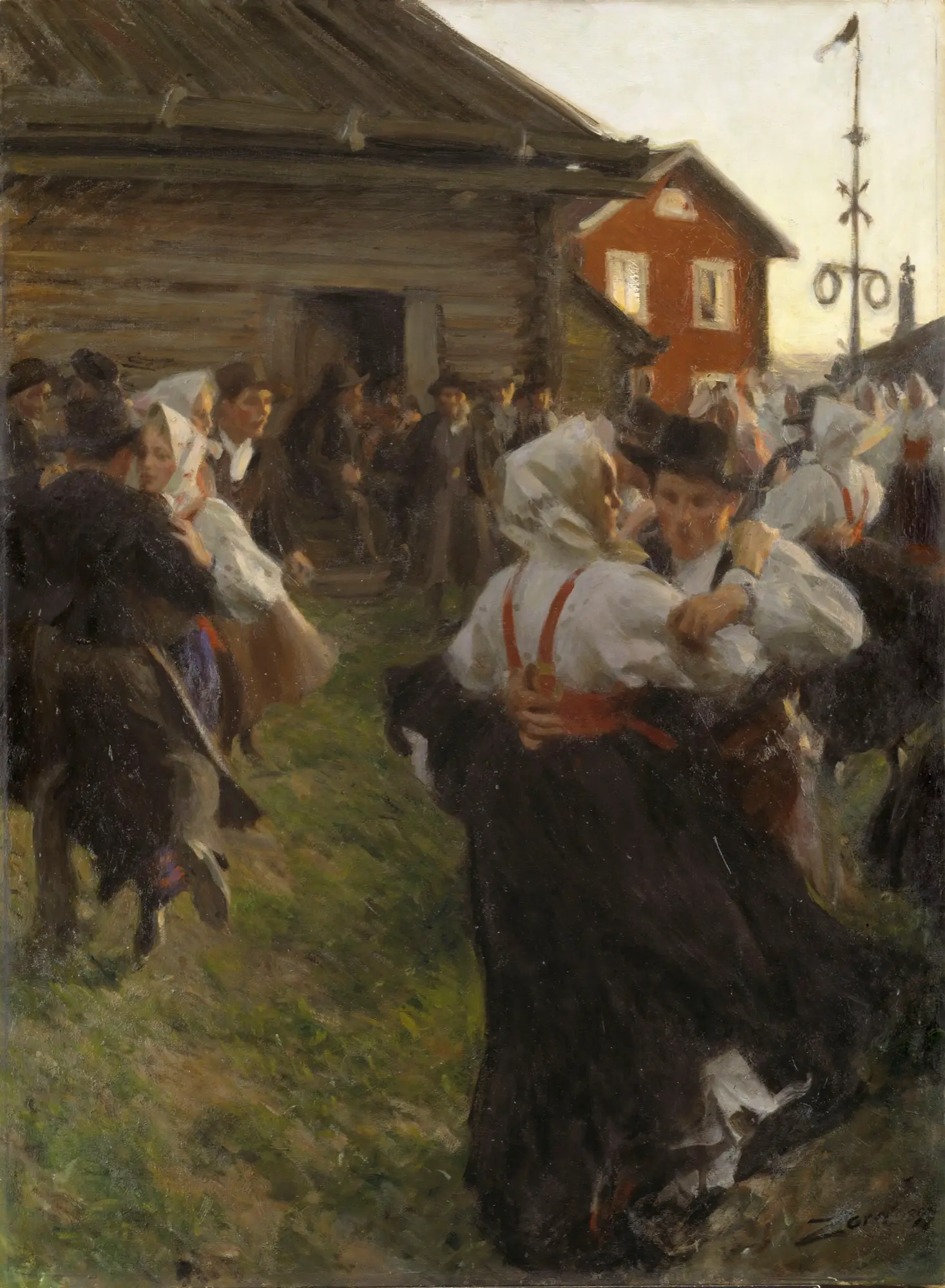
Midsummer Eve is always celebrated on a Friday between 19 and 25 June. In 2027, Midsummer Eve falls on Friday 25 June. It marks one of the most significant dates on the Swedish calendar. If you want to experience traditional festivities, Dalarna has folk costumes, fiddlers, garlands, and church boat races. Events take place across the county before, during, and after Midsummer Eve. Learn more about regional events and customs in our guide to Midsummer in Sweden.
2. The midnight sun in Lapland
Travelling north of the Arctic Circle gives you continuous daylight throughout early summer. In Abisko, the midnight sun lasts 56 days, from 24 May to 18 July. In Kiruna, the midnight sun stays above the horizon for 50 days, running from 27 May to 15 July. During this window, you can hike, explore outdoor reserves, and travel at any hour without darkness.
3. Hike Kungsleden
Kungsleden, which translates as the King's Trail, runs just over 450 km between Abisko and Hemavan. The Swedish Tourist Association (STF) set up the trail in the early 20th century. Logistics are straightforward at the northern trailhead because the train stops daily right opposite Abisko Tourist Station, where Kungsleden begins. For shelter, STF runs 16 mountain huts along Kungsleden, spaced 10 to 20 km apart, though note that there are none between Kvikkjokk and Ammarnäs. Read our complete guide to hiking Kungsleden for route planning.
4. The Stockholm archipelago
The Stockholm archipelago is Sweden's largest archipelago, comprising over 30,000 islands across more than 650 square miles. The archipelago begins just 20 minutes from the city centre. Several destinations are close enough for quick day outings: Fjäderholmarna, Vaxholm, Gustavsberg, Värmdö, and Grinda are within an hour of the city by local transport or ferry. If you want to travel farther out, Sandön, Möja, Nåttarö, Utö, and Finnhamn are a couple of hours away. At Vaxholm, Vaxholm Fortress, commissioned by King Gustav Vasa in the 16th century, operates as a museum open June to September, alongside a hotel.
5. Gothenburg's car-free islands
The islands of Gothenburg's southern archipelago are entirely car-free and reached all year round on the Styrsöbolaget ferries. Getting to the ferry departure point at Saltholmen from central Gothenburg is direct using local public transport. Saltholmen is reached by tram 11 (as well as line 9 during summer) in about 35 minutes, or by bus 114, known as Ö-snabben (the island express bus), in about 25 minutes.
6. Medieval Week in Visby
Medieval Week, held during calendar week 32, turns the town of Visby medieval with theatre, bustling markets, and jousting tournaments. The festival draws up to 40,000 people to Gotland. Medieval Week on Gotland in 2027 runs from 8 to 15 August, featuring a programme of over 300 individual events. To plan your visit, see our overview of Visby.
7. Gotland's sea stacks
Beyond Visby, Gotland is famous for its natural limestone formations. Some of Gotland's best-known sea stacks stand at Langhammars on the smaller island of Fårö. These eroded pillars reach almost 10 metres tall on an exposed pebble beach. Fårö sits just north-east of the main island of Gotland and is reached via a free six-minute ferry ride from Fårösund. The entire island is formed of limestone and offers sandy beaches, open fields, and meadows to explore.
8. Liseberg
Liseberg is in Gothenburg. The 2027 summer season runs from 17 April to 26 September, though summer and Halloween 2027 tickets are not on sale yet. For visitors interested in entertainment, most summer music performances are included directly in general admission, but concerts staged on Stora scenen (the main stage) need a separate ticket.
9. Crayfish parties
The crayfish party (kräftskiva) season starts in early August and runs into September. Traditionally, the festivities began on the first Wednesday of August, following the lifting of the old historical fishing ban that ran up to 7 August. During preparation, crayfish are cooked in water, salt, and sugar with plenty of crown dill. They turn bright red during boiling and are served and eaten cold alongside bread, cheese, and drinks.
10. National Day
Sweden celebrates its National Day each year on 6 June. The date marks two major constitutional milestones: Gustav Vasa's election as king in Strängnäs on 6 June 1523, which brought an end to the Scandinavian Kalmar Union, and the adoption of the historic instruments of government, the constitutions of 1809 and 1974.
11. The High Coast
The High Coast Trail offers long-distance hiking through an area where post-glacial rebound continues today. The trail extends 135 km from Hornöberget to Örnsköldsvik and is arranged into nine distinct sections. The entire route passes through a designated UNESCO World Heritage Site where the land is still rising from the sea.
12. Skansen's long summer days
Skansen open-air museum in Stockholm provides an overview of Swedish historical living and native wildlife. For visitors travelling during Stockholm in summer, Skansen opens from 10.00 to 18.00 between 31 May and 29 August. The park extends its hours for special holiday celebrations, staying open until 21.00 on Walpurgis Night (30 April), until 20.00 on National Day (6 June), and until 22.00 on Midsummer Eve (25 June).