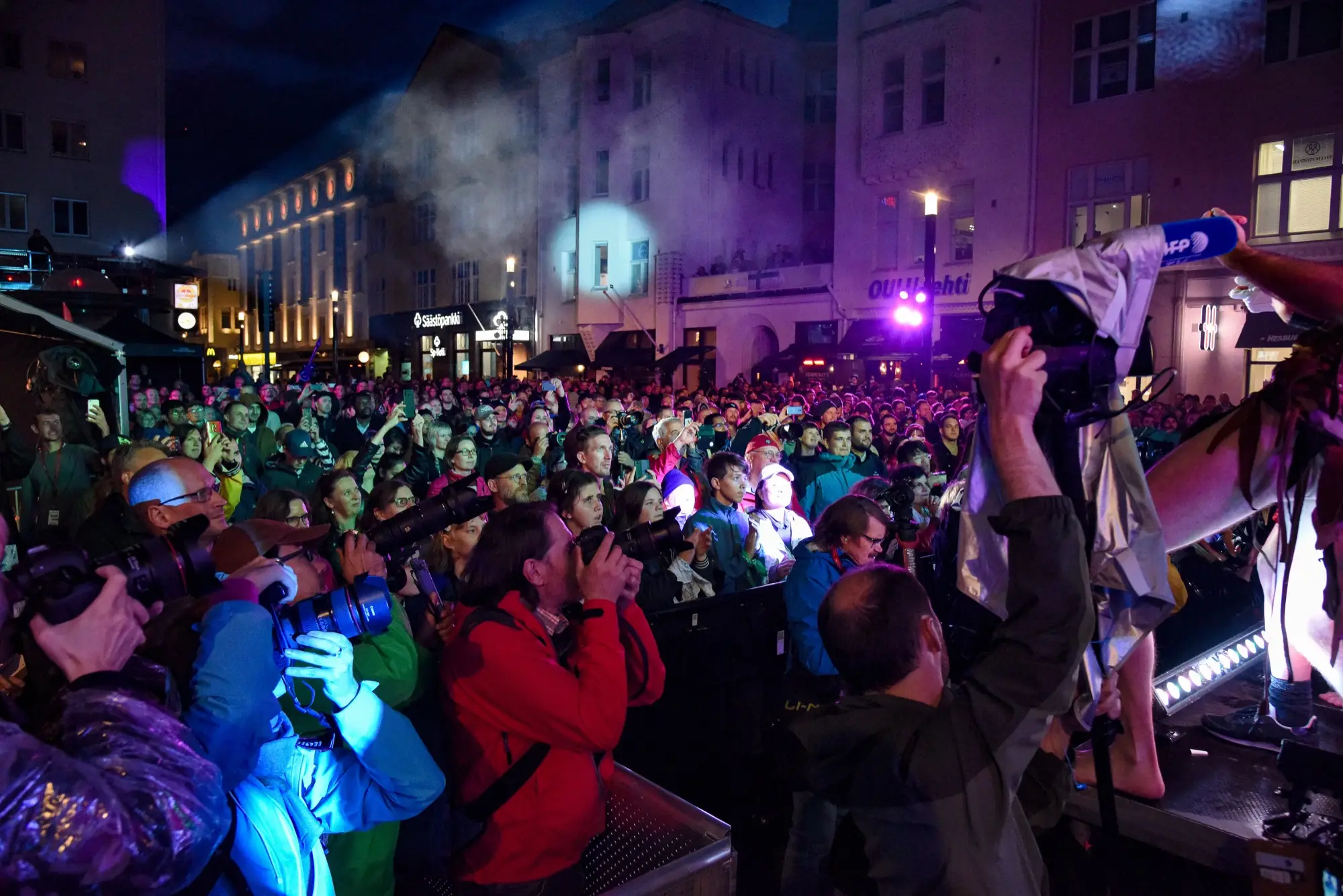

The Air Guitar World Championships are held in Oulu, on the Gulf of Bothnia in northern Finland, every August, and have been since 1996. Contestants play a guitar that is not there, for exactly one minute, and a jury scores them on a scale from 4.0 to 6.0. The 2026 final, the 30th, was on 28 and 29 August and it was free to watch. The next one has not been dated yet.
The organisers themselves call it semi-absurd performance art, and it has been taken seriously, in exactly the right proportion, for three decades. The rules run to a page and a half and are enforced. The finalists come from Japan, the United States, France, Taiwan and Brazil as well as Finland, and in an ordinary year around 5,000 people watch the final in the centre of Oulu.
What happened in 2026
Oulu was a European Capital of Culture in 2026, and the championships became part of that year's biggest summer event, the Delta Life Grand Finale. The organisers moved the competition from the city-centre streets to a stage built over the water in Pokkisenpuisto, the park at the mouth of the Oulu river where the city began. The audience stood on the shore, with two big screens.
The format changed with it. The final was split over two evenings, and the Dark Horses qualifier, the open round for anyone without a national title, was held in two stages: a virtual round on 6 June, then a live round on the stage on Thursday 27 August. Four of the fifteen who got that far qualified. The man who invented the championships, the musician Jukka Takalo, wrote the Delta Life show that followed the air guitar each night.
Aapo "The Angus" Rautio from Oulu won with 34.8 points, keeping the title he took in 2025. Nanami "Seven Seas" Nagura of Japan, champion in 2014, 2018 and 2023, was second on 34.4. Saladin "Six String Sal" Thomas of the USA was third, level on 33.4 with France's Kirill "Guitarantula" Blumenkrants. The organisers' results page counts more than 50 air guitarists from 13 countries across the week and 5,000 people on the shore for the final.
How it began
The first championship was held in August 1996 on Rotuaari, Oulu's pedestrian street, as a side event of the Oulu Music Video Festival, which a group of local video students had started two years earlier. The festival wanted something noisier outdoors, and Takalo came up with the invisible instrument. The first world champion was Oikku Ylinen, and Finns won the first five years.
It did not stay local. Takalo told Yle in 2013 that it "got out of hand" in the first year, with the BBC and Chinese media calling. Britain's Zac Monro won in 2001 and 2002, and the title has since gone to the United States, New Zealand, the Netherlands, Japan, France, Germany and Canada. No championship was held in 2020; in 2021 former champions competed in a virtual one-off. When Rautio won in 2025 it was the first Finnish title since 2000.
The rules and the 6.0 scale
The rules are short:
- The instrument must be invisible. Electric, acoustic or both are allowed.
- The final has two rounds. In the first, each contestant plays a song of their own, edited to exactly 60 seconds. The top eight go through to the second, which is played to a compulsory song they hear for the first time just before the round starts.
- Each juror scores between 4.0 and 6.0, and the two rounds are added together. A tie is settled by an Air Off to a song chosen by the organisers.
- Air roadies are allowed. Backing bands, real or air, are not. Nor are real instruments, or anything used as a stand-in for a guitar. A real pick is fine.
- You get up to ten seconds on stage to set the scene before the music starts.
The popular version is that you are judged on three things: technical merit, stage presence and "airness". The current rules list six: originality, the ability to be taken over by the music, stage presence, technical merit, artistic impression and Airness. Airness is the one that matters, and it is the one nobody can define. The best explanation is watching someone who has it. In 2026 the final jury had five members, including the guitarist Juha Torvinen, head of the jury since 1996.
Air guitar for world peace
The stated purpose of the championships is world peace. The official line is that wars would end, climate change would stop and all bad things would disappear if everyone in the world played air guitar, and the motto is "Make air, not war". It is said with a straight face and meant about half seriously, which is the tone of the whole event.
In practice it means two rituals. Each evening opens with a declaration of air guitar peace, and at the end everyone present plays together; in 2026 that was to "Rockin' in the Free World". If you go, you will be expected to join in. Nobody minds how you play.
Taking part
There are two routes to the final:
- Win your national championship. Only licensed national champions and the reigning world champion go straight to the final. In 2026 national finals were held in the USA, Canada, France, Germany, Brazil, Finland, Japan, Taiwan, the Netherlands, the UK and Belgium. Finland's took place at the Workers' Music Festival in Valkeakoski on 25 July, and the UK's on 27 June. The national championships page links to each country's organiser.
- The Dark Horses. Anyone else can try to qualify in Oulu, normally on the Thursday before the final, with one song of exactly one minute. In 2026 a video round on 6 June came first. In 2025 there were two sign-up windows, the second closing on 15 July, and 30 air guitarists competed in the qualifier. Sign-up is announced on the organisers' news page.
Contestants sign a contract with the organiser, Airnest Productions, and are responsible for clearing the rights to edit their song. There is no dress code, but almost every finalist performs in costume and under a stage name.
Watching it
In 2026 the final was free, with no age limit, and started at 20:45 each night; each round lasted about an hour. The finals are streamed live, and the recording stays free to watch on the championships' site until the next edition. Around the final there are side events: Airientation, a get-together on the Wednesday that was ticketed in 2025, a qualifier night, and afterparties in Oulu's bars with airioke, which is karaoke for air guitar.
The usual pattern, outside the capital-of-culture year, is Dark Horses on a Thursday and the final on the Friday of the second half of August: 25 August 2023 on Rotuaari, 23 August 2024 and 22 August 2025. The dates for 2027 had not been announced when this was checked. The championships are part of the Oulu August Festivals, which run through the month.
Getting to Oulu
Oulu is 610 km (380 miles) north of Helsinki.
- Train. On the day of the 2026 qualifier there were 13 daytime direct trains from Helsinki, between 05:03 and 18:20. The fastest, the 10:20 Pendolino, took 5 h 25 min, and most of the others between 5 h 28 min and 6 h 39 min. Three slower Intercity trains took 8 h 31 min to 8 h 56 min. Two night trains, at 19:29 and 23:13, take around 9 hours. From Helsinki Airport, change at Tikkurila, as the airport guide explains. Oulu station is less than a kilometre from the centre.
- Flight. Finnair flies between Helsinki and Oulu several times a day. Oulu Airport is a 30-minute bus ride from the centre.
- Car. Route 4 (E75) runs all the way. It is motorway to Jyväskylä and mostly single carriageway after that, and the Helsinki to Oulu road page shows current conditions.
The championships have an official partner hotel in the centre, GreenStar, and competitors can ask the organisers for a discount code.
Oulu in late August
Late August in Oulu is cool rather than warm. At the airport weather station, the last ten days of August from 2021 to 2026 averaged daily highs between 15.6 and 20.1 °C (60 to 68 °F), and nights between 6.7 and 12.1 °C. The coldest night in that period, in 2025, fell to 2.1 °C. The final is an evening outdoors by the water, so bring a warm layer and something waterproof.
The light is changing fast. On 28 August 2026 the sun set at 20:52, a few minutes after the final began, and Oulu loses about seven minutes of daylight a day at that time of year. The sky still does not get fully dark at night. The Oulu daylight page has the exact times for any date.
The Wife Carrying World Championships in Sonkajärvi are Finland's other famous contest of this kind, and it has more: swamp soccer, hobby horses and the sauna championships that no longer exist. They are collected in Finland's unusual championships.