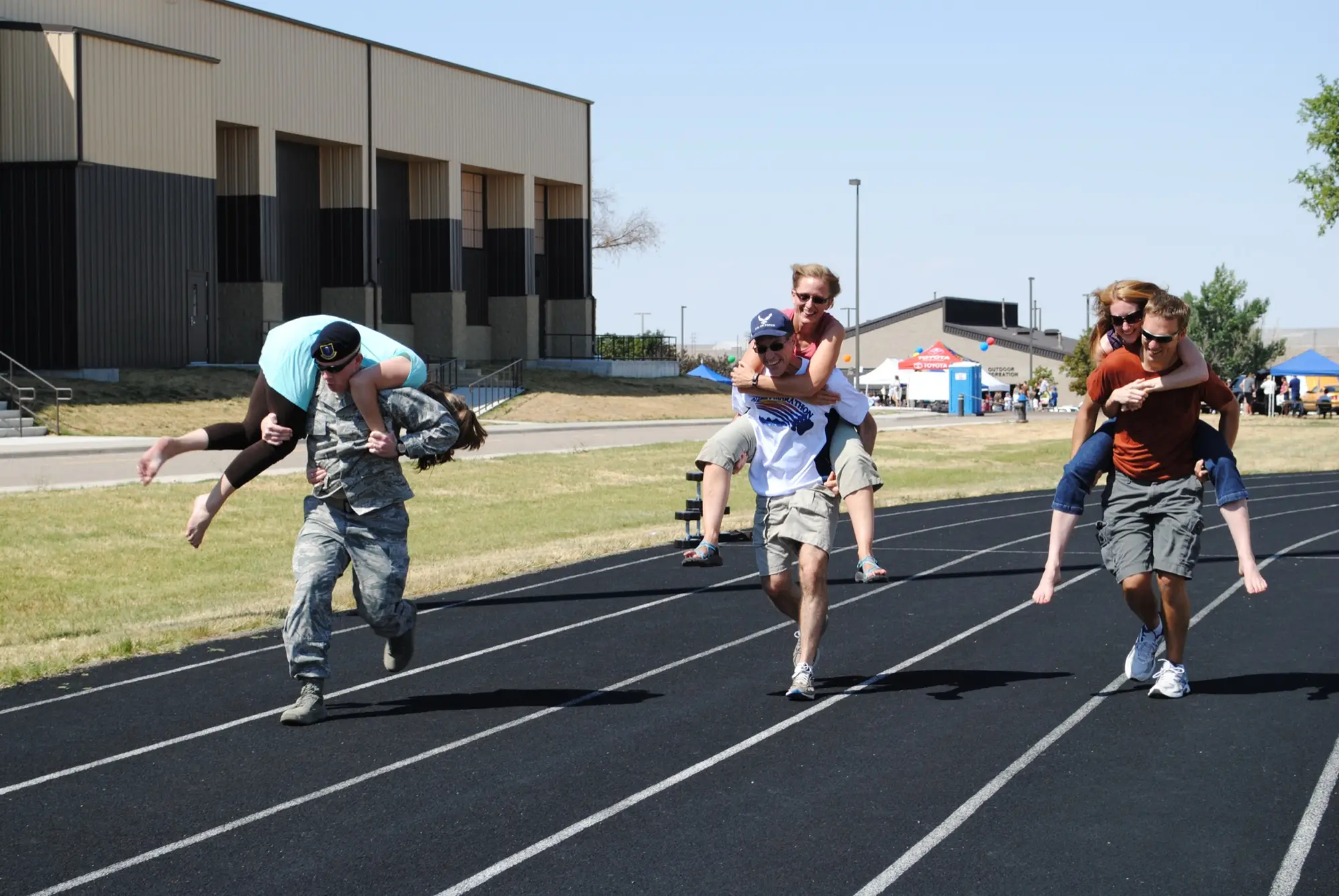

The Wife Carrying World Championships (Eukonkannon MM-kisat) are held every July in Sonkajärvi, a small municipality in Upper Savo in eastern Finland. The next ones are on Friday 2 and Saturday 3 July 2027. Couples race over a 253.5 m (about 830 ft) track with a water pit, and the winners take home the wife's weight in beer.
It started as a joke at a village market, and it is still funny. It is also a real race, with a rulebook and a record that has stood since 2006.
The rules
The official rules are short and specific:
- The track is 253.5 m long, with two dry obstacles and one water obstacle about 1 m (3 ft) deep. It was rebuilt in 2024 with a mondo and sand surface.
- The "wife" does not have to be your wife. She can be your own or someone else's, and has to be at least 17. The carrier has to be at least 18.
- She has to weigh at least 49 kg (108 lb). If she weighs less, she wears a backpack with enough weight in it to make up the difference.
- Dropping her costs no time. You pick her up again straight away. The 15-second drop penalty in older articles is not in the current rules.
- No straps or carrying aids, and no spikes, football boots or taped shoes. Footwear is inspected.
- The fastest couple wins a trophy plus "wife-carrying drink" to the wife's weight. Everybody, Visit Finland included, calls it beer. Prizes are not paid in cash or posted.
The 49 kg, Eero Pitkänen told Yle in 2017, was Armi Kuusela's weight when she became Miss Universe in 1952.
Around the main race there is a sprint in heats over about 120 m, a class for carriers aged 40 and over, and a women's class. In the team race three carriers take turns with one wife, and each changeover is made by drinking a 0.5 l bottle of the same drink.
Carrying styles, and why the Estonian carry wins
Yle asked Joni Juntunen, who has raced in Sonkajärvi every year, to go through the styles in 2016.
- Piggyback. Common in the early years. It needs strong arms, and holding her legs spoils your running rhythm.
- Fireman's carry. She lies across your shoulders. It works when you weigh about the same, but her weight sits high. A one-shoulder version is the fastest over the short legs of the team race.
- Estonian carry. She hangs upside down on your back, legs locked around your neck. Estonian couples brought it in the late 1990s, won straight away, and nothing else has reached the top since. She does the holding on, so he can simply run. She should grip with her ankles, not squeeze with her thighs, or he cannot breathe. Her head goes under at the water obstacle, and a helmet is sensible near the hurdles.
- The wedding carry. In your arms, across the threshold. Ruinous for the back, and now seen only as a show.
Estonian couples won every year from 1998 to 2008. Margo Uusorg and Sandra Kullas set the main-race record, 56.9 seconds, in 2006, on the old course. On the new track the fastest time so far is 1:01.17, run in 2025 by Caleb and Justine Roesler, the first American winners.
Robber Ronkainen and where it started
The origin story is Herkko "Rosvo" Ronkainen, a Sonkajärvi bandit who tested would-be gang members by making them run over fences and streams with a sack of rye on their backs. In some tellings his men also carried off women from neighbouring villages.
The organiser's version has him born in the mid-1800s at Sukeva, sent to Siberia in 1885 and dead in 1922, and its author says plainly that the story is largely her invention. Yle puts him at the turn of the 1700s and 1800s. The details depend on who is telling it.
The race is easier to date. It was part of the Sonkajärvi parish market from 1990, became a Finnish championship in 1992, and has been a world championship since 1996. The 2020 and 2021 events were cancelled, so 2026 was the 29th.
The 2026 championships
The 2026 edition ran on 3–4 July, with 60 couples in the main race, six teams, and competitors from 12 countries. About 2,500 people watched on the Saturday.
Taisto Miettinen won his ninth world title, at 61, carrying Katja Kovanen, in 1:04.4. He had had back surgery the previous winter. Vytautas Kirkliauskas and Neringa Kirkliauskiene of Lithuania were second, and Jonatan Wasenius and Lotta Lindroos of Helsinki third. The Friday sprint went to Teemu Tuovinen and Jatta Leinonen from Kuopio. The team race went to Team Beer For My Horses, and the women's class to Sini Ylönen and Jasmin Kaivola.
2027 dates and how to enter
The 2027 championships are on Friday 2 and Saturday 3 July, the usual first weekend of July.
Anyone can enter, from anywhere. You register in the organiser's online shop, pay there, and give details for both carrier and carried. At the end of September 2026 the shop listed the entry fee as €55 per couple for the main race, the sprint, the women's class and both 40-plus classes, and €160 for a team. The fee includes weekend passes for both of you and a T-shirt each. Registration closes on the Wednesday before the race at 22:00, which for 2027 is 30 June. You can cancel up to 30 days before for a €10 fee; after that there is no refund.
Collect your competitor bag at the info desk at least an hour before your start. There are changing rooms and showers in the sports hall, and the track is open for practice on Saturday from 11:00 to 11:30.
The weekend around the race
The championships sit inside the Sonkajärvi parish market (pitäjänmarkkinat), which runs on Friday and Saturday from 10:00 with stalls, local food, a Robber Ronkainen camp and a children's obstacle course. On the 2027 programme the sprint starts at 19:00 on Friday. On Saturday the team race is at 13:00, the flag parade at 14:45 and the main race at 15:00, with prizes at 17:30 in the sports hall. Both nights end with an 18+ evening party (iltakinkerit) in the sports hall from 20:00 to 02:00, with Finnish pop and rock acts. In 2026 these included Irina and Tommi Läntinen.
In 2026 the Friday sprint was free to watch. A Saturday race ticket cost €18, or €5 for children aged 7–17. Each evening party was €38, Saturday day and evening together €48, and a weekend pass €62. Ticket prices for 2027 had not been published at the end of September 2026. The arena, the sports ground at Kuntotie 4, is step-free. The 2026 races were also streamed free by Iisalmen Sanomat.
Getting to Sonkajärvi
- Train. The nearest station is Iisalmi, about 25 km away. Direct InterCity trains from Helsinki take 5 h 20 min to 5 h 30 min, with departures through the day. Helsinki to Kuopio takes about 4 h 15 min.
- Event bus. On race weekend a bus runs from Iisalmi bus station to the Sonkajärvi municipal hall for €10 each way. For 2027 it leaves Iisalmi at 18:00 on Friday and at 11:00 and 18:30 on Saturday, and comes back at 18:00 on Saturday and at 02:00 after each evening party.
- Plane. Kuopio and Kajaani airports are both about 80 km away, and Finnair flies from Helsinki to Kuopio. From either airport the practical onward option is a hire car.
- Car. Drive road 5 north through Mikkeli and Kuopio to Iisalmi, then east to Sonkajärvi. The event parking is at Rutakontie 13 in the centre, with traffic control over the weekend.
Where to stay
Sonkajärvi itself has only a handful of places to stay. The organiser lists Gasthaus Neuvola and Hombu in the village, cottages at Elomäki and at Keskikoski in Sonkakoski, Ruukintupa at Jyrkkä, and Lohiranta holiday village at Sukeva. Most people stay in Iisalmi and take the event bus: the organiser's list there includes the Sokos Hotel Koljonvirta, Koljonvirta manor, Haapaniemi and the Hotel Golden Dome. There are two caravan areas at €10 a night, card only. One is next to the sports hall, with toilets and showers; the other is at the Kangaslampi swimming place, 2.5 km from the centre.
Early July is high summer, light until late, and the guide to the seasons covers what that means for mosquitoes.
Not the same as wife-pushing
At Koli, in North Karelia, there has been a winter race called wife-pushing (eukontyöntö), in which the woman sits on a kicksled pushed across the frozen Lake Pielinen. It has nothing to do with Sonkajärvi, and it depends on the ice road, which opens to cars only once the ice is at least 40 cm thick.
If you want more of the same kind of summer, the air guitar world championships are in Oulu in late August, and the swamp soccer world championships are in Hyrynsalmi in July. The whole list, from sauna endurance to hobby horses, is in Finland's unusual championships.