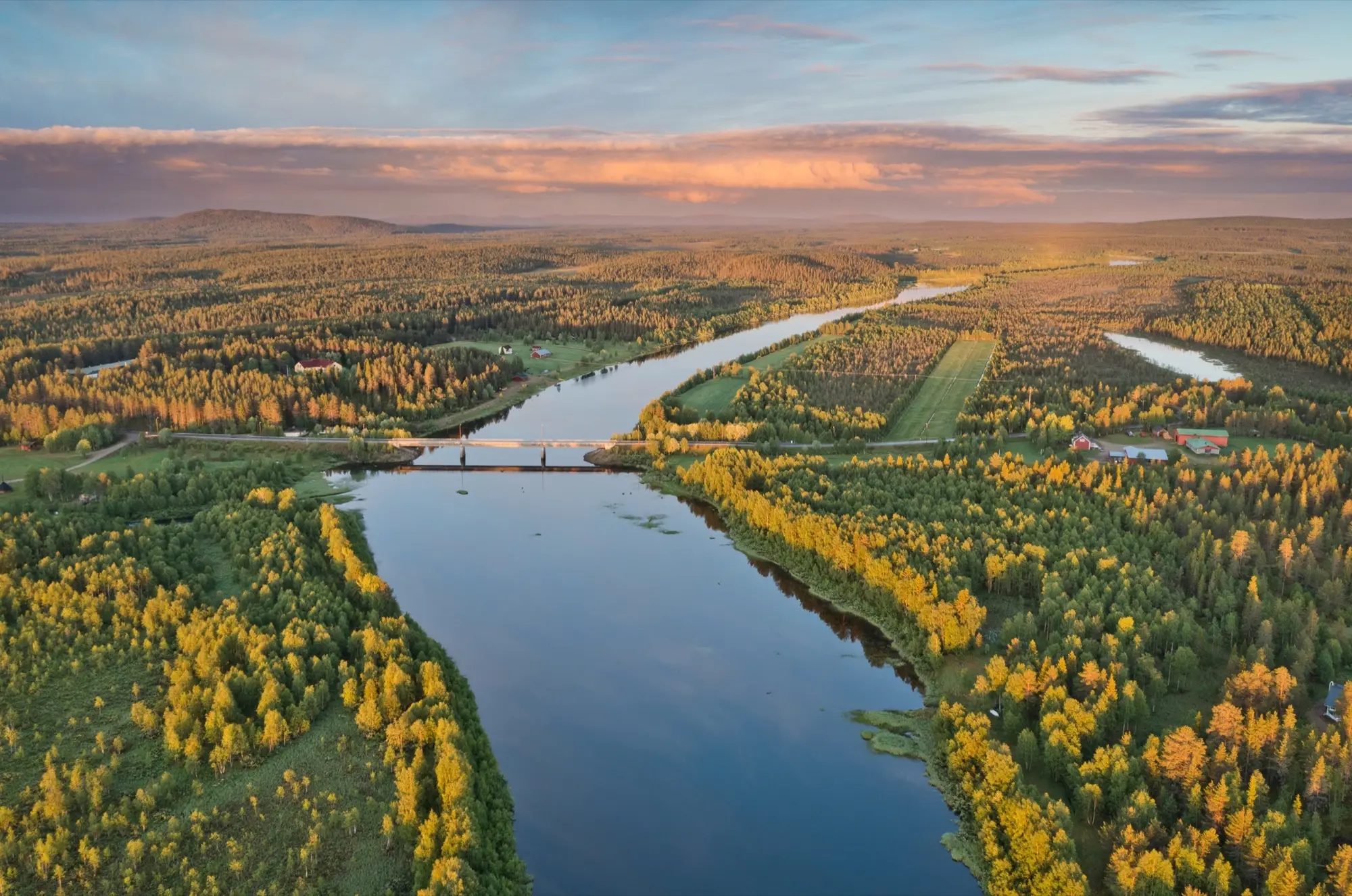

There is no single best month for Finland, because Finland is two countries stacked on top of each other. Helsinki is at 60°N, on the sea, with a climate like a colder Copenhagen. Utsjoki is at 69.9°N, above the treeline, and has two months of polar night. The right month depends almost entirely on which of those you are coming for.
The short version: February and March for snow and the aurora, June and July for the light, September for both at once in the north. November is the month to avoid, everywhere.
The light, month by month
This is the table that decides most trips, and it is not a matter of opinion. It is computed for the 15th of each month from each town's coordinates. "Astronomically dark" means the sun is more than 18° below the horizon, which is what the sky needs before a faint aurora is visible at all.
| 15th of | Helsinki daylight | Rovaniemi daylight | Utsjoki daylight | Rovaniemi astronomically dark |
|---|---|---|---|---|
| January | 6h 44m | 4h 20m | none | 12h 24m |
| February | 9h 14m | 8h 16m | 7h 28m | 9h 46m |
| March | 11h 48m | 11h 44m | 11h 40m | 6h 04m |
| April | 14h 38m | 15h 30m | 16h 16m | none |
| May | 17h 14m | 19h 32m | 22h 50m | none |
| June | 18h 52m | 24h | 24h | none |
| July | 18h 04m | 21h 22m | 24h | none |
| August | 15h 40m | 16h 58m | 18h 04m | none |
| September | 12h 52m | 13h 08m | 13h 20m | 3h 40m |
| October | 10h 08m | 9h 30m | 9h 00m | 8h 36m |
| November | 7h 28m | 5h 40m | 3h 48m | 11h 42m |
| December | 5h 52m | 2h 24m | none | 13h 08m |
Three things fall out of it.
There is an aurora season, and it has hard edges. In Rovaniemi there is no astronomical darkness at all from mid-April to early September. That does not mean a poor chance of the northern lights in those months. It means none. In Helsinki the gap runs from the start of May to the second half of August. Anyone who sells you a northern lights trip to Lapland in July is selling you something else. The aurora page gives tonight's answer for six places, with cloud included, and the northern lights in Finland guide covers which months inside the season are best. Staying in Rovaniemi? Its aurora page has tonight's darkness and cloud.
Utsjoki has real polar night; Rovaniemi does not. At the top of the country the sun does not rise at all from late November to mid-January. Rovaniemi never loses the sun completely: on the shortest day it still gets a little over two hours of it, with long blue twilight on either side. The Rovaniemi winter guide explains why the Arctic Circle does not work the way the textbooks say.
March is the most even month in the country. On the 15th, Helsinki, Rovaniemi and Utsjoki all get within eight minutes of each other's daylight. The whole country has snow, light and dark nights at the same time.
Every town's own band for today is on the daylight pages.
The temperatures
Monthly mean temperatures for 1991–2020, from the Finnish Meteorological Institute's climate statistics. A monthly mean hides the range: in January the average afternoon in Rovaniemi reaches −7.3 °C (19 °F) and the average night falls to −13.5 °C (8 °F).
| Month | Helsinki | Rovaniemi | Utsjoki (Kevo) |
|---|---|---|---|
| January | −3.1 °C (26 °F) | −10.3 °C (13 °F) | −13.3 °C (8 °F) |
| February | −3.8 °C (25 °F) | −10.3 °C (13 °F) | −12.6 °C (9 °F) |
| March | −0.7 °C (31 °F) | −5.6 °C (22 °F) | −7.8 °C (18 °F) |
| April | 4.4 °C (40 °F) | 0.1 °C (32 °F) | −1.9 °C (29 °F) |
| May | 10.4 °C (51 °F) | 6.5 °C (44 °F) | 4.2 °C (40 °F) |
| June | 14.9 °C (59 °F) | 12.5 °C (54 °F) | 9.8 °C (50 °F) |
| July | 18.1 °C (65 °F) | 15.6 °C (60 °F) | 13.4 °C (56 °F) |
| August | 16.9 °C (62 °F) | 13.1 °C (56 °F) | 11.1 °C (52 °F) |
| September | 12.3 °C (54 °F) | 7.7 °C (46 °F) | 6.4 °C (44 °F) |
| October | 6.6 °C (44 °F) | 0.8 °C (33 °F) | −0.4 °C (31 °F) |
| November | 2.4 °C (36 °F) | −4.4 °C (24 °F) | −7.2 °C (19 °F) |
| December | −0.7 °C (31 °F) | −7.7 °C (18 °F) | −10.6 °C (13 °F) |
The coldest reading at Kevo in those thirty years was −48.2 °C (−55 °F), in January 1999. Summer is warmer than people expect. The average July afternoon in Helsinki reaches 21.9 °C (71 °F), and every station on this list has recorded over 30 °C (86 °F).
February is the coldest month in Helsinki, not January, because the sea keeps the coast mild into midwinter and then lets go. The sea also freezes around then in a cold year, which is when Helsinki residents walk out to the islands.
Snow: when it comes and when it goes
FMI's snow statistics give the typical start of the permanent snow cover as 18 November in Helsinki, 21 October near Rovaniemi and 18 October in Sodankylä. The snow season lasts 97 days in Helsinki and 203 in Sodankylä. Snow leaves the south around the turn of March and April, and lasts until the end of May in the far north.
Two corrections to those averages. First, the Helsinki figure is a 30-year typical date, and in a mild winter the capital has no lasting snow at all until January, or ever. Do not book Helsinki for a white Christmas. Second, Metsähallitus now writes that in northern Finland the lasting snow cover usually forms in late November, and sometimes only in December, where it used to be guaranteed by late October. If snow is the point, come after New Year.
Snow is deepest in March, not in midwinter. The median depth at Rovaniemi airport peaks at around 75 cm (30 in) in the second half of March. From about mid-April to mid-May, northern Lapland has hanki: the snow thaws in the sun, freezes hard overnight, and you can ski or walk anywhere on the crust before lunch. It is the best-kept secret of the Finnish year, and it comes with twenty-hour days.
Month by month, honestly
January. Cold, dark in the north and grey in the south. Utsjoki is in polar night. Lapland goes quiet after the first week, once the Christmas crowd has gone. Helsinki starts the year with Lux Helsinki, the light festival, which this time runs from 30 December 2026 to 6 January 2027.
February. The best month for a winter trip to Lapland if you want reliable cold and snow, long aurora nights, and daylight to ski in. The catch is the Finnish school ski holidays. In 2027 they are staggered over weeks 8 to 10, 22 February to 12 March. Helsinki, Espoo and Vantaa take week 8, and Oulu and Rovaniemi take week 10. Resort cottages book up and prices go up. Plan around the week that matches the resort's catchment.
March. The month locals recommend. Deep snow, sunshine, milder cold, and still more than six hours of dark sky at Rovaniemi in mid-month. Aurora activity also tends to be higher around the equinox. The Tampere Film Festival runs 10–14 March 2027.
April. The in-between month. In the south, grey slush and brown grass; in the north, the first weeks of crust snow and very long days. By the middle of the month the aurora season in Lapland is over.
May. Spring arrives late and fast. Birches go from bare to green in about a week in the second half of the month in the south. Lapland is in thaw, with flooded tracks and closed trails. 1 May (vappu) is a national street party in white student caps and mostly takes place outdoors, whatever the weather.
June. The light is the reason to come. Midsummer is the Saturday between 20 and 26 June, and in 2027 Midsummer Eve falls on Friday 25 June. Helsinki empties as people leave for their cottages, and many shops close for the day. The Midnight Sun Film Festival in Sodankylä runs 16–20 June 2027, with screenings around the clock under a sun that does not set. Mosquitoes arrive at about Midsummer in the north and stay until early or mid-August.
July. Finland's holiday month: warmest water, busy lakes, festivals every weekend. Ruisrock in Turku is 9–11 July 2027, and the Savonlinna Opera Festival has performances from 3 to 31 July 2027 in a medieval castle. Many offices and some restaurants close for four weeks. In Lapland, July is mosquito season. It is manageable with repellent and a head net, but it is not a detail.
August. Still summer, with dark evenings returning in the south in the second half of the month. Flow Festival in Helsinki is 13–15 August 2027. The Helsinki Festival of arts and music runs from mid-August into early September; the 2026 festival ran 18 August to 5 September. Crayfish parties and berry picking. An underrated month.
September. Ruska, the autumn colour, reaches the fells of northern Lapland in the first half of the month and moves south from there. Dark skies return to Rovaniemi in the second week and grow quickly, and the equinox helps aurora activity. It is above freezing, the mosquitoes have gone and the resorts are quiet. The September darkness answer has the week-by-week figures. If you only take one trip north, this and March are the two to choose between.
October. Colour ends early in the month and the north goes brown and grey while it waits for snow. Autumn storms in the south. The Helsinki Baltic Herring Market, held since 1743, fills the Market Square on 4–10 October 2026.
November. The grim one. No snow in most of the country, dark by half past four in Helsinki, low cloud for weeks, the leaves long gone. Lapland may or may not have snow, and Utsjoki goes into polar night at the end of the month. Finns themselves use November as the example of what they endure. If you have to come, come for a city, a sauna and the Helsinki events calendar, not for the landscape.
December. Christmas markets, candles in every window, 6 December Independence Day, and in Lapland the Santa industry at full capacity and full price. The south is dark and, in most recent years, snowless before Christmas. In the north, the blue midday twilight over snow is worth the cold, but the first two weeks of January have the same light at a lower price.
The short answer by purpose
- Northern lights: September to early April, in the north. Best balance: second half of September, or February and March. Never May to mid-August.
- Snow and husky or reindeer trips: January to March. The dog sledding and reindeer guide explains how to choose.
- Midnight sun: June and early July. Rovaniemi has it from mid-June to early July, Utsjoki from late May to late July.
- Hiking in Lapland: early to mid-September for colour and no mosquitoes; late June and July for warmth, with repellent.
- Helsinki and the lakes: June to August. December for Christmas, if you accept there will probably be no snow.
- Quietest: November, April and October, in that order of how much you will regret it.