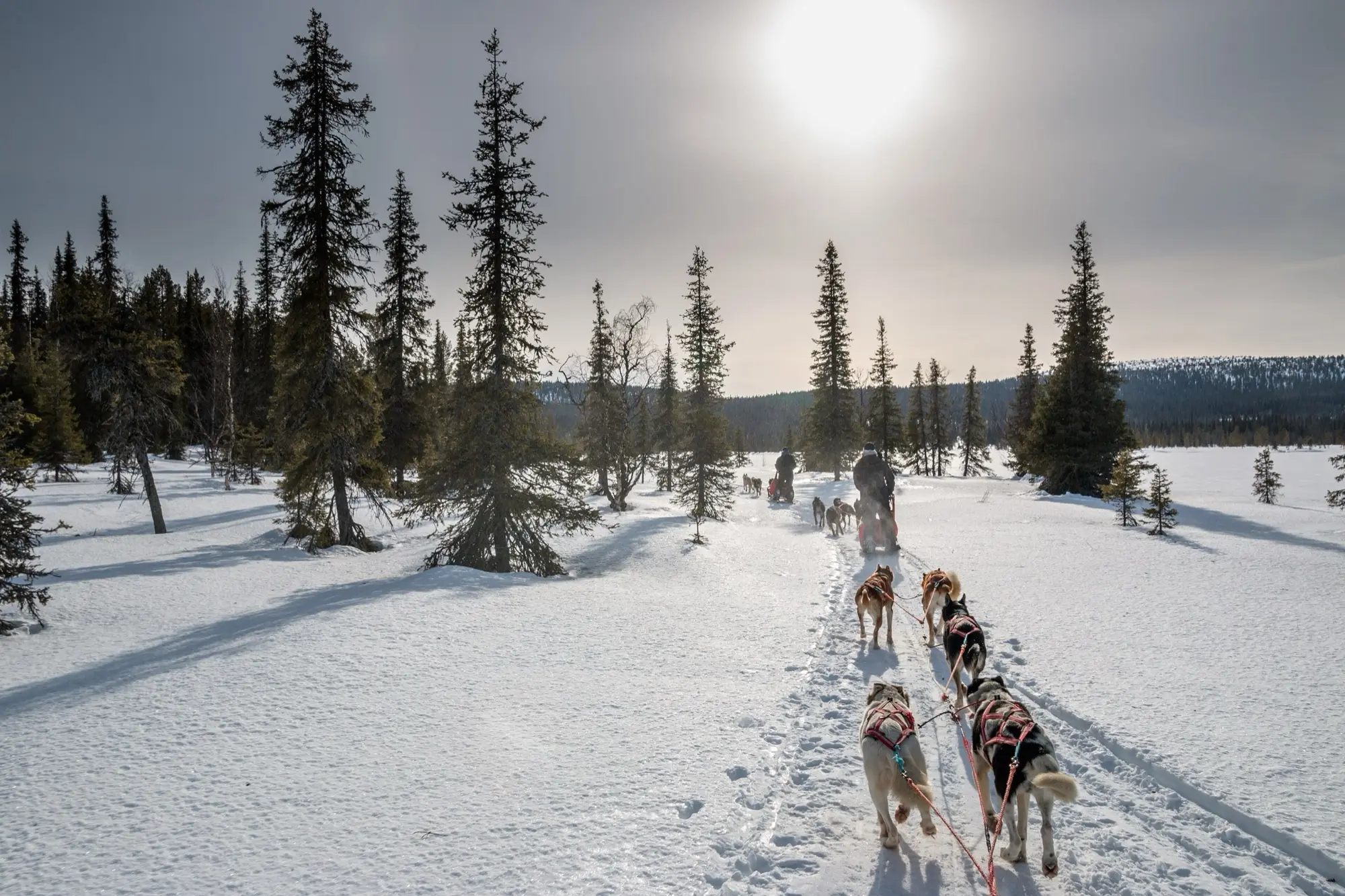

Both trips put you on a sled in a snowy forest, and there the similarity ends. A husky team is fast, loud and physical, and on most trips you drive it yourself. A reindeer sleigh is slow and quiet, and somebody else is in charge of the animal. Pick the wrong one and you get either an hour of being too scared to look at the view or an hour of wishing something would happen.
Husky or reindeer: the one-paragraph answer
Choose huskies if you want to do something. You stand on the runners and drive a team of dogs through the forest, braking on the downhills, while your partner sits in the basket. People do fall off, usually on the first bend. It is the more memorable of the two for most adults.
Choose reindeer if you are travelling with small children or older relatives, if you want to talk to the herder, or if you would like to actually look at the landscape. The sleigh moves at walking pace. The interesting part is usually the farm and the herding family's explanation of how the year works, rather than the ride.
If you can afford both, do the huskies on a cold, clear day and the reindeer in the evening, when a slow sleigh through dark forest is the best possible way to wait for an aurora. Tonight's answer is on the aurora page for Rovaniemi, Levi or Saariselkä, and the northern lights in Finland guide explains how to read it.
How long you are actually on the sled
This is the number the listing hides. A "3-hour husky safari" includes the transfer, kitting up in thermal gear, a safety talk, meeting the dogs, and hot juice at the end. The time on the runners is a fraction of that. From the operators' own pages, September 2026:
| Trip | On the sled | Whole programme |
|---|---|---|
| Bearhill Husky, Rovaniemi, "Happy Trail" (self-drive) | 45 min, about 6–10 km | 2.5 h |
| Bearhill Husky, Rovaniemi, "Call of the Wild" (self-drive) | 1.5 h, about 12–18 km | 3 h |
| Apukka, Rovaniemi (self-drive) | 6 km | 2 h |
| Levi, 5 km self-drive | about 20 min | 2.5 h |
| Levi, 10 km self-drive | about 30 min | 3 h |
| Lapland Safaris, Saariselkä, 10 km husky | about 50 min | not stated |
| Lapland Safaris, Rovaniemi, 3 km reindeer | about 1 h | 2–2.5 h |
| Santa Claus Reindeer, Rovaniemi, daytime safari | about 25 min | 3 h |
| Saariselän Porotila, Saariselkä, reindeer | 45 min | 2–2.5 h |
| Sammuntupa, Levi, 1 km reindeer | 5–15 min | — |
Two things follow. A 5 km husky trip is a taster: twenty minutes of driving, split between two people. If you want to find out what driving a team feels like, book 10 km or more. And on a short reindeer ride, most of the price is the visit to the farm.
What it costs
Adult prices "from", read on the operators' pages on 27 September 2026, for the 2026–27 winter. Most operators list only adult prices; child prices, where they exist, are lower.
Huskies
- Bearhill Husky, Rovaniemi: 2.5 hours with 45 minutes of driving, from €196 (€201 between 30 November and 10 January). Teens pay €167 and children €128. The 3-hour trip with 1.5 hours of driving is from €249. Pickup, thermal outfit and a warm drink are included.
- Apukka, Rovaniemi: 2 hours, 6 km self-driven, from €149, January to April.
- Levi, sold through Levi Tours: 5 km self-drive from €159, 10 km from €225. A 2 km ride where a musher drives and you sit is €125–135.
- Lapland Safaris runs 5, 10 and 20 km trips from Saariselkä and elsewhere, but its prices only appear once you pick a date, so none are quoted here.
Reindeer
- Santa Claus Reindeer, at Santa Claus Village in Rovaniemi: a 400 m ride €30, 800 m €50, a 1-hour safari €120, and a 3-hour daytime programme €160 with a ride of about 25 minutes.
- Sammuntupa, Levi: a 1 km ride of 5–15 minutes €49, or €99 with feeding, a small museum and a hot drink. No transport; you make your own way there.
- Lapland Welcome, Saariselkä: 2 hours with a ride of almost an hour, from €139.
- Saariselän Porotila, Saariselkä: 45 minutes on the sledge in a 2–2.5 hour programme, with pickup in Saariselkä. Price on request.
A rough rule for budgeting: a proper self-drive husky trip in Lapland costs about €150–250 a person, and a reindeer programme with a ride of any length about €100–160. Rides of a few hundred metres cost less, and they are exactly as long as they sound.
Driving a husky sled: what the day looks like
You are picked up from your hotel, usually 15 to 90 minutes before the start. At the kennel you get a thermal overall, boots, mittens and a hat, and in most places you are expected to wear them. Then there is a short lesson. The sled has a brake (a metal claw you stand on) and a snow anchor, and the whole technique is: never let go of the sled, and brake before the dogs catch up with you on a downhill.
Sleds take two people. One drives standing on the runners and the other sits in the basket, and you swap halfway. Bearhill's minimum age for driving is 17; younger children ride in the basket with an adult driving. Some operators take children from 4 as passengers.
The dogs are loudest in the minute before they start and silent the moment they run. That moment, when a whole yard of dogs stops howling at once and all you hear is the runners, is the thing people remember.
Cold. You stand still on the runners while the team pulls you through the cold air, so the wind chill is real. Bearhill writes that below −30 °C (−22 °F) the trip is for diehards and is often shortened or given a warm-up break, and that below −35 °C (−31 °F) it is cancelled. No other operator page we read stated a limit, so ask. The Lapland temperatures and daylight by month are in the best time to visit Finland.
Reindeer: what you are actually visiting
There are no wild reindeer in Lapland. According to the Reindeer Herders' Association, every reindeer in Finland is owned and earmarked with its owner's registered mark. The animals are semi-domesticated, living free in the forest for most of the year and gathered for round-ups. The herding area covers 36% of Finland, divided among 54 herding cooperatives, and the maximum permitted herd is 203,700 animals. The reindeer you meet at a farm are usually the tame sleigh animals, a few trained individuals. They are not the herd.
The sleigh is either pulled by one reindeer led by the herder on foot or on another sleigh, or by a short line of sleighs. You sit on reindeer hides under a blanket. Nobody drives. Some farms, Saariselän Porotila among them, hand out a "reindeer driving licence" at the end, which is a certificate, not a driving lesson.
The worthwhile part is the conversation. A herding family's year runs on round-ups, calf marking in summer, slaughter in autumn and feeding in the hardest part of winter. They will talk about predators, hard snow crusts that lock the lichen away, and roads. Ask. Reindeer on the road are also why driving in Lapland at night is slower than the map suggests; see the road from Rovaniemi to Saariselkä and Inari.
Animal welfare: what the law says, and what to ask
Finland's Animal Welfare Act, in force since 1 January 2024, says no animal may be kept permanently tethered or with its movement permanently restricted. Anyone keeping seven or more dogs over six months old has to notify the Finnish Food Authority before starting. That covers every tourist kennel. The older decree on keeping dogs still applies and names sled dogs specifically. A dog kept on a chain long-term may only be kept next to an inhabited building, with at least 40 m² to move in, and never on a metal or choke collar. Dogs under a year old may only be tethered temporarily. In a professional sled-dog yard, when the water freezes, the dogs are to be given water at least three times a day.
The law is a floor. Since 2021 there has also been a voluntary welfare standard for tourism sled-dog kennels, audited on site under the Green Activities label. It covers what happens to the dogs in summer and after they retire.
Questions worth asking any operator, huskies or reindeer:
- How many dogs do you have, and how many trips does each dog run a day? A kennel should answer both without hesitating.
- Where do the dogs live between runs? Fenced yards, dog houses, space to move. Short chains in rows are what the law restricts.
- What happens to the dogs in summer, and when they retire? Good answers include summer training on carts, rehoming and retired dogs living at the farm.
- Is the kennel audited under a welfare label?
- For reindeer: are these the family's own animals, and what do they do the rest of the year? A small farm run by a herding family is a different business from a pen by a car park.
- Can we meet the dogs before or after the run?
Then use your eyes. Look for lean, alert dogs, clean yards, dogs that come to the fence, and staff who know the dogs' names.
What to wear
The operator's overall goes on top. What you wear underneath decides whether you enjoy it:
- A thin wool or synthetic base layer, top and bottom. No cotton.
- A fleece or light down mid layer.
- Two pairs of socks at most, one of them wool. Too many socks squeeze the boot and make your feet colder.
- Thin gloves under the mittens you are given, so you can take a photograph without freezing your hand.
- A buff or scarf that covers your nose and cheeks for the driving.
- Sunglasses or ski goggles on a bright spring day. Snow glare in March is serious.
Phone batteries die quickly in the cold. Keep the phone in an inside pocket and take it out only for the picture.
When to go
Husky season generally runs from late November or December to March or early April, depending on snow. Bearhill's 2026–27 season runs from 30 November to 4 April. Reindeer sleigh rides need snow too, so the same window applies. The earliest weeks can open late if snow is thin, and the Christmas weeks are the busiest and dearest. February and March have the best combination of cold, snow and daylight to drive in.
If you are basing yourself in Rovaniemi, the Rovaniemi winter guide covers the rest of the trip, and the Rovaniemi daylight page shows how much light you will have for a morning run.