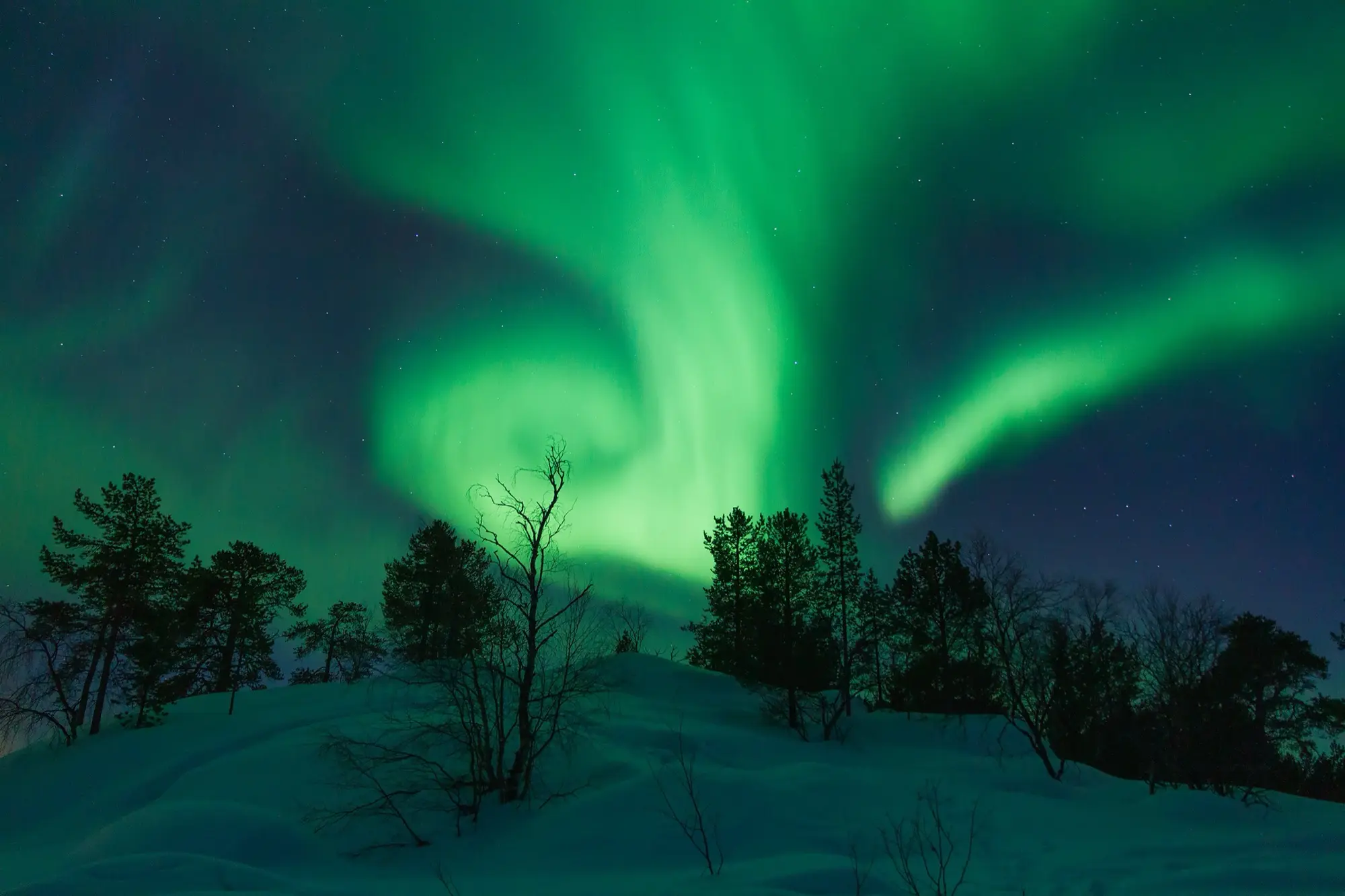

The aurora over Finland is not rare. Over northern Lapland it is the normal state of a clear dark night. What makes people fly home without seeing it is almost never a lack of aurora; it is cloud, a sky that is not yet dark, or standing under a streetlight looking the wrong way at the wrong hour.
This guide covers the four things that decide a night — darkness, activity, cloud and where you are standing — and then how to read the forecasts, including the verdict this site writes for six places every night. Place pages sit underneath it: Rovaniemi, Levi, Ylläs and Saariselkä and Inari.
How often, by latitude
The Finnish Meteorological Institute's long-run statistics, counted over clear, dark nights only:
- Kilpisjärvi and Utsjoki, the far north: three nights out of four.
- Sodankylä, central Lapland: every second night.
- Helsinki: about one night a month, and city light hides most of those.
Read the qualifier twice. These are the odds given a clear, dark sky. They say nothing about how often the sky is clear, and in a Lapland November that can be a week at a time without a gap. The single most useful thing you can do to see the aurora in Finland is give yourself enough nights for the weather to open up at least once. Three is a minimum; five is comfortable.
For Helsinki specifically, see can you see the northern lights in Helsinki. The short version: only in a real storm, and not a reason to plan a trip. If you are in the city anyway, the Helsinki aurora page says whether tonight is one of those nights.
When: the season is set by darkness
The aurora is there in summer too. You cannot see it, because the sky never gets dark enough. What matters is astronomical darkness, the sun more than 18° below the horizon, and in Lapland that condition vanishes for five months of the year.
Counter-intuitively, the further north you go, the shorter the aurora season, because the midnight-sun end of the year is longer up there. The dates below are computed for each place:
| Place | Dark nights return | Last dark night | Darkness on 21 December |
|---|---|---|---|
| Helsinki | 22 August | 20 April | 12h 36m |
| Rovaniemi | 8 September | 2 April | 13h 10m |
| Levi | 12 September | 30 March | 13h 20m |
| Saariselkä | 13 September | 28 March | 13h 24m |
| Kilpisjärvi | 15 September | 27 March | 13h 28m |
| Utsjoki | 17 September | 24 March | 13h 34m |
The first and last few nights of each season have only minutes of true darkness, around local midnight. Our verdict calls anything under an hour "almost too light" rather than pretending those nights are good ones. The September answer goes through that shoulder season night by night.
Within the season, the FMI names February–March and September–October as the best months. Two reasons: the geometry of the Earth's field against the solar wind around the equinoxes makes geomagnetic storms more frequent, and those months combine long nights with tolerable cold. March is the one the FMI singles out, and the one we would book: deep snow, dark evenings, and daylight back by breakfast. December has the longest nights, and the least daylight to do anything else with.
Time of night. The FMI's best window is 21:00 to 01:00 local time, peaking around 23:30, which is magnetic midnight over Finland. Displays happen outside it — a strong one can start at dusk — but if you are going out for one block of time, that is the block.
Where: the Lapland places we cover
Each of these has its own page with tonight's verdict, the computed darkness and the cloud forecast at its coordinates.
- Rovaniemi (66.5°N). A city on the Arctic Circle: easy to reach, plenty of beds, and plenty of streetlight. Quiet nights are usually enough here; walking or driving out of town is what makes the difference.
- Levi (67.8°N). Fell country, and the southernmost of the six with real polar night. The resort itself is bright; ten minutes' walk off the lit slopes is not. Ylläs, 36 km west, shares its sky.
- Saariselkä and Inari (68.4°N). The Arctic highway north of Sodankylä, with the Urho Kekkonen National Park on one side and Lake Inari further up. Low light pollution and open fells above the tree line.
- Kilpisjärvi (69.0°N). Finland's north-west corner, in the rain shadow of the Norwegian mountains: the driest sky of the six.
- Utsjoki (69.9°N). The northernmost village in Finland, on the Norwegian border.
South of Lapland, the odds fall steadily, from every other clear night around Sodankylä to about once a month on the south coast. The further south you are, the more you need a proper geomagnetic storm, somewhere dark, and an open view north.
Reading the forecast
There are three kinds of number, and each answers a different question. None of them alone tells you what you will see.
Kp: how disturbed the planet's field is
The Kp index runs from 0 to 9 and summarises the largest swings of the Earth's magnetic field over three-hour blocks, measured at observatories around the world. Kp 5 and above is a geomagnetic storm, graded G1 (Kp 5) up to G5 (Kp 9).
Kp is a global number, and what it means depends on where you are standing. In Helsinki you need a storm. In Utsjoki the aurora is often overhead at Kp 0 or 1, because the auroral oval sits over northern Lapland even on a quiet night. So "Kp 2 tonight" is a poor forecast for Helsinki and a perfectly good one for Kilpisjärvi. Aurora apps that send alerts at Kp 5 are written for people much further south.
Local magnetometers: what is happening over you now
The Finnish Meteorological Institute runs a network of magnetometers from southern Finland to the Norwegian border, and its Auroras Now service shows how fast the field is changing at each station, over ten-minute intervals. Each station has two thresholds: over the lower one, auroras are possible but usually dim; over the upper one, very likely. This is the closest thing to a real-time local detector there is, and the number most aurora apps leave out.
Cloud: whether you will see any of it
A strong display above solid cloud is invisible. Look at the cloud forecast for the dark hours at your spot, not the daily symbol for the nearest town, and look for gaps rather than averages: one clear hour at 23:00 is worth more than a mostly clear day.
How our verdict works
Every evening, each place on the aurora page gets one sentence. It is worked out from four inputs, in the order they can rule the night out:
- Darkness, computed from the date and coordinates. No feed is needed, so it never fails. No astronomical darkness means "too light", with the date darkness returns; under an hour of it means "almost too light".
- Cloud, from the FMI's forecast model, hourly, at the place's exact coordinates. We take the best hour inside the dark window. At 30% cloud or less we call the sky clear; up to 70% there are breaks worth waiting for; above 70% the night is clouded out.
- Activity: Kp, NOAA's model of the probability of aurora overhead, and the rate of change at the nearest FMI magnetometer if one is within 120 km. At that station, 40 nT per minute counts as active and 100 nT per minute as a substorm. Each place also has its own Kp threshold for a quiet night: 6 for Helsinki, 2 for Rovaniemi, 1 for Levi and Saariselkä, 0 for Kilpisjärvi and Utsjoki.
- The moon. A bright moon does not stop the aurora, but it washes out the faint end, so a moon at 70% or more gets a caveat added to an otherwise positive verdict rather than changing it.
The nearest magnetometers are 2 km from Kilpisjärvi, 16 km from Saariselkä, 17 km from Utsjoki, 59 km from Levi (at Muonio) and 74 km from Rovaniemi (at Ranua). Helsinki has none within 120 km in the open data, so its verdict rests on Kp and the NOAA model alone.
When a feed does not answer, the page keeps the last reading with its real age and says how old it is. When there is nothing to keep, it says it could not check. It never assumes a clear sky.
Where to stand
- Away from light. A kilometre out of a village is often enough in Lapland. In a town, the edge of a frozen lake or a river gives you open sky and distance from the lights at once.
- With a view north, especially the further south you are. In Lapland a display can fill the whole sky, but it usually starts as an arc low in the north.
- Somewhere you can stand for an hour. A display comes and goes in waves. The people who see the best of it are the ones still outside twenty minutes after the first arc faded.
Give your eyes time: full night vision takes tens of minutes, and one look at a bright phone screen resets it. A faint aurora looks grey-green to the eye; the saturated colour in photographs is the camera's longer exposure.
Photographing it
A phone in night mode on something steady now does a respectable job. With a camera, the FMI's own advice is the right starting point:
- A tripod and a remote release or self-timer, so pressing the shutter does not shake the frame.
- The widest aperture your lens has (the smallest f-number) and a high ISO.
- White balance on daylight, so the camera does not "correct" the green away.
- Start at an exposure of about four seconds and adjust. A fast-moving display wants shorter exposures; a faint, still arc can take longer.
- Manual focus on a distant light or star, set before you need it. Autofocus hunts in the dark.
Cold drains batteries quickly. Carry spares in an inside pocket and swap them, rather than trying to make one last. When you bring the camera back inside, put it in a closed bag first and let it warm up slowly, or it fogs up inside and out.
Tours or on your own
On your own works well when you are staying somewhere dark already — a cabin outside Levi, a hotel in Saariselkä, anywhere in Kilpisjärvi or Utsjoki — and the forecast shows clear sky over you. It costs nothing and you can go out every night.
A tour earns its price in two situations. The first is a town base like Rovaniemi, where you need to get 20 km out of the lights and do not have a car or do not want to drive an unlit road at night among reindeer. The second is a cloudy forecast with gaps: a guide with a van who watches the satellite images can drive towards the gap, and that mobility, more than the guiding, is what you are paying for. Most tours lend thermal overalls, which is worth more than it sounds at −25 °C.
What a tour cannot do is make the aurora appear. A company that "guarantees" it is selling you a second night when the first one fails.
If you are planning around it
- Come between mid-September and late March, and favour the equinox months.
- Book at least three nights, ideally five, somewhere north of Rovaniemi.
- Plan to be outside from 21:00 to 01:00, on the nights the cloud allows.
- Check tonight's verdict and the light through the day for your place before you go out, not the Kp headline.