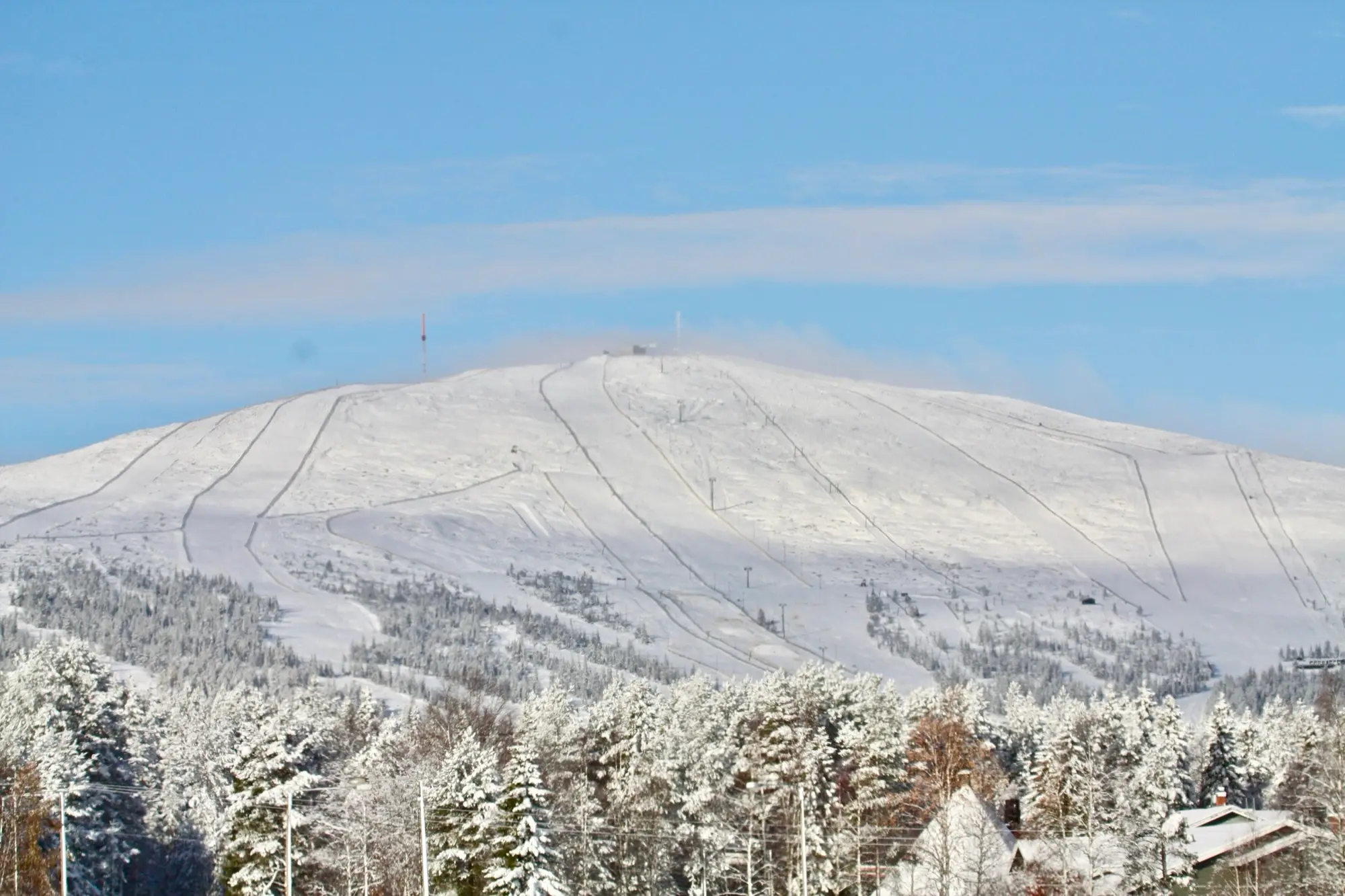

Ylläs is the largest ski resort in Finland and the least like a resort. There is no single centre. The fell, 719 m (2,359 ft) high, stands between two old villages, Äkäslompolo on the north side and Ylläsjärvi on the south, about 15 km apart by road, and the slopes run down to both. Around them is the southern end of the Pallas-Yllästunturi National Park, a chain of bare fells running north towards Hetta.
People who choose Ylläs over Levi usually do it for the length of the runs, the cross-country skiing and the quiet. They give up some nightlife and a short airport transfer.
Which village
Äkäslompolo is the bigger village, a scatter of houses, cabins and hotels around a lake of the same name on the north side of the fell. It has the national park's Kellokas visitor centre, and it is the natural base for cross-country skiing and for walking into the park.
Ylläsjärvi on the south side is smaller and more ski-focused, with the gondola up the fell. If you want to click into skis at the door and ride up in a cabin, stay here.
The two sides are linked by the slopes themselves and by the ski bus in winter. Without a car, the village you sleep in is the village you are in most evenings.
Getting there
By air. Kittilä airport is about half an hour's drive away, a little further from Äkäslompolo than from Ylläsjärvi. Liikenne Rundgren runs the airport bus to Ylläs for flights in the main season; outside it the transfer is on demand and has to be booked ahead.
By train. VR's night train from Helsinki arrives at Kolari the next morning during the ski season, and a shuttle bus covers the 35 km (22 mi) to Ylläs. This is the most relaxed way to arrive: dinner in Helsinki, breakfast in the fells. Prices and the Rovaniemi alternative are in the Rovaniemi guide.
By road from Rovaniemi, about two hours: road 79 towards Kittilä, the same road as for Levi, then road 80 west towards Ylläsjärvi. The Rovaniemi to Levi and Kittilä road page covers that stretch with its Fintraffic cameras. There is a bus from Rovaniemi as well, but it changes in Levi and takes much of the day; with luggage and children a hire car or a taxi is the realistic option.
By road from the south, drivers come up the Tornio valley on road 21, the E8, to Kolari, and turn east on road 939 or 940. The Tornio to Kilpisjärvi road page covers road 21.
Skiing
Ylläs has 62 slopes with 53 km (33 mi) in total. Almost half are over a kilometre long, eight are over two, and the longest are over three kilometres — the longest runs in Finland. The vertical is up to 464 m, again more than anywhere else in the country. It still is not the Alps; it is a long, even, cruising hill, and a very good one for intermediate skiers who want to put miles in.
The gondola on the Ylläsjärvi side takes you to the top in about seven minutes in eight-person cabins. It closes in storms and strong wind at the summit, which on an exposed Lapland fell happens more often than visitors expect.
Season, 2026–27. The target for opening the slopes is 21 November 2026, with the formal season opening on 4–6 December. The winter is the resort's 70th, and it runs until May Day.
Lift passes, 2026–27:
| Adult 1 day | Adult 6 days | Child (6–11) 1 day | Child 6 days | |
|---|---|---|---|---|
| Opening to 11 December | €55.50 | €235 | €35 | €141.50 |
| From 12 December | €60 | €272 | €38 | €161 |
An adult season pass is €598, or €473 if bought before 6 December 2026. Add the ski bus to a pass for €5 a day on a 1–5 day pass or €30 on a 6–14 day pass; children under six ride free. For a week based in one village, the bus add-on is what makes the other side of the fell usable.
Cross-country skiing and the national park
This is Ylläs's real strength. The tracks run out of both villages into the national park, across open fell and through old spruce forest. A long day on skis here is a different thing from a loop around a resort: open fell tops with no trees, and nothing between you and the next village but snow.
Pallas-Yllästunturi National Park runs north from Ylläs along a chain of fells towards Pallas and Hetta. The rules are the standard ones for a Finnish national park: camp only at permitted sites, light fires only at designated fireplaces, keep dogs on a leash. The park has two visitor centres; Kellokas at Äkäslompolo is the one on this side.
The park's classic walk is the Hetta–Pallas trail, 50 km (31 mi) over the open fells, laid out in 1934. Metsähallitus suggests three to four days for the whole route, with open wilderness huts along the way. From Ylläs it is further north, but it is the reason many summer visitors come to this corner of Lapland at all.
Summer and autumn
The gondola also runs in summer, from around Midsummer to the start of October, and the top of the fell becomes the start of a day's walking instead of a ski run. The walking is on open fell above the tree line with views in every direction, and in late June and early July the sun does not set on it.
Ruska, the autumn colour, turns the fells red and yellow in September, and it is our favourite week of the year here: no mosquitoes, no snow, few people, and the first dark nights returning in the second week of the month.
Summer has one real drawback: the insects. From late June through July, the midges and mosquitoes on the lower ground are heavy, and a head net is worth packing.
The light
Ylläs sits at 67.6°N, a fraction south of Levi, and only just inside the band with real polar night. Computed for Äkäslompolo:
- Polar night lasts about two weeks, from about 15 to 28 December. At Levi, 36 km east, it lasts from about 12 December to the end of the year.
- The midnight sun stays up from about 28 May to 13 July.
- Astronomical darkness, the condition the aurora needs, is back from about 11 September and gone after 30 March.
For today's light band and the full-year table, the closest daylight page is Levi's.
The aurora
Ylläs shares its sky with Levi, 36 km east, and the verdict in the side panel is Levi's. The two are close enough that the cloud forecast and the activity readings apply to both, and Ylläs is, if anything, the better side: the villages are smaller and darker, and the nearest FMI magnetometer, at Muonio, is 54 km from Äkäslompolo, slightly closer than it is to Levi.
Where to watch: anywhere a short walk out of either village with an open view north. The frozen lake at Äkäslompolo gives you the whole sky with the village behind you. The open fell above the tree line is spectacular and genuinely dangerous at night in winter; stay on marked tracks with a head torch.
The Levi aurora page has tonight's verdict and every reading behind it, and the northern lights in Finland guide explains how it is worked out.
When to go
- Late November and early December for the cheapest skiing of the season and the start of polar night.
- February to April for the long days back, deep snow and the best cross-country skiing. March, with dark evenings and long sunny days, is the one we would pick.
- September for ruska, hiking and the first aurora nights.
- Late June and July for the midnight sun on the fells, with insect repellent.
Levi is next door: the Levi guide covers the busier alternative, and the two make a good combination if you have a car.