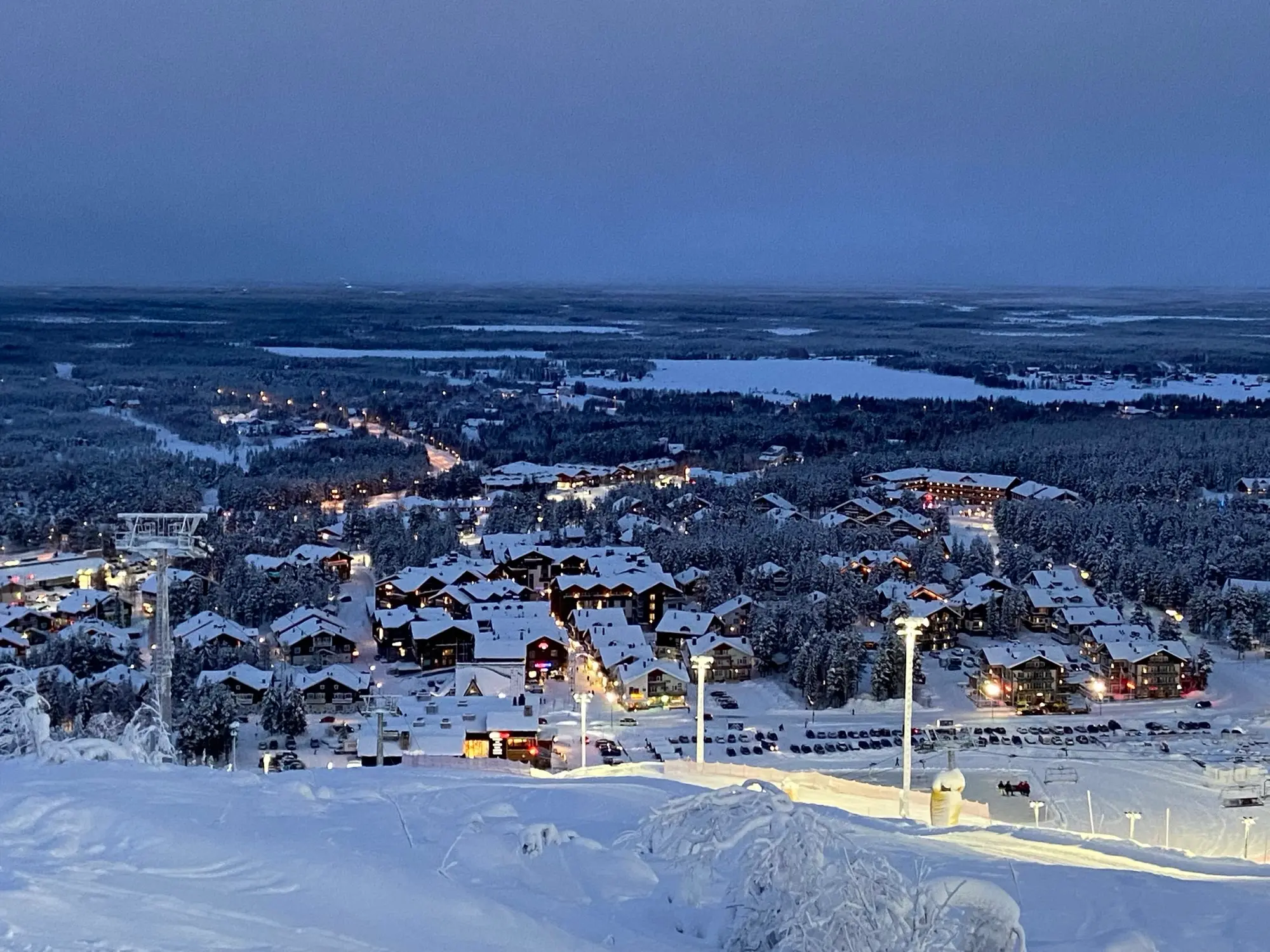

Levi is a fell with a village at its foot and a ski resort wrapped around it, 170 km north of Rovaniemi in the municipality of Kittilä. The ski resort counts more than 600,000 skier days a year, and it feels like it: a compact centre of hotels, restaurants and apartment blocks at the foot of the slopes, and an airport close enough that you can ski the afternoon you land.
It is also the first place heading north in Finland where the sun does not rise at all for part of December, and its ski season runs from October to early May. Those two facts decide most of what follows.
Getting there
By air. Kittilä airport is 15 km (9 mi) from Levi's centre, ten minutes by road. Tunturilinjat runs the airport bus to Levi for scheduled flights; outside the main season and in summer it becomes an on-demand transfer that you have to book in advance. Taxis and private minibuses cover the rest.
By train. There is no station at Levi. The nearest is Kolari, about 80 km (49 mi) away, served by VR's night train from the south during the ski season, and a connecting coach meets each arriving train. The other option is Rovaniemi, about 170 km (105 mi) away, with a year-round night train and regular Matkahuolto coaches up to Levi. The night train is covered in the Rovaniemi guide.
By road. From Rovaniemi it is 170 km on road 79 towards Kittilä, and from Helsinki about 980 km. Road 79 is single carriageway, unlit for most of its length, and has reindeer on it all winter. The Rovaniemi to Levi and Kittilä road page shows the four Fintraffic cameras on it, with the surface temperature at each. Hire cars come on winter tyres; the winter tyre rules explain what that does and does not cover.
In winter, OnniBus also runs a Helsinki–Lahti–Jyväskylä–Oulu–Rovaniemi coach, which is the cheapest way north if you have the time.
Skiing
Levi counts 44 slopes and 26 lifts, including two gondolas and six chairlifts, and 38.5 km (24 mi) of groomed slopes. The newest chairlift, the Sunny Express, is being built on the South Slopes for the 2026–27 season, alongside the existing South chairlift; the South Slopes are the gentle, family end of the hill and the busiest.
The terrain is mostly blue and red, with black runs on the steeper faces and a mogul track. Nobody comes to Levi for vertical. They come because the season is long and the lifts are close to the beds.
Season. The 2026–27 alpine and cross-country season opened on 2 October 2026, on snow preserved from the previous winter: Levi Glacier, the Front Slope park and the mogul track first, with the rest opening as the natural snow arrives. It runs until early May. Those October weeks are a narrow ribbon of white on a brown fell and are mostly for racing teams in training; the real resort opens with the natural snow in November.
Lift passes, 2026–27. Adult (12–64): €60 for one day at the ticket office, €57 if bought online at least 14 days ahead; €269 for six days. Children 6–11 and seniors 65+: €37 for a day, €159 for six. An adult season pass is €595. Buying online always takes 2% off, and buying 14 days ahead takes 5% off.
The dark is not the problem it sounds. In December the ski day happens in twilight and under lights. That is less strange than it reads: the snow reflects everything, and the midday light is blue rather than black.
Cross-country skiing
This is where Levi is quietly better than its reputation. There are about 230 km (143 mi) of maintained tracks, 28 km of them lit, and the main trails are lit every day from 6:00 to 23:00. The season begins in October on a loop of stored snow and, in a good year, runs to April or even May.
The tracks head out from the village across the fell's lower slopes, the forest and the frozen marshes. On a March afternoon with the sun back and −10 °C, a long loop on skis is the best thing to do in Levi, and it needs no ticket at all.
The rest of a winter week
The resort's activity companies run the usual Lapland list: husky and reindeer rides, snowmobile safaris, ice fishing, snowshoe walks. All are bookable from the village and priced by the operator.
Things we would actually suggest:
- An evening on the unlit tracks. Once the track lights go off at 23:00, a cross-country loop a few kilometres out of the village is the darkest easy place to watch the sky from.
- One snowmobile trip on the marked routes, if you have never driven one, with a guide the first time.
- A day at Ylläs, 36 km west as the crow flies. It is a quieter, bigger hill; see the Ylläs guide.
Summer and autumn
Levi without snow is a hiking and mountain-biking resort with the midnight sun on top.
In summer 2026 the Gondola2000 and Express cabin lifts ran to the top of the fell, and the Activity Park there was open daily from 6 June to 20 September, 10:00–18:00. From the top you walk down or around the fell on marked trails, and the midnight-sun view from the summit on a clear night is the reason to go at all. The Levi Bike Park opens on Midsummer's Day, with all tracks open in July.
Ruska, the autumn colour, arrives on the fells in September, and in the second week of September real darkness comes back. A mid-September week is the one time of year when you can walk in autumn colour by day and look for the aurora by night, before the snow.
The light
Levi is the southernmost place in Finland with real polar night. The figures are computed for the village's coordinates:
| Date | Daylight | Astronomically dark |
|---|---|---|
| 1 December | 2h 34m | 12h 48m |
| 21 December | none | 13h 20m |
| 1 February | 6h 02m | 11h 10m |
| 1 March | 9h 52m | 7h 54m |
| 20 March | 12h 20m | 4h 36m |
The sun does not rise from about 12 December to the end of the year. That is polar night, but not darkness: around midday there are two or three hours of deep blue twilight, bright enough to ski in, and the southern sky goes pink and orange without the sun ever appearing.
The opposite end of the year is longer. The sun stays up around the clock from about 27 May to 15 July, and from the end of March to the second week of September there is no astronomical darkness at all. The Levi daylight page has today's light band and the full year.
The aurora
At 67.8°N, Levi sits under the auroral oval on most nights. Our verdict for the aurora at Levi treats Kp 1 as enough on a quiet night, and the aurora season — nights with real darkness — runs from about 12 September to 30 March.
Two local details matter more than the forecast:
- The resort is bright. The village, the lit slopes and the car parks put up a lot of light. Walk ten minutes out along any cross-country track and the sky changes completely. The verdict assumes you do.
- The local magnetometer is at Muonio, 59 km north-west, which is close enough to tell you what the field over Levi is doing right now rather than what a planet-wide index says it did in the last three hours.
The northern lights in Finland guide explains how Kp, the magnetometers and the cloud forecast combine into the one sentence the page gives you.
When to go
- Late November to Christmas for polar night and the first real snow. Expensive around Christmas.
- February and March for the best of everything: deep snow, long days coming back, long dark evenings, and the equinox bump in aurora activity. The Finnish winter holidays fill the resort in late February and early March.
- April for spring skiing in sunshine, with the snow still deep and the nights too light for the aurora.
- Mid-September for autumn colour and the first dark nights.
If the trip is mostly about skiing, the road cameras and the road page are worth a look before you drive up from Rovaniemi on a winter evening; road 79 is the part of the journey that can go wrong.