
North of Sodankylä, road 4 climbs out of the forest into fell country, and the character of Lapland changes. Saariselkä is a purpose-built fell village on the edge of the Urho Kekkonen National Park: hotels, cabins, a small ski area on two rounded fells, and hundreds of kilometres of wilderness behind it. Past it the road drops to Ivalo, the airport town, and then follows the shore of Lake Inari to Inari village, the centre of Sámi life in Finland.
We treat them as one destination because they share an airport, a road and a sky, and because most visitors should see both. Saariselkä is where you stay for the fells and the skiing; Inari is where you go to understand where you are.
Getting there
By air. Ivalo airport sits between the two, about 20 minutes' drive from Saariselkä. A bus meets every flight landing at Ivalo and runs to Saariselkä, from €10 for an adult and €5 for a child, paid on board. Inari is further north; the airport shuttle there runs as a charter that you book with the operator. A hire car makes the most sense here, because the things worth doing are spread out along the road.
By train and bus. The nearest station is Rovaniemi. From there Eskelisen Lapin Linjat coaches run north on road 4 through Sodankylä to Saariselkä, Ivalo and Inari. Tickets are sold through Matkahuolto or on the bus by card or cash. It is a long afternoon, but a comfortable one, and the night train plus the coach gets you from Helsinki to the fells without flying. The train details are in the Rovaniemi guide.
By road. This is the Arctic highway, road 4, the E75: 330 km (205 mi) from Rovaniemi to Inari. It is the northernmost stretch of road 4 with Fintraffic cameras, and a closure on it means a 200 km detour. The Rovaniemi to Saariselkä and Inari road page shows each camera in the order you pass it, with the surface temperature. Reindeer on the road are the rule in this stretch, not the exception, and they do not move for headlights.
Saariselkä in winter
Downhill. The Saariselkä ski resort is spread over two fells, Kaunispää and Iisakkipää: 24 slopes, 16 of them lit, six lifts, a longest run of 2,000 m and a vertical of 180 m, plus two snow parks and toboggan runs. It is a family hill with a view, not a destination for serious downhill skiers; they go to Levi or Ylläs. The target opening for 2026–27 is 21 November 2026, and normal-season lift tickets from then to 3 April 2027 are €55 for an adult day and €259 for six days within eight.
Cross-country and the national park. Saariselkä is really a cross-country and wilderness base. Urho Kekkonen National Park begins at the edge of the village. It is the second-largest national park in Finland, and it has the most extensive network of open and bookable huts in the country, which is why Finns ski and walk across it for days at a time. Groomed ski tracks lead out from the village and from Kiilopää, the fell centre south of it, onto the open fells.
The park's own warnings are worth taking literally: mobile coverage has gaps, and above the tree line, weather that looks fine from the village can close in quickly. For a first venture onto the fells in winter, go with a guide or stay on the marked tracks.
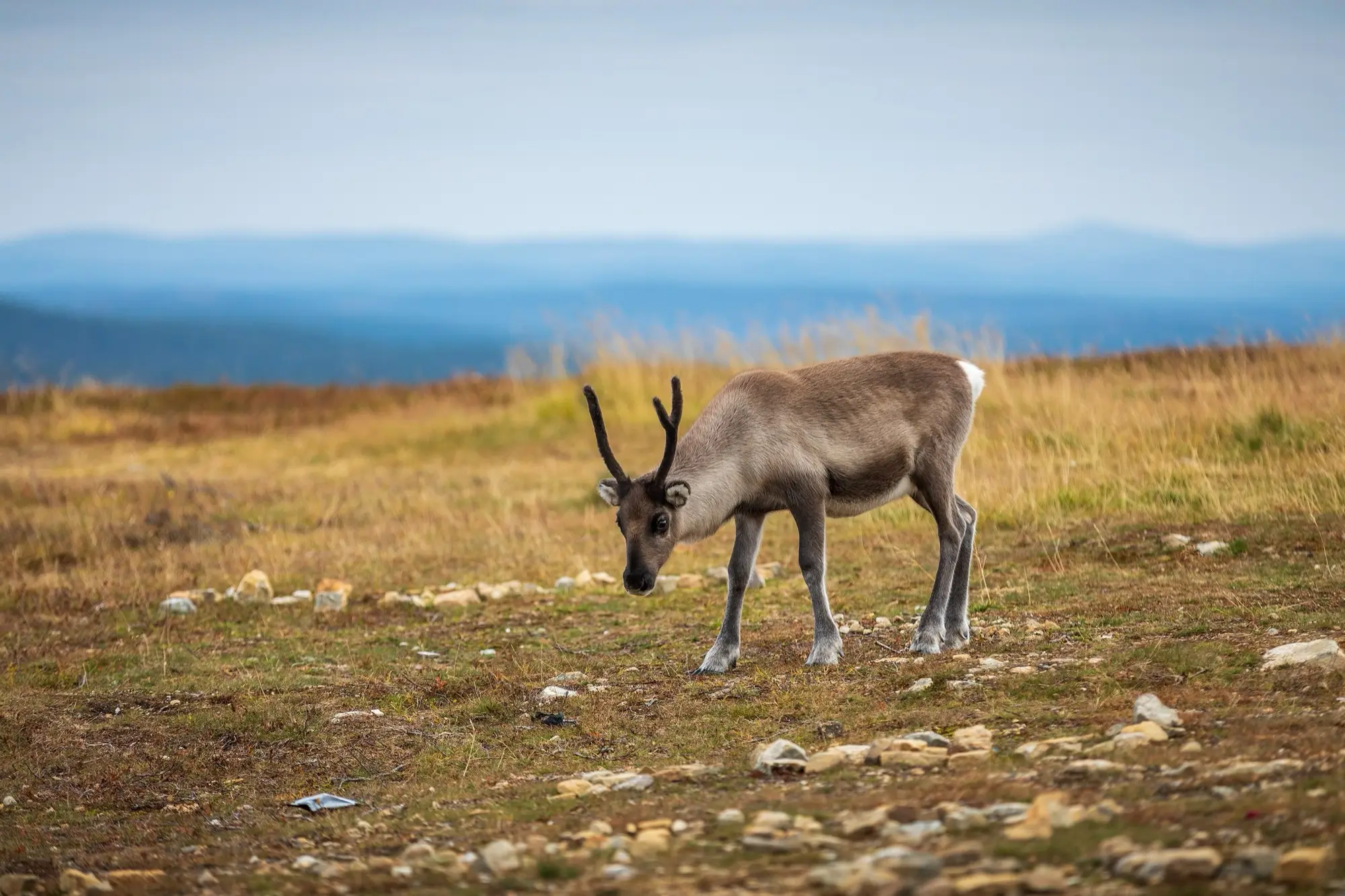
Other winter things. Husky and reindeer rides, snowshoe walks and snowmobile safaris are all run from the village. A reindeer farm visit is a better idea here than further south; this is reindeer herding country, and the animals on the road outside are working stock.
Saariselkä in summer and autumn
The best short walk is up Kiilopää. The Kiirunapolku trail leaves the Kiilopää car park, climbs the lower slope, and reaches the summit after 2 km, with steps over the stoniest parts. From the top you look across the whole of the national park's fell country. It is not maintained in winter, so this is a snow-free season walk.
Longer walks head out from Saariselkä and Kiilopää along marked routes to wilderness huts in the park, and a multi-day crossing of the park is something many Finns do at least once. Ruska, the autumn colour, turns the fells red and gold in September; it is the busiest walking season, for good reason, and in mid-September the first dark nights return.
Inari
Inari is a small village on the shore of Lake Inari, which Metsähallitus calls the clearest and cleanest of Finland's large lakes. It is the centre of the Sámi in Finland, and the Sámi Parliament meets here.
Siida is the reason most people stop, and it earns the time. It is both the Sámi museum and the northern Lapland nature centre, and it was named Finland's Museum of the Year in 2024. The indoor exhibitions explain Sámi life, reindeer herding and the northern year; the open-air museum shows the buildings. It is open daily 9–18 from 1 June to 27 September 2026, and Monday to Saturday 10–17 from 5 October 2026 to 31 May 2027. Tickets are €18 for an adult, €15 reduced, €7 for ages 7–17, and free under seven.
Pielpajärvi wilderness church is the walk to do from Inari. The trail starts from a car park at Sarviniementie 270, about 3 km north-east of Siida, and runs through old pine forest past small lakes; the first buildings of the old winter village appear after about 4.5 km. The church was built between 1752 and 1760 and served Inari's Sámi until the end of the 1800s. Its door is always open. The path is stony and rooted, and it is a snow-free season route only; camping is not allowed within half a kilometre of the church.
Lake Inari itself is the other attraction: boat trips in summer, ice fishing and snowmobile trips across it in winter, and thousands of islands.
The light
Saariselkä is at 68.4°N, well into the polar-night zone. Computed for the village:
| Date | Daylight | Astronomically dark |
|---|---|---|
| 1 December | 1h 44m | 12h 50m |
| 21 December | none | 13h 24m |
| 15 January | 2h 56m | 12h 32m |
| 1 February | 5h 46m | 11h 08m |
| 1 March | 9h 48m | 7h 48m |
The sun does not rise at Saariselkä from about 6 December to 5 January, a month of polar night. At Inari village, half a degree further north, it lasts from about 2 December to 9 January. Neither is darkness in the way people imagine: a few hours around midday are a long blue and pink twilight, bright enough to walk and ski in, and when there is snow on the ground the landscape reflects every scrap of it.
In summer the sun stays up round the clock from about 24 May to 18 July at Saariselkä, and from about 21 May to 21 July at Inari. The Saariselkä daylight page has today's light band.
The aurora
This is some of the best aurora country in Finland that you can reach by scheduled flight. At 68.4°N the auroral oval is overhead on most nights, so a quiet night is usually enough, and Saariselkä's verdict counts Kp 1 as possible. The nearest FMI magnetometer is 16 km away, so the local reading really is local.
The aurora season, nights with real darkness, runs from about 13 September to 28 March.
Where to go:
- Kaunispää, the fell above Saariselkä, has a road to the top and an open view in every direction. Popular, and for good reason.
- Kiilopää, south of the village, is darker and higher.
- Lake Inari, frozen from early winter, gives you a flat horizon and a sky with no lights at all once you are a few hundred metres out from the shore.
The Saariselkä and Inari aurora page gives tonight's verdict with every reading timestamped, and the northern lights in Finland guide explains how Kp, the magnetometers and the cloud forecast combine.
How long, and when
- Four nights is the right minimum: two in Saariselkä, a day trip to Inari, and enough nights for the cloud to open once.
- A week lets you ski or walk into the national park properly.
- December for polar night. February and March for deep snow, returning daylight, dark evenings and the best skiing. September for ruska, walking and the first aurora nights. Late June and July for the midnight sun, with a mosquito net.
For the drive further north to the Norwegian border, see Utsjoki's aurora page and its daylight page: two months of polar night, the darkest winter in Finland.