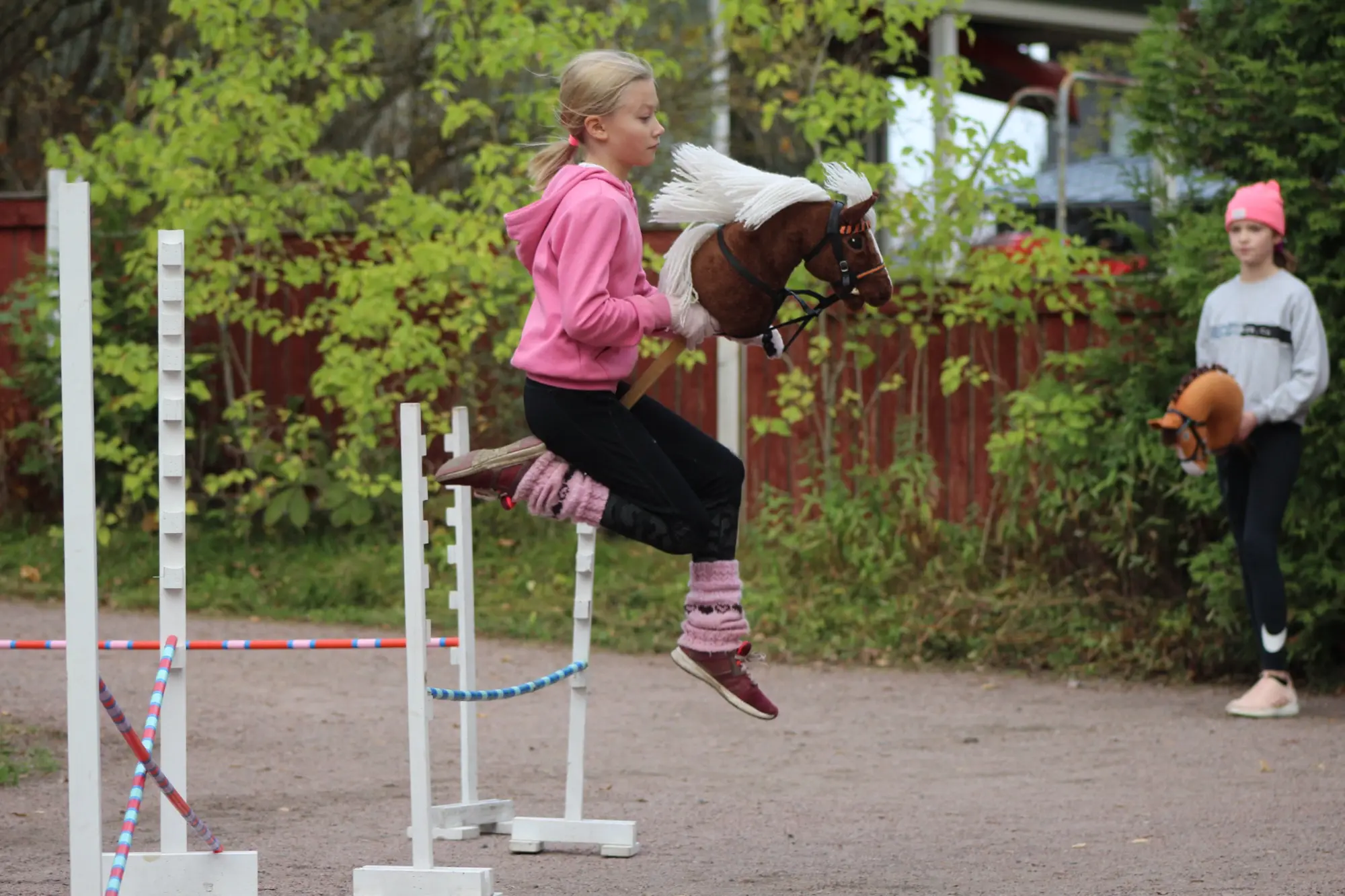

Hobbyhorsing is riding a toy horse on a stick as a sport: the rider is also the horse, jumping fences, riding dressage tests and western patterns on foot. It started in Finland in the early 2000s, and the biggest event in it is the Finnish Hobbyhorse Championships in Seinäjoki, held on a Saturday in mid-June. The 2026 edition was on 13 June, and the 2027 date had not been announced when this page was checked.
The riders are mostly girls and teenagers, and they built the whole thing themselves: the horses, the rules, the judges, and the championship. It is worth watching once before forming an opinion about it.
What hobbyhorsing actually is
A hobby horse (keppihevonen, or keppari for short) is a stuffed horse's head on a stick of 70–100 cm. The rider holds it in front of them and moves the way a horse would: a trot, a canter, a collected dressage walk. Their legs are the horse's forelegs and their upper body is the rider, which is how Yle put it when the hobby first reached a wider audience. Clearing a 100 cm fence at a canter, in rhythm and without knocking the pole, takes real leg strength and body control.
The sport side sits on top of a craft. Most riders make their own horses, name them, keep them in a "stable" of several, and show them. There are official shows, with trained judges, where the horse itself is judged on how it looks and how well it is made. Buying one costs anything from a few tens of euros to a couple of hundred, according to Yle's reporting from the championships.
Where it started
The hobby grew up online, on a Finnish hobby horse forum where the early championships were planned in public. Yle's count in 2017 was about 100 people doing it a decade earlier and about 10,000 by then. One of the first, Alisa Aarniomäki, posted videos of herself riding, took a lot of abuse for it online and in the forest where she trained, and kept going. She later won Finnish titles.
The association that now runs the sport, Suomen Keppihevosharrastajat ry, dates itself to an informal group around 2004. It held its first championship in 2012, was registered as an association in 2016, and trains its own dressage, jumping and show judges. The championships are organised by volunteers and are not run for profit. Other groups sometimes hold small, light-hearted fundraisers called "hobby horse SM" too; the association points out that those are not the official championships.
Hobbyhorse Revolution, the 2017 film
Most people outside Finland heard of hobbyhorsing through Hobbyhorse Revolution, Selma Vilhunen's documentary. It premiered at the Tampere Film Festival in March 2017, won two prizes there, and went on to festivals in Switzerland and Toronto. It follows three girls through their training and a championship season. It is kind to them, and it is the best 88 minutes you can spend on the subject. Yle Areena lists it.
The Finnish championships in Seinäjoki
The Keppihevosten SM-kilpailut are held at Seinäjoki Areena, a 13,000 m² sports hall on the edge of the town centre, in two connected halls. 2026 was the 13th championship: they have run every year since 2012 apart from 2020 and 2021, and 2026 was the seventh time in Seinäjoki. The local paper, Ilkka-Pohjalainen, expected 500 competitors on the day, from Ivalo to Argentina. The association's own figures for a typical year are about 400 starts, a crowd of about 1,800 to 2,100, and 100 to 160 riders left on reserve lists in the popular classes.
There are two kinds of class. Championship classes decide the Finnish titles. You need Finnish citizenship, a membership of the association, and a place won in qualifiers: live jumping qualifiers around the country, and video qualifiers for dressage. Open classes are open to any age and nationality, and places are drawn by lot among everyone who applies.
Disciplines and fence heights
The 2026 class list is a good summary of what the sport includes:
- Show jumping. The open championship is ridden over a 100–110 cm course, and the junior championship, for riders born in 2014 or later, over 70–80 cm. The open classes run in steps from 50 cm to 110 cm. Scoring is faults first, then time.
- High jump. A single fence that starts at 125 cm and goes up. Riders choose to come in anywhere between 125 and 140 cm, and cannot go back down.
- Team jumping. Teams of three to five over 80 cm, usually one team per country.
- Dressage. Set tests at Grand Prix level for the open championship and Intermediaire II for juniors, on a 7 x 21 m arena. The international freestyle is a four-minute test to the rider's own music.
- Western. Horsemanship, trail (poles, a gate, precision rather than speed) and pole bending, which is speed round six poles.
- Shows. Self-made horses only, judged in beginner, advanced and experienced classes. The audience votes for a favourite through the day.
- Children. A 50 cm jumping class for children under 10, and an untimed skills track that anyone can enter on the day.
Hunter and cross-country classes appear at events abroad, but the Finnish championships do not run them.
Beyond Finland
The sport has spread along the same route it grew at home: social media first, then clubs, then associations. The International Hobbyhorse Federation lists member associations in Finland, the Czech Republic, Slovakia, Hungary, Poland, Germany, Austria and the United States. The first European Hobbyhorse Championships were held in Prague on 6 June 2026, a week before Seinäjoki. Germany held its second national championship in Frankfurt on 2–3 May 2026. Seinäjoki still runs international classes, at the championship heights, specifically for riders who travel in.
How children get into it
It costs almost nothing to start. The Finnish Gymnastics Federation's instructions make a horse from an old sock, stuffing, yarn, felt ears, button eyes and a stick of 70–100 cm. The Equestrian Federation publishes hobby horse material for schools and riding clubs: patterns for horses and fences, course plans and lesson plans. The hobby horse association published a guide for club leaders in 2025, and most activity is still informal: competitions, training days and camps organised by the riders themselves and announced on Instagram. For a family living in Finland, the local riding club or the municipality's youth services are the places to ask about a group.
Going to watch
When. A Saturday in mid-June: 15 June 2019, 17 June 2023, 14 June 2025 and 13 June 2026. Check the championship site in spring for the 2027 date. The association was still recruiting its 2027 organising team at the end of September 2026.
Tickets. In 2026, advance tickets started at €18 and door tickets at €25, with a limited number sold at the door. Children under 3 went free. Advance sales opened on 1 December the year before, through Ticketmaster.
Getting there. Seinäjoki is on the main line north from Helsinki. On an ordinary Friday in October 2026 there were 17 direct day trains, the fastest taking 2 hours 45 minutes. The arena is about 1.5 km south-west of the station. By car it is about four hours from Helsinki Airport, and parking at the arena is free for about 300 cars. The Helsinki airport guide covers the first leg if you fly in.
On the day. Expect a very full hall, a lot of families, and more than a hundred sellers, from riders selling horses they have made to small companies. The jumping arena was streamed live in 2026 by Ilkka-Pohjalainen and Kaleva, behind a short paywall, if you want to see it first. Take the riders seriously and ask before photographing anyone.
Taking part. Adults and visitors from abroad can enter the open classes, but places are drawn by lot and applications close weeks before the event.
Hobbyhorsing is the one on this list that grew into a real sport. The guide to Finland's unusual championships has the others, and the Air Guitar World Championships in Oulu are on the same railway line, further north.