Can you see the northern lights in Inari tonight?
Clouded out — 100% cloud at best between 20:34 and 05:24.
Checked against NOAA SWPC, FMI's Ivalo magnetometer and the FMI HARMONIE forecast.
Tonight Inari is 12 of 13 on the ranked table of places.
Get an alert when Inari lights up
A notification on the nights it is dark, the sky is clear enough and the field is active enough for Inari. One a night at most, nothing on the other nights.
Alerts come to this browser on this device. No email, no account; turn them off here or from any alert.
At 68.9°N in Finland, Inari has weeks around the winter solstice when the sun does not rise, and a quiet geomagnetic night is often enough to see the aurora.
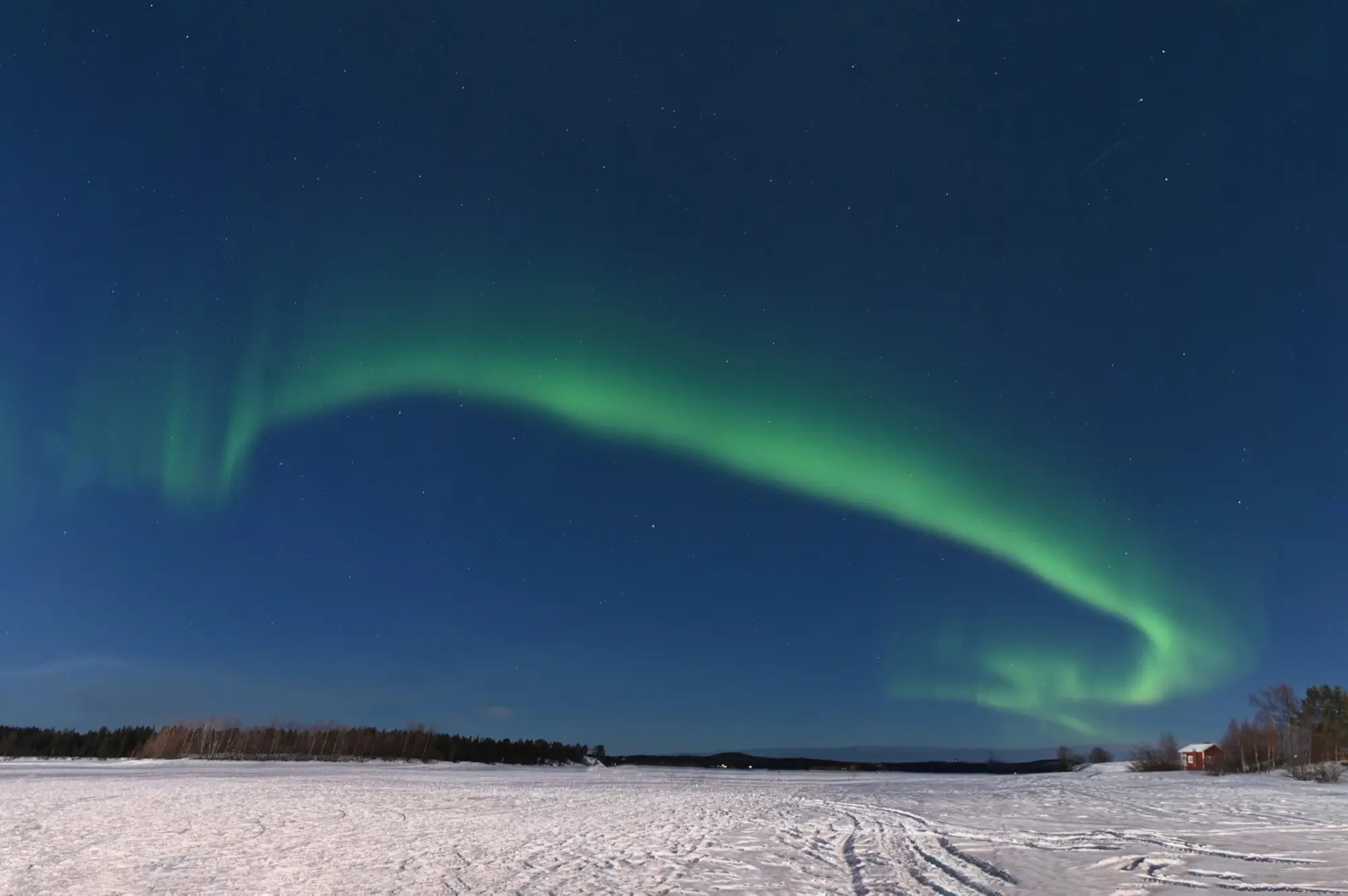
Photo: Daniele57C, CC BY 4.0

The evidence
- Geomagnetic activity
- Kp 0.00 (quiet) NOAA SWPC, estimated Kp, 4 minutes agoForecast peak Kp 4.33 during the dark hours NOAA SWPC 3-day forecast, issued 03:30 EEST2% chance of aurora overhead NOAA SWPC OVATION, 14 minutes agoLocal disturbance 1 nT/min at Ivalo, 40 km away FMI magnetometer network, 46 minutes ago
- Cloud over the dark hours
- 100% cloud at best around 21:00, 100% at worst FMI HARMONIE forecast, covering 20:34–05:24
- Darkness
- Astronomical dark 20:34–05:24 (8h 50m) computed here from the date and the coordinatesSunset 17:17, sunrise 08:39 computed here
- Moon
- First quarter, 60% lit, 0° above the horizon at the start of the dark hours computed here
Finland's all-sky aurora cameras are run by the Finnish Meteorological Institute at Sodankylä, Muonio, Kevo and Nyrölä. FMI does not publish those images under a licence that lets us embed them, so we link instead: Auroras Now!. See where the data comes from for what we checked.
How dark does it get in Inari tonight?
It is astronomically dark — dark enough to see the aurora — from 20:34 to 05:24 local time, 8 hours and 50 minutes.
Dark hours by date, 2026–27 season
| Date | Dark from | Dark until | Hours of darkness |
|---|---|---|---|
| 1 September | Not dark enough for the aurora | ||
| 15 September | 00:28 | 01:50 | 1h 22m |
| 1 October | 22:02 | 04:04 | 6h 02m |
| 15 October | 20:52 | 05:08 | 8h 16m |
| 1 November | 18:46 | 05:08 | 10h 22m |
| 15 November | 18:06 | 05:52 | 11h 46m |
| 1 December | 17:36 | 06:30 | 12h 54m |
| 15 December | 17:26 | 06:50 | 13h 24m |
| 1 January | 17:38 | 06:54 | 13h 16m |
| 15 January | 18:04 | 06:40 | 12h 36m |
| 1 February | 18:50 | 06:02 | 11h 12m |
| 15 February | 19:38 | 05:16 | 9h 38m |
| 1 March | 20:32 | 04:16 | 7h 44m |
| 15 March | 21:42 | 03:00 | 5h 18m |
| 1 April | Not dark enough for the aurora | ||
Astronomical darkness (the sun more than 18° below the horizon), Inari local time, computed here from the date and the coordinates.
Lapland North states that Inari sits under the auroral oval on the shore of Lake Inari. Watching the aurora is best from an open, dark place away from settlement lights, though auroras cannot be seen through thick cloud. Getting to the village requires planning transport from Ivalo Airport or taking a regional coach.
When to see the northern lights in Inari
Lapland North gives the northern lights season as September to April, and states that Inari's position under the auroral oval makes it ideal for watching the northern lights. According to the municipality of Inari, the area lies above the Arctic Circle and experiences the polar night, known as kaamos (polar night) in Finnish, when the sun does not rise above the horizon and winter has only twilight.
The Finnish Meteorological Institute states that the best months are February to March and September to October. Statistically, late winter and early autumn are the best times for auroras. Because spring is on average less cloudy, the Finnish Meteorological Institute recommends March. You can compare regions across the country in our guide to the best places to see the northern lights.
Finnish Meteorological Institute statistics show that on clear dark nights, auroras are seen on average three nights in four (75% of nights) near the latitude of Kilpisjärvi. In Utsjoki Lapland, the share is about 10 percentage points lower. Around Sodankylä, auroras are seen on average every second night. Auroras do not depend on frost, but they cannot be seen through thick cloud; in hard frost the sky is often clear, and in mild weather it is often overcast.
Across Lapland, the average chance of auroras passes 50% by nine in the evening, Finnish winter time, peaks at about 23:30 at magnetic midnight, and falls below 50% again around four or five in the morning. Learn more about geomagnetic indices and viewing conditions in our guide to the northern lights in Finland. Lapland North notes that in autumn, nights become dark enough for the aurora again while lakes and rivers are still open; on a windless night the water can be calm as a mirror, making it the best time to photograph the aurora with its reflection.
How to get to Inari
Lapland North identifies Ivalo Airport, the northernmost airport in Finland, as the arrival point for Inari, operating year-round flights from Helsinki and seasonal direct flights from several European cities in winter. For the winter season 2026/2027, Lapland North lists flight connections to Ivalo from London (BA Euroflyer), Paris Orly (Vueling and Transavia), Amsterdam (TUI fly), Düsseldorf (Eurowings), Frankfurt (Lufthansa), Zürich (Edelweiss Air), Vienna (Austrian) and Munich (Discover Airlines).
Siida states that Inari is 50 km from Ivalo Airport, 40 km from Ivalo, and 75 km from Saariselkä. Lapland North notes that Inari village is 50 minutes by car from Ivalo Airport. Finavia states that the shuttle from the airport to Inari village runs as a charter service, booked with the operator Ilmari Slant Ky. For aurora conditions around the airport, see our guide to Saariselkä and Ivalo.
The E75 is the main north-south road, running from Rovaniemi through Sodankylä, Saariselkä, Ivalo and Inari to Utsjoki. Drivers can check live road conditions on the E75. Siida notes that daily coaches run from Rovaniemi to Inari, with timetables published on the Matkahuolto website. Lapland North gives the travel time as about 4 hours. Lapland North also states that from Kirkenes in Norway it is 120 km to Inari, crossing the border at Näätämö, about 1.5 hours by car, with seasonal buses running between Kirkenes and Inari.
Where to stand to see the aurora
The Finnish Meteorological Institute advises watching from an open place, as dark as possible and away from the light pollution of settlements. Full night vision takes tens of minutes to develop, and if a lamp is needed it should be a dim red one. The municipality of Inari advises carrying a headlamp and a spare battery outside lit areas.
Lapland North describes Lake Inari, also called the Sámi Sea, as the third largest and second deepest lake in Finland, and points to the Siida Sámi museum standing by Lake Inari. For further background on the area, read our guide to Saariselkä and Inari. Lapland North lists northern lights tours among the popular experiences offered in Inari.
Additional locations in the surrounding area include:
- Nellim: Lapland North describes this small village on the south-eastern shore of Lake Inari, less than an hour from Ivalo Airport, as far from city lights and one of the best places in Lapland to see the northern lights.
- Lemmenjoki: Lapland North notes that in winter, the river valley beside Lemmenjoki National Park is a quiet place for northern lights watching when the sky is dark and clear.
The municipality of Inari warns that temperatures below -40 °C are possible, so frostbite and hypothermia are real and serious risks. Lapland North warns drivers not to stop in the middle of the road to take photos, and to pull off at a safe place or a parking area.
Where to watch near Inari
- Inarijärvi (Lake Inari) at Inari village in the centre. Lapland North states Inari sits under the auroral oval for watching the northern lights. You can reach the lake directly from the village shore, where the Siida museum stands.
- Nellim 52 km east. Lapland North considers this village one of the best places in Lapland to see the aurora, thanks to clear nights, lakeside views and distance from city lights. You can reach it in less than an hour from Ivalo Airport.
- Lemmenjoki 36 km south-west. Lapland North states that in winter this river valley beside Lemmenjoki National Park is a quiet wilderness destination for watching the northern lights when the sky is dark and clear.
What the numbers mean
Four things have to line up before you see anything, and three of them are on this page above. The fourth is your own eyes adjusting, which takes about twenty minutes in real darkness and does not survive a glance at a phone.
Darkness comes first because it cannot be argued with. The aurora is always there when the field is active; you can only see it once the sun is more than 18° below the horizon, which is what the dark band above marks. In Inari that is 8 hours and 50 minutes tonight.
Kp is a global index of how disturbed the Earth's magnetic field is, from 0 to 9, published every three hours. It is a blunt instrument: it says the whole planet was disturbed, not that the aurora is over Inari now. At 69°N the auroral oval usually sits overhead already, so a quiet Kp is no reason to stay in.
The local disturbance is the better number, and it is the one most aurora pages do not have. FMI runs magnetometers across Lapland; we take the rate of change of the horizontal field at the nearest one, in nanotesla per minute, which for Inari is Ivalo, 40 km away. A field moving fast overhead means current flowing overhead, which is the aurora itself. Above roughly 40 nT/min it is usually visible; above 100 a substorm is running and it will be moving.
Cloud ends most attempts. The figure above is the total cloud cover FMI's HARMONIE model forecasts for the dark hours, at these exact coordinates. Anything over about 70% and you will not see through it; under 30% and it stops mattering.
The moon does not stop the aurora. A full moon high in the sky washes out the faint green arcs that make up most displays, so a strong night still shows and a marginal one does not.
Getting there tonight
Rovaniemi to Saariselkä and Inari: Poor driving conditions on Rovaniemi to Saariselkä and Inari — the surface runs -2.5 to -0.5 °C. The surface is at or below freezing at 13 of 13 stations, from Rovaniemi Petäjäskoski northwards.


Plan the trip
- Best places to see the northern lights
- Northern lights in Finland: when and where to go
- Saariselkä and Inari: fells and Sámi Lapland
- Road conditions, Rovaniemi to Saariselkä and Inari
- Dog sledding and reindeer in Lapland: how to choose
Nearby
Also on this site: how the daylight changes through the year, and the other 12 places.