Can you see the northern lights in Kirkenes tonight?
Possible after 16:58 — the field is quiet (Kp 0.67), but at 70°N a quiet night is often enough.
Checked against NOAA SWPC, FMI's Kevo magnetometer and the MET Norway Locationforecast.
Tonight Kirkenes is 8 of 26 on the ranked table of places.
Get an alert when Kirkenes lights up
A heads-up in the hours before dark when tonight's forecast Kp reaches your choice and the cloud forecast leaves a gap, and an alert when the field is active over a clear enough sky at Kirkenes. Two a night at most, nothing on the other nights.
Alerts come to this browser on this device. No email, no account; turn them off here or from any alert.
Aurora forecast for Kirkenes: the next three nights
| Night | Dark, local time | Forecast Kp | Kp needed | Clearest hour |
|---|---|---|---|---|
| TonightFri 13 Nov | 16:58–04:34 | Kp 1.67 | any Kp | 29% at best |
| Possible — Kp 0.67. | ||||
| Saturday nightSat 14 Nov | 16:54–04:38 | Kp 1.67 | any Kp | 54% at best |
| Possible — Kp up to 1.67 is forecast while it is dark, and at Kirkenes a quiet field is enough. Only if the cloud breaks: 54% at best. | ||||
| Sunday nightSun 15 Nov | 16:52–04:40 | Kp 1.67 until 01:00 | any Kp | not forecast yet |
| Possible — Kp up to 1.67 is forecast until 01:00, and at Kirkenes a quiet field is enough. The cloud forecast does not reach this night yet. | ||||
Checked . Kp from the NOAA SWPC three-day forecast, issued ; cloud from MET Norway Locationforecast, issued . Tonight's row is the verdict above, which also reads the Kp now, OVATION and the magnetometers; the nights after rest on the forecasts alone.
Key facts
- Astronomically dark in Kirkenes tonight from 16:58 to 04:34 local time, 11 hours and 36 minutes, as of .
- Aurora outlook for the next three nights: Fri 13 Nov, Possible; Sat 14 Nov, Possible; Sun 15 Nov, Possible, as of .
- In the 2026–27 season, astronomical darkness returns between 15 September and 1 October and ends between 15 March and 1 April.
- Kirkenes is at 69.73°N, 30.05°E.
Updated
Located in Norway at 69.7°N, Kirkenes experiences polar night when the sun does not rise for weeks around the winter solstice, and a quiet geomagnetic night is often enough to see the aurora.
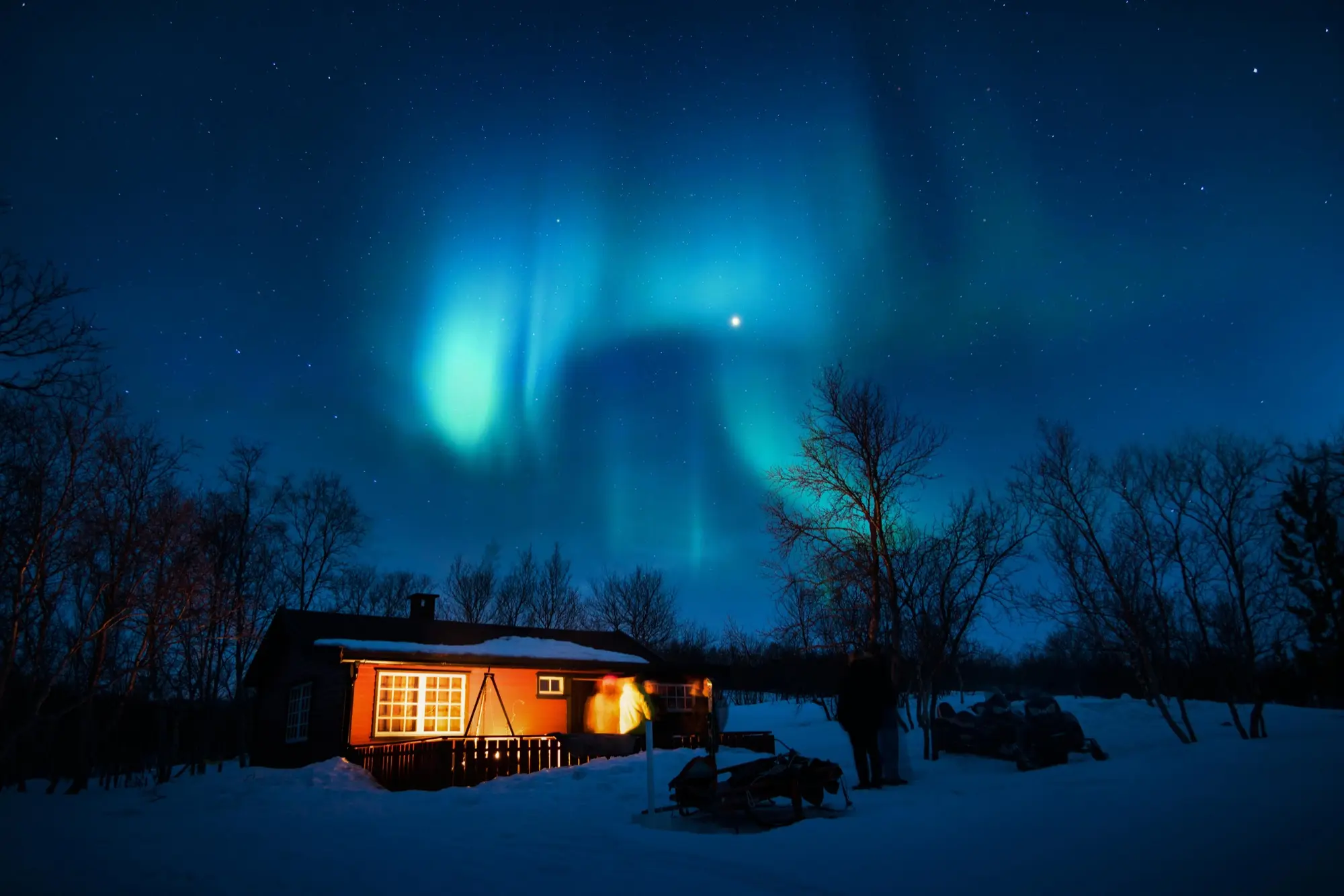
Photo: Stefan Stefancik, CC0

The evidence
- Geomagnetic activity
- Kp 0.67 (quiet) NOAA SWPC, estimated Kp,Forecast peak Kp 1.67 during the dark hours NOAA SWPC 3-day forecast, issued 01:30 CET1% chance of aurora overhead NOAA SWPC OVATION,Local disturbance 3 nT/min at Kevo, 117 km away FMI magnetometer network,
- Cloud over the dark hours
- 29% cloud at best around 17:00, 100% at worst MET Norway Locationforecast, covering 16:58–04:34
- Darkness
- Astronomical dark 16:58–04:34 (11h 36m) computed here from the date and the coordinatesSunset 12:56, sunrise 08:36 computed here
- Moon
- Waxing crescent, 17% lit, below the horizon at the start of the dark hours computed here
Cloud forecast: MET Norway, under CC BY 4.0, reduced here to the clearest and cloudiest hour of the dark window. See where the data comes from.
How dark does it get in Kirkenes tonight?
It is astronomically dark — dark enough to see the aurora — from 16:58 to 04:34 local time, 11 hours and 36 minutes.
Dark hours by date, 2026–27 season
| Date | Dark from | Dark until | Hours of darkness |
|---|---|---|---|
| 15 September | Not dark enough for the aurora | ||
| 1 October | 20:58 | 02:44 | 5h 46m |
| 15 October | 19:44 | 03:52 | 8h 08m |
| 1 November | 17:34 | 03:56 | 10h 22m |
| 15 November | 16:52 | 04:40 | 11h 48m |
| 1 December | 16:22 | 05:20 | 12h 58m |
| 15 December | 16:12 | 05:42 | 13h 30m |
| 1 January | 16:22 | 05:46 | 13h 24m |
| 15 January | 16:50 | 05:30 | 12h 40m |
| 1 February | 17:38 | 04:50 | 11h 12m |
| 15 February | 18:28 | 04:02 | 9h 34m |
| 1 March | 19:26 | 03:00 | 7h 34m |
| 15 March | 20:42 | 01:36 | 4h 54m |
| 1 April | Not dark enough for the aurora | ||
Astronomical darkness (the sun more than 18° below the horizon), Kirkenes local time, computed here from the date and the coordinates.
Visit Kirkenes describes a dry inland climate with low rainfall all year, while Northern Norway's tourism board describes a dry and stable winter climate where frequent clear skies give excellent chances of seeing the aurora. You can reach the town by scheduled flights, on the coastal route ships, or by road from Norway and neighbouring Finland.
When to see the northern lights in Kirkenes
According to Visit Kirkenes and Hurtigruten, the northern lights can be seen from late August to late March. Northern Norway's tourism board notes that the green rays of the northern lights are often visible above Kirkenes.
Weather conditions here differ from much of the Norwegian coast. Visit Kirkenes states that the town has a dry inland climate with low rainfall all year, rather than the damper weather found at other coastal destinations. Northern Norway's tourism board also describes the winter climate in Kirkenes as dry and stable, noting that frequent clear skies provide excellent chances of seeing the aurora. For a broader comparison across the region, read our guide to the best places to see the northern lights.
Visit Kirkenes reports an average temperature of 10 °C in July and -13 °C in January. The tourism board notes that the climate brings freezing temperatures from November to April and is rarely mild compared with other parts of Northern Norway. Visit Kirkenes says snow is guaranteed from November or December to April, which is also the season for winter excursions such as dog sledding and snowmobiling.
Travellers must also plan for winter weather disruption. Looking at climate change, Visit Kirkenes says a few more snowstorms and strong winds could affect transport and planning, with periodic road closures or cancelled flights and ships.
How to get to Kirkenes
By air
Kirkenes Airport is located at Høybuktmoen outside the town. SAS and Norwegian operate direct flights between Oslo and Kirkenes. Visit Kirkenes confirms there are daily flights connecting Kirkenes to Oslo, Tromsø, and regional destinations across Finnmark. An airport bus runs between Kirkenes Airport and the town.
By sea
Kirkenes serves as the turning point for the Coastal Express route from Bergen. Passengers can join or leave the vessel here. Hurtigruten notes that the walk between the port and the town centre takes only 20 minutes.
The coastal route sails from Kirkenes every day around noon and reaches Honningsvåg, close to the North Cape, early the next morning; depending on the day it is operated by Havila or Hurtigruten. If you plan to continue along the coast, see our guide to the North Cape.
By road
The E6 ends in Kirkenes, and you can drive there all year. Northern Norway's tourism board states that driving from Oslo entirely through Norway covers 2,380 km and takes 34 hours. The tourism board advises that winter driving in the region is manageable for those accustomed to snow, ice, and narrow roads, but suggests public transport can be a better option otherwise.
Travellers arriving from Finnish Lapland can cross the border by car. Lapland North notes that the closest road link from the Inari and Saariselkä areas to Kirkenes crosses the national border at Näätämö. You can combine a trip here with visits to Inari or Saariselkä.
Where to stand to see the aurora
Northern Norway's tourism board notes that visitors can look for the aurora on organised tours by dog sled or snowmobile, or independently on skis along marked trails surrounding the settlements. For guests remaining at their accommodation, the Kirkenes Snow Hotel monitors the night sky and alerts guests whenever the aurora appears.
A northern lights tour by minibus listed by Visit Kirkenes follows the weather and aurora forecasts, chooses the direction with the clearest sky that evening, and takes a small group. The operator stops by a fire under the stars, far from the town's lights, though it says the northern lights are a natural phenomenon and can never be guaranteed. For these excursions, the operator advises dressing warmly, in wool, a windproof jacket, a hat, mittens and good shoes, and lends a winter suit if needed.
Visit Kirkenes describes the Pasvik Valley as home to Norway's largest continuous pine forest, offering the northern lights and the silence of the snow-covered landscape in winter. A dog-sledding tour listed by Visit Kirkenes drives about 40 minutes from Kirkenes to a kennel and sleds through the dark Pasvik Valley with a chance of the northern lights, stopping if they appear.
Further south in the valley lies Øvre Pasvik National Park, which DarkSky International certified as Norway's first International Dark Sky Place. The national park sits approximately 100 km south of Kirkenes, and its official visitor centre, Svanhovd, is located at Svanvik, 45 km south of Kirkenes.
Where to watch near Kirkenes
- Pasvik Valley 52 km south-west. According to Visit Kirkenes, the valley offers the northern lights and quiet winter landscapes. An evening dog-sledding tour picks you up in Kirkenes, drives 40 minutes to a kennel, and sleds into the dark valley for viewing.
- Øvre Pasvik National Park 81 km south-west. Certified by DarkSky International as Norway's first International Dark Sky Place, the park has no permanent lighting inside its boundaries. You reach it via its visitor centre at Svanhovd in Svanvik, 45 km south of Kirkenes.
- Bugøynes 31 km north-west. In winter, you may see the northern lights over the Varangerfjord from the wood-fired Barents Sauna Camp in this fishing village.
What the numbers mean
Four things have to line up before you see anything, and three of them are on this page above. The fourth is your own eyes adjusting, which takes about twenty minutes in real darkness and does not survive a glance at a phone.
Darkness comes first because it cannot be argued with. The aurora is always there when the field is active; you can only see it once the sun is more than 18° below the horizon, which is what the dark band above marks. In Kirkenes that is 11 hours and 36 minutes tonight.
Kp is a global index of how disturbed the Earth's magnetic field is, from 0 to 9, published every three hours. It is a blunt instrument: it says the whole planet was disturbed, not that the aurora is over Kirkenes now. At 70°N the auroral oval usually sits overhead already, so a quiet Kp is no reason to stay in.
The local disturbance is the better number, and it is the one most aurora pages do not have. FMI runs magnetometers across Lapland; we take the rate of change of the horizontal field at the nearest one, in nanotesla per minute, which for Kirkenes is Kevo, 117 km away. A field moving fast overhead means current flowing overhead, which is the aurora itself. Above roughly 40 nT/min it is usually visible; above 100 a substorm is running and it will be moving.
Cloud ends most attempts. The figure above is the total cloud cover MET Norway's Locationforecast forecasts for the dark hours, at these exact coordinates. Anything over about 70% and you will not see through it; under 30% and it stops mattering.
The moon does not stop the aurora. A full moon high in the sky washes out the faint green arcs that make up most displays, so a strong night still shows and a marginal one does not.
Plan the trip
- Best places to see the northern lights
- Northern lights in Norway: when and where to go
- Best time to visit Norway
- Daylight in Tromsø through the year
Nearby
Also on this site: how the daylight changes through the year, and the other 25 places.