Can you see the northern lights in North Cape tonight?
Possible after 17:12 — the field is quiet (Kp 0.67), but at 71°N a quiet night is often enough.
Checked against NOAA SWPC and the MET Norway Locationforecast.
Tonight North Cape is 2 of 26 on the ranked table of places.
Get an alert when North Cape lights up
A heads-up in the hours before dark when tonight's forecast Kp reaches your choice and the cloud forecast leaves a gap, and an alert when the field is active over a clear enough sky at North Cape. Two a night at most, nothing on the other nights.
Alerts come to this browser on this device. No email, no account; turn them off here or from any alert.
Aurora forecast for North Cape: the next three nights
| Night | Dark, local time | Forecast Kp | Kp needed | Clearest hour |
|---|---|---|---|---|
| TonightFri 13 Nov | 17:12–04:52 | Kp 1.67 | any Kp | 0% at best |
| Possible — Kp 0.67. | ||||
| Saturday nightSat 14 Nov | 17:10–04:54 | Kp 1.67 | any Kp | 91% at best |
| Clouded out — 91% cloud at best through the dark hours, with Kp up to 1.67 forecast. | ||||
| Sunday nightSun 15 Nov | 17:08–04:58 | Kp 1.67 until 01:00 | any Kp | not forecast yet |
| Possible — Kp up to 1.67 is forecast until 01:00, and at North Cape a quiet field is enough. The cloud forecast does not reach this night yet. | ||||
Checked . Kp from the NOAA SWPC three-day forecast, issued ; cloud from MET Norway Locationforecast, issued . Tonight's row is the verdict above, which also reads the Kp now, OVATION and the magnetometers; the nights after rest on the forecasts alone.
Key facts
- Astronomically dark in North Cape tonight from 17:12 to 04:52 local time, 11 hours and 40 minutes, as of .
- Aurora outlook for the next three nights: Fri 13 Nov, Possible; Sat 14 Nov, Clouded out; Sun 15 Nov, Possible, as of .
- In the 2026–27 season, astronomical darkness returns between 15 September and 1 October and ends between 15 March and 1 April.
- North Cape is at 70.98°N, 25.97°E.
Updated
At 71.0°N on Norway's Magerøya island, North Cape experiences weeks around the winter solstice where the sun does not rise, and a quiet geomagnetic night is often enough to see the aurora.
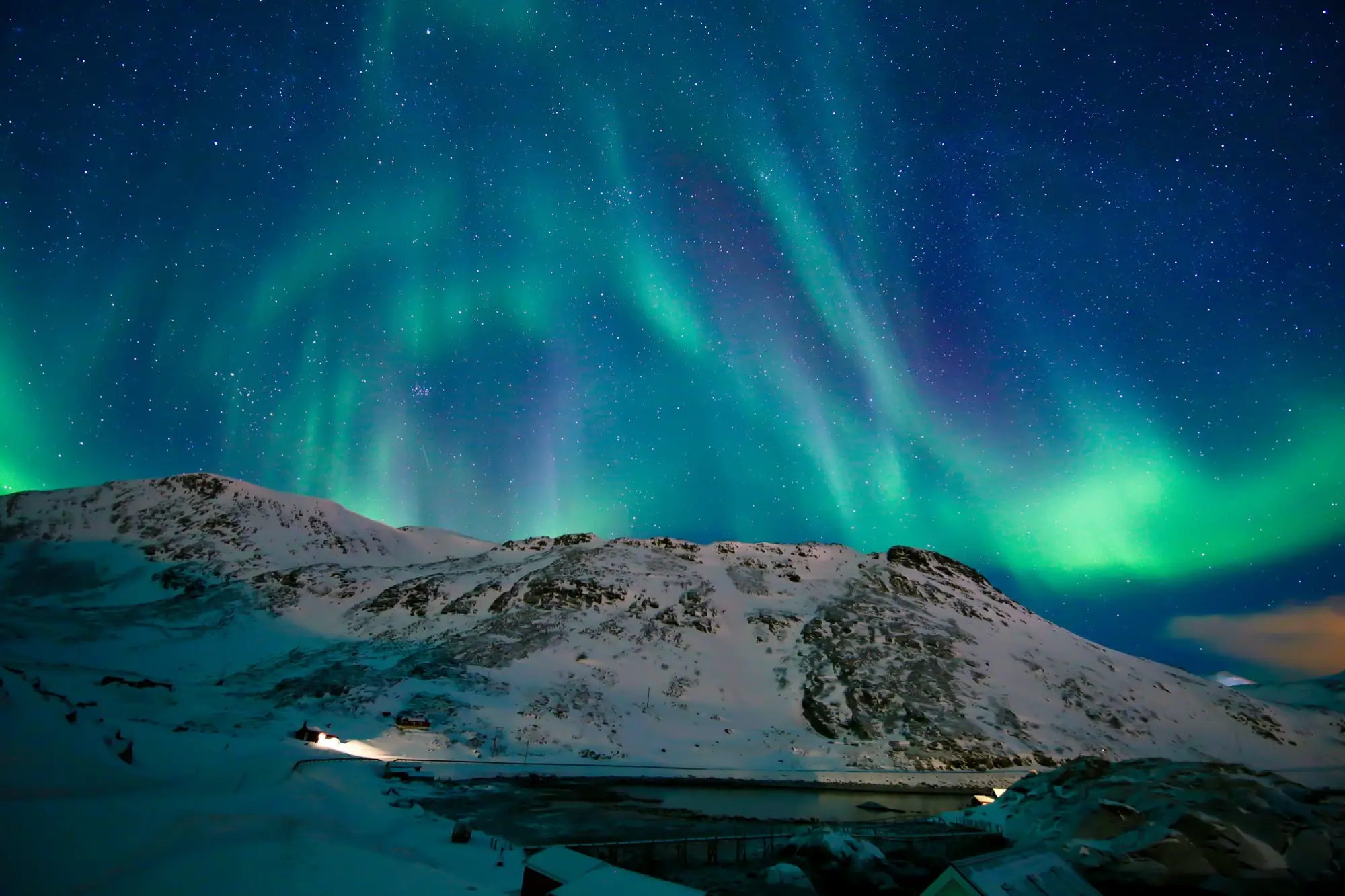
Photo: Leonardo Cavallini, CC0

The evidence
- Geomagnetic activity
- Kp 0.67 (quiet) NOAA SWPC, estimated Kp,Forecast peak Kp 1.67 during the dark hours NOAA SWPC 3-day forecast, issued 01:30 CET1% chance of aurora overhead NOAA SWPC OVATION,
- Cloud over the dark hours
- 0% cloud at best around 21:00, 99% at worst MET Norway Locationforecast, covering 17:12–04:52
- Darkness
- Astronomical dark 17:12–04:52 (11h 40m) computed here from the date and the coordinatesSunset 12:44, sunrise 09:22 computed here
- Moon
- Waxing crescent, 17% lit, below the horizon at the start of the dark hours computed here
Cloud forecast: MET Norway, under CC BY 4.0, reduced here to the clearest and cloudiest hour of the dark window. See where the data comes from.
How dark does it get in North Cape tonight?
It is astronomically dark — dark enough to see the aurora — from 17:12 to 04:52 local time, 11 hours and 40 minutes.
Dark hours by date, 2026–27 season
| Date | Dark from | Dark until | Hours of darkness |
|---|---|---|---|
| 15 September | Not dark enough for the aurora | ||
| 1 October | 21:30 | 02:44 | 5h 14m |
| 15 October | 20:06 | 04:00 | 7h 54m |
| 1 November | 17:52 | 04:10 | 10h 18m |
| 15 November | 17:08 | 04:58 | 11h 50m |
| 1 December | 16:34 | 05:40 | 13h 06m |
| 15 December | 16:22 | 06:02 | 13h 40m |
| 1 January | 16:34 | 06:06 | 13h 32m |
| 15 January | 17:04 | 05:48 | 12h 44m |
| 1 February | 17:54 | 05:06 | 11h 12m |
| 15 February | 18:46 | 04:14 | 9h 28m |
| 1 March | 19:50 | 03:06 | 7h 16m |
| 15 March | 21:18 | 01:32 | 4h 14m |
| 1 April | Not dark enough for the aurora | ||
Astronomical darkness (the sun more than 18° below the horizon), North Cape local time, computed here from the date and the coordinates.
To see the northern lights at the North Cape, base yourself in Honningsvåg between September and early April, when the skies are dark enough. In winter, the road to the plateau may only be driven in scheduled convoys led by a snowplough, and the road can close in bad weather. Visit Nordkapp says a few nights during the season give you a good chance, and advises not saving the plateau for your last day in case the convoy is cancelled.
When to see the northern lights at the North Cape
Visit Nordkapp states that the northern lights season in Nordkapp runs from about September to early April, when the nights are dark enough. According to Visit Nordkapp's practical guide, you need three conditions: darkness, clear skies and activity in the sky. There is no guarantee, but spending a few nights in Nordkapp during the season gives you a good chance.
The tourism board divides the season into three distinct periods:
- Autumn (September to November): Often brings milder weather and more open skies.
- Polar night (late November to January): It remains dark for most of the day, allowing you to see the aurora from early afternoon.
- Returning light (February and March): Lets you combine snowy daytime landscapes with dark nights.
Visit Nordkapp notes that the aurora often appears between 18:00 and 01:00, but can show up whenever it is dark. Coastal weather changes quickly, and clouds can clear in minutes. Winter temperatures are often between -5 and -15 °C, with wind, and the wind chill can make conditions feel much colder. If you are comparing regions across the country, see our overview of the northern lights in Norway.
How to get to the North Cape in winter
Honningsvåg Airport has daily flights operated by Widerøe connecting via Tromsø, and sits about 10 minutes from the town centre by car or taxi. Visit Nordkapp advises arriving in Honningsvåg one or two days before your most important tours, and leaving at least one extra day before any long-haul flight home.
Other routes onto Magerøya include coastal vessels and the mainland bus:
- Coastal ships: Ships dock in Honningsvåg twice a day, northbound and southbound, right in the town centre. Hurtigruten calls at Honningsvåg all year on the Coastal Express, docking mid-morning with time for an excursion to the North Cape.
- Mainland bus: Visit Nordkapp warns that in strong wind, heavy snow or poor visibility buses may be delayed or cancelled, especially over the mountain plateau between Olderfjord and Alta. Compare conditions with our Alta northern lights guide.
If you drive, fuel and electric vehicle charging are available in Honningsvåg but few or none exist elsewhere on Magerøya. The nearest alternatives on the mainland are at Olderfjord, 98 km away. Visit Nordkapp states that any car driven in Northern Norway from late October to early May should have proper winter tyres, which local rental cars provide.
The winter convoy on the E69
In winter, usually from November to April, the stretch of the E69 between Skarsvåg and the North Cape plateau may only be driven in scheduled convoys led by a snowplough. Statens vegvesen sets fixed convoy times that apply through the winter unless bad weather shuts the road. Statens vegvesen's convoy timetable includes departures from the Skarsvåg junction and from Nordkapp at 19.30 and 21.30, but you should check Statens vegvesen on the day because conditions can affect departures.
Statens vegvesen notes that the weather, not the calendar, decides when the convoy season starts and ends, and the road over the mountain closes completely when the weather becomes too severe. Visit Nordkapp states that the convoys are free and need no booking, and advises arriving at the meeting point at least 15 minutes early and following the convoy leader without overtaking or stopping.
Visit Nordkapp advises visitors not to save the North Cape plateau for their final day, ensuring a backup opportunity if a convoy is cancelled. Guided tours run to the convoy times; for drivers with little winter experience, a guided tour is often safer and easier. Taxis cannot be relied upon for trips to the cape. A daily public bus runs from Honningsvåg to the cape behind a snowplough throughout winter, though Northern Norway's tourism board notes it faces cancellations more often than other bus lines because the cape is so exposed.
Where to stand to see the aurora
Visit Nordkapp recommends leaving the streetlights of Honningsvåg behind, as the island's fishing villages and open landscapes provide darker skies. Never stop on the road to watch the aurora; pull into designated parking areas, wear warm clothing and bring a headlamp.
The North Cape plateau sits on the edge of a 307-metre cliff above the Arctic Ocean. Visit Nordkapp says it can be visited all year, and in winter the polar night gives a chance of the northern lights; the North Cape Hall visitor centre is open all year. Access to the plateau and the Globe monument is free, and vehicle parking is free for up to 6 hours, with no overnight parking permitted. Entering the North Cape Hall costs money. Northern Norway's tourism board says the evening convoy lets you stay up at the North Cape Hall and wait for the northern lights, with times set by Statens vegvesen to check on the day; the weather is a lottery, but it says the aurora appears more often than you would think.
Visit Nordkapp warns that in winter snow and ice make the ground slippery and snow overhangs can form at the cliff edge, so stay well away from it. Keep well back from the drop.
Beyond the plateau, two settlements offer dark coastal settings:
- Gjesvær: A fishing village roughly 36 km from Honningsvåg, identified by Visit Nordkapp as a good winter location for aurora viewing.
- Skarsvåg: Visit Nordkapp says Skarsvåg, about 23 km from Honningsvåg on the road to the North Cape, is reachable in winter, though travel conditions vary, and offers good chances to see the northern lights.
Where to watch near North Cape
- North Cape Plateau 22 km north. Sitting on a 307-metre cliff over the Arctic Ocean, the polar night provides northern lights viewing. You reach it in winter by free, unbooked snowplough convoy from the Skarsvåg junction, with evening convoys allowing waits at the North Cape Hall.
- Gjesvær 25 km north-west. Visit Nordkapp considers this village a good place to catch the northern lights in winter. You can drive there from Honningsvåg in 35 to 40 minutes along a road usually kept open, though Visit Nordkapp advises checking conditions first.
- Skarsvåg 15 km north. Visit Nordkapp says it offers good chances to see the northern lights in winter. You reach it by car, about 23 km or 20 minutes from Honningsvåg on the road to the North Cape.
What the numbers mean
Four things have to line up before you see anything, and three of them are on this page above. The fourth is your own eyes adjusting, which takes about twenty minutes in real darkness and does not survive a glance at a phone.
Darkness comes first because it cannot be argued with. The aurora is always there when the field is active; you can only see it once the sun is more than 18° below the horizon, which is what the dark band above marks. In North Cape that is 11 hours and 40 minutes tonight.
Kp is a global index of how disturbed the Earth's magnetic field is, from 0 to 9, published every three hours. It is a blunt instrument: it says the whole planet was disturbed, not that the aurora is over North Cape now. At 71°N the auroral oval usually sits overhead already, so a quiet Kp is no reason to stay in.
The local disturbance is the better number, and it is the one most aurora pages do not have. FMI runs magnetometers across Lapland; we take the rate of change of the horizontal field at the nearest one, in nanotesla per minute. North Cape has none within 120 km, so its verdict rests on Kp and OVATION. A field moving fast overhead means current flowing overhead, which is the aurora itself. Above roughly 40 nT/min it is usually visible; above 100 a substorm is running and it will be moving.
Cloud ends most attempts. The figure above is the total cloud cover MET Norway's Locationforecast forecasts for the dark hours, at these exact coordinates. Anything over about 70% and you will not see through it; under 30% and it stops mattering.
The moon does not stop the aurora. A full moon high in the sky washes out the faint green arcs that make up most displays, so a strong night still shows and a marginal one does not.
Plan the trip
- Best places to see the northern lights
- Northern lights in Norway: when and where to go
- Best time to visit Norway
- Is Norway expensive? Real prices and rules
Nearby
Also on this site: how the daylight changes through the year, and the other 25 places.