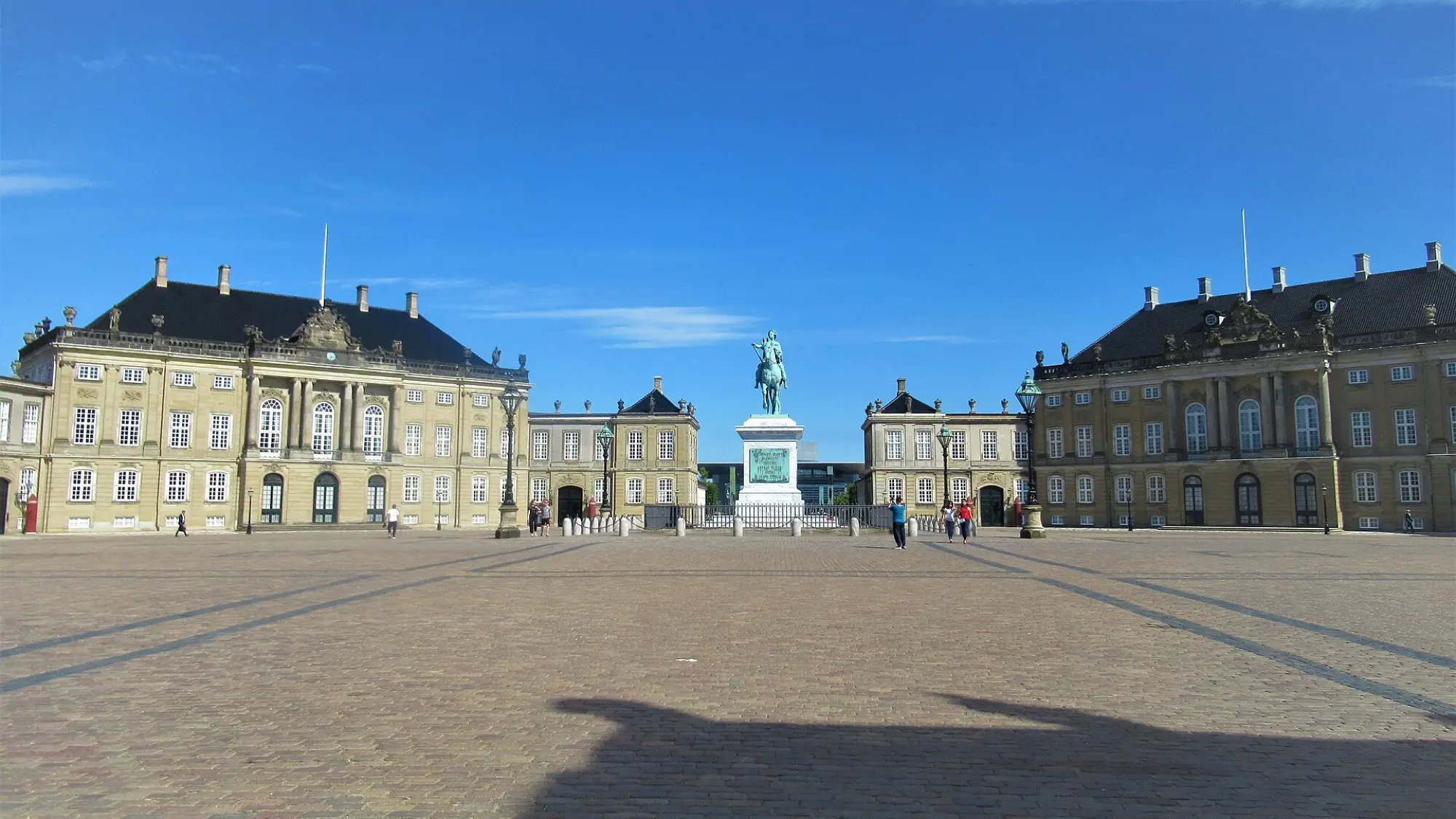

The Royal Life Guard marches every day from its barracks at Gothersgade 100 by Rosenborg to Amalienborg, where the guard changes at 12:00 noon. When the King is in residence, the parade leaves at 11:27 with music. Watching the ceremony is free, and you must keep 1.5 metres from the palace buildings.
The guard's march from Rosenborg to the palace square
During the King's guard, a parade leaves the Life Guard's barracks at Gothersgade 100 by Rosenborg Castle at 11:27 every day. It marches past the Round Tower and Kongens Nytorv among other places, and marches onto the palace square just before 12:00. The VisitCopenhagen listing for the changing of the royal guards gives 11:45 am-12:15 pm for each day it lists from 19 November to 3 December.
On the march home to the barracks, with the band playing, the guards pass Frederik's Church (the Marble Church) and Store Kongensgade, among other places. VisitCopenhagen lists watching the changing of the guard at Amalienborg among the city's experiences that are completely free; see our guide to free things to do for others.
What happens on the square
According to The Danish Royal House details on the guard change, the ceremony runs in this order:
- On the square, the guard being relieved stands at attention with rifles.
- The incoming guard marches to the left of the equestrian statue and makes a front march towards the palace where the King lives.
- The incoming guard's flag, the command symbol, is collected from the flag room and handed to the flag bearer by the adjutant on duty.
- The two guards then make a changeover march.
- A patrol changes the sentries at the sentry boxes, while the officers of both guards go to the King to report for and stand down from duty.
- The band of the Royal Life Guard plays a short concert on the square.
- The relieved guard repeats the front march and hands its flag back in the flag room before marching home.
During the guard's day on duty, the sentries are relieved every two hours.
King's guard, lieutenant's guard or palace guard
The guard changes at Amalienborg every day, and there are three types of guard: the King's guard, the lieutenant's guard and the palace guard.
- The King's guard: Mounted when the King lives at Frederik VIII's Palace. While it is mounted, music can be heard on the palace square every day around 12:00.
- The lieutenant's guard: Mounted when the Crown Prince as regent, or Queen Mary, Queen Margrethe, Prince Joachim or Princess Benedikte as acting head of state, lives at Amalienborg.
- The palace guard: Mounted when the King lives at one of the other palaces or on the royal yacht Dannebrog. Because of this rule, there is always at least a palace guard at Amalienborg.
The royal family uses the Chancellery House at Fredensborg Palace as its residence in summer and lives in Frederik VIII's Palace at Amalienborg in winter.
Where to stand
VisitCopenhagen asks you to place yourself on the square so you do not block or get too close to the marching guards, and to stand in the green areas of its map of the square.
You are not allowed to stand less than 1.5 metres from the palace buildings or to sit on the stairs. Vehicles are not allowed on Amalienborg Palace Square; the nearest drop-off point is in Frederiksgade, about 50 m from the museum entrance.
The four palaces and who uses them
Amalienborg is the King's winter residence and the royal family's residence in Copenhagen. It is four palaces built around an octagonal courtyard. Frederik V built the complex to mark the 300th anniversary of the coronation of Christian I, the first Oldenborg king, and gave the sites to four noblemen who committed to building identical palaces designed by the court architect Nicolai Eigtved.
- Frederik VIII's Palace (Brockdorff's Palace): Built in 1750-60 for Baron Joachim Brockdorff. It is the royal family's private residence.
- Christian VII's Palace (Moltke's Palace): Built in 1750-54 for the Lord High Steward A. G. Moltke. It is the King's representative palace and since 1885 has been used for guests and ceremonies.
- Christian VIII's Palace (Levetzau's Palace): Built in 1750-60 for Privy Councillor Christian Frederik Levetzau. It is the residence of Prince Joachim, Princess Marie and Princess Benedikte, and houses the Amalienborg Museum.
- Christian IX's Palace (Schack's Palace): Begun in 1750, this palace is Queen Margrethe's winter residence.
Schack's Palace was joined to Moltke's Palace by the Colonnade, a passage at first-floor level on eight Ionic columns, which let traffic continue along Amaliegade. Amalienborg became the royal residence after Christiansborg Palace burned down in the night between 26 and 27 February 1794, and within a few days the King had acquired the Moltke and Schack palaces.
The equestrian statue and moments on the square
The French sculptor J.F.J. Saly's equestrian statue of Frederik V, the founder of Amalienborg and Frederiksstaden, stands in the centre of the courtyard. The Royal Danish Collection notes that the original palace on the site, built by Queen Sophie Amalie, burned down in 1689 after Christian V's birthday celebrations.
The Royal Danish Collection's timeline of the square includes:
- In 1912, Christian X was proclaimed king from the balcony of Christian VII's Palace.
- In 1915, Christian X signed the new constitution giving women and domestic servants the vote, and between 12,000 and 20,000 women marched to Amalienborg Square, where the King received them.
- In 1944, during the Second World War, German and Danish soldiers exchanged fire in Amalienborg Square.
The Amalienborg Museum
The Amalienborg Museum is situated in Christian VIII's Palace, and you enter through the gate nearest Frederiksgade. Inside the museum, you walk through the royal family's historic offices and the gala hall, which is still used by the royal family on special occasions. Objects on display include the wine coolers in the Fabergé Chamber.
VisitCopenhagen explains that the museum shows the private interiors of the most recent kings and queens and reaches back 150 years to Christian IX and Queen Louise, called "the in-laws of Europe" because four of their children took the thrones of England, Greece, Russia and Denmark. On most days, there is admittance to the gala hall and the other rooms on the piano nobile, which the royal family still uses for representative purposes.
From the entrance, you go down one level to the museum shop. A platform lift leads to the cloakroom and a lift leads to the upper levels, allowing wheelchair users to reach every part of the museum.
Museum tickets and the Copenhagen Card
The Royal Danish Collection says you save DKK 10 per ticket by buying online.
| Ticket type | Online price | Door price |
|---|---|---|
| Adult | DKK 125 | DKK 135 |
| Student (with valid ID) | DKK 80 | DKK 90 |
| Children and young people under 18 | Free | Free |
The Royal Palace Pass costs DKK 245 online or DKK 255 at the door. It covers Rosenborg Castle, the Amalienborg Museum and every visitor site at Christiansborg Palace for 72 hours from your first visit.
The museum accepts the Copenhagen Card. You show the app's QR code at the museum shop to collect a free ticket; a time slot cannot be booked online with the card.
Museum opening hours
The museum's general opening hours are 10:00 to 16:00 from Tuesday to Sunday, closed on Mondays. The museum asks you to check the week's hours before you visit.
| Period | Days | Opening hours |
|---|---|---|
| 28 March to 1 November | Every day (Monday included)* | 10:00 to 16:00 |
| 1 November to 23 December | Tuesday to Sunday (Mondays closed) | 10:00 to 16:00 |
| Summer holidays 2026 (27 June to 30 August) | Every day | 10:00 to 17:00 |
| 24 and 25 December 2026 | Closed | Closed |
| 26 to 30 December 2026 | Every day | 10:00 to 16:00 |
| 31 December 2026 | New Year's Eve | 10:00 to 14:00 |
| 1 January 2027 | New Year's Day | 11:00 to 19:00 |
*Apart from special opening hours in that period.
Bags, pushchairs and photographs
Backpacks are not allowed in the museum. A handbag may be at most 15 x 23 x 15 cm and must be worn in front. Larger bags go into the free cloakroom lockers, which have no room for suitcases.
Pushchairs and prams are not allowed inside the museum and can be left in the cloakroom next to the shop; the museum recommends bringing a carrying sling. You may take photographs with handheld equipment only, without tripods. Eating and drinking are not allowed inside the museum.
Frederik's Church and its dome
The foundation stone of the Marble Church (Marmorkirken), officially Frederik's Church, was laid in 1749. It was built of limestone instead of marble and opened in 1894, 145 years later.
Entry to Frederik's Church is free, but it is not open for sightseeing during services. The church is open:
- Monday to Thursday: 10-17
- Friday: 12-17
- Saturday: 10-17
- Sunday: 13-17
The church closes for services, concerts and rehearsals. Dome tours run on Saturday and Sunday at 13.30 for DKK 50 an adult, and are free for children aged 0 to 12. There is a limit of at most 15 people a tour. Tickets cannot be booked ahead, and tours are cancelled for services, concerts and bad weather.
Getting there and the garden by the harbour
The nearest metro station to the Amalienborg Museum is Marmorkirken (the Marble Church). The museum has no parking facilities.
According to the Royal Danish Collection, Amalie Garden opened as a public park between Amalienborg and Copenhagen harbour in 1983.