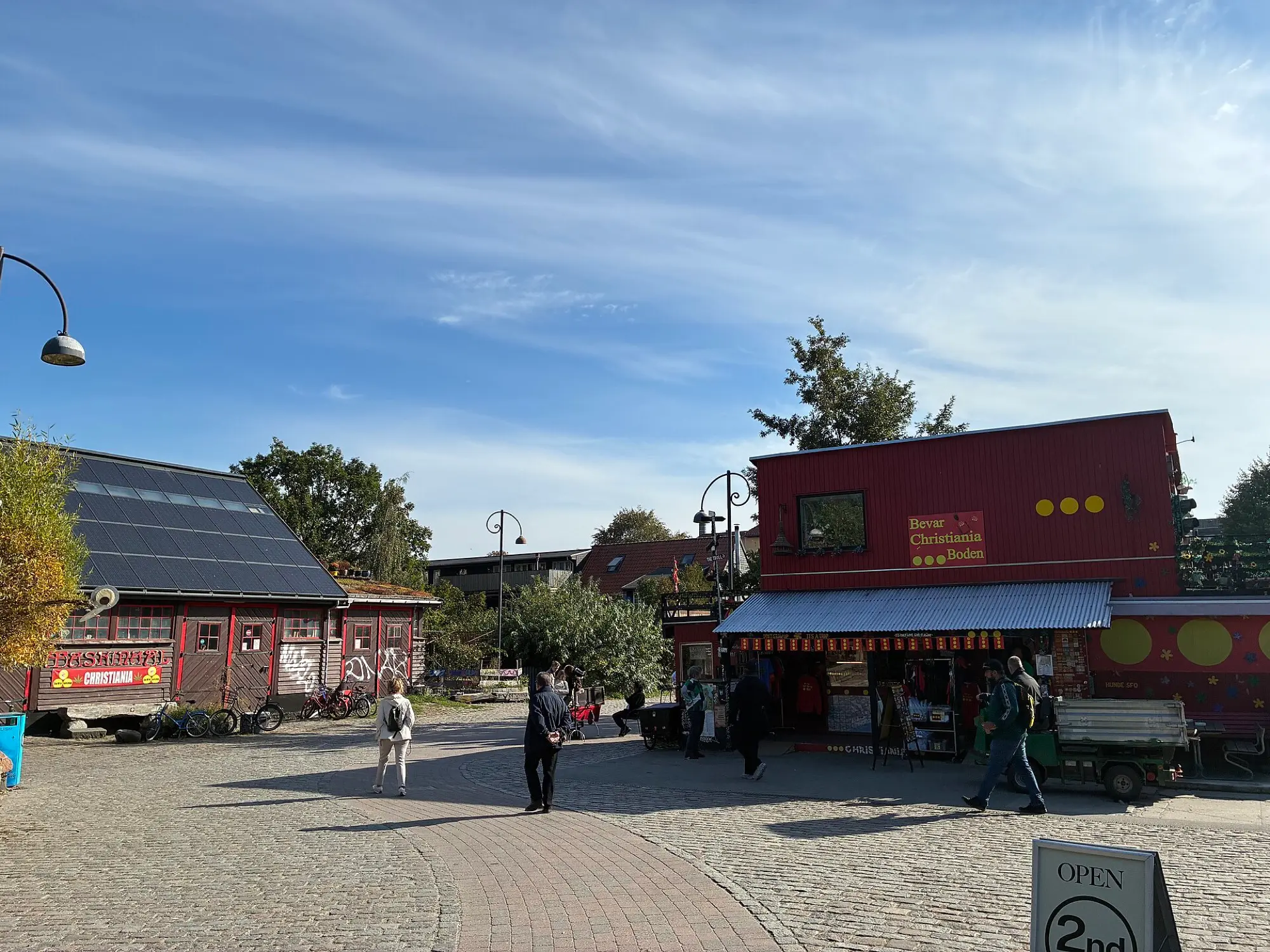

Christiania began on 26 September 1971, when people moved into empty buildings of the Bådsmandsstræde barracks in Christianshavn; since 2012 a foundation owns the area. The open hash market on Pusher Street ended in 2024, after Christiania's own common meeting decided in 2023 that the street must close. You are asked to walk slowly, respect the homes and follow the signs on photography; residents give walk-up tours at weekends for DKK 100.
What Christiania is, and how it began
The City of Copenhagen's Christianshavn local committee dates the founding of Freetown Christiania to 26 September 1971, when squatters, hippies, artists, homeless people and drug users moved into empty buildings of the Bådsmandsstræde barracks in Christianshavn. VisitCopenhagen notes that Christiania has existed as a free town and alternative community since its founding in the early 1970s, having started as a social experiment during the summer.
In 1989 the Danish parliament passed the Christiania Law, which legalised the area and set conditions and a framework for its use.
Christiania governs itself. Its own site states that its highest authority is the common meeting (fællesmødet), which every resident may attend. The community is divided into 15 local areas, each holding its own area meeting.
From squat to foundation: 2011, 2012 and 2022
The Christiania Foundation (Fonden Fristaden Christiania) was formally founded by the actor Anne Marie Helger on Christiania's birthday, 26 September 2011, to buy, own, rent or otherwise run the Christiania area. Since 2012 the foundation has been the official owner of the area, and residents can buy or rent themselves free through it. Christiania's own site says that, as part of its agreement with the state in 2012, Christiania must allocate its homes openly and transparently.
In August 2022 the residents agreed with the government that new public (almene) housing will be built in Christiania up to 2031. In return, residents may buy the part of the rampart and the homes they rent from the state for 67 million kroner. The local committee's page puts the number of residents at about 850 and says up to 300 new residents can move in by 2031. For Christianshavn and the other districts around Christiania, see our guide to where to stay in Copenhagen.
Pusher Street and its closure
For decades, Pusher Street was known as Denmark's most famous hash street. After several violent incidents, Christiania decided in 2023 that the open trade in hash had to stop. The local committee records that after another shooting and killing in August 2023, Christiania's common meeting decided that Pusher Street should be closed.
On 6 April 2024 residents, politicians and friends of the free town marked the break by digging up Pusher Street's cobblestones and carrying them away in wheelbarrows. The Museum of Copenhagen confirms that Pusher Street was shut down in 2024. VisitCopenhagen's safety guidance calls the digging up of the cobblestones a symbolic gesture marking the end of the open drug market. VisitCopenhagen also notes that Danish law prohibits dealing, buying and possessing illegal substances, and advises against going to Christiania for them.
VisitCopenhagen describes Pusher Street as a street of small arts and crafts shops, cafés and bakeries, with one of Thomas Dambo's trolls in the middle, alongside music from the jazz club and the old community centres in the evening.
The rules visitors are asked to follow
VisitCopenhagen's guidelines start by asking you to respect residents, community and nature, because Christiania is a home, not just a place to visit. The organisation asks visitors:
- not to peep into people's windows
- to walk slowly
- to follow signs and instructions
- to be considerate when taking photographs and respect areas where photography is prohibited
- to use the bins and take care of the green areas
VisitDenmark's page of sights in Copenhagen says that some visitors may find the area around Pusher Street rough, and recommends following the do's and don'ts signs at the entrances and not taking any photos or videos. VisitCopenhagen states directly that it is not legal to buy cannabis, in Christiania or anywhere else in Denmark.
The UK Foreign Office advises taking extra care in Christiania and Nørrebro, particularly late at night, because there have been some instances of gang violence there. It also lists Christiania, alongside Nyhavn and Kongens Nytorv, among the areas popular with tourists where pickpocketing and bag-snatching are common. You can read more about broad precautions in our review of whether Denmark is safe.
Guided tours by residents
Two different groups run tours, with different times, prices and meeting points.
Rundvisergruppen
Rundvisergruppen, Christiania's tour guide group, has shown groups round for over 30 years. Its guides have lived most of their lives in Christiania.
- Walk-up tours require no advance booking. They run in Danish and English all year every Saturday and Sunday at 15:00, and every day at 15:00 in July and August. Tickets cost DKK 100 per person, payable by card or cash.
- The walk-up tour meets just inside Christiania's main entrance on Prinsessegade and lasts an hour or a little longer, depending on the weather.
- Group tours can be booked every day of the year except Mondays before 11:00. These last about 2 hours and normally begin with a half-hour introduction, costing DKK 100 per person with a minimum fee of DKK 500; children under 6 go free.
Visit Christiania Freetown
Visit Christiania Freetown describes itself as a newly started initiative of local Christiania residents (christianitter) with years of knowledge of the free town. It runs open two-hour tours in Danish and English on Saturdays and Sundays from 12 to 14. They meet on the lawn by Den Grå Hal at Mælkevejen.
- Adults: DKK 100
- Pensioners: DKK 80
- Students: DKK 50
- Children aged 6 to 18: DKK 40
- Children under 6: free
The same group offers a group tour for up to 25 people with a café or bar visit of about 30 minutes, at DKK 170 per adult. If you are planning an afternoon tour late in the year, check how early it gets dark in Copenhagen.
Where to eat and drink
Places to eat and drink inside Christiania:
- Café Månefiskeren at Fabriksområdet 97S opened in 1975 as a pub. It has since become an alcohol-free café run as an association and collective by around 30 people, serving brunch, soups and cake.
- Grønsagen at Fabriksområdet 54 is a greengrocer offering a vegetarian lunch buffet where you pay by weight. VisitCopenhagen notes it is typically open from around 12 noon to 7 pm most days, with shorter days on Tuesdays.
- Christiania Bryghus began around 2017 as the free town's first local brewery and brews every beer with hemp. Its taproom, The Lab, is at Mælkevejen 81A.
- Nemoland at Fabriksområdet 52 features a bar, a bistro and a large outdoor stage, running free Sunday concerts every summer.
- Sunshine Bakery has been Christiania's baker and all-night kiosk since 1974, according to the Visit Christiania Freetown guides; besides coffee, cakes and pizza slices, it also specialises in Nepalese food.
- The large building near the entrance houses the Spiseloppen restaurant, the Gallopperiet art gallery and the Loppen music venue, while Langgaden has the Morgenstedet vegetarian eatery.
To fit Christianshavn and Christiania into a visit to the city, see a longer Copenhagen itinerary.
Getting there
VisitCopenhagen suggests taking the metro directly from the airport to Christianshavn station and walking from there towards Christiania. The tour guide group's directions:
- The Copenhagen Metro to Christianshavn station
- Bus 2A to Christianshavns Torv
- Bus 9A to Prinsessegade
The main entrance stands on Prinsessegade, with the long Loppen building positioned just to your right as you walk in. VisitDenmark's walking route concludes by following the footpaths along the moat back to Torvegade, where bus 2A runs back towards Central Station and City Hall Square. VisitCopenhagen says Christiania's green paths and open spaces blend with the ramparts, the lake and the trees.