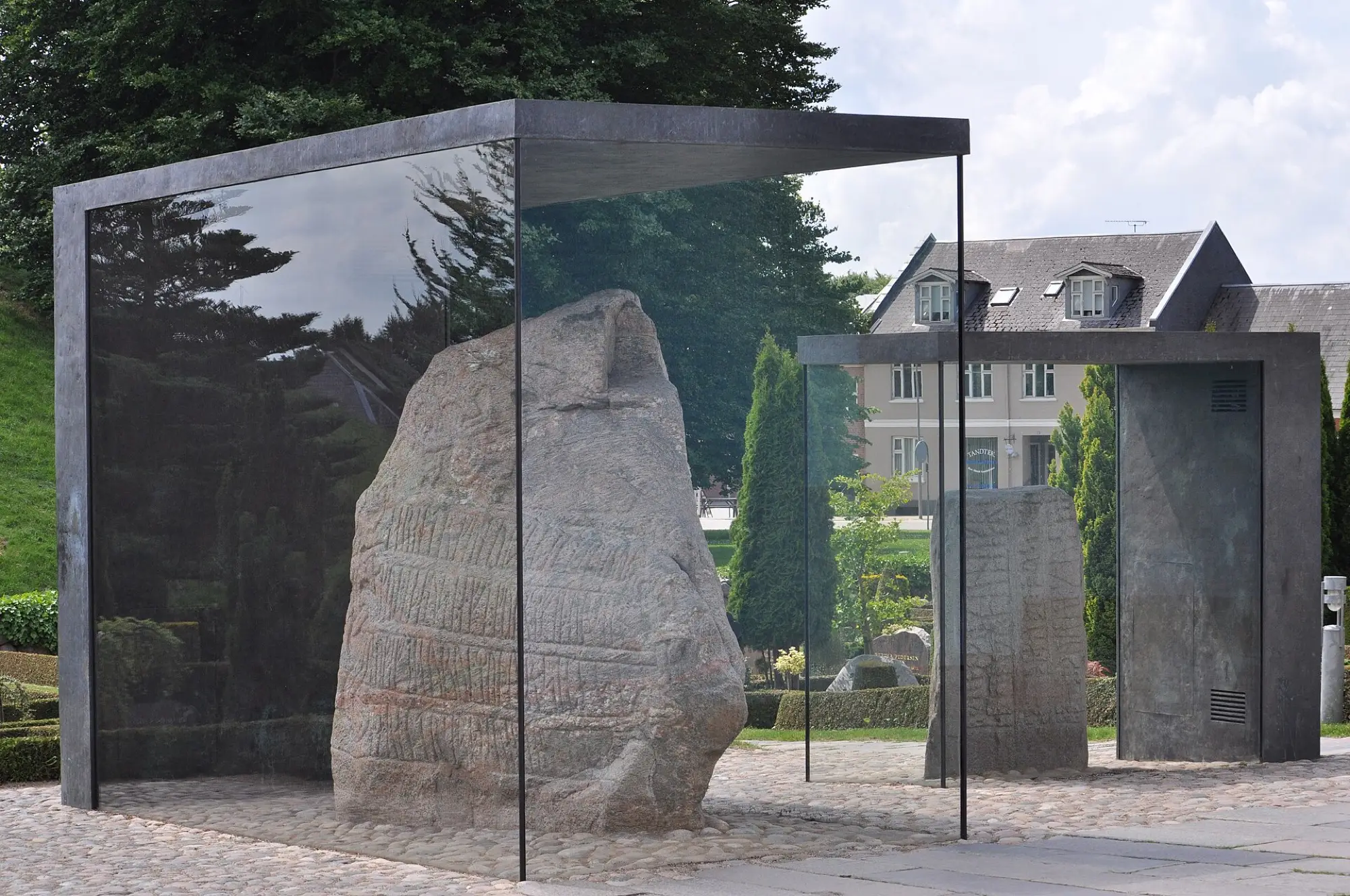

In Jelling stand two runestones, raised by King Gorm the Old for Queen Thyra and by his son Harald Bluetooth, with two burial mounds and a church. The site has been on the UNESCO World Heritage List since 1994, the outdoor monument area is always open, and the Kongernes Jelling museum charges DKK 60 in the low season, under-18s free.
The two runestones and what they say
The smaller runestone is the older of the two, from around 950 AD. Gorm the Old raised it in memory of his wife Queen Thyra, and Kongernes Jelling says it is the first time the name Denmark appears within the country's borders. Its text reads "King Gorm made this monument in memory of Thyra, his wife, Denmark's pride."
UNESCO says the original position of the smaller stone is not known, and that it has stood where it is since about 1630.
Harald Bluetooth raised the great Jelling stone. According to UNESCO's World Heritage entry, it stands exactly midway between the two mounds, and its inscription beneath a Nordic dragon reads "King Harald bade this monument be made in memory of Gorm his father and Thyra his mother, that Harald who won for himself all Denmark and Norway and made the Danes Christians".
UNESCO says the south-west face of Harald's stone has the earliest depiction of Christ in Scandinavia, with an inscription on the conversion of the Danes to Christianity between 953 and 965. VisitVejle dates Harald Bluetooth's turn to the Christian god to the year 965, and says the Christ figure from the stone is in all Danish passports. See also the Moesgaard Museum guide and the Ribe guide.
Why the stones are called the kingdom's birth certificate
Kongernes Jelling says "the kingdom's birth and name certificate is written in runes", and that for 1,000 years the two stones have been symbols of the founding of the Danish state and identity. VisitVejle says Harald's runestone is considered Denmark's baptismal certificate.
Kongernes Jelling says Harald Bluetooth was not the first Christian in Denmark, but was the one who officially christened the country, and marked it by raising the great Jelling stone, with a Christ figure on one side. VisitVejle says Gorm's stone is the oldest evidence of the name Denmark and is therefore called Denmark's name certificate.
To protect them from the weather the stones stand in display cases, lit in the evening. As detailed by Kongernes Jelling, Denmark's baptismal and name certificates can be seen around the clock.
The mounds, the church and the palisade
UNESCO says the two flat-topped mounds are 70 metres in diameter and up to 11 metres high, almost identical, built of turf stacked in even layers.
The burial chamber in the north mound was examined in 1820 and found empty, but the Jelling cup was found there and is shown in the experience centre. Gorm the Old may have been laid to rest there and later moved. The south mound had no grave, so Kongernes Jelling says it may have been a memorial mound. Kongernes Jelling points to the view from the mound north of the church.
UNESCO says the small whitewashed stone church stands on the site of at least three earlier wooden churches, all destroyed by fire. VisitVejle says Gorm the Old was found under the church in 1978 and reburied there in 2000.
The palisade around the monuments was 1,440 metres long and several metres high. It is marked with white posts, and you can walk its whole perimeter. Kongernes Jelling says the ship setting, 356 metres long with 500 stones, is the world's largest and the oldest monument in the area. Three identical longhouses where the king's men lived and a fourth house with a watchtower stood inside the palisade until they burned before the year 1000; large white stones mark where they stood.
Why UNESCO listed the site
The Jelling mounds, runic stones and church were inscribed on the UNESCO World Heritage List in 1994, under criterion (iii). Kongernes Jelling says Jelling was the first Danish site on the list, chosen because the monuments are considered Europe's finest from the Viking Age.
UNESCO says the mounds and one runestone are examples of pagan Nordic culture, while the other runestone and the church illustrate the Christianisation of the Danes towards the middle of the 10th century. UNESCO lists a minor boundary modification to the site in 2018. The property covers 12.7 ha, with a buffer zone of 59.2 ha. For more ideas across the country, see things to do in Denmark.
The Kongernes Jelling museum, prices and hours
Kongernes Jelling, at Gormsgade 23 in Jelling, is a museum and experience centre and part of the National Museum of Denmark. In the low season, from 1 November 2026, entry costs DKK 60 per person, and everyone under 18 goes free. Kongernes Jelling lists the high-season price from 5 February 2027 as DKK 125 per person, with free entry for under-18s. A ticket is valid for 1 year from the date of purchase.
The experience centre opening hours vary across the calendar:
- From 2 January to 30 April it opens Tuesday to Sunday, 10:00 to 16:00.
- From 1 May to 31 October it opens every day, 10:00 to 17:00.
- From 1 November to 22 December it opens Tuesday to Sunday, 10:00 to 16:00.
- From 27 to 30 December it opens 11:00 to 15:00.
The outdoor monument area is always open. The special exhibition of the gold treasure from Vindelev runs from 9 May 2025 to 29 December 2026. VisitVejle says digital binoculars on the museum's rooftop terrace show how Jelling looked 1000 years ago, and that the museum explains the Bluetooth wireless technology. VisitVejle says a Viking market is held at the monuments every year in July.
Getting to Jelling by train, bus or car
From Jelling station there are hourly trains to and from Vejle, which connects to Aarhus, Odense, Copenhagen, Billund and other towns, and to and from Herning and Struer. Check the journey planner Rejseplanen for train times. Four times a day there is a direct express train to and from Odense and Copenhagen. You can read more about Danish rail routes and ticketing through Denmark by train.
You can see the monuments from Jelling station, and the walk to Kongernes Jelling takes 4 minutes. On weekdays bus 211 also runs hourly between Vejle and Jelling.
By car you head for Kollegievej 22, a large car park with charging stations and space for motorhomes; the main entrance faces Vestergade. For a longer drive, see the Denmark road trip guide. Alternatively, VisitVejle says the Grejsdalstien hiking route between Vejle and Jelling is 16 km and takes about 3 to 5 hours, and you can return by train or bus.