
When planning where to pause on a journey through Denmark, twelve settlements stand out across the regions shown on the map of Denmark: Ribe, Christiansfeld, Ærøskøbing, Marstal, Svaneke, Gudhjem, Dragør, Ebeltoft, Faaborg, Tønder, Møgeltønder and Sønderho. They are grouped by region below.
Ribe: Denmark's oldest town
According to Lex, Ribe is Denmark's oldest town still in existence, known for its cathedral. You can read about Ribe, Denmark and its historic streets before visiting. Lex notes that Ribe has a historical museum covering the Viking Age and the town's medieval history. In addition, an outdoor Viking centre outside Ribe features working workshops in summer. You can read more about early settlement history across the country in the guide to Viking sites in Denmark.
Christiansfeld: the Moravian town
Lex records that Christiansfeld is a town in South Jutland situated between Kolding and Haderslev, 8 km from the Little Belt, named after Christian VII. The town was founded by the Moravian Brethren (Herrnhuter) in 1773 and has produced Christiansfeld honey cakes since 1783. UNESCO added Christiansfeld to the World Heritage List in 2015. Lex states that the centre consists of carefully restored, fairly uniform older buildings in a plain style, and in the congregation's churchyard, God's Acre, the sisters lie in the east and the brothers in the west.
Ærøskøbing: an old seafaring town
Lex describes Ærøskøbing as an old seafaring town situated on Ærø in the South Funen Archipelago, reachable among the Danish islands. Lex states that Ærøskøbing contains around 40 listed buildings, rich in half-timbering, decorated front doors and tall dormers. The oldest houses in the old town date from the 1600s and 1700s. The town's Flaske-Peters Samling is named after Peter Jacobsen (1873 to 1960), known as Bottle Peter, who went to sea at 16 and learnt to build ships in bottles from a Finnish sailor.
Marstal: the skippers' town
Also located on Ærø, Marstal is the largest town on the island's east coast according to Lex. It grew from a small fishing village into a seafaring town during the 1600s and 1700s. Lex records that Marstal is marked by old seafaring traditions and is known as the skippers' town. The local maritime museum in the old town, Marstal Søfartsmuseum, was founded in 1929.
Svaneke: a preserved town on Bornholm
Lex identifies Svaneke as a town situated on Bornholm's rocky north-east coast. Svaneke received the Council of Europe's gold medal for consistent preservation of the town in 1975. Lex notes that Siemsens Gård remains among the largest of the town's many half-timbered buildings.
Gudhjem: harbours cut into the rock
Lex records that Gudhjem is a town on Bornholm's north-east coast with 730 inhabitants (2025). Gudhjem's two harbours are blasted into the rock; the older harbour dates from the 1870s and 1880s, and the small emergency harbour of Nørresand was added in 1906. Lex states that Gudhjem was an important fishing harbour and led the way in smoking herring during the 1880s.
Dragør: on the tip of Amager
Just outside the capital, which you can explore through the guide to Copenhagen, lies Dragør. Lex describes Dragør as an old skipper, fishing and ferry town situated on the south-east tip of Amager. Lex states that Dragør has grown together with Store Magleby and retains original, well-kept old quarters.
Ebeltoft: the frigate and the glass museum
Located within reach of Aarhus, Ebeltoft has an old core that lies around the old town hall from 1576/1789 according to Lex. The frigate Jylland, moored at Ebeltoft in 1960 and restored by 1994, sits in dry dock as the main attraction of the maritime centre, which features working workshops and old wooden ships. Lex notes that the Glass Museum (1986) is also situated by the harbour.
Faaborg: the old town gate
South of Odense, Faaborg features the medieval Vesterport. Lex states this gate is the only remnant of the town's fortifications and, together with the medieval gate in Stege, represents one of only two surviving town gates in Denmark. Faaborg's bell tower, dating from around 1450, serves the Church of the Holy Spirit located 150 m away. Lex records that Faaborg's cultural history museums include the open-air Kaleko Mølle and a prison exhibition opened in 1991 in the old town hall, court house and jail on the square.
Tønder: lace on the edge of the marsh
Lex notes that Tønder lies low where the heath plain meets the marsh, bounded by the Vidå river to the south. Tønder developed into a centre for making and selling lace. Drøhses Hus on Storegade, a gabled house dating from 1672, holds changing exhibitions focusing on lace and textiles.
Møgeltønder: Slotsgade
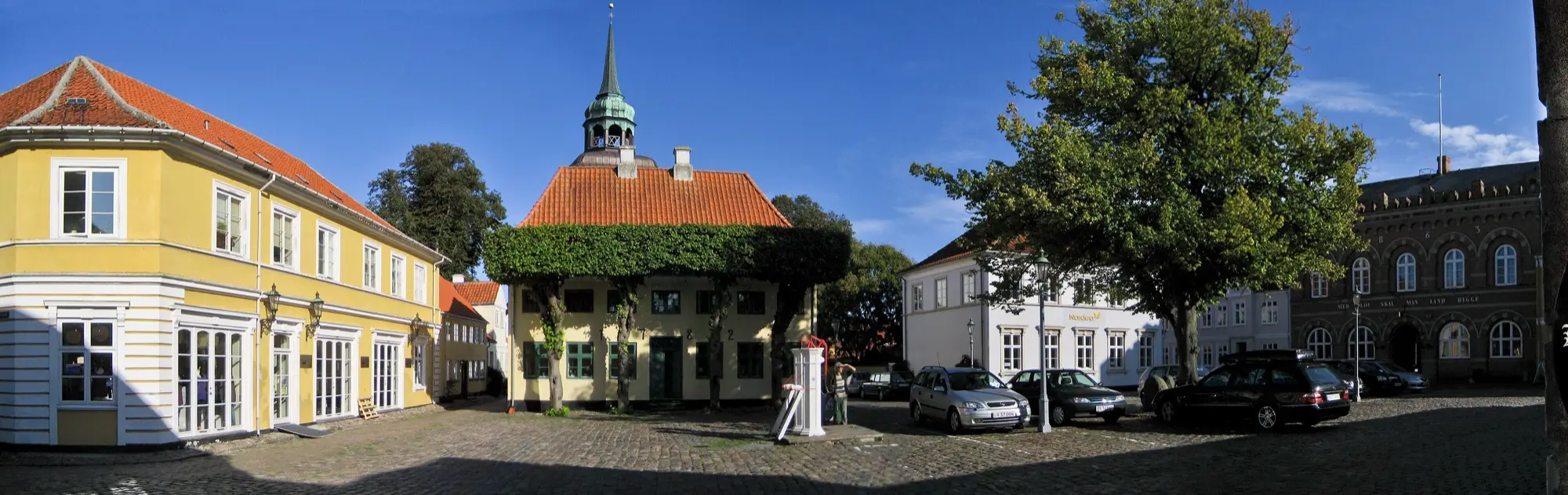
Nearby in South Jutland, Møgeltønder features the cobbled street Slotsgade. Lex states that Slotsgade is lined with lime trees, links Schackenborg with the church, and was laid out in the 1680s. According to Lex, Slotsgade preserves an unusual number of well-preserved brick houses dating from the 1700s and 1800s.
Sønderho: the skipper town on Fanø
Lex describes Sønderho as an old skipper town situated on the southern tip of Fanø in the Danish part of the Wadden Sea. Sønderho's harbour remains a natural harbour that is hard to keep open because it silts up. Lex notes that most of the oldest buildings in the settlement date from the mid-1700s to the first half of the 1800s.