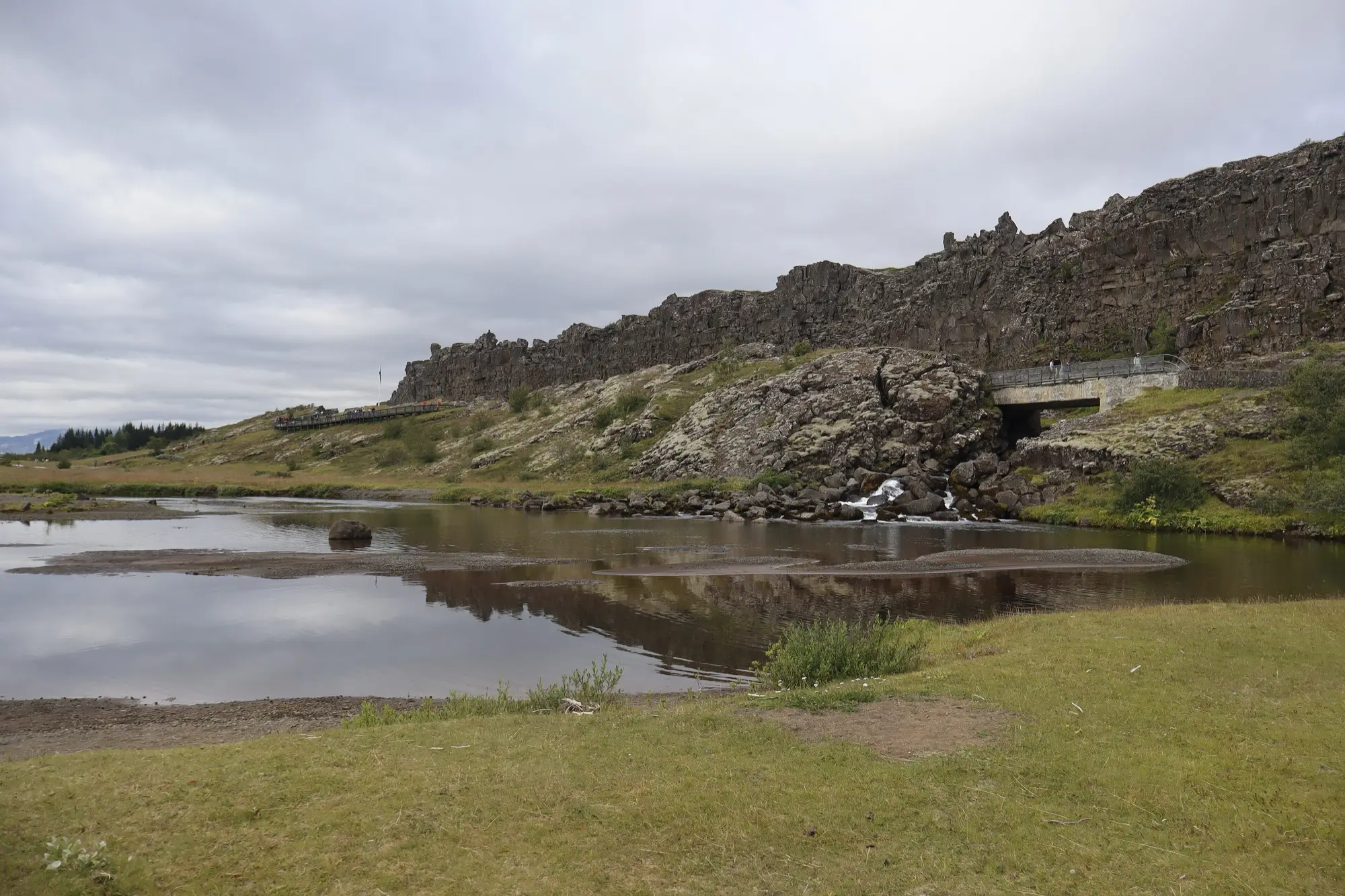

Þingvellir (Thingvellir) is where the Alþing met from around 930, a UNESCO World Heritage Site since 2004 and a national park since 1930, set in the rift between two tectonic plates. It is 50 km from Reykjavík by paved road, open around the clock with no entrance fee, but cars pay a parking service fee. For tonight's aurora verdict for Þingvellir away from city light, check the live page.
What Þingvellir is and why it matters
Visit Iceland names the country's three national parks as Þingvellir, a UNESCO World Heritage Site in South Iceland; Snæfellsjökull, at the edge of the Snæfellsnes peninsula in the west; and Vatnajökull, also a UNESCO World Heritage Site. You can compare all three reserves in our guide to Iceland's national parks.
At Þingvellir, which translates as "assembly plains", the Alþing (general assembly) was established around 930 and met on the site until 1798. Under a law passed in 1928, the protected area shall always be the property of the Icelandic nation, under the preservation of the Alþing. Today Þingvellir is maintained as a protected national shrine.
The park gives 1930 as the year Þingvellir National Park was established; it is now one of the most visited sites in Iceland. Iceland proclaimed its independence from Denmark at Þingvellir on 17 June 1944. Þingvellir was accepted as a UNESCO World Heritage Site in 2004 for its cultural value. Legally, the area is protected under Act No. 47/2004 and managed by the Þingvellir Committee, which operates under parliament.
The rift: Almannagjá and the lake
The park lies in a fissure zone on the tectonic plate boundaries of the Mid-Atlantic Ridge, and Lake Þingvallavatn lies in a rift valley. Almannagjá, the largest of the gorges, is the focal point of the park. A hiking path leads through it to the Law Rock and the Öxará river.
Þingvellir lies on the northern shore of Þingvallavatn, Iceland's biggest lake. Along the gorge, the Öxará river forms the Öxarárfoss waterfall at Almannagjá. Numerous hiking trails extend all over the park. Outside the ancient assembly site itself, most of these paths lead to the abandoned farms of Hrauntún, Skógarkot and Vatnskot, where structural remains can still be seen.
Silfra: diving and snorkelling rules
Silfra, a fissure in the rift valley that separates the North American plate and the Hreppar microplate, is a popular diving location. Within the national park, diving and snorkelling are allowed in only two fissures: Silfra and Davíðsgjá. Visit South Iceland describes snorkelling and diving at Þingvellir as activities done with experienced local tour operators.
The park enforces strict regulations for anyone entering the water:
- Every dive and every snorkel in Silfra must be registered, by companies and individuals alike.
- An individual registering must accept a liability statement and pay a visitor fee, online, at the service centre at Leirar or at the visitor centre at Hakið.
- Diving or snorkelling alone in Silfra is not permitted.
- Diving alone, cave diving and going deeper than 18 metres are not allowed.
- Scuba divers must hold a drysuit qualification or have made at least 10 drysuit dives in the last two years. Diving in a wetsuit is not allowed.
- The national park does not supply diving or snorkelling equipment.
- Everyone who dives in the park does so at their own risk, and the diver is responsible for holding the required diving qualifications and having all the equipment in good condition.
Getting there and parking
Þingvellir forms the first stop on the classic route described in our Golden Circle self-drive guide. According to the Road Administration, the driving distances along paved roads are:
- Reykjavík to the Þingvellir service centre: 50 km, all paved, over Mosfellsheiði.
- Þingvellir service centre to Laugarvatn: 27 km, all paved, over Lyngdalsheiði.
- Þingvellir service centre to Geysir: 56 km, all paved, by Lyngdalsheiði.
The park is open 24/7 and charges no entrance fee to enter the grounds, but there is a parking fee for motor vehicles and an entrance fee for the historical exhibition. On the price list confirmed by the ministry on 28 December 2023, the parking service fee is 1000 ISK for a passenger car with 5 or fewer passengers and 400 ISK for a motorcycle.
One payment covers all car parks for the day it is paid. The fee is charged at:
- P1 Hakið, by the visitor centre at the top of Almannagjá.
- P2 Efri-vellir, below Öxarárfoss.
- P5 Valhöll, nearest the church and Silfra.
These parking fees pay for upkeep, care and snow clearing in and around the car parks, toilets included.
A separate funding system has been proposed. On 22 September 2026, the Ministry of Industries put out for consultation a draft bill for a nature and infrastructure fee covering Geysir, Gullfoss and Þingvellir. Under this proposal, the fee would be paid by people aged 18 and over who are not tax-resident in Iceland. The planned one-year pass would cost 4,500 kr. from 1 June to 30 October and 3,000 kr. from 1 November to 31 May, with charging planned to begin on 1 May 2027. Under the draft bill, parking fees could no longer be charged on state-owned or state-managed land where the new fee applies, meaning the existing parking fees inside Þingvellir National Park would end.
The visitor centre and camping
The visitor centre at Hakið, located next to car park P1, houses the interactive exhibition Heart of Iceland. A visit takes about 40 minutes. The centre opens from 09:00 to 18:00 from April to October, and from 09:00 to 17:00 from November to March. Admission to the Heart of Iceland exhibition costs 1200 kr. for adults, while children aged 17 and under enter free of charge.
The park's campsites are generally open in summer, from 1 June to 15 September. The Fagrabrekka and Vatnskot sites are reserved for tents only. The campsite at Nyrðri-Leirar stays open year-round, operating from 16 September to 31 May as well as during the standard summer period.