
Visit Iceland puts the Golden Circle at about 250 km from and back to Reykjavík, drivable all year without a 4x4. By the Road Administration's distances, the drive is Reykjavík to Þingvellir 50 km, Þingvellir to Geysir 56 km by Laugarvatn, Geysir to Gullfoss 10 km, and back to Reykjavík by Selfoss (71 km plus 57 km, 244 km in all) or the way you came (115 km, 231 km in all). In November 2026, parking costs 1,000 ISK at Þingvellir, 1080 ISK at Geysir, and 1080 ISK at Gullfoss.
The Golden Circle loop in one answer
According to Visit Iceland, the Golden Circle is Iceland's best-known scenic route, providing a round trip combining landmarks and historic places across approximately 250 km from and back to Reykjavík. The route is drivable all year without a 4x4 vehicle.
Driving distances on the loop are measured between key junctions. The Road Administration gives 50 km from Reykjavík to the Þingvellir service centre, all of it paved, over Mosfellsheiði. From the Þingvellir service centre to Geysir, the Road Administration gives 56 km, all of it paved, by Lyngdalsheiði. Between Geysir and Gullfoss, the Road Administration gives 10 km, which is also paved throughout.
Added up from the Road Administration's individual legs, the complete loop from Reykjavík out to Þingvellir, Geysir, and Gullfoss, and back by way of Selfoss, is 244 km. If you instead choose to drive out to Gullfoss and return the way you came via Laugarvatn, the distance added up from the Road Administration's legs is 231 km. Visit South Iceland notes that the route is open all year, its main roads are regularly serviced and generally easy to drive in summer and winter, and many people drive it themselves.
The route and the distance of every leg
Every section of the standard Golden Circle follows asphalt roads. The Road Administration gives the following specific distances for each leg:
- Reykjavík to Þingvellir service centre: 50 km, all of it paved, over the Mosfellsheiði heath.
- Þingvellir service centre to Laugarvatn: 27 km, all of it paved, over Lyngdalsheiði.
- Laugarvatn to Geysir: 29 km, all of it paved.
- Þingvellir service centre to Geysir: 56 km, all of it paved, via Lyngdalsheiði. Laugarvatn lies directly on this 56 km road, situated 27 km from Þingvellir and 29 km before Geysir.
- Geysir to Gullfoss: 10 km, all of it paved.
- Gullfoss to Selfoss: 71 km, all of it paved, running almost entirely on Biskupstungnabraut (road 35) through Grímsnes.
- Selfoss to Reykjavík: 57 km, all of it paved, over Hellisheiði.
Added up from the Road Administration's legs, following the loop from Reykjavík through Þingvellir, Geysir, and Gullfoss before returning through Selfoss totals 244 km. Alternatively, the Road Administration gives 115 km, all paved, to return from Gullfoss back to Reykjavík retracing the route over Lyngdalsheiði and Mosfellsheiði. The Road Administration also records a shorter 114 km route between Gullfoss and Reykjavík, but that path contains 49 km of gravel over mountain roads that are open only part of the summer and are not passable for ordinary cars. Added up from the Road Administration's legs, going out to Gullfoss and returning the way you came by Laugarvatn totals 231 km. Visit Iceland gives the standard loop as approximately 250 km from and back to Reykjavík, accessible all year without requiring a four-wheel-drive car.
Þingvellir: the rift valley and the old parliament
At Þingvellir (assembly plains), the Alþing (general assembly) was established around 930 and met on the site until 1798. Iceland later proclaimed its independence from Denmark at Þingvellir on 17 June 1944. Þingvellir has been a UNESCO World Heritage Site since 2004, and the park gives 1930 as the year Þingvellir National Park was established. For a full breakdown of the grounds, read our guide to Þingvellir National Park.
Tectonic plates drift apart at Þingvellir, exposing fissures across the landscape. This rift is visible in the Almannagjá canyon and at Silfra, where you can dive and snorkel between the continental plates. Þingvellir lies on the northern shore of Þingvallavatn, Iceland's biggest lake. Within the park, the Öxará river drops over the edge of the gorge to form the Öxarárfoss waterfall at Almannagjá.
Þingvellir National Park is open 24/7 and charges no entrance fee to walk the grounds, though motor vehicles must pay a parking fee. There is also an entrance fee for the park's Heart of Iceland exhibition, located inside the visitor centre at Hakið next to car park P1. Listed in November 2026, admission to the exhibition is 1200 kr. for adults, while children aged 17 and under enter free of charge. For nighttime visits, you can check the Þingvellir northern lights forecast to see sky conditions away from city lighting.
Parking at Þingvellir
Parking in the national park is charged as a service fee. The environment ministry confirmed the park's current service-fee tariff on 28 December 2023, setting the charge for a car with 5 or fewer passengers at 1000 kr. As listed in November 2026, a passenger car with 5 or fewer seats pays 1,000 ISK, while a motorcycle pays 400 ISK. Paying this fee grants parking for the day of payment, and a single payment covers all car parks within the park boundaries.
The parking fee is collected at car park P1 at Hakið (near the top of Almannagjá and adjacent to the visitor centre), at P2 Efri-Vellir (located below Öxarárfoss), and at P5 Valhöll (the closest car park to the church and the Silfra fissure). At Hakið, an automated payment system reads number plates with cameras, checking registrations against payments when you drive away. Payment machines are located inside the visitor centre, at the toilets next to it, and at car parks P5 and P2. Revenue from these parking fees pays for upkeep, maintenance, and snow clearing in and around the car parks, including toilet facilities.
Snorkelling and diving in Silfra: the park's rules
Within Þingvellir National Park, diving and snorkelling are restricted by strict conservation rules and permitted in only two fissures: Silfra and Davíðsgjá. Visit South Iceland describes snorkelling and diving at Þingvellir as activities conducted with experienced local tour operators.
Every dive and every snorkel in Silfra must be registered beforehand, applying to commercial companies and independent individuals alike. An individual registering must accept a liability statement and pay a visitor fee, which can be done online, at the Leirar service centre, or at the Hakið visitor centre. Diving or snorkelling alone in Silfra is not permitted. Everyone who dives in the park does so at their own risk; the diver is responsible for holding the required diving qualifications and ensuring all personal equipment is in good working order. The national park does not supply diving or snorkelling equipment.
Specific rules apply to scuba divers entering the water. Divers must hold a drysuit qualification or have completed at least 10 drysuit dives in the last two years. Diving in a wetsuit is prohibited. In addition, cave diving, diving alone, and descending deeper than 18 metres are strictly prohibited.
Geysir and Strokkur in Haukadalur
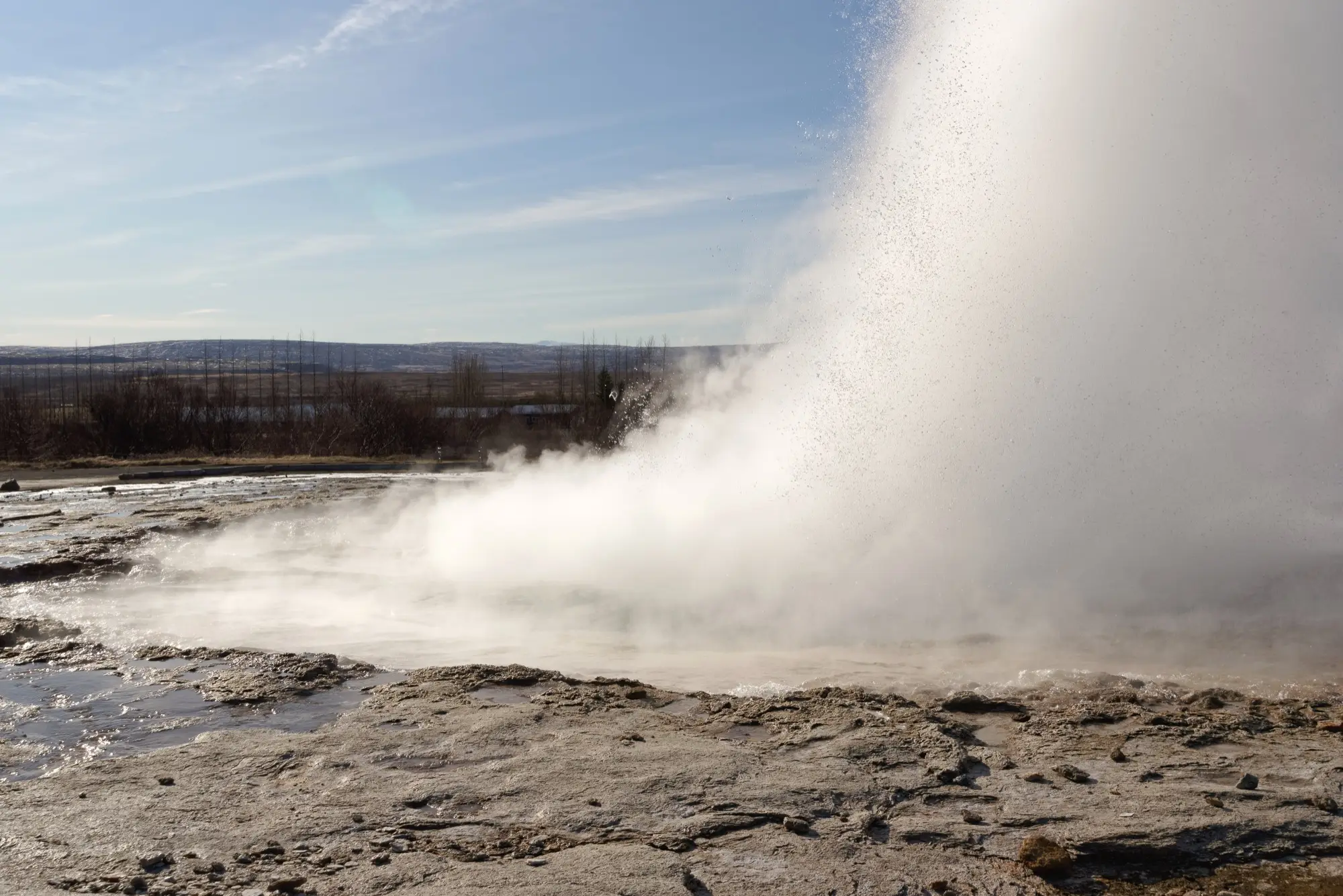
The Geysir geothermal area in Haukadalur was protected as a natural monument on 17 June 2020 and covers 1.2 km². The Great Geysir itself barely spouts, having remained dormant since 1916 when it abruptly ceased activity. However, Strokkur (the churn), located 100 metres south of the Great Geysir, erupts reliably every 8 to 10 minutes, throwing water up to 30 metres into the air. Visit Iceland advises observers to stand on the upwind side of the geyser to avoid falling spray.
Safety and environmental regulations are strictly enforced across the reserve. All visitors must keep to the marked walkways throughout the hot spring area. Throwing stones, coins, or any other items into the thermal springs is prohibited, and bathing in the hot springs and pools is barred. For other bathing locations, see our overview of hot springs in Iceland.
Parking at the site is managed by Parka. As listed in November 2026, Parka lists a fixed fee of 1080 ISK for a vehicle with up to 7 seats for up to 8 hours, 400 ISK for a motorcycle, and a transaction fee of 89 ISK when paying through its website. The fee covers both vehicle parking and access to the toilet facilities. If a visit is not paid for, an extra parking charge of 1,490 ISK is added and a claim is raised with the vehicle's owner. Web payments are accepted up to 24 hours after leaving the car park.
Gullfoss: two drops into the canyon
At Gullfoss, an average of 100,000 litres of glacial water from the Hvítá river plunge 31 metres into the canyon every second. Visit South Iceland describes Gullfoss as two separate falls: an upper drop of 11 metres and a lower drop of 21 metres. Gullfoss and the surrounding Hvítárgljúfur canyon at Brattholt have been protected as a nature reserve since 1979. For other falls across the country, consult our guide to waterfalls in Iceland.
Within the nature reserve, driving off-road and outside marked trails is prohibited. Drones may not be flown without explicit permission from the Environment Agency. Gullfoss is accessible throughout the year, but during winter conditions, the pathways leading to the lower viewing platforms are sometimes closed due to ice and snow accumulation. Visit South Iceland notes these potential trail closures and advises checking Safetravel before arriving.
Parking is monitored by Parka. As listed in November 2026, Parka lists a fixed parking fee of 1080 ISK for a vehicle with up to 7 seats for up to 4 hours, 400 ISK for a motorcycle, and an 89 ISK transaction fee when paying on its web page. This fee includes parking and access to on-site toilets. If the stay is left unpaid, an extra parking charge of 1,960 ISK is applied; drivers can complete their payment online up to 24 hours after departure.
Optional stops: Laugarvatn, Friðheimar, Faxi and Skálholt
Drivers can add several heritage sites and thermal attractions along the paved loop:
- Laugarvatn: The Road Administration gives 77 km from Reykjavík to Laugarvatn, all paved, crossing Mosfellsheiði and Lyngdalsheiði. In the village of Laugarvatn on road 37, Laugarvatn Fontana offers steam baths situated over a natural geyser alongside a geothermal bakery tour demonstrating rye bread baked in the ground.
- Friðheimar: The Road Administration gives 19 km from Geysir to Reykholt in Biskupstungur, all paved, on Biskupstungnabraut. Friðheimar grows tomatoes year-round under artificial lighting in greenhouses, allowing guests to dine among the plants. The restaurant is open from 11:30 to 16:00 every day of the year; greenhouse visits are restricted to pre-booked groups.
- Faxi waterfall: Parking at Faxi is managed by Parka. As listed in November 2026, Parka lists a fixed fee of 900 ISK for a vehicle with up to 7 seats for up to 8 hours and 450 ISK for a motorcycle, with the fee covering parking and toilet facilities.
- Skálholt: The Road Administration gives 9 km from Reykholt in Biskupstungur to Skálholt, all paved. Iceland's first bishopric was founded at Skálholt in 1056, remaining the island's primary seat of culture and learning until the Reformation in 1550. Skálholt charges no parking, admission, or facility fees, though visitors can donate by scanning QR codes on car park signs. Continuing onward, the Road Administration gives 38 km from Skálholt to Selfoss on paved roads.
Optional stops: the Secret Lagoon at Flúðir and Kerið crater
Two further stops sit near the southern return leg:
- The Secret Lagoon: Located in the village of Flúðir just off the main circuit, the Secret Lagoon is Iceland's oldest swimming pool, dating from 1891. The Road Administration gives 31 km from Gullfoss to Flúðir on an all-paved route, and 46 km from Flúðir onward to Selfoss, all paved. Added up from the Road Administration's legs, returning from Gullfoss by way of Flúðir and Selfoss results in a 250 km loop. Entry for adults aged 15 or older is listed at 4,500 ISK (as listed in November 2026). The operator asks guests to book ahead, stating that entry cannot be guaranteed without a prior booking.
- Kerið crater: Formed in red volcanic rock in Grímsnes, the Kerið volcanic crater lake measures approximately 55 m deep, 170 m wide, and 270 m across. To visit the crater and lake, Kerið charges a service fee of 700 kr. (as listed in November 2026). This admission covers the walking trails circling the crater rim, free vehicle parking, and access to on-site toilets.
What the stops cost: parking and fees in one place
Vehicle charges and entry tariffs across the Golden Circle are standardized at fixed rates (all fees as listed in November 2026, except for the Þingvellir tariff which was confirmed by the environment ministry on 28 December 2023):
- Þingvellir National Park: 1,000 ISK service fee for passenger cars with 5 or fewer seats; 400 ISK for motorcycles. A single fee covers all park car parks for the day.
- Geysir: 1080 ISK via Parka for vehicles up to 7 seats (up to 8 hours); 400 ISK for motorcycles; 89 ISK web transaction fee. Parking and toilets included.
- Gullfoss: 1080 ISK via Parka for vehicles up to 7 seats (up to 4 hours); 400 ISK for motorcycles; 89 ISK web transaction fee. Parking and toilets included.
- Faxi waterfall: 900 ISK via Parka for vehicles up to 7 seats (up to 8 hours); 450 ISK for motorcycles. Parking and toilets included.
- Kerið crater: 700 kr. service fee per person. Parking and toilets included.
- Skálholt: Free access, with no parking, admission, or facility fee (voluntary donations via QR code).
On 22 September 2026, the Ministry of Industries put out for consultation a draft bill proposing a unified nature and infrastructure fee covering Geysir, Gullfoss, and Þingvellir. Under the proposal, visitors aged 18 and over who are not tax-resident in Iceland would purchase a one-year pass. The pass is proposed to cost 4,500 ISK during the high season from 1 June to 30 October, and 3,000 ISK during the low season from 1 November to 31 May, with charging planned to begin on 1 May 2027. Under this draft bill, parking fees could no longer be levied on state-owned or state-managed lands subject to the new infrastructure fee, meaning parking charges at Þingvellir National Park would end.
No bus to the three main stops
Public transit cannot be used to complete the standard sightseeing circuit. No scheduled public buses run to Þingvellir, Geysir, or Gullfoss. The regional public transport provider, Strætó, operates routes in south Iceland such as route 72 from Selfoss to Flúðir and route 73 from Selfoss to Grímsnes, but these do not reach the primary sights. To travel the route, you must either drive yourself or join an organised coach tour. If you do not plan to hire a car, see our guide to day trips from Reykjavík for alternative excursions that can be completed by scheduled bus.
Driving the Golden Circle in winter
Although the Golden Circle roads are regularly cleared, winter travel demands preparation. Safetravel warns that winter conditions can occur in spring and autumn as well as during midwinter. Hire vehicles should be equipped with winter tyres. While four-wheel drive improves traction in specific situations, Safetravel notes that it does not eliminate the danger of skidding on icy road surfaces.
Under Icelandic vehicle regulations, when snow or ice covers the surface, cars must be equipped with snow chains or alternative equipment providing grip, such as winter-pattern tyres with or without studs. Studded tyres and snow chains are prohibited from 15 April to 31 October inclusive, unless prevailing driving conditions specifically require them.
Safetravel warns that strong winds, falling snow, rain, and drifting snow can make driving difficult and hazardous even when road surfaces look clear. Furthermore, winter ice and snow occasionally force the closure of trails leading to the lower viewing platforms at Gullfoss. You should check the current status on Safetravel and monitor live road surfaces via umferdin.is both in the morning and several times throughout the day. Safetravel instructs motorists to allow extra travel time and prepare for limited daylight, which makes navigating harder; you can verify Reykjavík winter daylight before setting out. Posted speed limits are intended solely for optimal driving conditions, which are seldom present during Icelandic winters.
Staying safe on the loop
General traffic laws apply across the route. Speed limits are set at 50 km/h in urban areas, 80 km/h on rural gravel roads, and 90 km/h on rural paved roads, unless individual road signs indicate otherwise. Consult our comprehensive summary of driving in Iceland for specific rules, F-road regulations, and penalty tariffs. Safetravel warns drivers never to stop in the middle of a lane or on the road shoulder to take photographs; you must pull into designated parking areas completely off the highway.
Drivers should watch out for livestock wandering onto the tarmac, particularly sheep, horses, or cows. Take extreme care whenever a ewe and her lamb are spotted on opposite sides of the road. At geothermal locations, keep to designated tracks: visitors at Geysir must remain on marked paths, never throw objects into thermal features, and stay upwind of Strokkur's eruptions.
For any emergency in Iceland, call 112. Safetravel advises travellers to submit an itinerary with someone capable of responding if needed, and to use the official Safetravel mobile app, which can transmit your GPS location directly to the 112 emergency services. If you plan to extend your travels past the Golden Circle, browse our guide to things to do in Iceland for regional highlights across the rest of the island.