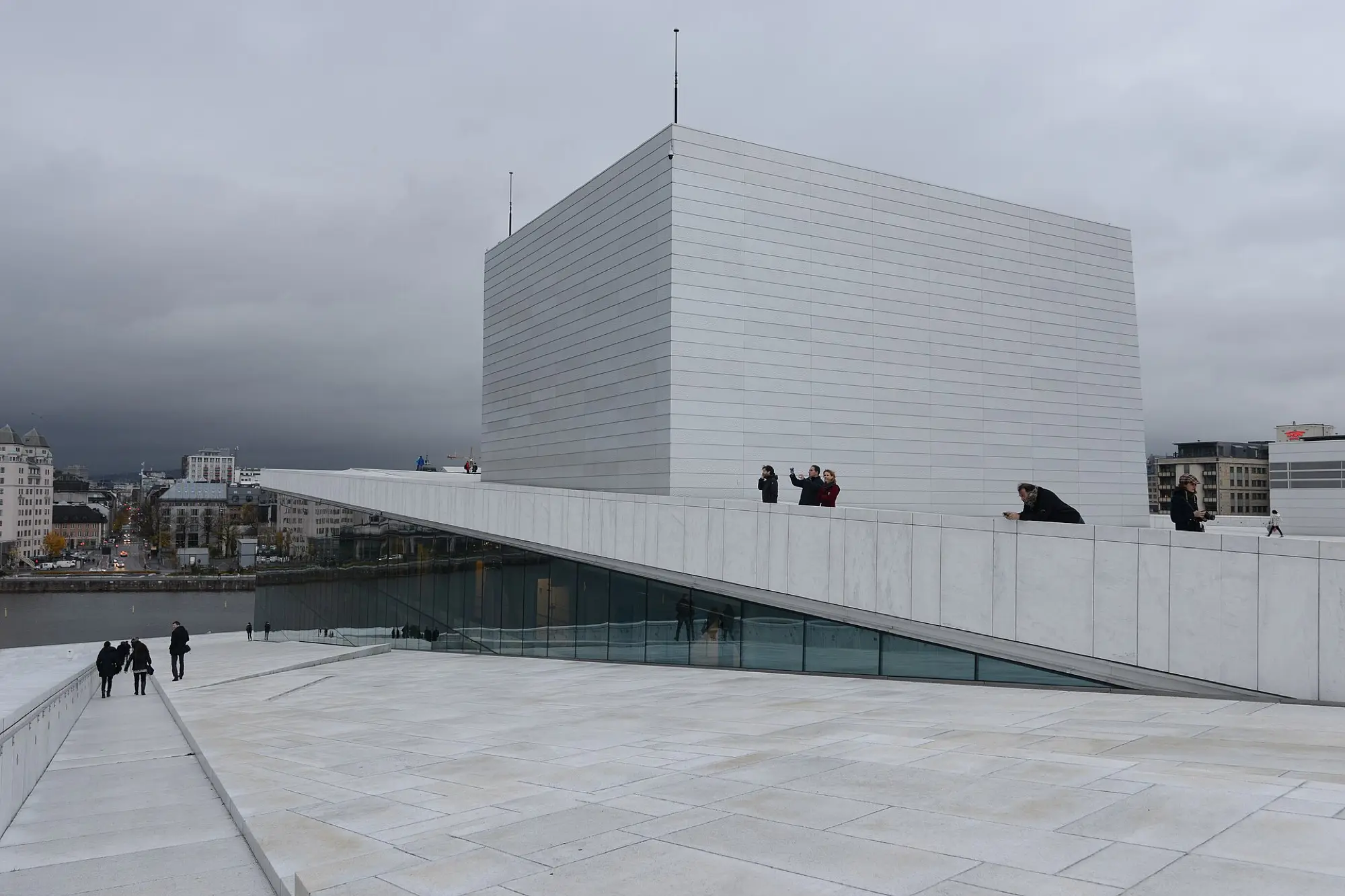

The Opera House roof, the harbour promenade, Deichman Bjørvika, City Hall, the 22 July Centre, the cathedral and the Akershus Fortress grounds are free every day they open. MUNCH is free on the first Wednesday evening of the month. The Vigeland, Ekebergparken and Tjuvholmen sculpture parks are free and open around the clock, and the Palace Park, the Akerselva river, Sognsvann and the city beaches are open to walk and swim in.
For major paid sites, the wider guide to things to do in Oslo details ticketing and museum admissions.
Free in Oslo at a glance
According to VisitOSLO's guide to free attractions, many key landmarks cost nothing to enter. Many public art showrooms across town are completely free to enter, showing works ranging from photography to installations.
When travelling between these sights, note that in Oslo (zone 1) a Ruter single ticket costs NOK 46 for an adult and a 24-hour ticket costs NOK 137 (prices from 25 January 2026).
| Place | When it is free or open | How to get there |
|---|---|---|
| 1. Opera House roof | Open all year round; foyer open Mon–Sat 11–16, Sun 12–16 | Kirsten Flagstads plass 1 |
| 2. Harbour promenade | Open all year round | Start at Sørenga or Frognerkilen |
| 3. Deichman Bjørvika | Most things free; open weekdays 08–22, weekends 10–18 | Anne-Cath. Vestlys plass 1, between Oslo S and the Opera |
| 4. MUNCH | Free first Wednesday of the month 18:00–21:00 (except Jul, Aug, Sep) | 10-minute walk from Oslo Central Station |
| 5. Akershus Fortress grounds | Free entry; main gate open daily 06:00–21:00, side gates 07:00–18:00 | 15-minute walk from Oslo Central Station |
| 6. Oslo City Hall | Free entry; Mon–Sat 09:00–16:00 (closed Sundays and select Dec dates) | Rådhusplassen 1 |
| 7. 22 July Centre | Always free entry; Tue–Wed, Fri–Sun 11:00–17:00, Thu 11:00–20:00 | Akersgata 42, city centre |
| 8. Oslo Cathedral | Free entry; Sat–Thu 10.00–16.00, Fri 16.00–00.00 | Stortorvet 1, central Oslo |
| 9. The Storting | Free summer tours Mon–Fri mornings; gallery open during sessions | Summer tours meet at Løvebakken; gallery entrance from Karl Johans gate |
| 10. Palace Park | Free open access; guard change daily 1.30 pm (VisitOSLO); Queen's Park 18 May–1 Oct | Top of Karl Johans gate |
| 11. Spikersuppa skating rink | Free to use and open to everyone; ice prepared 9:00–10:00 | Metro to Stortinget or Nationaltheatret |
| 12. Middelalderparken ruins | On VisitOSLO's list of sights that cost nothing to enjoy | Middelalderparken |
| 13. Free art galleries | Free entry; check the venue's site for opening hours | Rådhusgata and Kvadraturen |
| 14. Tjuvholmen sculpture park | Free entry, open 24/7 every day of the week | Waterfront behind Astrup Fearnley Museum |
| 15. Vigeland Park | Free entry, always open | Tram 12 or bus 20 to Frogner plass |
| 16. Ekebergparken | Free entry, open around the clock all year round | Tram 13 or 19 towards Ljabru to Ekebergparken |
| 17. Botanical Garden | Free entry; open daily 07:00–17:00 (1 Oct–31 Mar) | Metro to Tøyen, southern entrance Monrads gate |
| 18. Akerselva river walk | Free open access along the 8 km river path | Connect from Maridalsvannet or Sørenga tunnel |
| 19. Vulkan and Mathallen | Free access; Mathallen open Tue–Sat 10–20, Sun 11–18 (closed Mon) | 15-minute walk from Jernbanetorget |
| 20. Damstredet & Telthusbakken | Free open street access | Walk from Akersveien or Gamle Aker kirke |
| 21. Sognsvann trails | Free open access; floodlit path round the lake | Metro line 5 to Sognsvann terminus |
| 22. Sørenga sea pool | 07:00–22:00 (1 Apr–14 Oct) / 07:00–16:00 in winter | Sørenga waterfront, Bjørvika |
| 23. Huk beach | Free public beach; lifeguards in school holidays | Bus 30 from the city centre |
| 24. Hovedøya island | Free once you land; requires regular Ruter boat ticket | Boat B1 or B1X from Aker Brygge |
1. The Opera House roof
The Norwegian National Opera & Ballet in Bjørvika is on VisitOSLO's list of sights that cost nothing to enjoy. Designed by the Norwegian architecture firm Snøhetta, the building sits at Kirsten Flagstads plass 1. The Opera House invites visitors to climb its roof for panoramic views of Oslo and the fjord, all year round. The interior foyer is open Monday to Saturday from 11-16 and Sunday from 12-16, or until the end of the performance. Find more background on visiting the Opera House roof.
2. The harbour promenade
The harbour promenade lets you walk along the Oslo harbour for almost 10 kilometres without interruption, and it is open all year round. Large orange information towers mark the route, showing the way and carrying boards that explain nearby attractions and regional history. Starting from Sørenga, the trail passes the Opera, the Deichman library, the Barcode high-rises, Akershus Fortress, City Hall, Aker Brygge and Tjuvholmen. The final orange tower stands at Frognerkilen, just past the Kongen marina, where the promenade joins wider coastal paths.
3. Deichman Bjørvika, the main library
Deichman Bjørvika, Oslo's main library, stands at Anne-Cath. Vestlys plass 1 between Oslo Central Station and the Opera. Most things at Deichman Bjørvika are free, and anyone can use the building without a library card. The library is open on weekdays from 08-22 and on Saturdays and Sundays from 10-18. On the 1st floor, Kaffoteket sells coffee and lunch, while the Centropa restaurant operates on the 2nd floor with its own roof terrace.
4. MUNCH on the first Wednesday evening
MUNCH is free to enter on the first Wednesday of each month from 18:00 to 21:00, except during July, August and September. The free evening is drop-in; you get your ticket at the museum. The museum sits at Edvard Munchs plass 1 in Bjørvika, a 10-minute walk from Oslo Central Station. On other days, general adult admission is NOK 220, visitors under 25 pay NOK 100, and children aged 0-17 enter free. Read more details about exhibitions at MUNCH.
5. The Akershus Fortress grounds
Entrance to the Akershus Fortress area is free of charge. The fortress main gate is open every day from 06:00-21:00, while the side gates open from 07:00-18:00. The fortress main entrance in Kirkegata is roughly a 15-minute walk from Oslo Central Station. The fortress visitor centre operates daily from 10:00-17:00 between May and August, and from 10:00-16:00 from September to April. You can find out more about exploring Akershus Fortress.
6. Oslo City Hall
Oslo City Hall (Rådhuset, the seat of the city council and administration) opened in 1950 and is open to everyone. Located at Rådhusplassen 1, the building opens Monday to Saturday from 09:00 to 16:00 and is closed on Sundays. Every visitor passes a security screening, so expect queues at busy times.
City Hall is closed to visitors on 3 December, from 12:00 on 4 December, from 5 to 11 December, and on 24, 25, 26 and 31 December 2026. The 49-bell carillon plays hourly from 7 a.m. to midnight, with live carillon concerts on Sundays at 3 p.m. in June, July and August, and at 11:00 a.m. on the first Saturday of each month the rest of the year. From 30 June to 27 August, free 45-minute guided tours run without advance booking on Tuesdays, Thursdays and Saturdays at 12:00 pm and 2:00 pm.
7. The 22 July Centre
The 22 July Centre always has free entry. Situated at Akersgata 42, it serves as the national remembrance and learning centre concerning the 2011 attacks on the government quarter and Utøya, housing a memorial room dedicated to the 77 victims. Opening hours are Tuesday, Wednesday and Friday to Sunday from 11:00-17:00, and Thursday from 11:00-20:00. Because demand is high, the centre recommends booking a free admission ticket before arriving. The temporary exhibition on radicalisation contains disturbing material and is recommended for visitors aged 12 and over.
8. Oslo Cathedral
Oslo Cathedral (Oslo domkirke) at Stortorvet 1 is on VisitOSLO's register of sights that cost nothing to enjoy. Consecrated in 1697 and restored to its Baroque interior in 1950, it serves the royal family and Norwegian government for official weddings and funerals. General visiting is open Saturday to Thursday from 10.00-16.00 and on Fridays from 16.00-00.00; guided tours must be booked in advance. The nave features ceiling murals by Hugo Lous Mohr painted between 1936 and 1950, alongside stained-glass windows crafted by Emanuel Vigeland.
9. The Storting, the Norwegian parliament
The Storting offers free guided tours for tourists in the summer months; they are free and open to everyone, up to 30 people a tour. The 2026 summer tours ran from 22 June to 28 August, Monday to Friday at 09.00 and 10.15, departing from Løvebakken, the main entrance; they last about 45 minutes and cannot be booked. The rest of the year the pre-booked tours are mainly for school classes, and visiting tourists cannot book them. When the Storting is in session, visitors can watch from the public gallery with no prior registration; the entrance is from Karl Johans gate, and everyone goes through a security check and leaves coats and bags in a locked cloakroom.
10. The Palace Park and the changing of the guard
Surrounding the Royal Palace at the head of Karl Johans gate, the Palace Park (Slottsparken) dates to the 1840s, offering open lawns, mature trees and ponds. Within its grounds, Princess Ingrid Alexandra's sculpture park features 12 sculptures designed from drawings by Norwegian schoolchildren. The Queen's Park, located in the southern section, is a seasonal enclosure open only from 18 May to 1 October. VisitOSLO gives the changing of the guard outside the Royal Palace, at the top of Karl Johans gate, as every day at 1.30 pm. From April to September the King's Guard and the armed forces' bands march a guard parade from Akershus Fortress at about 13:15, now from Kontraskjæret, up Akersgata, past Egertorget and along Karl Johans gate to the Royal Palace and Palace Square. The armed forces' bands' page, updated on 10 September 2026, says the remaining guard parades of 2026 were cancelled because of court mourning, and that parades can be cancelled at short notice. VisitOSLO lists the guard parade at the Palace Park as free.
11. Skating at Spikersuppa
Spikersuppa, the outdoor ice rink positioned between the Parliament and the National Theatre, is free to use and open to everyone. To get there, take the metro to either Stortinget or Nationaltheatret station. Visitors can bring their own skates or hire a pair for 200 kroner from the nearby stand. The rink surface is prepared between 9:00 and 10:00 every day, during which time all skating is prohibited.
12. The medieval ruins in Middelalderparken
The ruins of St Mary's Church (Mariakirken) and St Clement's Church in Middelalderparken are on VisitOSLO's list of sights that cost nothing to enjoy. First built around 1050, St Mary's was the royal chapel in the Middle Ages and the burial place of King Håkon V.
13. Oslo's free art galleries
VisitOSLO says many of Oslo's art showrooms are completely free to enter, with exhibitions from photography to installations. In the historic Kvadraturen district, Rådhusgata houses galleries in almost every building, including Oslo Kunstforening, Galleri Format and SOFT galleri.
14. Tjuvholmen sculpture park
Tjuvholmen sculpture park is free and open to everyone around the clock, 24/7, every day of the week. Located directly behind the Astrup Fearnley Museum on the waterfront, the park was designed by Renzo Piano and opened in 2012. It contains 8 sculptures, featuring works by Louise Bourgeois, Antony Gormley and Anish Kapoor. Tjuvholmen also has a beach and swimming pier.
15. Vigeland Park and the rest of Frogner Park
Vigeland Park is always open and free to enter, receiving over one million visitors every year. Accessible via tram 12 or bus 20 to Frogner plass, the grounds display more than 200 sculptures by Gustav Vigeland, including the Angry Boy (Sinnataggen) and the central Monolith (Monolitten). The wider Frogner Park contains Norway's largest collection of roses, comprising 14,000 plants across 150 species, as well as the country's largest playground near the main entrance. Frogner Manor and the Museum of Oslo sit in the corner beside Frogner plass.
16. Ekebergparken
Ekebergparken sculpture park is open around the clock, all year round, and free to visit. Tram lines 13 and 19 towards Ljabru stop at the Ekebergparken stop. The collection includes open-air works such as Salvador Dalí's Venus de Milo aux tiroirs (1964). James Turrell's installations, Skyspace and Ganzfeld (2013), are open on Sundays for free public tours between 11:00 and 16:00, with sessions scheduled from 15.11 to 20.12 2026.
17. The botanical garden at Tøyen
The Botanical Garden at Tøyen is maintained on VisitOSLO's register of cost-free attractions, containing over 4,500 plant species arranged across themed outdoor zones. From 1 October to 31 March, the outdoor grounds open every day from 07:00 to 17:00. Note that the garden's historic greenhouses, the Palm House and the Victoria House, are temporarily closed. All metro lines stop at Tøyen station, which is a 450-metre, 6-minute walk from the garden's southern gates on Monrads gate.
18. Walking the Akerselva river
The Akerselva river flows for eight kilometres through central Oslo, from Maridalsvannet lake to the Oslofjord, dividing the city's east and west sides. Landmarks along the river include the Lilleborg factories, the Aamot bridge, Hønse-Lovisa's house and Nedre Foss. The most spectacular waterfall along the course is located at Mølla, right by the Beier bridge and the small red Hønse-Lovisas hus in Grünerløkka. At Sørenga, a 300-metre lit tunnel provides access to the Akerselva river.
19. Vulkan and the Mathallen food hall
Vulkan, located along the Grünerløkka bank of the Akerselva, is on VisitOSLO's list of sights that cost nothing to enjoy. The district incorporates cultural spaces, two hotels, restaurants and a local energy centre with 300-metre-deep geothermal wells. The Mathallen food hall opens Tuesday to Saturday 10-20 and Sunday 11-18, remaining closed on Mondays, though some restaurants stay open longer. The complex is a 15-minute walk from Jernbanetorget.
20. Damstredet and Telthusbakken
Damstredet and Telthusbakken are on VisitOSLO's list of sights that cost nothing to enjoy. Damstredet is a cobbled street measuring 160 metres between Akersveien and Fredensborgveien, lined with wooden houses built in the first half of the 19th century. Nearby Telthusbakken measures 260 metres, lying just below the medieval Gamle Aker kirke with small wooden houses on one side and allotment gardens on the other.
21. Sognsvann and the Nordmarka trails
Sognsvann lake marks the northern terminus of metro line 5, sitting within standard fare zone 1. A 3.3-kilometre gravel path surrounds the lake; it is floodlit after dark and designed for walkers and runners rather than bikes. During winter, municipal crews clear and grit this perimeter track, and when lake ice is sufficiently thick, the city prepares a skating rink and a walking track on the lake. Sognsvann also serves as an entry gateway to Nordmarka, a 430-square-kilometre forest of blue-marked footpaths, cycle routes and swimming lakes (carrying a route map is advised for longer distances). The café at Ullevålseter is open all year round and takes about an hour to reach on foot from Sognsvann.
22. Sørenga sea pool and Operastranda
Sørenga sea pool (Sørenga sjøbad) is an urban fjord bathing facility open daily from 07:00-22:00 during the official bathing season (1 April to 14 October) and 07:00-16:00 in winter. The 190-metre complex features a sandy beach, diving tower, and an open 50-metre pool with eight lanes. Winter dipping is popular directly from the edge of the pier when it snows. Adjacent to the Opera House, Operastranda offers another city-centre option, where families with toddlers may prefer the shallow water, sand and playground. Swimming in the fjord is not recommended for 24 hours after heavy rain.
23. Huk beach on Bygdøy
Located at the tip of the Bygdøy peninsula, Huk is one of Oslo's most popular beaches, offering bathing jetties and a sandy beach for children. It was the first beach in Oslo to obtain Blue Flag status, which denotes clean water, first aid equipment, and lifeguards during the school holidays. Bus 30 runs from the city centre straight to Huk. From the shore, coastal paths lead west to Paradisbukta or east to Frognerkilen.
24. Hovedøya, for the price of a Ruter ticket
Hovedøya itself costs nothing to explore, but reaching it requires public transport. The island is served by Ruter's boat route B1 departing from Aker Brygge, stopping across Hovedøya, Lindøya, Gressholmen, Bleikøya and Nakkholmen. Standard public transport fares apply: an adult zone 1 single ticket costs NOK 46, while a 24-hour ticket costs NOK 137.
From 4 July to 30 August, boat B1 does not stop at Hovedøya between 10am and 9pm; boat B1X runs to Hovedøya every 20 minutes instead. On the island, visitors can explore forest, hiking trails and the ruins of an English Cistercian monastery founded in 1147 and burned in 1532.
Cheap rather than free
Several prominent Oslo sights charge admission, but you can reduce individual ticket costs by using multi-venue passes. A comparison of pass benefits is detailed in the Oslo Pass guide. An adult Oslo Pass costs NOK 580 for 24 hours, NOK 845 for 48 hours and NOK 995 for 72 hours, providing free entry to more than 30 museums alongside unlimited public transport. At the National Museum (Nasjonalmuseet), members show their membership card, and Oslo Pass holders show an active Oslo Pass at the ticket counter and get a free ticket. The Nobel Peace Center charges a standard adult entry fee of NOK 180 (children aged 0-17 enter free), but runs a half-price admission period from 7 September to 12 December while new second-floor exhibitions are prepared.