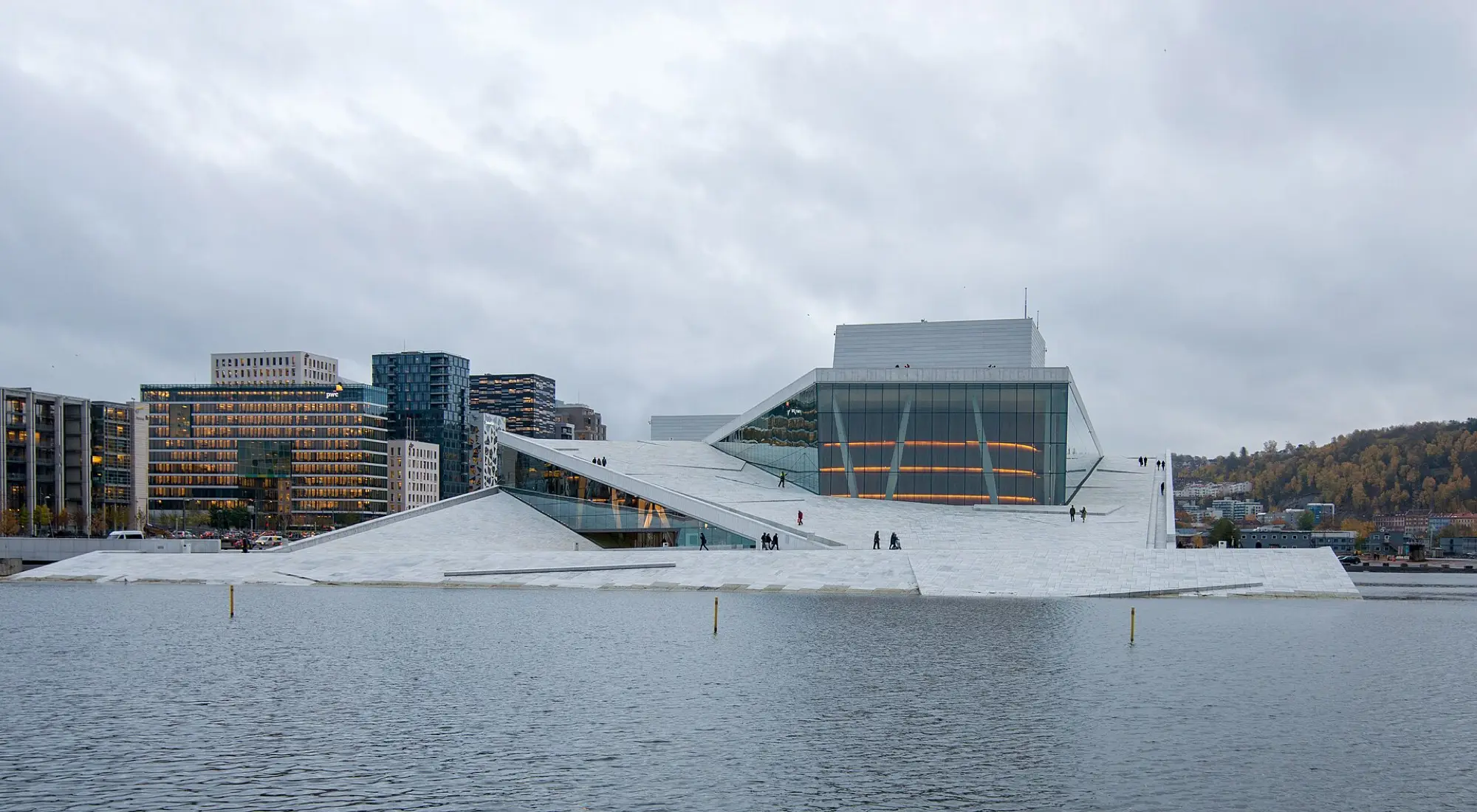

The Oslo Opera House, home of the Norwegian National Opera & Ballet at Kirsten Flagstads plass 1 in Bjørvika, was designed by Snøhetta and opened on 12 April 2008. VisitOSLO says visitors can climb its roof all year round, while the foyer opens Monday to Saturday 11-16 and Sunday 12-16, or until the end of the performance. Guided tours in English run on Saturdays and Sundays, lasting about 50 minutes and costing NOK 180 for adults.
Walking on the roof
VisitOSLO says the Opera House invites visitors to climb its roof and enjoy panoramic views of Oslo and the fjord, all year round; the guide to Oslo in winter covers the rest of a winter day in the city. The architects, Snøhetta, wanted to make the roof a platform accessible to all, creating a new public space in the centre of Oslo that draws together the fjord and the city. The opera calls it the first opera house in the world where you can walk on the roof, and says it has become one of Norway's big tourist attractions.
Like the roof plaza, the lobby is open to the public, and visitors have been free to roam its spaces since the building opened in 2008. White Carrara marble covers the roof and the lobby as one continuous public ground plane, which Snøhetta calls a 20,000 m2 art piece in itself. The walkable marble roof was designed by the artists Kristian Blystad, Kalle Grude and Jorunn Sannes. The roof plaza hosts outdoor concerts and simulcasts of operas from the main theatre, with as many as 15,000 people at a single rooftop event.
The building, from Snøhetta's design to the opening in 2008
Designed by Snøhetta, the Opera House cost NOK 4.3 billion and took five years to build; the first spade went into the ground on 17 February 2003, and it opened with a gala performance on 12 April 2008. The building has a gross area of 49,000 m2 in about 1,100 rooms and three halls for opera, ballet and concerts; it houses the Norwegian National Opera & Ballet (Den Norske Opera & Ballett), founded in 1957.
The Opera House was the first building completed in the Bjørvika area and is built on piles in the Oslo fjord, as part of the plan to turn the industrial waterfront into public space. Snøhetta says the Opera House welcomes 1.7 million visitors a year. The clean-up of the site, once a polluted industrial shipyard, restored the Oslo fjord to its cleanest in nearly 100 years, and the water now supports several public swimming areas. The awards Snøhetta lists for the building include the Mies van der Rohe Award in 2009, the World Architecture Award for best cultural building in 2009 and the European Prize for Public Space in 2010.
Marble, oak and glass
Snøhetta used three main materials, stone, wood and metal; the principal stone is white marble from Carrara in Italy, the wood in the foyer, public galleries and main house is oak, the metal facades on the roof are aluminium, and the design uses large glass facades. In the foyer a large, undulating oak wall hides the three performance halls; the main stage is the heart of the building, with dark, golden woodwork shaped by its acoustics, and there are two smaller stages, the Second Stage and the Studio. Walking around the outside, you can look through big glass windows into the scene painting room, the sewing room and the hat and mask section.
The art in and around the house
The house has eight art projects by 17 artists, among them Pae White's stage curtain Metafoil, Olafur Eliasson's four white-lit installations in the foyer wardrobe area called The other wall, and Monica Bonvicini's sculpture She lies, anchored in the harbour outside.
Inside the foyer without a ticket
The Norwegian National Opera & Ballet is at Kirsten Flagstads plass 1, 0106 Oslo, at the harbour. Our guide on where to stay in Oslo compares staying in Bjørvika or the centre.
The foyer is open Monday to Saturday 11-16 and Sunday 12-16, or until the end of the performance. The box office and shop are open Monday to Saturday 11-16 and Sunday 12-16, longer on performance days; the ticket phone is +47 21 42 21 21, Monday to Friday 11-16. Morning aria is a free daytime event in the foyer.
Dining options operate inside the building:
- Brasserie Opera in the foyer serves lunch and dinner Monday to Sunday 12-20, or until the performance starts, with the bar open from 11 Monday to Saturday, and has views of the fjord.
- The seafood restaurant Havsmak, next to the Second Stage to the left of the main entrance, is open Tuesday to Friday 16-23 and Saturday 13-23.
The cloakroom is unstaffed; lockable lockers take 10-krone coins or tokens from the ticket office, and there is no room for suitcases, which the opera sends to the baggage storage at Oslo Central Station. Toilets are in the foyer, by the cloakroom and by the Stage 2 entrance. A wheelchair entrance is by the main entrance on the far left, and disabled parking is in Operagaten, north of the building, 150 metres from the marble bridge into the house.
The guided tour
Guided tours in English run on Saturdays and Sundays, last about 50 minutes and cost NOK 180 for adults and NOK 105 for children. The tour goes through the many spaces inside the house with a look behind the scenes, and covers the building's architecture, the art, stage technology, and opera and ballet. Other city sights are listed in our guide to things to do in Oslo.
Tour tickets go on sale every Tuesday, in the same week as the tours take place. A group is at most 25 people, tours start on the hour so you should be early, private group tours are no longer offered, and bringing your own translator is not permitted. Tours meet at the box office in the foyer, and the opera warns that the house is big and the walking distances fairly long. On Saturdays when the family event Opera for everyone, Saturday song, takes place, there are also special guided tours for children. The Oslo Pass gives a 15% discount on the Opera House guided tours; the tour is not one of its free entries.
Seeing an opera or ballet
The opera plays on three stages, the main house with 1369 seats, the second house with 400 and the Studio with 200; the roof and foyer are also used for concerts.
Standing and listening tickets cost NOK 195 for most main-stage performances according to the opera's booking information. Standing places are at the rear, in the centre of the 2nd balcony, and listening seats have a limited view of the stage. Most performances have discounts of 50% for children aged 0-16 and for anyone under 30, and 20% for seniors from 67; the NOK 195 main-stage tickets get no discount, and a NOK 30 booking fee is added after any discount.
Tickets can be paid for with Visa, Mastercard or Vipps, and printed or shown on a phone. Not every foreign card is accepted on operaen.no, because the card's country of issue must match the country of the computer's IP address; if payment fails, customer service is on +47 21 42 21 21.
Tickets can be exchanged up to the day before the performance, by phone or at the box office, and for Sunday and Monday performances by the preceding Friday; refunds are given only if a performance is cancelled or moved. Performances begin precisely and the doors close; latecomers can watch on a monitor on the 1st balcony until the first break. One hour before main-stage opera and ballet performances there is a free introductory talk in the communication centre, but only in Norwegian.
The Nutcracker in December
The Norwegian National Ballet's Nutcracker runs on the main stage from 28 November to 22 December 2026, lasts 2 hours 15 minutes with one interval, and tickets cost 195 to 995 kroner. This production, choreographed by Kaloyan Boyadjiev, is set in winter in Christiania in 1905, with dancers of the Norwegian National Ballet alongside pupils of the ballet school and Tchaikovsky's music played by the Norwegian National Opera Orchestra. Consult our overview of Oslo in December for other events that month.
When the opera's page was read on 18 November, every Nutcracker performance from 28 November to 22 December was marked sold out. Details on the standing and listening tickets are covered in the section above.
Getting there
Around Oslo Central Station, Tollboden and Bjørvika a number of buses and trams stop, as well as the metro; the opera points visitors to Ruter for routes and stops. The guide to getting from Oslo Airport to the city centre covers the trip to Oslo Central Station.
The Oslo Badstuforening sauna village at Sukkerbiten lies just outside the Opera House and MUNCH, a 7-8 minute walk from Oslo Central Station. MUNCH is a 10-minute walk from Oslo Central Station; its nearest stops are Bjørvika for trams and buses and MUNCH Bjørvika for the boat. Bicycle parking is along Operagaten and on the south side of the building; the nearest car parks are at Sørenga, in Prinsens gate and at Oslo Central Station.
Next door in Bjørvika
Bjørvika was a container port and a major motorway junction; the motorway now runs underground and the waterfront is open to the public.
Deichman Bjørvika, Oslo's main library, is at Anne-Cath. Vestlys plass 1, midway between Oslo Central Station and the Opera. Deichman Bjørvika is open on weekdays 08-22 and on Saturdays and Sundays 10-18. Most things at Deichman Bjørvika are free, and the library can be used without a library card.
MUNCH is open Sunday to Tuesday 10-18 and Wednesday to Saturday 10-21. MUNCH costs NOK 220 for adults and NOK 100 for anyone under 25, and children aged 0-17 go in free. VisitOSLO says families with toddlers may prefer the Operastranda beach for its shallower water, sand and playground.
The 2027 closure
In its season announcement of 4 May 2026, the opera said the stage machinery needs a technical upgrade after almost 20 years of daily use, so the main stage will be closed from April to October 2027, and that the opera house will be closed in summer 2027 for maintenance.