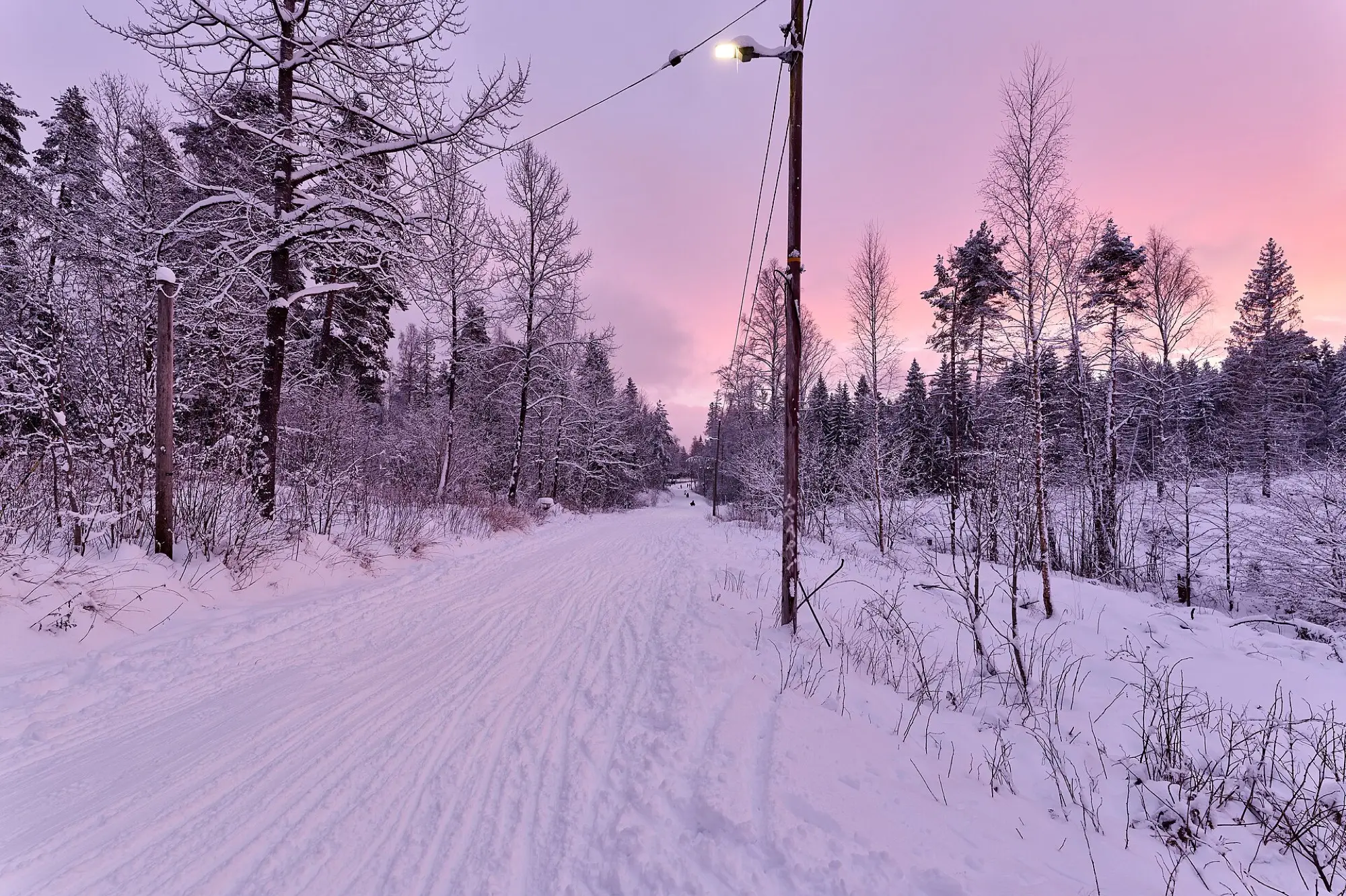

Oslo is a capital where the metro runs to the ski trails. The city combines outdoor activities and culture across twelve main sights: cross-country skiing on the lit trails, Sognsvann and the forest cafés, the Korketrekkeren toboggan run, downhill skiing at Tryvann, skating at Spikersuppa, skating at Frogner stadion, a floating sauna and a dip in the fjord, the Holmenkollen ski museum and jump tower, the World Cup in March, MUNCH, the National Museum, and the Fram Museum.
Outdoor activities depend on conditions. The toboggan run, the trails and the rinks open only when there is enough snow or ice.
1. Cross-country skiing on the lit trails
The City of Oslo's own trail crews groom about 350 kilometres of ski trails with grooming machines and about 100 kilometres with snowmobiles, in the city and in the Marka forest. Many of the city's trails lie low, where there is often less snow than higher up.
Oslo's first lit trail opened in 1946, from Frognerseteren to Tryvann. In the winter half of the year the lights come on at 06:00 and go off when it gets light, then come on again at dusk and stay on until 23:00. The city publishes its own trail map with grooming status; the whole Marka trail network is on Skiforeningen's sporet.no, which needs a subscription or Skiforeningen membership.
Skimore Oslo rents a complete cross-country ski package for NOK 390 for one day and NOK 500 for two days; all rentals need photo ID or a deposit. Skimore's rental, ski school, shop and cafés are at the top of Tryvann.
2. Sognsvann, Ullevålseter and the forest cafés on foot
Sognsvann is the terminus of metro line 5. In winter the path round Sognsvann is cleared of snow and gritted, and when the ice is thick enough the city also prepares a skating rink and a walking track on the lake. The loop round Sognsvann is just over 3 km, has lighting and little climbing, and is cleared and gritted so that wheelchair users can use it too. Counts from 2015 showed about 60,000 people using the Sognsvann area each month, an average of 2,000 a day.
The City of Oslo owns 11 forest cafés and cabins in the Marka, among them Rustadsaga and Ullevålseter. Ullevålseter, a café in the southern Nordmarka forest, is about an hour's walk from Sognsvann and is open all year, serving cocoa, cinnamon buns and rolls. It lists its hours as Tuesday to Sunday 09:00 to 17:00, closed on Mondays. If you do not ski, the nearest cleared access to Ullevålseter is a forest road of about 4 km from Hammeren in Maridalen, reached by bus 51. The City of Oslo took over Ullevålseter in 1923 and turned the farm into a café in 1927; it lies at 335 metres and has been run by the same family since 1927.
For people who do not ski, the city clears a number of forest roads in the Marka, several of them lit in the evening, with cafés along them; it grits them when needed but still advises spikes or ice grips. From Midtstuen a cleared forest road climbs about 4.5 km to Tryvann, nearly 400 metres above sea level, with views over Oslo; at the top is Tryvannstua, a log cabin built in 1931 from storm-felled timber, known for sourdough baking, waffles and cocoa.
3. The Korketrekkeren toboggan run
Korketrekkeren (the corkscrew) is a toboggan run of about 2,700 metres with a drop of 255 metres, from Frognerseteren down to Midtstuen. A run takes about 8 to 10 minutes without stopping, and you take the metro from Midtstuen back up to Frognerseteren. The metro from Nationaltheatret to Frognerseteren takes 35 minutes, and the ride back up after a run takes 16 minutes.
Sledging on Korketrekkeren is free with your own sled; the city recommends a helmet, and the run is open only when there is enough snow. Toilets are in Akeforeningen's clubhouse at the top. The city normally grooms the run every night when there is enough snow and frost, so conditions are best in the morning; weekdays are usually quiet, Saturdays are quiet until 11:00 and Sundays until 12:00.
Akeforeningen, the toboggan club, rents wooden sleds and rodels (steerable sledges) for NOK 145 a day for adults and NOK 100 for under-18s; a helmet is included when available, and an unreturned sled costs NOK 4000. Akeforeningen's rental is at Holmenkollveien 200, just below Frognerseteren restaurant and above the start of the run, and lists its hours as 09:00 to 21:00 every day. Akeforeningen's rules are a helmet, warm dry clothes and shoes above the ankle; no plastic bags or sledging mats that cannot be steered; never stop in the middle of the run, and no walking on it in the season.
Skimore also rents sleds at Frognerseteren, between the station and the start of the run, for NOK 115 for children under 16 shorter than 160 cm and NOK 150 for anyone taller; it normally opens during December, once there is snow.
4. Downhill skiing at Tryvann
Skimore Oslo at Tryvann has 18 runs, from the easy children's area at the top to the black Wyller run; it is open in the evenings on weekdays and every slope is floodlit. Tryvann is 30 minutes from the city centre by car or metro, and the season usually runs from November or December until Easter.
A one-day guest pass for all lifts costs NOK 580 for adults aged 16 to 66, NOK 480 for children aged 7 to 15 and for seniors 67 and over, and NOK 230 for under-7s; a single ride is NOK 100 and the keycard NOK 75. An adult's first day at Tryvann, a day pass plus the keycard, comes to NOK 655. A one-day alpine ski or snowboard package costs NOK 560 for adults 16 and over and NOK 460 for children up to 15.
Take metro line 1 towards Frognerseteren to Voksenkollen station; a connecting Ruter bus meets every other train on weekdays and every train at weekends, and runs only in the winter season. The walk up takes about 15 minutes.
5. Skating at Spikersuppa
Spikersuppa, Oslo's best-known rink, is in the city centre between the Parliament and the National Theatre; it is free and open to everyone, and the nearest metro stations are Stortinget and Nationaltheatret. The rink was laid in the pool at Spikersuppa in 1994, paid for by Narvesen, and got the nickname Narvisen.
You can bring your own skates or rent a pair for NOK 200 in the pavilion beside the ice, which also has a kiosk; sharpening your own skates costs NOK 200. From 1 January to 15 March skate rental is open 15:00 to 21:00 Monday to Friday and 11:00 to 21:00 on Saturdays and Sundays.
Pucks and hockey sticks are not allowed, and the ice is prepared every morning, with no skating while that is done.
6. Skating at Frogner stadion
Frogner stadion is iced over in winter; from the rink's opening in November until the middle of March it is open for speed skating on a 400-metre track, bandy and public skating. Weather permitting, the city starts laying the ice in the middle of October, and it takes about 2 to 3 weeks before the ice is ready.
Shoes are not allowed on the ice, everyone must leave the ice while it is prepared, a helmet is recommended, and the rink can close at short notice in heavy snow or rain; there is no guarantee the ice is freshly prepared. Clubs train there in the afternoons, evenings and at weekends; the public is welcome in the middle field during speed-skating sessions, and pucks, balls and sticks are allowed behind the ball nets on both sides in public time at weekends. Changing rooms open after 16:00, and the Church City Mission's Skattekammeret runs an equipment lending centre at the stadium, with its hours posted on its Facebook page; Vigeland Park is nearby.
7. A floating sauna and a dip in the fjord
Oslo Badstuforening, the city's sauna association, runs floating saunas at 7 locations, open in all weathers, with shared sessions every day. Its Langkaia sauna village, a few minutes' walk from Oslo Central Station, has six saunas and year-round swimming in the fjord from ladders, though swimming is not recommended after heavy or prolonged rain or sewage discharges; there is an ice-cold bucket shower.
A shared sauna session at Langkaia costs NOK 260 for non-members and NOK 150 for members; a private sauna starts at NOK 2200 for non-members. Bring your own padlock for the lockers and a water bottle; Langkaia is reached by stairs and is not wheelchair accessible, and the association recommends its Sukkerbiten village instead for anyone who cannot use stairs.
KOK's shared sauna sessions last 1.5 hours including changing, with up to 8 single seats; bring swimwear, two towels and water. KOK's shared saunas are at Aker Brygge, with a view of Akershus Fortress, and at Langkaia, facing the Opera and MUNCH; only Langkaia has a cold-water shower.
8. The Holmenkollen ski museum and jump tower
The Holmenkollen Ski Museum and jump tower are open seven days a week all year; from January to April the hours are 10:00 to 16:00. In 2026 a ticket costs NOK 200 for adults, NOK 150 for young adults under 30 and NOK 100 for children aged 6 to 17, and every ticket covers both the ski museum and the jump tower.
Take metro line 1, the Frognerseteren line, to Holmenkollen station; the walk from there is 10 minutes, only a few hundred metres but steep. A lift takes you to the top of the jump tower, 64 metres above the ground and 427 metres above sea level, with views of the Oslofjord, the city and the Marka forest.
The museum covers 5000 years of skiing history; it celebrated its 100th anniversary in 2023, has been renovated, and its facade, inspired by old wooden skis, was designed by Snøhetta. The "Winter joy" exhibition on the second floor covers the rise of outdoor life in the 19th century, the history of the Holmenkollen jump and the roots of biathlon, with the royal family's old skis.
9. The ski festival and World Cup races at Holmenkollen
The FIS World Cup in cross-country skiing, ski jumping and Nordic combined comes to Holmenkollen on 12 to 14 March 2027. Tickets are sold on Ticketmaster; the options are a day pass for the main cross-country stand, an arena ticket for the Haugen area and jump fields A and B with activities for children, a Saturday afternoon ski-jumping ticket, a family ticket for two adults and up to three children, and a weekend pass. Tickets are not refunded, not even if the race is cancelled; they can be resold through Ticketmaster Resale.
There is no parking in Holmenkollen during the ski festival; the organisers say metro line 1 is the easiest and quickest way there. To warm up, go into Kollenkafeen, the white tent at the end of the jump's outrun, which sells food and hot drinks. The IBU biathlon World Cup is at Holmenkollen on 15 to 21 March 2027.
10. MUNCH, for a dark afternoon
MUNCH is open 10-18 from Sunday to Tuesday and 10-21 from Wednesday to Saturday. Admission is NOK 220 for adults and NOK 100 for under-25s, and free for children up to 17; timed tickets can be booked in advance. Admission is free on the first Wednesday of each month from 18:00 to 21:00, drop-in, with tickets at the museum; this does not apply in July, August and September.
A version of The Scream is always on display at MUNCH. MUNCH is a 10-minute walk from Oslo Central Station; the nearest stop is Bjørvika, for trams and buses. The museum is wheelchair accessible, and accessible toilets with baby changing are in the lobby cloakroom and on floors 3, 6, 9, 12 and 13. You can see how this fits with other sights in our guide to things to do in Oslo.
11. The National Museum and its winter exhibitions
The National Museum, at Brynjulf Bulls plass 3, holds Norway's largest collection of art, architecture and design. If you are planning several cultural visits, check whether the Oslo Pass is worth it for a winter museum day.
Its winter exhibitions include Adrián Villar Rojas, "The end of imagination", from 19 November 2026 to 7 March 2027, and "Metis", by Ole Jørgen Ness, from 3 December 2026 to 29 March 2027. The museum's 2027 programme opens "Lul Krag and Rosendal" on 18 March 2027; the Frida Kahlo exhibition comes later, from 19 June 2027.
12. Polar history at the Fram Museum on Bygdøy
The Fram Museum is open every day of the year; from 1 October to 30 April the hours are 10:00 to 17:00, and there is no need to buy tickets in advance. Tickets cost NOK 180 for adults, NOK 140 for seniors, NOK 70 for children and students, and NOK 400 for a family of two adults and up to five children.
The museum is on Bygdøy, reached by bus 30 from the city centre; the Kon-Tiki Museum and the Norwegian Maritime Museum are next door. The Bygdøy museum ferry from the City Hall pier ran from 14 March to 4 October in 2026, so in January, February and early March the bus is the way to get there.
When to go: weather and light from January to March
At the Oslo (Blindern) weather station the normal monthly mean temperature is -2.3 °C in January, -2.0 °C in February and 1.3 °C in March, and normal precipitation is 58 mm, 46 mm and 41 mm.
Daylight changes quickly as winter progresses. Based on the Oslo daylight table:
- 1 January: sunrise is at 09:17 and sunset at 15:22, giving 6h 06m of daylight.
- 1 February: sunrise is at 08:28 and sunset at 16:31, giving 8h 02m of daylight.
- 1 March: sunrise is at 07:12 and sunset at 17:44, giving 10h 32m of daylight.
Even on gritted paths the city advises you to judge the conditions and wear spikes or ice grips. If you are comparing destinations, read our guide to Tromsø in winter.
Getting around: the metro, tickets and the ski lines
The whole metro network is in Ruter's zone 1, so a one-zone ticket covers the ski lines to Frognerseteren, Holmenkollen and Sognsvann. To see what a winter stay costs overall, consult our guide on is Norway expensive.
A one-zone single ticket is valid for 60 minutes from activation, with transfers, on Ruter's buses, trams, metro and ferries and on Vy trains in Oslo and Akershus; buy it in the Ruter app or on a travel card. A single ticket bought on board a bus or boat costs NOK 20 more for adults and NOK 10 more for children and seniors.