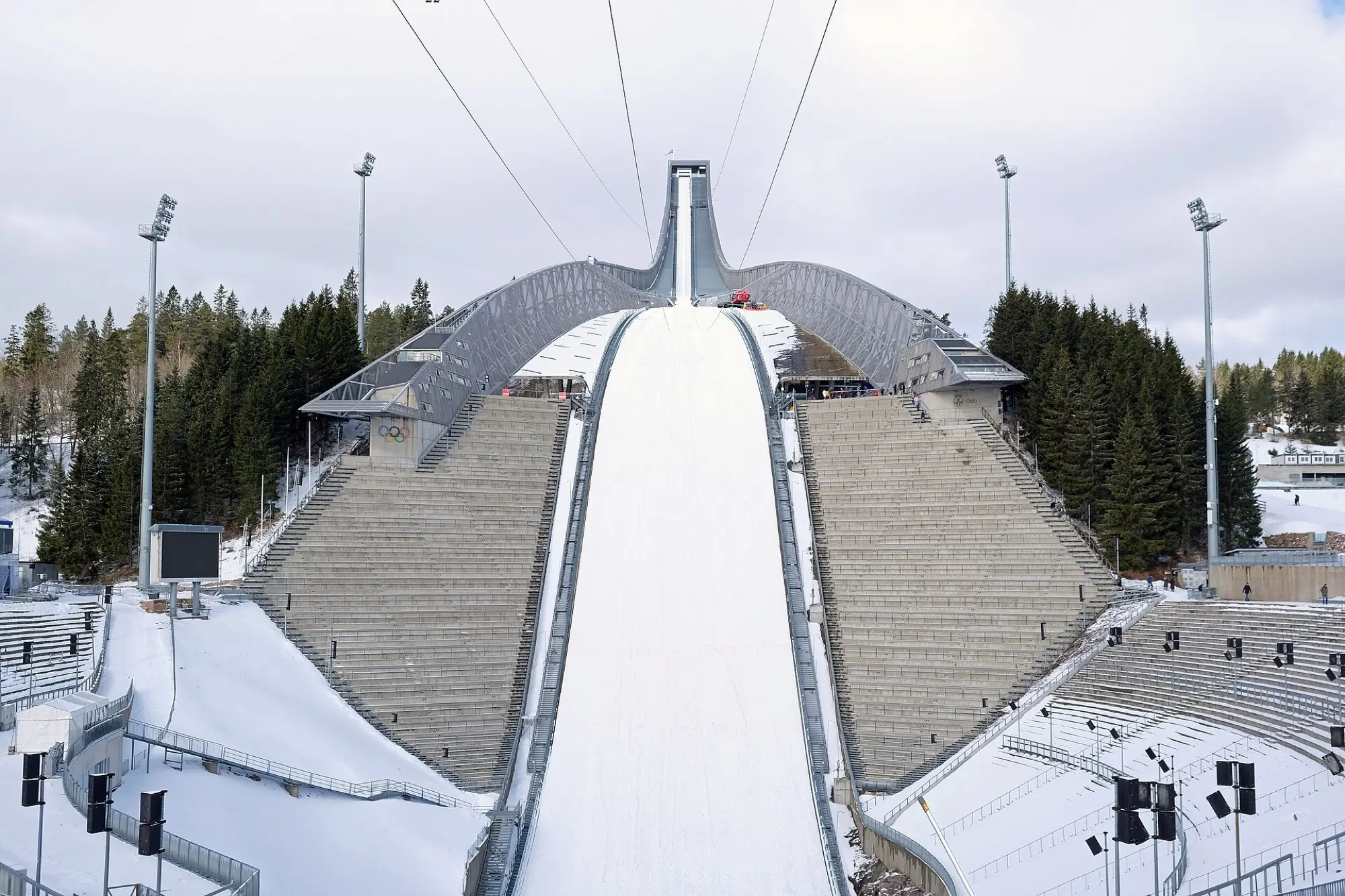

Holmenkollen is the ski jump on the hill above Oslo, 20 to 25 minutes from the centre on metro line 1 and a 10-minute steep walk. One ticket covers the ski museum and the lift to the top of the jump tower, walking round the jump costs nothing, and the trails and Frognerseteren are further up the same line.
Holmenkollen in short
One ticket covers both the ski museum and the jump tower; the museum sits in the Holmenkollen ski jump itself. If you only want to look around, it costs nothing to walk round the area, look at the ski jump and play frisbee golf. You need a ticket only for the jump tower, the ski museum or the zipline.
At the 2026 prices an adult ticket costs NOK 200 and a child aged 6-17 NOK 100. Everyone with an Oslo Pass gets in free and scans the pass on arrival; see the Oslo Pass guide for whether the card pays for itself on your visit. If you want a structured three-day schedule that includes this stop, look at our Oslo itinerary.
Opening hours and ticket prices
The ski museum and jump tower are open seven days a week, all year round. The opening hours run as follows:
- January to April: 10:00-16:00 every day
- May to September: 10:00-17:00 every day
- October to December: 10:00-16:00 every day
On Christmas Eve, New Year's Eve and 17 May the museum is open 10:00-14:00. For holiday schedules across the rest of the city, see our guide to Oslo in December.
| Type of ticket | Price |
|---|---|
| Adult | NOK 200 |
| Child (6-17) | NOK 100 |
| Senior | NOK 180 |
| Young adult under 30 | NOK 150 |
| Family (two adults and two children) | NOK 500 |
| Family (two adults and three children) | NOK 600 |
Children under 6 get into the museum free; ask for a ticket at the desk when you arrive. For a family the family ticket is cheaper: two adults and two children pay NOK 600 on separate tickets, NOK 100 more than the NOK 500 family ticket.
You can buy admission online through the Skimuseet ticket shop or at the museum entrance. A ticket bought online is for one specific day and valid only during that day's opening hours, and with it you go straight to the entrance and scan the QR code. Keep in mind that a ticket bought in advance gives no priority in any queue for the lift to the jump tower, and bought tickets are not refunded.
The jump tower and the view from the top
A lift takes you to the top of the jump tower, 64 metres above the ground and 427 metres above sea level. From the top you see the Oslofjord, the city and the Marka (forest), and in the distance the mountains Blefjell and Norefjell; you also look down directly on the ski arena below.
The lift ride is included in the museum ticket. The lift to the top of the jump tower takes at most 13 people a trip. The jump tower is adapted for wheelchair users, and it keeps the same opening hours as the ski museum.
What is in the ski museum
The ski museum was founded in 1923 and is the world's oldest specialised ski museum; objects from the polar expeditions, given by Fridtjof Nansen and Roald Amundsen, are an important part of its collection. The museum opened in 1923 in a timber building at Frognerseteren and moved down to the ski jump for the 1952 Olympic Games in Oslo; parts of today's café are in the original 1952 museum. In 1983 the museum was extended with new rooms cut into the rock beside the jump; the architect, Arnstein Friling, took his inspiration from the Temppeliaukio church in Helsinki. For its centenary in 2023 the museum opened a new foyer and café designed by Snøhetta and a new main exhibition on the oldest skiing and polar history.
The exhibition "The white track" starts with Norway's oldest ski find, a ski about 5200 years old found at Drevja in Nordland, with traces of fur on the underside. It covers Fridtjof Nansen's 1888 crossing of the Greenland ice sheet and his 1893 to 1896 attempt on the North Pole, and shows the clothes Nansen and Hjalmar Johansen wore on their ski journey towards the pole. It also tells the race to the South Pole, which Amundsen reached on 14 December 1911 and Scott on 18 January 1912; Scott's own skis, brought home by the Norwegian Trygve Gran, are on show.
On the second floor, "Winter joy" covers the rise of outdoor life in the 19th century, the history of the Holmenkollen jump, the roots of biathlon and a wall of fame, with the royal family's old skis. An interactive exhibition on weather and climate, made with the Norwegian Meteorological Institute, uses Oslo's snow as a climate barometer and asks how climate change affects skiing in the Oslo forests. Blåkollen, a play area for children with slides, tunnels and caves, is included in the ticket; it is due to be replaced and stays open until January 2027. The museum's information is presented in Norwegian and English, and photography for private use is allowed inside. For the rest of Oslo's sights, check our guide to things to do in Oslo.
The zipline, the abseil and the ski simulator
The Kollensvevet zipline runs from the top of the jump tower 361 metres down the hill, with a drop of 107.5 metres. The maximum weight on the zipline is 120 kilograms including the harness and helmet, which weigh about 2.5 kg; there is no minimum weight. There is no age limit on the zipline as long as you are within the weight limit; the oldest rider so far was 97. The zipline is not included in the museum ticket; you buy admission to the ski museum first, then pay for the zipline at the top of the jump tower.
The zipline is seasonal; its listed season opens on 11 April and ends on Sunday 8 November. Its listed operating hours are:
- April: weekends 10:15-16:00
- May and the first half of June: weekends 10:15-17:00 (closed on 17 May)
- From 15 June: every day 10:15-17:00 through July, August and into September
- From 14 September: weekends 10:15-17:00
- October and November: weekends 10:15-16:00
The Kollenrappellen abseil goes 57 metres down the jump tower; it must be booked in advance and is open all year round.
The ski simulator, right by the jump, puts you in the start gate of the Holmenkollen jump and sends you down the inrun at almost 100 kilometres an hour; it also has a World Cup downhill run at Kvitfjell. A run in the simulator takes about five minutes, and you must be at least 6 years old. The ski simulator is not part of the museum ticket; it costs NOK 130 for an adult, NOK 75 for a child and NOK 350 for a family of two adults and two children, bought on arrival. An adult who adds the ski simulator to the museum ticket pays NOK 330 in all.
The jump and the national ski arena
The first hill at Holmenkollen was built in 1892, and it has been rebuilt many times, most recently for the 2011 World Ski Championships. The ski jumping at the 1952 Olympic Winter Games was held here, as were the World Championships jumping in 1930, 1966, 1982 and 2011. The present jump is built in steel as a sloping, free-standing frame, with an inrun of about 97 metres; a cable car under the inrun goes up to the start house at the top.
Holmenkollbakken is a large hill (HS134) with a chairlift and a cable car, and holds 18,000 spectators in the amphitheatre and 12,000 on the terraces. Next to it, Midtstubakken (HS106) and the small training hills at Midtstuen are covered in plastic for summer jumping.
The City of Oslo owns the national ski arena and runs it, makes the snow and grooms the trails; Skiforeningen, the ski association, owns the ski museum and runs the jump tower. The cross-country trails and the ski jumps are free to use for everyday sport. Near the jump are Holmenkollen chapel, rebuilt in 1996 after a fire, and a bronze statue from 1984 of King Olav V on skis with his dog; a statue of Fridtjof Nansen stands by the ski museum.
Skiing at Holmenkollen and up to Frognerseteren in winter
The arena's competition trails, about 10 km in all with distances from 1 km to 10 km and certified for the World Cup, include a 5 km lit trail; they are demanding and best suited to racers. The stadium itself is the part best suited to beginners. The arena's ski trails are normally open every day 07:00-23:00, lit when it is needed, and the trails and jumps are groomed every day when the weather and snow allow. During events all or part of the arena and its trails may be closed; there are no public changing rooms, but there are public toilets behind the cross-country stadium and at the ski museum. Bull Superski, in the middle of the arena, rents skis, has a small shop and can sharpen and wax skis.
Oslo's first lit ski trail opened in 1946 and ran from Frognerseteren to Tryvann; in the winter half of the year the city's lit trails come on at 06:00, go off when it gets light, come on again at dusk and stay on until 23:00. Nordmarka, the forest of 430 square kilometres north of Oslo, has more than 450 km of groomed, red-marked ski trails in winter, some of them lit in the evening. The city publishes its own trail map with grooming status; the whole Marka trail network is on Skiforeningen's sporet.no, which needs a subscription or Skiforeningen membership. For downhill skiing at Tryvann, stay on line 1 to Voksenkollen station; a connecting bus runs in the winter season, or the walk up takes about 15 minutes. See our overview of Oslo in winter for more cold-weather activities.
Frognerseteren
Frognerseteren is a restaurant from 1891 high above the city; metro line 1 runs to Frognerseteren station, and the way is signposted from the station to the café. Its café, Kafe Seterstua, is normally open Monday to Saturday 11:00-22:00 and Sunday 11:00-21:00; the Finstua restaurant opens Monday to Friday 12:00-22:00. On the Sundays in Advent the whole house is booked for family Christmas lunches and the ordinary café is closed. The café is open 11:00-16:00 on 23 December, closed on 24 and 25 December, and open 11:00-17:00 on 31 December and 1 January.
Korketrekkeren is a toboggan run of about 2,700 metres with a drop of 255 metres from Frognerseteren down to Midtstuen; a run takes about 8 to 10 minutes, and you take the metro from Midtstuen back up to Frognerseteren. Sledging on Korketrekkeren is free with your own sled; the city recommends a helmet, and the run is open only when there is enough snow. From Midtstuen a forest road climbs about 4.5 km to Tryvann, nearly 400 metres above sea level, with views over Oslo; at the top is Tryvannstua, a log cabin from 1931 known for its sourdough baking, waffles and cocoa. The city clears this road of snow in winter.
Holmenkollen in summer, on foot and by bike
In summer Nordmarka has blue-marked hiking trails, cycling routes and lakes for swimming, and several of its cabins are open for a break, a meal or a night, most of them run by DNT Oslo og Omegn, Skiforeningen and the City of Oslo. The Nordmarka routes are usually well marked, but a map is recommended for longer distances. Hiking signs round Holmenkollen show the way, and Skiforeningen's iMarka app has route ideas, maps and the forest cabins' opening hours. For warm-weather ideas across the city, read our guide to Oslo in summer.
The 18-hole frisbee golf course in Holmenkollen is free and needs no booking; it is open from about the end of April to the end of October, there are no discs for hire, and in 2025 it logged over 100,000 rounds in the UDisc app. In summer the arena has 4.75 km of roller-ski tracks, demanding and best for racers, and play areas in Kapellskogen and on Lille Gratishaugen. Further into the woods, Nordmarkskapellet, a forest chapel built in 1933, lies about 6 kilometres from Frognerseteren and about 3.5 kilometres from Ullevålseter.
The 2027 World Cup and the other races
The FIS World Cup in cross-country skiing, ski jumping and Nordic combined comes to Holmenkollen on 12-14 March 2027. The race timetable is as follows:
| Day | Time | Race |
|---|---|---|
| Friday 12 March | 08:45 | Nordic combined jumping (men) |
| Friday 12 March | 09:50 | Nordic combined jumping (women) |
| Friday 12 March | 13:00 | Nordic combined 5 km (women) |
| Friday 12 March | 13:30 | Nordic combined 7.5 km (men) |
| Friday 12 March | 14:30 | Ski jumping qualification (women) |
| Friday 12 March | 18:00 | Ski jumping qualification (men) |
| Saturday 13 March | 08:45 | Nordic combined jumping (men) |
| Saturday 13 March | 09:30 | Nordic combined jumping (women) |
| Saturday 13 March | 10:30 | 50 km mass start (men) |
| Saturday 13 March | 14:00 | Nordic combined 5 km (women) |
| Saturday 13 March | 14:40 | Nordic combined 10 km (men) |
| Saturday 13 March | 15:20 | Individual ski jumping (men) |
| Saturday 13 March | 18:30 | Individual ski jumping (women) |
| Sunday 14 March | 10:00 | Individual ski jumping (women) |
| Sunday 14 March | 11:30 | 50 km mass start (women) |
| Sunday 14 March | 15:15 | Individual ski jumping (men) |
Tickets are sold on Ticketmaster; the options are a day pass for the main stand, an arena ticket for the Haugen area and jump areas A and B, with activities for children, a Saturday afternoon ski-jumping ticket, a family ticket for two adults and up to three children, and a weekend pass. A limited number of main-stand day passes for Saturday 13 and Sunday 14 March, and of the Saturday ski-jumping tickets, are sold with a 20% early-bird discount. Race tickets are not refunded, not even if the race is cancelled; they can be resold through Ticketmaster Resale.
There is no parking at Holmenkollen during the ski festival; the organisers say metro line 1 is the easiest and quickest way there, and advise allowing plenty of time because many people travel at once. A race ticket does not include public transport; buy a Ruter ticket as well. You may bring your own food and drink, but not alcohol, and bags are checked at the entrance.
The IBU biathlon World Cup is at Holmenkollen on 15-21 March 2027. Holmenkollen hosts the IBU Biathlon World Championships on 5-18 February 2029. Skiforeningen's ski race, Holmenkollmarsjen, is on Saturday 20 February 2027, and entries are open.
Getting there
The metro takes about 20 to 25 minutes from the city centre to Holmenkollen station, depending on where you board; take line 1 towards Frognerseteren from Oslo S (Jernbanetorget), Nationaltheatret or Majorstuen. From Holmenkollen station it is a 10-minute walk to the museum, only a few hundred metres but quite steep, with a view on the way. Continuing past Holmenkollen, the metro from Nationaltheatret to Frognerseteren takes 35 minutes. If you are choosing a base near the stations, see our guide to where to stay in Oslo.
The whole metro network is in Ruter's zone 1, so a one-zone ticket covers the ride to Holmenkollen and Frognerseteren. In Oslo (Ruter zone 1) a single ticket costs NOK 46 for an adult and a 24-hour ticket NOK 137 (NOK 69 for a child or senior).
If you drive with GPS, the address is Kongeveien 40. The ski museum has its own car park, where you can park free for 48 hours, though the museum encourages public transport; this free car park is about a 200-metre walk from the museum's main entrance. You can also cycle up to Holmenkollen; on an ordinary bike the slopes are a workout, and several bike rental shops in central Oslo rent electric bikes.
The café, the shop and other practical things
The museum's café and shop are open during the museum's opening hours. The café looks out over Oslo and serves hot and cold dishes, with outdoor seating on the south side. The museum shop sells souvenirs and has a Dale of Norway section with the latest Norwegian wool garments; our guide to Norwegian sweaters explains the traditional patterns.
The toilets in the Holmenkollen area are free and open to everyone during the museum's opening hours; the toilets inside the museum are for paying visitors. The museum is wheelchair accessible, with a lift and accessible toilets. Dogs may not go into the museum but may come into the foyer and the café; service dogs are allowed.