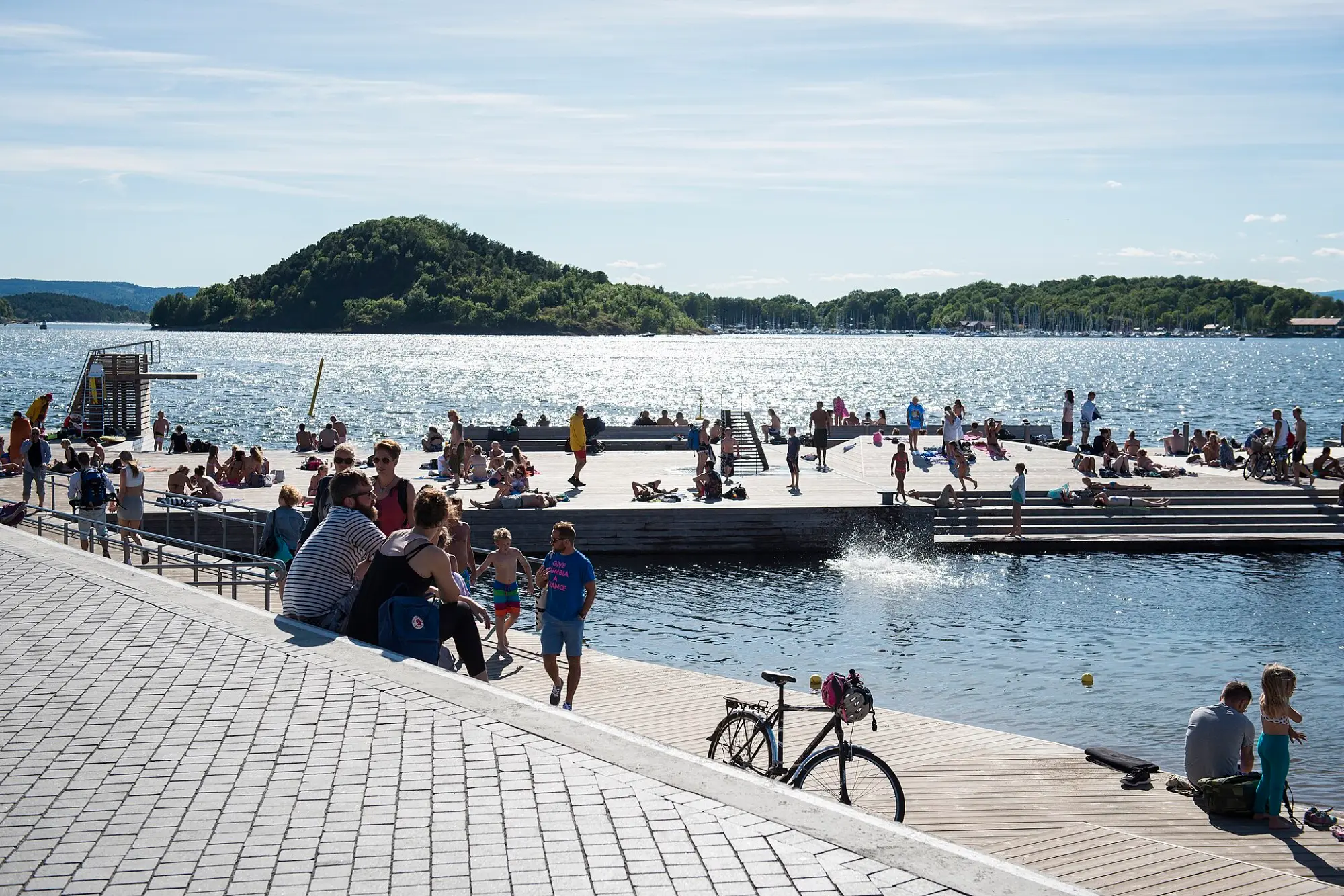

Oslo in summer revolves around long light evenings and the fjord. The twelve activities are the island boats and Hovedøya, Gressholmen and the cabin islands, camping on Langøyene, Sørenga sea pool and the Opera roof, Huk beach, the Bygdøy ferry to the museums, a floating sauna, Vigeland Park, Sognsvann and Nordmarka, the Akerselva river walk, Holmenkollen, and the two big events, Øya and Norway Cup.
1. Island hopping on the Ruter boats, starting with Hovedøya
Public ferries operated by Ruter depart from Aker Brygge. Line B1 loops round Hovedøya, Lindøya, Gressholmen, Bleikøya and Nakholmen. The summer line B1X shuttles between Aker Brygge and Hovedøya, while line B2 runs Hovedøya, Gressholmen, Langøyene. A regular public transport ticket or an Oslo Pass lets you get on and off any of the ferries between Aker Brygge and the islands.
According to the City of Oslo bathing directory, Hovedøya is the island closest to the city centre, and the boat from Aker Brygge takes only eight minutes. Departures run all year round. The best swimming is on the west side of the island, which has two beaches; the middle is a big field for ball games. In the north are the ruins of a Cistercian monastery from 1147, two cannon batteries from 1808 and two gunpowder depots from the island's army days. In the summer months the café Klosterkroa (the monastery inn) is open most days of the week, serving sandwiches, waffles and ice cream. Hovedøya is partly a nature reserve; you may not camp or light a fire there, and grills may only be used on gravel or sand or at the barbecue spots near the beach.
2. Gressholmen and the cabin islands
Gressholmen, Rambergøya and Heggholmen are three connected islands, with the best swimming on the east side of Gressholmen and the south side of Rambergøya. Heggholmen has one of the oldest lighthouses in the Oslofjord. Gressholmen was the site of Norway's first main airport, established in 1927. On the island, Gressholmen Kro is a seasonal café and restaurant open in summer, serving dishes such as oysters, prawns and mussels.
The City of Oslo warns of pollution from an old shooting range on parts of Gressholmen and Rambergøya; the islands can still be used if you follow the city's advice. Camping and open fires are not allowed on Gressholmen, Rambergøya and Heggholmen, and grills may only be used on gravel or sand. Nakholmen and Lindøya, the cabin islands, are known for their many summer cabins but can be visited by anyone. Nakholmen has a small beach on its south-west side with a bathing jetty, a diving board and a swimming raft.
3. Langøyene, the one island where you may camp
Langøyene has a long, family-friendly sandy beach and is the only island near the city where you may camp. You can pitch a tent or hang a hammock for up to two nights in the marked area on the north of the island. After two nights you must take everything with you and leave; after 24 hours away you may come back and camp for two more nights. Some of the seven tent zones are closed for set periods in summer to protect the vegetation.
Langøyene was two islands; the sound between them was a waste dump from 1908 to 1948, and the island reopened in May 2022 after a full clean-up, with a new beach, new toilets and clean drinking water. Facilities include a double volleyball court, a big grass field for picnics and ball games, marked barbecue spots and a naturist area on the south side of the southern island. The kiosk is open seven days a week from 12:00 to 18:00. The toilets and water are open up to and including week 40. Open fires are not allowed on the island.
4. Sørenga sea pool and the Opera roof
Sørenga sea pool (Sørenga sjøbad) is 190 metres long and has, besides a sand beach, an open 50-metre pool with eight lanes. It is open 07:00 to 22:00 in the bathing season, 1 April to 14 October, and 07:00 to 16:00 in winter. Five lifeguards are on duty every day from 12:00 to 20:00 during the school summer holiday.
The whole beach area at Sørenga covers 5000 square metres, with a grass park, a diving tower, outdoor showers, accessible toilets and a child-friendly sand beach. Sørenga and Operastranda, the beach by the Opera House, are two of Oslo's most urban bathing places. You can climb the Opera House roof for views over Oslo and the fjord all year round. Sørenga and the beach and swimming pier at Tjuvholmen are right next to the main sights in the city centre.
5. Huk on Bygdøy, Oslo's Blue Flag beach
Huk is one of Oslo's most popular beaches, situated at the tip of the Bygdøy peninsula, with grass and sand for barbecues, swimming and sunbathing, bathing jetties and a sandy beach for children. It was the first beach in Oslo with Blue Flag status, which means clean water, regularly cleaned toilets, first aid equipment and lifeguards in the school holidays.
From the city centre, bus 30 runs directly there and stops by the beach. By bike it takes about 20 minutes from Oslo Central Station along the harbour promenade. Facilities include courts for beach volleyball and basketball, as well as a café and toilet building opened in 2022. The site features its own separate clothing-optional beach right beside the main one, along with two fixed grills, and charcoal is sold at the kiosk; grilling on the bare rock is not allowed. The coastal path from the beach leads west to Paradisbukta or east to Frognerkilen.
6. The Bygdøy ferry to the museums
The Bygdøy ferry is seasonal; in 2026 it ran from 14 March to 4 October. The ferry leaves City Hall pier 3 (Rådhusbrygge 3) every 20 minutes and takes 10 minutes to the first stop, Dronningen (Norsk Folkemuseum), then Bygdøynes (Kon-Tiki, Fram and the Maritime Museum). From 1 June to 31 August the 2026 timetable added earlier and later boats, so the first left City Hall at 09:10 and the last left City Hall at 17:50; outside those months the first left at 09:50 and the last at 16:50. Ruter tickets are not valid on the Bygdøy ferry, but the Oslo Pass is.
Norsk Folkemuseum is open every day 10:00 to 17:00 from 1 May to 4 October, and in summer the open-air museum has activities, music and dance, farm animals and hosts in traditional costume. An adult ticket costs NOK 200; children up to 17 go free. Most visitors spend 2 to 4 hours here, and from the Dronningen ferry stop it is a 10-minute walk. Nearby, the Fram Museum is open every day of the year, 09:30 to 18:00 from 1 May to 30 September; an adult ticket costs NOK 180.
7. A floating sauna and a dip in the fjord
Oslo Badstuforening runs floating saunas at 7 locations, open in all weathers from 7 am to 11 pm. Sukkerbiten, outside the Opera House and MUNCH and a 7 to 8-minute walk from Oslo Central Station, has 14 saunas and calls itself Norway's largest floating sauna village; you can jump or dive from some of the sauna roofs. In the summer months Sukkerbiten adds an ice-cold bucket shower and two cold plunge pools to its four showers.
Langkaia, a few minutes' walk from Oslo Central Station, has six saunas and a diving and observation tower; it is reached by stairs and has no toilets yet. A shared sauna session at Langkaia costs NOK 260 for non-members and NOK 150 for members. After prolonged or heavy rain Oslo Badstuforening advises waiting a day before swimming, and gives no refunds on days when fjord swimming is not recommended.
A shared session at KOK's wood-fired saunas lasts 1.5 hours including changing, with up to 8 single seats; bring swimwear, two towels and water. KOK's shared saunas are at Aker Brygge, by the promenade with a view of Akershus Fortress, and at Langkaia, facing the Opera and MUNCH; only Langkaia has a cold-water shower.
8. Vigeland Park and the museum's summer hours
Vigeland Park (Vigelandsparken) is always open and free. Take tram 12 or bus 20 to Frogner plass for the park and the Vigeland Museum. The museum is normally open Tuesday to Sunday 12 pm to 4 pm, but from June to August it opens Tuesday to Sunday 10 am to 5 pm; it is closed on Mondays. An adult ticket costs NOK 120; under-18s and Oslo Pass holders go free. Guided tours run in the park through the summer. You can find more city attractions in our guide to things to do in Oslo.
9. Sognsvann and the Nordmarka forest
Sognsvann is the end of metro line 5, and there is a large car park at the south end of the lake. The path round Sognsvann is 3.3 kilometres, a gravel path made for walkers and runners rather than bikes, and it is lit after dark. Sognsvann, once a drinking water source for Oslo, has a freshwater bathing place with a sandy bottom, smooth rocks, grassy slopes and three bathing jetties, and a free beach volleyball court at the south end. Counts from 2015 found 60000 people using the Sognsvann area every month, an average of 2000 a day.
Nordmarka, the 430-square-kilometre forest north of Oslo, has blue-marked hiking trails, cycling routes and lakes for swimming in summer. Several cabins in Nordmarka are open to the public for a break, a meal or a night, most of them run by DNT Oslo og Omegn, Skiforeningen and the City of Oslo. The Nordmarka routes are usually well marked, but a map is recommended for longer distances.
10. The Akerselva river walk
The Akerselva river runs through the centre of Oslo from Maridalsvannet lake to the Oslofjord, dividing the city's east and west sides. The river is eight kilometres long and passes waterfalls, swimming spots, fishing grounds and woodland. Akerselva's most spectacular waterfall is by the Beier bridge; other landmarks on the river include the Lilleborg factories and Nedre Foss.
11. Holmenkollen, the ski museum and the jump tower
The Holmenkollen Ski Museum and jump tower are open every day 10:00 to 17:00 from May to September, an hour longer than in the rest of the year. In 2026 one ticket to the Ski Museum and the jump tower cost NOK 200 for an adult and NOK 100 for a child aged 6 to 17. Metro line 1, the Frognerseter line, goes to Holmenkollen station, a 10-minute walk that is only a few hundred metres but quite steep. Holmenkollen also has an 18-hole frisbee golf course in Holmenkollen National Park.
12. Øya and Norway Cup, the two big August weeks
Øyafestivalen has announced its dates as 11 to 14 August 2027 and 9 to 12 August 2028. Øya is one of Oslo's largest music festivals, four days of concerts, food and stalls in Tøyenparken, with a club day in the city the night before and the Øyanatt club concerts after the park closes. VisitOSLO lists the festival days 11 to 13 August as 13:00 to 23:00 and 14 August as 12:00 to 23:00, in Tøyenparken. The first 11 artists for Øya 2027 include Robyn, who will play her only concert in Norway in 2027, Pavement, deLillos and Kevin Morby. For most people the metro to Tøyen is the easiest way to the festival; all lines stop there and the entrance is a few minutes' walk from the station. There is no age limit in the festival area. Øya accepts only digital tickets, which are exchanged for a wristband to get into the festival area.
Norway Cup 2027 runs from 31 July to 7 August. Norway Cup is one of the world's largest football tournaments for children and young people aged 6 to 19, organised by Bækkelagets Sportsklub; it began in 1972 with 420 teams, and in 2023 a record 2183 teams took part. VisitOSLO lists Norway Cup at Ekebergsletta, and free to attend. Besides about 6,000 football games, Norway Cup has a fun fair, concerts, miniature golf and a celebrity football match. The playoffs start on the Wednesday and the finals are played on the Friday and Saturday; matches run from 08:00 to 21:00.
When to go: weather and light in June, July and August
At the Oslo (Blindern) weather station the normal monthly mean temperature is 15.3 °C in June, 17.7 °C in July and 16.5 °C in August, and normal rainfall is 80 mm, 87 mm and 103 mm, so August is the wettest of the three.
According to the daylight tables for Oslo, in Oslo the sun rises at 04:05 and sets at 22:23 on 1 June, 18h 18m of daylight; on the summer solstice, 21 June, it rises at 03:53 and sets at 22:43, 18h 50m; on 1 August it still gives 16h 46m of daylight. On all three dates the sky is never dark enough for the aurora. The City of Oslo measures bathing water temperature and quality at its beaches from June to August, and advises against swimming when the values are too high. To see how summer fits into a wider trip, read our overview on the best time to visit Norway.
Boats, tickets and swimming safety
On Ruter's ferry page (last updated October 2026), the summer boat timetable ran from 16 May through August in 2026, adding extra routes and departures; the next summer's timetable is published by the operator. Line B1X runs as an extra line to Hovedøya in the high season. In 2026, from 4 July to 30 August, B1 did not stop at Hovedøya and Gressholmen between 10am and 9pm; in those hours B1X ran to Hovedøya every 20 minutes and B2 to Gressholmen every half hour.
Ruter's regular tickets are valid on all its boat routes. In Oslo (zone 1) a Ruter single ticket costs NOK 46 for an adult and a 24-hour ticket NOK 137. You can check what a summer day in Oslo costs before travelling.
When planning travel on the fjord, keep these safety points in mind:
- On hot days the last boat back from the islands can be full. Ruter keeps running until everyone has been taken home, but you must be at the pier by the departure time.
- Do not miss the last ferry back, because there is no water taxi in Oslo, and the sea rescue service only rarely takes people back to the city, for a fee.
- Swimming in the fjord, rivers and lakes is not recommended for 24 hours after heavy rain.
- Some beaches, especially on the fjord, have sharp stones and mussels in the water, so water shoes are recommended.