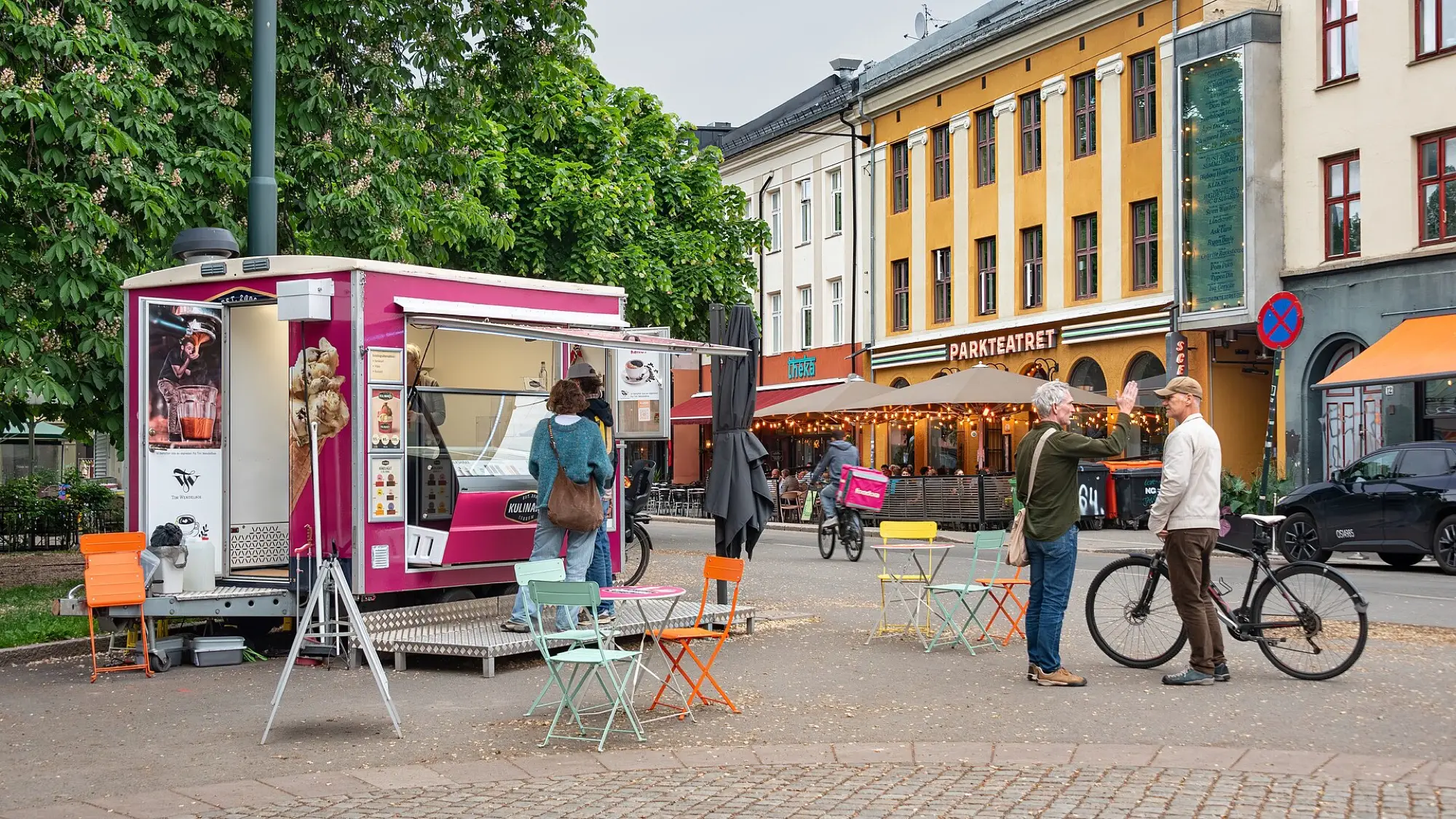

The best area to stay in Oslo depends on your focus: the city centre and Oslo S suit a first visit, Aker Brygge and Tjuvholmen suit art, seafood and the Bygdøy ferry, Bjørvika suits the Opera, MUNCH, saunas and families, Grünerløkka suits vintage shops, cafés and nightlife, Frogner and Majorstuen suit Bogstadveien and Vigeland Park, and Grønland, Tøyen and Gamle Oslo suit world food and the oldest Oslo. This guide describes the character and transit links of these six neighbourhoods rather than specific hotels.
The six areas at a glance
VisitOSLO notes that distances between attractions in Oslo are often quite short, meaning a lot of the city can be explored on foot or by bike. The city centre is compact, with much to see without travelling far. VisitOSLO says all of Oslo, including the last stops of the metro, is in fare zone 1; only trips beyond Oslo, such as to Oslo Airport Gardermoen across four zones, need more.
| Area | What it is like | Getting there | Walk from Oslo Central Station | Best for |
|---|---|---|---|---|
| City centre and Oslo S | Shopping, historic buildings, cafés, restaurants and nightlife | Metro, buses, trams around Oslo Central Station | In the area | First visit |
| Aker Brygge and Tjuvholmen | Harbourside promenade, fine dining, art galleries and shopping | Tram 12 to Aker brygge, ferry terminal | no figure | Art, seafood and ferries |
| Bjørvika and Oslobukta | Modern waterfront, museums, library, beaches and saunas | Walk from Oslo S, metro, buses, trams | 7-8 to 10 minutes | Modern sights and saunas |
| Grünerløkka | Countercultural, hip district, vintage shops and food hall | Tram 12 to Schous plass, buses 34 and 54 | 15 minutes to Mathallen | Vintage shops and cafés |
| Frogner and Majorstuen | Established shopping, parks, sculpture collections and transit hub | Majorstuen central hub, tram 12, bus 20 | no figure | Parks and shopping |
| Grønland and Tøyen | Diverse dining, oldest stone ruins, botanical garden and parks | All metro lines at Tøyen, tram 17, trams 13 and 19 | Starts just east of station | World food and history |
1. The city centre and Oslo S: Karl Johans gate and Kvadraturen, for a first visit
VisitOSLO says the city centre is usually visitors' first stop in Oslo, with shopping, great hotels and historic buildings, and cafés and restaurants around the main street, Karl Johans gate. It suits travellers arriving for the first time who want immediate access to transit and services. The city centre is also where Oslo goes out at night, with a lively bar and club scene. Kvadraturen, situated between Akershus Fortress and Karl Johans gate, takes its name from its rectangular street plan; it is the historical centre of Oslo, dating from 1624, with some of the city's oldest buildings alongside many galleries and museums. Around Torggata street, the centre features many small restaurants, shops and bars. Further north, Tullinløkka lies north of Karl Johans gate and the Palace Park, offering popular restaurants, bars, second-hand shops and art attractions. Along the water, the harbour promenade runs from Bjørvika in the east to Aker Brygge in the west, offering saunas, sightseeing boats, seafood and street food.
Several key sights are within walking distance:
- Akershus Fortress: the main entrance in Kirkegata is about a 15-minute walk from Oslo Central Station (Oslo S).
- Historical Museum: situated on Tullinløkka, a ten-minute walk from the National Theatre (Nationaltheatret).
- Oslo Visitor Centre: located directly inside the Central Station.
To get here from the airport, the Flytoget airport express train runs between Oslo Airport and Oslo Central Station every 10 minutes during the day, and every 20 minutes early in the morning, late at night, at weekends and during school holidays. Local transport links converge here: around Oslo Central Station, Tollboden and Bjørvika, a number of buses and trams stop, alongside the metro.
2. Aker Brygge and Tjuvholmen: the harbour promenade, for art, seafood and the Bygdøy ferry
VisitOSLO sums up Aker Brygge and Tjuvholmen as shopping, fine dining and art galleries along the harbour promenade. It suits visitors focusing on contemporary galleries, waterfront dining and island boat trips. In summer the pier at Aker Brygge is busy, with lunch at the fjordside restaurants. The old harbour buildings at Aker Brygge house an indoor shopping street offering interior design, books, vintage items and Norwegian and Scandinavian clothing brands, while several local restaurants specialise in seafood. Entertainment includes Latter, Oslo's largest comedy club, and KOK Oslo, which runs floating saunas along the wharf. A bridge connects Aker Brygge to Tjuvholmen, an island filled with restaurants, galleries and outdoor art installations.
Key sights in the neighbourhood include:
- Astrup Fearnley Museum: an international contemporary art museum designed by the Italian architect Renzo Piano, standing at the far end of Tjuvholmen with a large sculpture park and a beach outside.
- Nobel Peace Center: the museum of the Nobel Peace Prize, situated directly on City Hall Square.
- Bygdøy ferries: departing from Rådhusbrygge 3 by City Hall every 20 minutes, taking 10 minutes to reach the Bygdøy peninsula; in 2026 the ferry sails from 14 March to 4 October.
For public transport, the Nobel Peace Center is 100 metres from the Aker brygge tram stop served by tram line 12, 100 metres from the Aker Brygge ferry terminal, and 700 metres from Nationaltheatret station. Note that the Bygdøy ferries are not covered by Ruter's public transport tickets. For island hopping, Ruter's boat route B1 departs from Aker Brygge to Hovedøya, Lindøya, Gressholmen, Bleikøya and Nakkholmen. You can check things to do in Oslo for further sightseeing details.
3. Bjørvika and Oslobukta: the Opera, MUNCH and the saunas, next to the station
VisitOSLO calls Bjørvika and Oslobukta the most modern part of the city centre, built beside the historic centre of medieval Oslo, with restaurants, museums, galleries and Norwegian brands in the shops. It suits visitors who want new architecture, waterfront saunas and short walking times to the main railway concourse. Bjørvika was previously a container port and a major motorway junction; the motorway now runs underground and the waterfront is open to the public. VisitOSLO notes that children love Bjørvika for its water and play: families with toddlers may prefer the shallow Operastranda beach with its sand and playground, while older children jump from Munch brygge. At nearby Sørenga, across a pontoon bridge from Sukkerbiten, there is a shallow sandy pool, a diving platform, a wheelchair-accessible ramp into the fjord, and kayaks to rent.
Key sights within walking distance include:
- Oslo Opera House (Operahuset): visitors can climb the roof for views over Oslo and the fjord all year round.
- MUNCH: located at Edvard Munchs plass 1, this museum dedicated to Edvard Munch stands on its own pier on the fjord, displays other artists' work beside his, and sits a 10-minute walk from Oslo Central Station.
- Deichman Bjørvika: Oslo's main library, located at Anne-Cath. Vestlys plass 1 midway between Oslo S and the Opera; most things are free and the library can be used without a library card.
- Sukkerbiten sauna village: run by Oslo Badstuforening just outside the Opera House and MUNCH, a 7-8 minute walk from Oslo Central Station.
To reach the district, you can walk directly from Oslo S, or use the numerous buses, trams and metro services that stop around Oslo Central Station, Tollboden and Bjørvika.
4. Grünerløkka: vintage shops and the Akerselva, for cafés and nightlife
Grünerløkka was a working-class district in the 1800s; VisitOSLO now calls it one of Oslo's most diverse, countercultural and hip districts, with niche shops, restaurants and nightlife. It suits visitors looking for independent boutiques, riverside walks and evening dining. Grünerløkka has many vintage shops, design boutiques, independent stores and flea markets, and VisitOSLO recommends exploring it on foot. In the upper part of the neighbourhood, the small park Birkelunden hosts an outdoor second-hand market on Sundays. Sofienberg Park, located just east of Thorvald Meyers gate, hosts the Piknik i Parken music festival on a June weekend. Just north of Grünerløkka lies Torshov, which features venues for alternative theatre, music and improv.
Sights and cultural spots in this area include:
- Akerselva: the river forms Grünerløkka's western boundary, where a riverside walking path passes old brick factories, the Blå music venue and Mathallen food hall.
- Mathallen Oslo: the food hall at Vulkan 5, situated between St. Hanshaugen to the west and Grünerløkka to the east, sitting a 15-minute walk from Jernbanetorget, the square in front of Oslo Central Station.
To reach Grünerløkka and Vulkan, take tram 12 to Schous plass and walk down to Nordre gate before crossing the bridge to Vulkan. Alternatively, buses 54 and 34 stop at Møllerveien.
5. Frogner and Majorstuen: Bogstadveien and Vigeland Park, on the west side
Behind the Royal Palace, the streets Bogstadveien and Hegdehaugsveien lead to Majorstua, an established area for nightlife and shopping. It suits visitors who want access to major parks, sculpture collections and shopping streets. Along these streets are exclusive brands such as Acne, Holzweiler and Filippa K alongside chain stores, and the Valkyrien shopping mall. Further west, Frogner, Briskeby and Bygdøy allé are known for ornate houses, art galleries, antique dealers and a high density of restaurants and cafés. East of Bogstadveien lie Bislett and St. Hanshaugen, offering small shops, coffee shops and nightlife, with St. Hanshaugen park occupying a hill with a view over the city.
Key sights in the district include:
- Vigeland Sculpture Park: situated inside Frogner Park, featuring 200 sculptures by Gustav Vigeland, including the Angry Boy (Sinnataggen) and the Monolith (Monolitten); the park is always open and free to enter.
- Vigeland Museum and Museum of Oslo: both located inside Frogner Park, which also includes tennis courts, Frogner stadium and running paths.
- Holmenkollen ski jump: metro line 1 goes almost all the way to the ski jump, ending with a short but steep 10-minute walk from Holmenkollen station.
Public transport here is anchored by Majorstuen station, which opened in 1898 as the terminus of the Holmenkollen Line. Ruter calls Majorstuen a central hub for public transport in Oslo. To reach Vigeland Park directly, take tram 12 or bus 20 to Frogner plass.
6. Grønland, Tøyen and Gamle Oslo: world food and the oldest Oslo, east of the station
VisitOSLO describes Oslo East as a large, diverse area where food from all over the world, nightlife and cultural events meet the oldest chapters of Oslo's history. It suits travellers wanting broad dining options and historic ruins within walking distance of Oslo S. Grønland begins just east of Oslo Central Station, with pubs and bars, restaurants with food from all over the world, vegetable stalls with good-value produce and cheap fabric shops. From Grønland you can walk to Tøyen and its botanical garden, or to Kampen and its wooden houses; Klosterenga park, a sculpture park, is nearby. To the south, Gamlebyen (the Old Town) preserves the ruins of Oslo's oldest stone buildings in Middelalderparken.
Notable sights within walking distance include:
- Natural History Museum (Naturhistorisk museum): a 6-minute walk (450 m) from Tøyen station to its southern entrance.
- Middelalderparken: home to the stone ruins of medieval Oslo.
- Ekebergparken: a sculpture park situated on Ekeberg hill where Munch was inspired to paint the Scream; it is open around the clock, all year round, free to enter, and offers one of the best views of Oslo and the fjord.
To travel around Oslo East, all metro lines stop at Tøyen station, which is a 6-minute walk (450 m) from the Natural History Museum's southern entrance. Tram 17 to Lakkegata skole stops a 2-minute walk (200 m) from the museum's entrance in Sars' gate. To reach Ekebergparken, take tram 13 or 19 towards Ljabru.
Getting from Oslo Airport to your area
When arriving at Oslo Airport Gardermoen, several public transport services run to central Oslo:
- Flytoget airport express train: runs between Oslo Airport and Oslo Central Station every 10 minutes during the day, and every 20 minutes early in the morning, late at night, at weekends and in school holidays. Flytoget gives its travel time from the airport to the city centre as 19 minutes, and it stops at several stations in the centre of Oslo. No Ruter ticket is valid on Flytoget, not even a period ticket for all zones.
- Vy regular trains: Vy links Oslo Central Station and Oslo Airport, with three departures an hour on average in each direction. A Ruter ticket to Oslo Airport Gardermoen must cover four zones. The Oslo Pass covers Vy's local trains to Oslo Airport, but not Flytoget or Flybussen.
- Flybussen express buses: run several routes between the airport, the city centre and the surrounding districts, most of them around the clock, taking 40-50 minutes to the city centre.
If you plan to continue across the country after staying near the central station, read our guide to the Oslo to Bergen train.
Getting around once you are there
Oslo's public transport network is operated by Ruter. All of Oslo, including the last stops of the metro, is in fare zone 1; only trips beyond Oslo, such as to Oslo Airport Gardermoen across four zones, need more.
VisitOSLO gives Ruter's zone 1 fares from 25 January 2026 as NOK 46 for an adult single ticket, NOK 137 for a 24-hour ticket and NOK 379 for a 7-day ticket; fares change. A single ticket for one zone is valid for 60 minutes from activation, with transfers between buses, trams, metro, ferries and Vy's trains in Oslo. Tickets cannot be bought on board the tram or metro; buy in the Ruter app first. On buses and boats you can buy a single ticket on board, in cash, for more. Children under 6 travel free on Ruter.
The transit network consists of:
- Metro (T-bane): five lines, numbered 1 to 5.
- Trams (Trikk): lines 12, 13, 15, 17, 18 and 19.
- Bus routes: bus 30 runs from Jernbanetorget to Bygdøynes every 10 minutes all year round, stops at all the Bygdøy museums and takes 15 minutes from the city centre.
- Ferries: the Bygdøy ferries are not on Ruter tickets, but they are on the Oslo Pass.
The Oslo Pass covers Ruter's buses, trams, metro, ferries and Vy's local trains in zones 1, 2, 3, 4V and 4N for 24, 48 or 72 hours. Check daylight in Oslo to plan walking between districts.
What staying in Oslo costs and how to keep it down
VisitOSLO says even the cheapest hotels in Oslo are never below 3 stars, breakfast is often included and wi-fi is free.
For more comfort on a budget VisitOSLO suggests a pension or guest house, often near the city centre. Hostels and campsites are the cheapest options with water and electricity. With your own tent you can camp free in the forest or on the island of Langøyene. To see how lodging fits into general travel spending, read is Norway expensive?.
Frequently asked questions
What is the best area to stay in Oslo for a first-time visitor?
VisitOSLO says the city centre is usually visitors' first stop in Oslo, with shopping, great hotels and historic buildings, and cafés and restaurants around the main street, Karl Johans gate.
Which public transport zone covers hotels in central Oslo?
All of Oslo, including the last stops of the metro, is in fare zone 1; only trips beyond Oslo, such as to Oslo Airport Gardermoen (four zones), need more.
How fast does the train run from the airport to Oslo Central Station?
Flytoget gives its travel time from the airport to the city centre as 19 minutes, running every 10 minutes during the day, and every 20 minutes early in the morning, late at night, at weekends and in school holidays.
Which neighbourhood serves as the best transit hub for exploring the west side?
Ruter calls Majorstuen a central hub for public transport in Oslo.
Where should families with children base themselves?
VisitOSLO says children love Bjørvika for its water and play: families with toddlers may prefer the shallow Operastranda beach with its sand and playground, while older children jump from Munch brygge.
Are budget hotels in Oslo decent quality?
VisitOSLO says even the cheapest hotels in Oslo are never below 3 stars, breakfast is often included and wi-fi is free.
Can you buy transit tickets directly on board trams in Oslo?
No. Tickets cannot be bought on board the tram or metro; buy in the Ruter app first. On buses and boats you can buy a single ticket on board, in cash, for more.