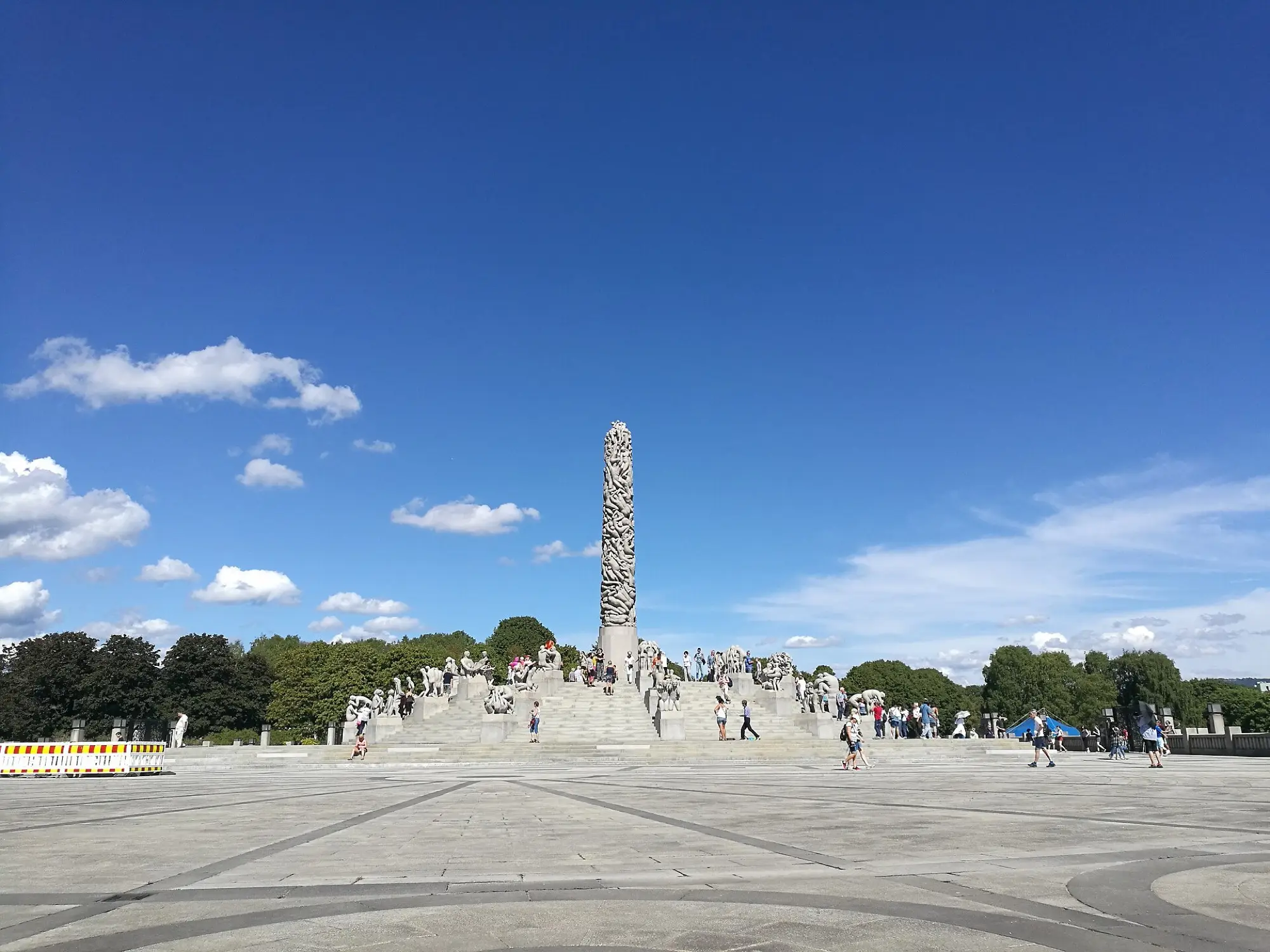

Vigeland Park is always open and free to enter in Oslo, with its sculptures arranged along an axis featuring the Bridge with Sinnataggen (the Angry Boy), the Fountain, the Monolith and the Wheel of Life. Take tram 12 or bus 20 to Frogner plass to reach the grounds. The Vigeland Museum at Nobels gate 32 is closed on Mondays and costs NOK 120 for an adult, while entry is free for ages 0-17 and with the Oslo Pass.
Vigeland Park at a glance
Vigeland Park is always open and free. The sculpture park is Gustav Vigeland's life work, with more than 200 sculptures in granite, bronze and wrought iron. Store norske leksikon counts 214 sculptures in the park, made up of more than 600 figures; the park's official name is Frognerparken og Vigelandsanlegget.
The sculptures stand mostly along an 850-metre main axis running east to west, from the main gates on Kirkeveien over the Bridge and the Fountain to the Monolith and the Wheel of Life. VisitOSLO says the park is one of Norway's top tourist attractions, with more than one million visitors a year, and is open all year round, 24 hours a day. In 2009 it became the first park in Norway to be protected by the Directorate for Cultural Heritage (Riksantikvaren). The Oslo itinerary includes the park, while other sights appear in the guide to free things to do in Oslo and the overview of things to do in Oslo.
Gustav Vigeland, from Mandal to Frogner
Gustav Vigeland was born on 11 April 1869 in Mandal and died in Oslo on 12 March 1943. Vigeland came to Kristiania (Oslo) at 15 to work as an apprentice woodcarver, and made his debut at the autumn exhibition in 1889 with Hagar and Ismael.
Between 1898 and 1902 Vigeland modelled 44 sculptures for Nidaros Cathedral in Trondheim. The Abel monument in the Palace Park, unveiled in 1908, was Vigeland's definitive breakthrough as a sculptor. In 1921 Vigeland signed a contract with the city, which took ownership of all his work in exchange for a studio that would become a museum after his death. Vigeland and his wife Ingerid moved into the apartment at Frogner in 1924, and he lived there until his death in 1943.
How a fountain became a park
The starting point for the park was Vigeland's Fountain, which was originally meant to stand at Eidsvolls plass in front of the Parliament. Vigeland exhibited his model of the Fountain in 1906 to great success, and in 1907 it was commissioned for Eidsvoll square.
On 27 November 1924 the city council decided to use an area west of the Frogner ponds for the Fountain and the Monolith. In July 1931 the city council approved Vigeland's plan for the sculptures on the Bridge and the extension of the park west of the ponds. Vigeland wanted all the sculptures put up at about the same time, but the Second World War made him unsure of their fate, so he had the Bridge sculptures placed in 1939-1940. The park was installed mainly between 1940 and 1949, but it is the result of more than 40 years of Vigeland's work.
The main gate on Kirkeveien
The main gate was erected in September 1941 and completed in July 1942. Vigeland's work in wrought iron for the park began in 1923-24; the blacksmith Alfred Mikkelsen made the first four dragon panels, now part of the main gate. The main gates on Kirkeveien are five large wrought-iron gates and two smaller pedestrian gates, flanked by two gatehouses.
The Bridge and Sinnataggen, the Angry Boy
The Bridge's 58 bronze sculptures show children, women and men of different ages, on the shared themes of play, lust, energy and vitalism. On the Bridge stands the little boy Sinnataggen (the Angry Boy). Store norske leksikon calls Sinnataggen one of the most popular sculptures in Frogner Park.
Vigeland modelled the Bridge sculptures between 1925 and 1933, and they were among the first mounted in the park, in the early 1940s. In summer 1940, 46 of the 58 Bridge sculptures were put in place, Sinnataggen among them, and the Bridge opened to the public on 7 July 1940. At each corner of the granite bridge stands a granite group of lizards and people; in three a man fights a lizard and the animal wins. Below the Bridge, by the pond, a circle holds nine bronze sculptures of babies, with the Foetus at its centre as an image of the beginning of life.
The Fountain and the labyrinth
Beyond the Bridge the path runs through a rose garden to the Fountain, the earliest sculpture unit in the park, where six giants hold a large saucer-shaped vessel aloft. Twenty tree groups on the parapet around the basin show the stages of life, from childhood and adolescence through adulthood to old age and death. The Fountain was only erected, and the water turned on, in 1947, after Vigeland's death.
Around the Fountain Vigeland laid out a labyrinth of 1,800 square metres in black and white granite mosaic; its path is 3,000 metres long. Frogner Park's rose garden holds 14,000 roses of 150 varieties, and the park has around 3,000 trees, some of them more than 250 years old.
The Monolith
The Monolith stands at the highest point of the park, 17 metres above ground; it is carved from one block of stone and shows 121 human figures. The granite block came from the Iddefjord, near Halden, and originally weighed 280 tonnes.
Vigeland modelled the Monolith in clay in 1924-25; the carving began in 1929, and it took three stone carvers 13 years. Vigeland said of it, "The column is my religion". The Monolith stands on a circular flight of granite steps with 36 granite figure groups on the theme of the cycle of life. Eight wrought-iron gates were installed on the Monolith plateau in 1952.
The Wheel of Life and the later additions
West of the Monolith stands the Wheel of Life in bronze, modelled in 1933-34 and erected in 1949, a wreath of women, men and children holding on to each other. The Wheel of Life ends the main axis in the west and is made of seven figures, four adults and three children.
The bronze group the Clan was put up in 1988 as the northern end of the cross axis. The latest addition is the statue Surprised, modelled and cast in plaster in 1942 and unveiled in Frogner Park in 2002.
The Vigeland Museum next door
The Vigeland Museum is at Nobels gate 32, south of Vigeland Park in Frogner. The museum opened in 1947 in Vigeland's former studio and home, and shows a permanent exhibition of his art and temporary exhibitions of three-dimensional art. The permanent exhibition includes several of the plaster originals for the sculptures in the park. The museum's collection holds around 1,600 sculptures, 12,000 drawings and 420 woodcuts. The temporary exhibition is the Eckbos legat grant exhibition, the museum's autumn exhibition of new work, from 17 October to 4 April 2027.
According to the Vigeland Museum visitor information, the museum is closed on Mondays and open Tuesday to Sunday. From the first Tuesday of September through the last Sunday of May the Vigeland Museum is open 12:00-16:00. From the first Tuesday of June through the last Sunday of August the museum has longer hours, 10:00-17:00. The last admission is at 15:45. The museum is also closed on 1 January, 1 May, 17 May, 24 December, 25 December and 31 December.
Entry to the Vigeland Museum costs NOK 120 for an adult, NOK 100 for a senior and NOK 70 for ages 18-25; it is free for ages 0-17 and with the Oslo Pass.
Inside the museum, practical points
According to the Vigeland Museum visitor guidelines, the museum has no café, though there are places to eat nearby, and food and drink are not allowed in the exhibition halls. Prams and pushchairs are not allowed in the museum; it suggests bringing a baby carrier and has two to lend. Backpacks and bags go in lockable lockers, and the toilets are in the museum's vestibule.
Photography for private use is allowed as long as no tripods, softboxes or artificial lighting are used. The museum is a protected building; a wheelchair user can reach the permanent collection on the first floor by a ramp, but there is no lift, so the sketch room and the apartment need stairs.
Vigeland's apartment and the museum's tours
The apartment where Gustav and Ingerid Vigeland lived is on the third floor of the museum, nearly 300 square metres, with an interior designed by Vigeland himself. Vigeland's artist home can only be seen by appointment or on a public tour, and most public tours of the apartment are in Norwegian.
The museum's events list shows public tours of Vigeland's artist home at 13:00 on Sunday 6 December and on 27, 29 and 30 December. On Sunday 29 November the museum holds a Christmas workshop with free entrance, guided tours and workshops. The museum runs public tours of the park only in summer; for other guided tours of the park it refers visitors to VisitOSLO.
Frogner Park around the sculptures
Frogner Park is the largest park in central Oslo, and the sculpture park lies inside it with more than 200 of Vigeland's sculptures. Frogner Park is open around the clock and free to enter, and it is protected under the Cultural Heritage Act.
Frogner Park has a café and a restaurant, public toilets, fixed barbecues with bins for disposable grills, and a separate off-lead area for dogs. By the main entrance from Kirkeveien is the Frognerborgen playground, set up for families with fixed barbecues, benches and tables. Frogner Stadium and the Frognerbadet pool are in the corner nearest Majorstua; Frogner Manor and the Museum of Oslo are in the corner towards Frogner. In winter the municipality lays ski tracks through the sculpture landscape. The park is managed by the city's Agency for Urban Environment; commercial filming and events need its permission, and flying drones is prohibited.
The Museum of Oslo at the manor house
The Museum of Oslo is at Frogner Manor in Frogner Park, Halvdan Svartes gate 58, together with the Theatre Museum, and has a café and a gift shop. The Museum of Oslo is open Tuesday and Wednesday 11:00-16:00, Thursday 11:00-18:00, and Friday to Sunday 11:00-16:00.
Entry costs NOK 130 for an adult and NOK 65 for a student, is free for anyone under 26, and free for everyone on the first Thursday of the month; the ticket also covers the Theatre Museum. Every Wednesday at 13:00 there is a guided tour in English of Frogner Manor, with interiors from 1750-1900; it is included in the regular museum ticket, and its second floor has no lift.
Getting there and parking
Tram 12 or bus 20 to Frogner plass reaches the park and the museum. For Frogner Manor, the Museum of Oslo gives tram 12 or 15 or bus 20 to Frogner plass, or any metro line to Majorstuen. Paid parking is by Monolittveien, in Middelthuns gate by Frognerbadet, and at Halvdan Svartes gate 50. Visitors planning where to stay in Oslo can look at Frogner and Majorstuen near the park.
A Ruter single ticket for one zone is valid for 60 minutes with transfers on buses, trams, the metro and ferries; bought on board a bus it costs NOK 20 more for an adult. The Oslo Pass gives free entry to more than 30 museums and attractions and unlimited public transport. An adult Oslo Pass costs NOK 580 for 24 hours, NOK 845 for 48 hours and NOK 995 for 72 hours.
When to go
Vigeland Park is always open and free. The Vigeland Museum is closed on Mondays and open Tuesday to Sunday. From the first Tuesday of September through the last Sunday of May the Vigeland Museum is open 12:00-16:00. From the first Tuesday of June through the last Sunday of August the museum has longer hours, 10:00-17:00, during Oslo in summer. The museum is also closed on 1 January, 1 May, 17 May, 24 December, 25 December and 31 December.
The museum runs public tours of the park only in summer; for other guided tours of the park it refers visitors to VisitOSLO. During Oslo in winter, the municipality lays ski tracks through the sculpture landscape.
Frequently asked questions
Is Vigeland Park free?
Vigeland Park is always open and free.
How much is entry to the Vigeland Museum?
Entry to the Vigeland Museum costs NOK 120 for an adult, NOK 100 for a senior and NOK 70 for ages 18-25; it is free for ages 0-17 and with the Oslo Pass.
What are the opening hours of the Vigeland Museum?
The Vigeland Museum is closed on Mondays and open Tuesday to Sunday. From the first Tuesday of September through the last Sunday of May the Vigeland Museum is open 12:00-16:00.
Which public transport reaches the park and museum?
Tram 12 or bus 20 to Frogner plass reaches the park and the museum.
How many sculptures are in Vigeland Park?
The Vigeland Museum gives more than 200 sculptures in granite, bronze and wrought iron, and Store norske leksikon counts 214 sculptures made up of more than 600 figures.
What is the Monolith?
The Monolith stands at the highest point of the park, 17 metres above ground; it is carved from one block of stone and shows 121 human figures.
Where is the Angry Boy statue?
Sinnataggen stands on the Bridge, which carries 58 bronze sculptures, between the main gate on Kirkeveien and the Fountain.
Are drones allowed in Vigeland Park?
The park is managed by the city's Agency for Urban Environment; commercial filming and events need its permission, and flying drones is prohibited.
Does the Vigeland Museum have a café?
The museum has no café, though there are places to eat nearby, and food and drink are not allowed in the exhibition halls.