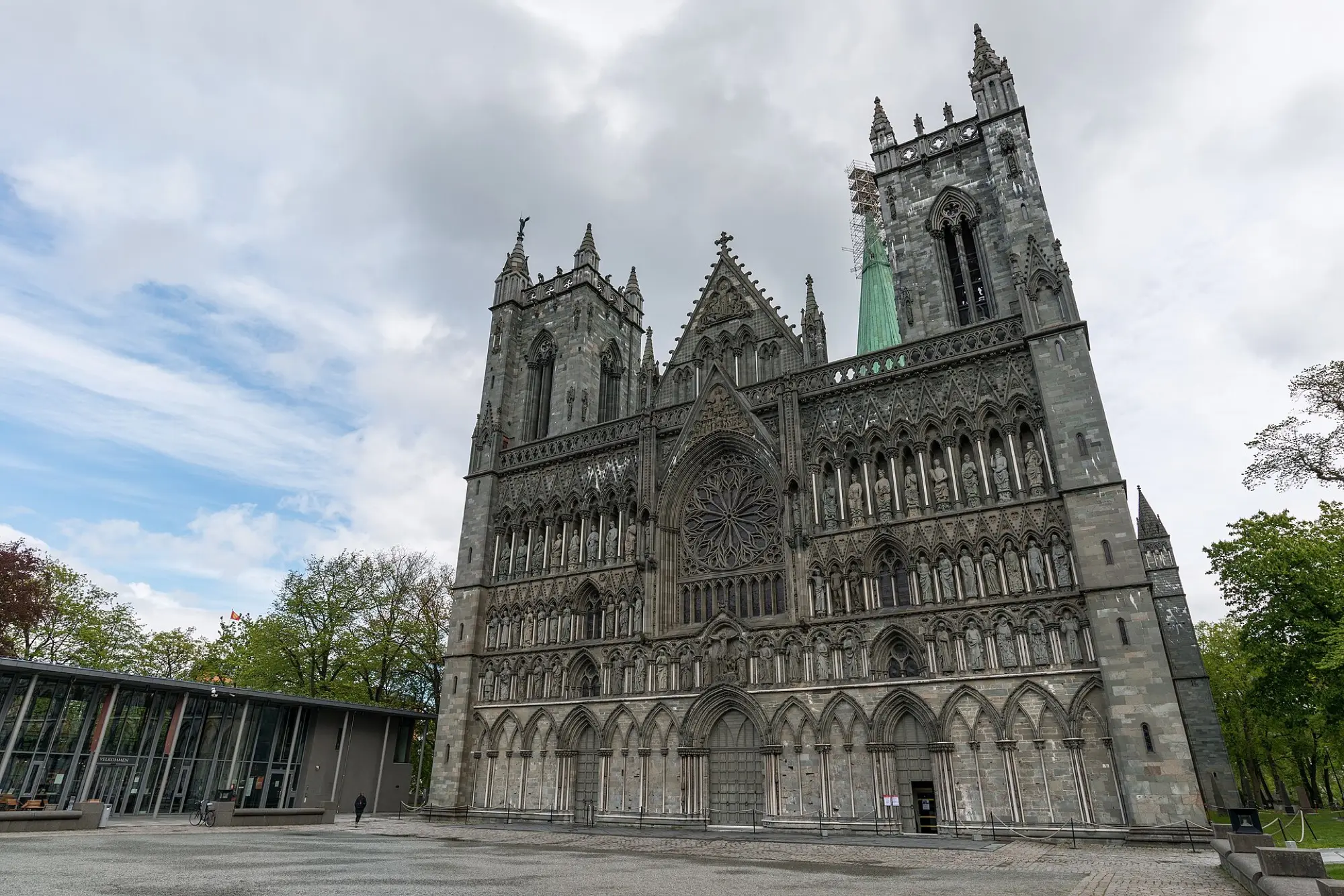

An adult ticket to Nidaros Cathedral costs NOK 140, while a combined ticket covering the cathedral, the Crown Regalia and the Archbishop's Palace museum costs NOK 260. Children under 8 enter free, attending a church service is free, and the central tower can be climbed only from May to August for an extra NOK 70 on top of the entrance fee.
The short answer
A standard adult ticket to Nidaros Cathedral costs NOK 140, and visitors aged 8 to 25 pay NOK 70. Children up to 7 go free. If you want to see both the cathedral and the adjacent museums, the combined ticket costs NOK 260 for adults and NOK 130 for ages 8 to 25. Bought separately, the cathedral (NOK 140) and the museum ticket (NOK 140) come to NOK 280 for an adult, so the combined ticket saves NOK 20. Going to a church service in the cathedral is free.
Tower climbs up the cathedral's central tower run only from May to the end of August. The climb costs NOK 70 on top of the cathedral ticket, and tickets are available only during summer.
Note one date in 2027: King Haakon VIII and Queen Mette-Marit are to be consecrated in Nidaros Cathedral on 22 August 2027. The cathedral's calendar shows it closed to visitors on 22 August 2027, the day of the royal consecration.
Tickets and what each one covers
Entry fees help fund the building's upkeep: the state budget covers about 50% of the cost of restoring and maintaining the cathedral, which is why entry is charged. Entrance tickets are valid for the whole day, and the ticket money goes to the restoration of the cathedral. The cathedral recommends buying your entrance ticket before the visit, though tickets are sold at the visitor centre as well as online via the Nidaros Cathedral website. Concert tickets are not sold at the visitor centre; they are bought on Hoopla.
| Ticket | Adult | Ages 8 to 25 | Under 8 |
|---|---|---|---|
| Nidaros Cathedral | NOK 140 | NOK 70 | Free |
| Crown Regalia and Archbishop's Palace | NOK 140 | NOK 70 | Free |
| Combined ticket (cathedral and both museums) | NOK 260 | NOK 130 | Free |
| Tower climb (summer only, added to entry) | NOK 70 | not published | Not admitted under 8 |
For an adult buying tickets separately, the cathedral (NOK 140) and the museum ticket (NOK 140) total NOK 280, meaning the combined ticket at NOK 260 saves NOK 20. For a visitor aged 8 to 25, the two separate tickets come to NOK 140 against NOK 130 combined, a saving of NOK 10.
The combined ticket covers Nidaros Cathedral, the Crown Regalia and the Archbishop's Palace museum. On some days the cathedral keeps slightly different hours from the two museums. The ticket office notes that a visit to all three takes about 1 to 1.5 hours and recommends starting at least an hour before closing time.
A pilgrim does not pay the entrance fee to see the church. Pilgrims who register at the pilgrim reception get the pilgrimage town's gold coin, which gives free entrance to the cathedral and other offers in Trondheim. Going to a church service remains free for everyone.
If you are planning your wider travel budget, see our guide on is Norway expensive?.
Opening hours, winter and summer
Opening hours can change around public holidays and church events, and parts of the cathedral may be closed off for religious services. The Crown Regalia exhibition is open all year, but the cathedral and museums run on different daily schedules.
| Place | Current winter schedule | Summer (calendar showed June to August) |
|---|---|---|
| Nidaros Cathedral | Mon–Fri 09:00 to 14:00, Sat 09:00 to 13:00, Sun 13:00 to 16:00 | Mon–Fri 09:00 to 18:00, Sun 13:00 to 17:00 |
| Crown Regalia and Archbishop's Palace | Mon closed, Tue–Fri 11:00 to 14:00, Sat 11:00 to 15:00, Sun 12:00 to 16:00 | Mon–Fri 10:00 to 17:00, Sun 12:00 to 16:00 |
On summer Sundays, the calendar showed the cathedral open 13:00 to 17:00, an hour longer than in winter. Summer weekday hours shown on the calendar were 09:00 to 18:00 for the cathedral and 10:00 to 17:00 for the Crown Regalia and Archbishop's Palace.
Over the Christmas period, the cathedral is closed on 23, 24 and 25 December 2026. It opens 13:00 to 16:00 on 26 December, 09:00 to 12:00 on 31 December and 13:00 to 15:00 on 1 January 2027. For winter travel planning, you can read more in our overview of Christmas markets in Norway and our seasonal breakdown on the best time to visit Norway.
The calendar also shows the cathedral closed on 22 August 2027 for the royal consecration.
Climbing the tower
Tower climbs up the cathedral's central tower run from May to the end of August. The climb costs NOK 70 on top of the cathedral ticket, meaning the cathedral ticket and tower climb come to NOK 210 for an adult. Tickets for the tower climb are bought on the spot.
The stairs up the tower are dark and narrow, with 172 steps in all, ending with a view over the city. Wear good shoes, because the stairs are tight and narrow, and you need to be in good physical shape. For safety reasons, the tower has an age limit of 8, and children under 12 must go with an adult. People with heart problems, asthma, epilepsy or claustrophobia are advised not to go up.
In summer there are also walks to small rooms and chapels from the 1100s high up in the cathedral, close to Oddmund Kristiansen's stained glass. Another summer walk goes down to the cellar and crypt, which hold Norway's largest collection of medieval gravestones and an unmarked grave that may be St Olav's.
Guided tours and the house rules
In the high season, May to August, there are daily guided tours in English and Norwegian. The rest of the year, guided tours in Norwegian and English run at weekends. Groups can book guided tours all year in Norwegian, English, German and French; a group booking is confirmed only once the cathedral replies.
Follow these house rules when planning your visit:
- Bags: Large bags, backpacks and suitcases cannot be taken into the cathedral. Leave them at your hotel or in the lockers at Trondheim Central Station (Trondheim S), which has 80 luggage boxes in three sizes in the basement of the waiting hall.
- Animals: Dogs and other pets are not allowed in the cathedral or the Archbishop's Palace, except guide and service dogs.
- Photography: Taking photos and filming for private use is allowed in the cathedral, as long as the pictures are not published or used commercially. Photography and filming are not allowed in the Crown Regalia exhibition.
- Facilities: Toilets are in the visitor centre, and accessible toilets are in the visitor centre and in the cathedral's basement. The visitor centre, housing the café Kafé to tårn and the shop, is at Bispegata 5, next to the cathedral.
- Safety: Keep outside the barriers around the cathedral, because stone fragments can fall.
The west front
The west front is a screen front consisting of the two west towers and the wall between them. The towers stand outside the nave walls, making the front wider than the nave itself. After a fire in 1531, the western part of the cathedral stood as a ruin for several hundred years, and stone from it was sold for other buildings in Trondheim. When rebuilding started in 1869, only the lowest part of the west front was standing, and only five of the large statues had survived. With so little left to show what the upper front had looked like, the west front became the most debated part of the rebuilding.
Some of Norway's leading artists made the 76 statues of saints and biblical figures on the wall today. The cathedral calls it one of Norway's largest art projects of the 1900s, behind only Vigeland's sculpture park. The lowest row shows Christ and the apostles, the middle row saints and virtues, and the top row prophets and kings of Israel from the Old Testament. SJ's Trondheim guide notes that the artist Kristoffer Leirdal sculpted Bob Dylan's face on the archangel Michael. The north tower of the west front was finished in 1964 and the south tower in 1968.
The stained glass in the main church, the rose window included, was designed and made by Gabriel Kielland in a workshop he ran from 1908 to 1934. The rose window measures 12 metres high and 8 metres in diameter.
Inside the cathedral
The cathedral is 102 metres long, 50 metres wide at its widest, and 21 metres high under the nave vault. The tower with its spire reaches 87 metres; the spire was measured in 2016 at 87 metres, not the 91 metres assumed before. It is the only church in Norway to use the Gothic system of flying buttresses throughout.
Inside, the main organ is Norway's largest, with nearly 10,000 pipes and about 130 stops. New lighting installed in 2020 shows sculptures, stained glass and vaults that used to be hidden in the dark. In autumn and winter the thousands of soapstone sculptures give the inside a mysterious look, while in spring and summer the sun comes through the coloured rose window. The Sami altar was consecrated in 2017 at the centenary of the Sami assembly, crafted by the South Sami artist Folke Fjällström.
In the octagon at the east end, the high altar, shaped after St Olav's shrine, marks the place believed to be his grave. Reaching it completes a pilgrimage. A walkway runs round the octagon, with a small chapel halfway round. That chapel holds a copy of the St Olav altar frontal, a painted panel from the first half of the 14th century; the original is kept in the Archbishop's Palace museum.
St Olav and how the cathedral came to be
Olav Haraldsson was born in the 990s and grew up in Ringerike. He fought in England for King Ethelred, spent two winters in Normandy and was baptised in Rouen in 1014. In 1024 Christianity became Norway's official religion. Olav was killed in the battle of Stiklestad on 29 July 1030. A year and five days after the battle, his grave was opened and he was declared a saint; witnesses said his hair and nails had grown.
His body was placed in a silver casket that stood by the altar for most of the Middle Ages, and his tomb became one of the most important pilgrimage sites in northern Europe. St Olav is usually shown with a crown, an axe and a dragon under his feet: the crown marks him as Norway's eternal king and the axe is the weapon that killed him. At the Reformation the casket was sent to Denmark to be melted into coins, and Olav's remains were buried in a secret place in the cathedral that no one knows today.
After the canonisation in 1031, a small wooden chapel was built where he had lain buried during the first year. In 1070 King Olav Kyrre replaced the chapel with a stone church, Christ Church (Kristkirken), then the largest church in Norway. In 1152 to 1153 the pope's envoy arrived in Nidaros to found an archbishopric for Norway and the islands to the west, and its income paid for a far larger church. The parts standing today were built between about 1150 and 1300, mixing architectural styles from Romanesque to High Gothic. Ten of Norway's kings are buried in the cathedral, along with several archbishops.
The great nave in the west lay as a roofless ruin for over 300 years after the fire of 1531. In 1868 the Storting granted money for the restoration, and work began the following year. The restoration has gone on for 150 years, and about 30 craftspeople still work on the cathedral. The green copper roof leaks badly, and the 2027 state budget adds money to start replacing it; the cathedral hopes to begin practical work in 2027.
Coronations, and the consecration on 22 August 2027
The 1814 constitution laid down that the king should be crowned and anointed in Nidaros Cathedral, St Olav's burial church. Four kings were crowned in the cathedral, Carl Johan, Carl IV, Oscar II and Haakon VII, before the requirement was abolished in 1908. King Haakon VII was crowned in the cathedral on 22 June 1906. The coronation clause was removed from the constitution in 1908, seen as both undemocratic and outdated.
When Olav V became king in 1957 he wanted a church blessing, so a consecration (signing) without crowning or anointing was created: the king kneels at the altar and receives the bishop's blessing. King Harald V and Queen Sonja were consecrated in the cathedral in 1991. King Harald died in August 2026; the crown and the sword of state were placed on his coffin in the palace chapel.
King Haakon VIII and Queen Mette-Marit are to be consecrated in Nidaros Cathedral on 22 August 2027. Haakon VIII will be the third Norwegian king to follow the consecration tradition. How to apply for a place at the ceremony is to be announced during the spring. The cathedral's calendar shows it closed to visitors on 22 August 2027, the day of the royal consecration.
The Archbishop's Palace and the Crown Regalia
The Archbishop's Palace (Erkebispegården) beside the cathedral was home to 27 archbishops, whose see reached from Norway north of Dovre to Iceland, the Faroes, Greenland, Orkney and the Isle of Man. Today the palace holds three museums, and its oldest part is used for ceremonies and banquets. The Archbishop's Palace museum shows original sculptures from the cathedral and finds from the 1990s excavations on the site. The third museum, the Armoury, covers the military history of central Norway.
The Crown Regalia (Riksregaliene) include crowns, orbs, sceptres and the sword of state, displayed in the vaults of the palace's west wing. The regalia used to be kept in a chapel in the cathedral's north west tower and have been shown in the Archbishop's Palace since 2006. Most of the regalia were made for Carl Johan's coronation in the cathedral in 1818; the king's crown is 20-carat gold set with jewels and pearls. The exhibition spans three floors with a lift, and the building includes a ticket desk, shop, toilets and lockers for backpacks.
Pilgrims, Olsok and Olavsfest
Pilegrimsleden, the St Olav Ways, is a network of historical trails leading to Nidaros Cathedral. There are nine routes: eight on land and one coastal route, Kystpilegrimsleia, by land and sea. The main pilgrim season runs from 1 June to 1 September. The most popular trail is Gudbrandsdalsleden, which runs 643 km from Oslo to Trondheim and takes about 32 days; it was the main route in the Middle Ages. Do not cross Dovrefjell on foot before 10 June, both because of snow and to leave calving wild reindeer in peace; take the train across instead. Another major trail, St. Olavsleden, runs 580 km from Selånger on Sweden's east coast to Trondheim, passing through Stiklestad where Olav fell.
To qualify for the Olav letter (Olavsbrevet), you must walk at least the last 100 km of any St Olav Way (or cycle the last 200 km) and collect stamps in a pilgrim passport. The pilgrim passport costs NOK 50 at regional pilgrim centres and other sellers, and the Olav letter is issued only at the pilgrim reception in Trondheim, located at Kjøpmannsgata 1 by the river behind the cathedral. The pilgrim reception received 13% more pilgrims in 2025 than the year before. The year 2030 marks 1,000 years since St Olav's death, and the national jubilee is expected to bring more visitors to the cathedral.
For a one-day walk, the last leg from Lian to the cathedral is an 8.5 km hike rated easy to medium, walkable from April to October. Take the Gråkallbanen tram to Lian to start. By old pilgrim custom, walkers circle the cathedral three times before going in. In the Marinen park, by the river south of the Archbishop's Palace, sits St Olav's spring, said to have appeared where his coffin was dug up a year after his death. In summer, pilgrim services take place every afternoon and are open to everyone regardless of the length of their walk.
Olsok, 29 July, is the feast day of St Olav, marking his death at Stiklestad on that date in 1030. Olavsfest, the city's cultural festival built around the Olav tradition, runs from 28 July to 3 August; in 2027 its market fills the area around the cathedral across those dates.
Also in Trondheim
Beyond the cathedral precinct, Trondheim contains several historical sites:
- Bakklandet: Situated just across the Nidelva river from the centre, below Kristiansten Fortress, this old working-class district features wooden houses, cafés and bars. In the 1960s the city planned a four-lane road through Bakklandet that would have demolished the wooden houses, but residents stopped the project in 1971.
- Old Town Bridge (Gamle Bybro): Built in 1681, the bridge crosses the Nidelva from the south end of Kjøpmannsgata to Bakklandet. The bridge and its gates as they stand today date from 1861. It is also known as the Portal of Happiness, after the words of the waltz Nidelven stille og vakker du er.
- Kristiansten Fortress (Kristiansten festning): Built after the city fire of 1681, the fortress saved Trondheim from Swedish conquest in 1718. The fortress gates are open every day of the year, providing a view over the city and the fjord.
- Stiftsgården: Located on Munkegata and built in 1774–78, Stiftsgården is the largest wooden palace in the Nordic countries and has served as the royal family's official Trondheim residence since 1906. You can see inside only on a guided tour, which is included in the 45-minute entry ticket and runs solely during the summer season. In 2026 the tour season ran from 9 June to 16 August, with tours every hour from 10:00 to 15:00 (Sundays 12:00 to 15:00).
Getting to Trondheim and to the cathedral
Nidaros Cathedral is located at Bispegata 3, 7013 Trondheim. For city bus travel, alight at the Nidarosdomen stop. There is bicycle parking directly at the visitor centre. If driving, the nearest car parks are Leutenhaven and Trondheim Torg, located a 10-minute walk from the cathedral.
Trondheim is connected to Oslo via the Dovre line (Dovrebanen), which runs 548 km over the Dovrefjell mountains and takes about 6.5 to 7 hours. SJ runs daily services on the line and one night train, on which passengers sleep in a seat or a private sleeping compartment. For details on services and tickets, read our guide to Norway by train. From Trondheim Central Station (Trondheim S), you can walk to most shops, sights, restaurants and hotels.
Arriving by air at Trondheim Airport Værnes, public transport options into the city centre include:
- Train: The local train connects Trondheim Airport Værnes to the city centre in about 35 minutes.
- Airport bus: The Værnes Express airport shuttle takes 30 minutes to reach the city centre, offering up to 4 departures an hour and operating for all flight arrivals. One of its scheduled city stops is Nidarosdomen Prinsens gate.
To see how Trondheim fits into an extended rail route through central and western Norway, consult our suggested Norway itinerary.